Zelenky Hajského was built, with a different name (see later), in 1908.
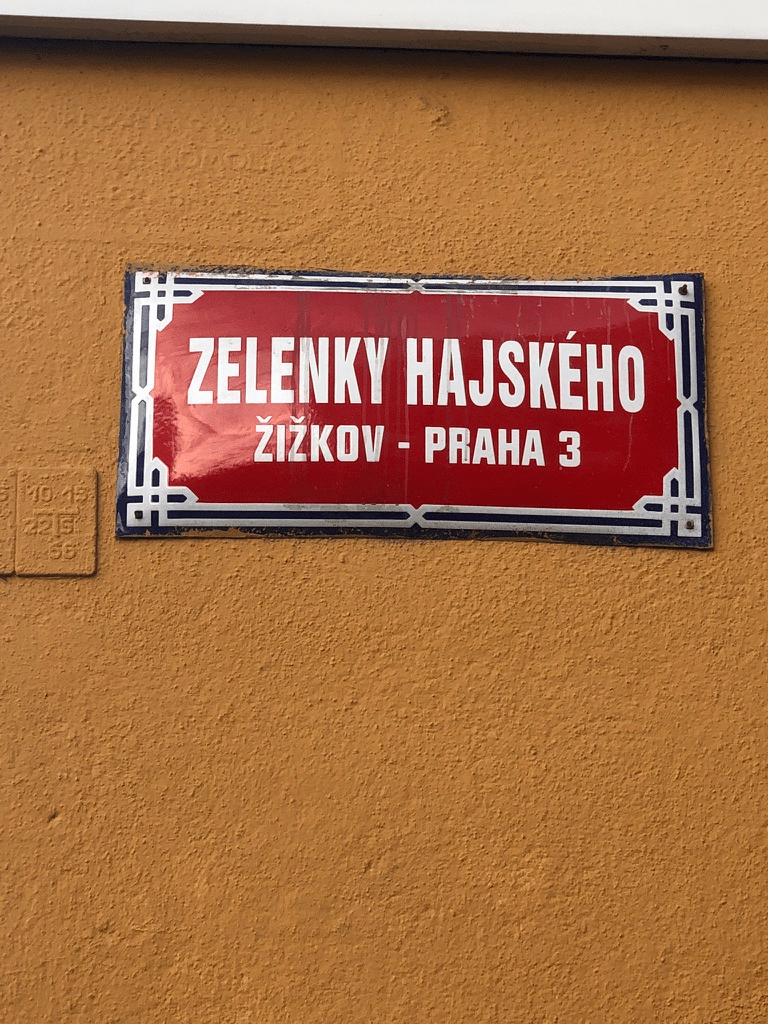
Jan Zelenka (1895-1942), born in Kamenný Újezd, but spending most of his life in Prague, was a primary school teacher, and, later, member of the Czech resistance in WW2.
From 1925, he worked in a newly-built school in Háj u Duchcova, where he was also actively involved in the local Sokol organisation.
When Háj, along with the rest of the Sudetenland, was annexed by Germany in 1938 as a result of the Munich Agreement, he returned to Prague.
From January 1939, he lived with his family in a flat on Biskupcova, where they were neighbours with the Moravec family (Marie, Alois, Miroslav and Vlastimil).
In 1941, Zelenka helped form Jindra, a Sokol-based resistance organisation, and then formed the Říjen (October) strike group. Around this time, he started using the pseudonym Hajský.
From spring 1942, Říjen worked closely with paratroopers Gabčík and Kubiš from Operation Anthropoid. Zelenka gave them shelter and contact with a former pupil who had detailed records of Reinhard Heydrich’s daily movements.
After Heydrich’s assassination, Zelenka was betrayed and, when the Gestapo tried to arrest him (17 June 1942), he committed suicide by swallowing cyanide.
His son Jan did the same; his wife Františka did not. She was arrested and executed at Mauthausen on 24 October.
The Moravec family also helped the paratroopers, and met a similar/identical fate to the Zelenkas: Marie also committed suicide by poison to avoid arrest on 17 June, whereas her husband Alois and son Vlastimil were executed at Mauthausen on the same day as Františka.
One of the organisational units of the Czech Sokol Community now bears Zelenka’s name.
Before 1948, this street was called Svatoplukova, presumably after Svatopluk of Bohemia, ruler from 1107 to 1109. Or possibly Svatopluk of Moravia, Prince of Great Moravia from approximately 870 to 894.

 What's in a Prague street name
Leave a comment