Originally published on Twitter on 7 August 2022.
U Památníku was built in 1933, and translate as ‘at the memorial’.
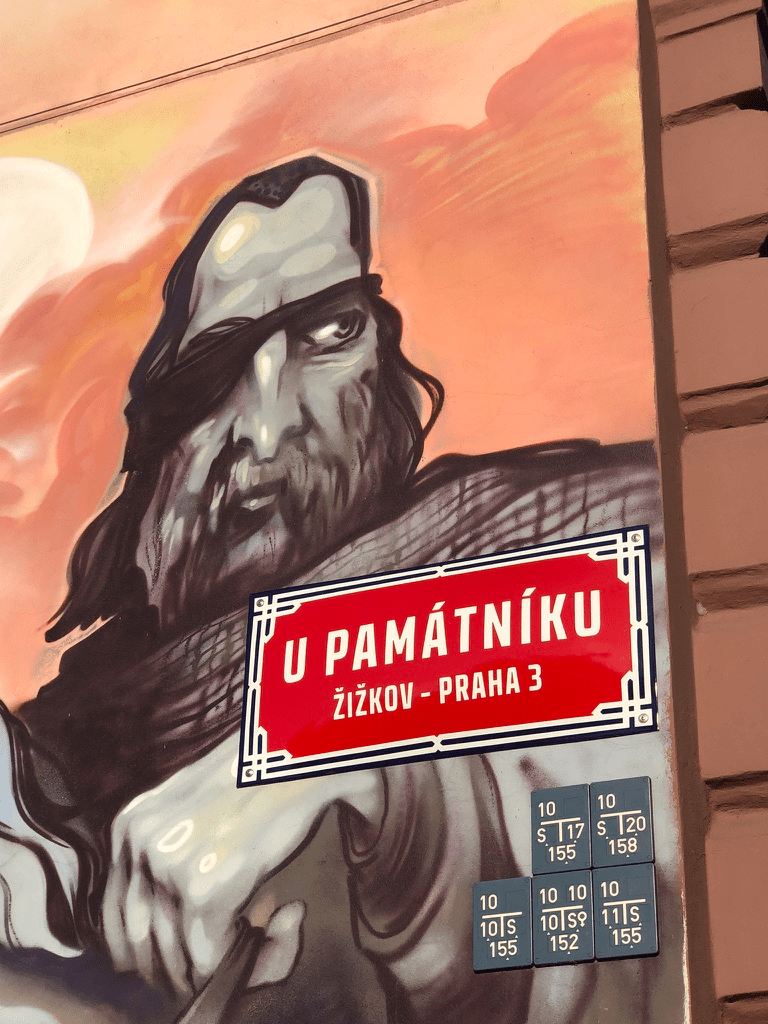
The ‘memorial’ in question is the National Monument on Vítkov Hill. It contains the Tomb of the Unknown Soldier, a ceremonial hall, and an exhibition on Czech/Czechoslovak statehood.
However, it’s most famous for its statue of Jan Žižka, towering over the neighbourhood that bears his name.
An association was founded in 1882 for construction of the monument, and a memorial tablet was placed on the hill in 1910.
The monument was ultimately built between 1928 and 1938, honouring Czechoslovakian legionaries. Until 1940, this street had the more specific name of U památníku osvobození (‘At the liberation monument’).
From 1940 to 1945, it went by the distinctly less patriotic name of ‘Na Vítkově’. It then reverted to ‘U památníku osvobození ‘ until 1961.
After several unsuccessful attempts, the Žižka statue was commissioned in 1931 from the sculptor Bohumil Kafka (1878-1942). He completed the plaster model in 1941, but died shortly afterwards. The statue itself was unveiled in 1950.
By then, the authorities had decided that the monument should celebrate Communism, and, from 1954 to 1962, it housed the Klement Gottwald mausoleum.
There are other Vítkov factoids, obviously, but if I reveal them all now, one of my upcoming posts will be very short indeed.
The Army Museum here reopened on 28 October after reconstruction. The reopening appears to have been a success, at least according to the MoD: https://mocr.army.cz/informacni-servis/zpravodajstvi/armadni-muzeum-zizkov-otevreno-pro-verejnost–proudy-navstevniku-hned-prvni-den-240096/

 What's in a Prague street name
Leave a comment