Originally published on Twitter on 22 August 2022.
Lipanská was built before 1875.
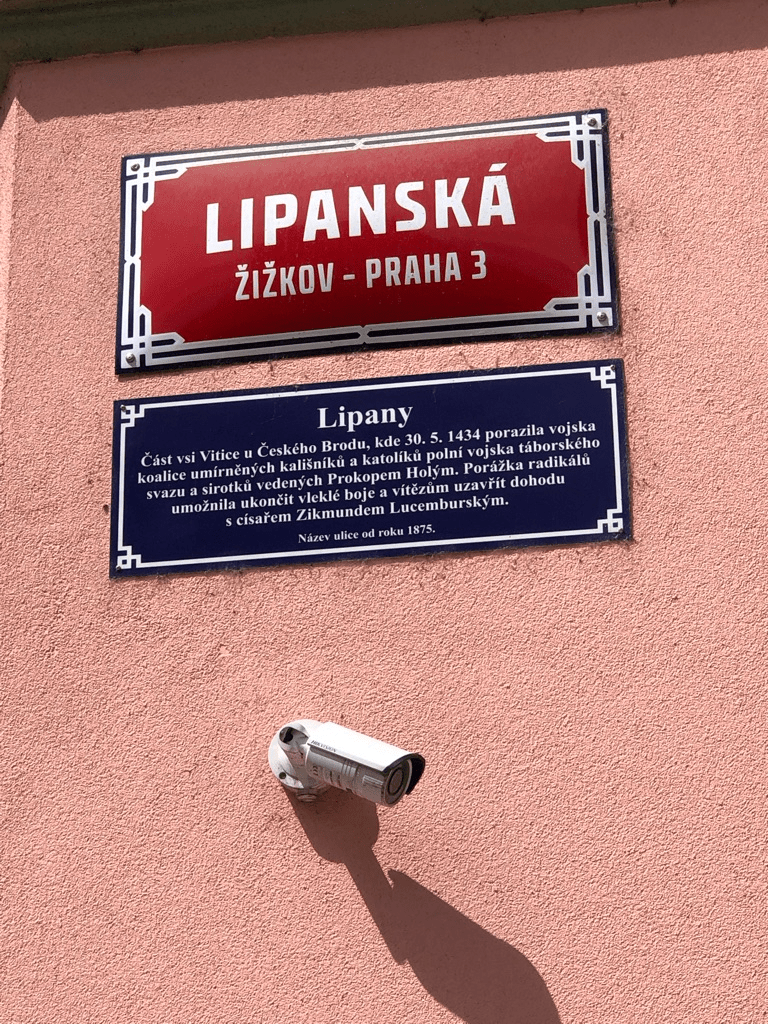
The Battle of Lipany, also known as the Battle of Český Brod, was fought on 30 May 1434.
On one side, you had the Táborites (radical Hussites), led by Prokop the Great (https://whatsinapraguestreetname.com/2022/11/24/prague-3-day-80-prokopovo-namesti/), and the similarly radical Sirotci (Orphans), led by Jan Čapek ze Sán. This was the more experienced side.
On the other side, you had the moderate Hussites, AKA the Utraquists or Calixtinists (https://whatsinapraguestreetname.com/2022/11/28/prague-3-day-100-kalisnicka/), led by Diviš Bořek z Miletínka, in coalition with the Catholics. This was the side with a numerical advantage.
When shelling between the two sides’ wagon forts began, the Coalition feigned confusion and started to retreat. The Radicals became convinced that victory was theirs – until the Coalition started to fire at them.
The Coalition entered the Radicals’ camp, and the Orphans fled to nearby Kolín. A massacre ensued, with the Radicals suffering 1,300 deaths, including that of Prokop, versus 200 deaths for the Coalition.
The Orphans largely ceased to exist. In 1436, the Compacts of Basel were signed (https://whatsinapraguestreetname.com/2022/11/26/prague-3-day-94-basilejske-namesti/), allowing Hussite priests to administer wine to laymen during the Eucharist. Shortly afterwards, all major factions acknowledged Zikmund Lucemburský as King of Moravia.
The last significant Táborite, Jan Roháč z Dubé (https://whatsinapraguestreetname.com/2022/11/25/prague-3-day-81-rohacova/) was hanged in 1437 after refusing to recognise Zikmund. The Hussite Wars were officially over.
Moderate Hussites would constitute the majority of the Czech population for approximately two centuries, until the Thirty Years’ War.

 What's in a Prague street name
Leave a comment