Originally published on Twitter on 26 August 2022.
Seifertova was built in 1875.
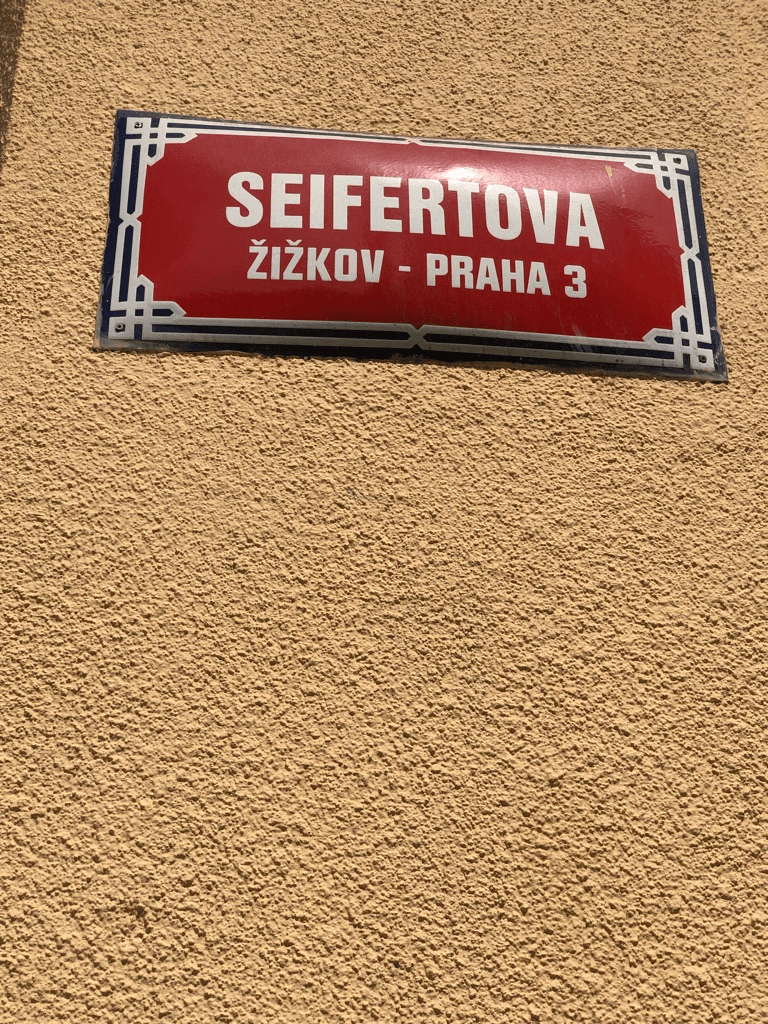
Until 1940, this was Karlova, after Karel IV; from 1940 to 1945, it was Lutherova, after Martin Luther.
After a brief return to its original name, it became Kalininova from 1947 to 1990, after Mikhail Kalinin (1875-1945), an Old Bolshevik revolutionary after whom Kaliningrad is named.
Jaroslav Seifert, meanwhile, was born in 1901 in Bořivojova Street (coming soon). As a child, his family moved around various poor sublets in Žižkov.
Seifert went to school in Kubelíkova (also coming soon) and Hálkova in Prague 2, but didn’t complete his studies.
In 1921, his first collection of poems, Město v slzách (City in tears) was published. He joined the Communist Party in the same year and became a regular contributor to Rudé právo.
He was expelled from the party in 1929 after protesting against the increasingly Stalinist style of Gottwald’s leadership.
He then joined the Social-Democratic Workers’ Party and started writing for Právo lidu. In 1949, he dropped journalism to devote himself entirely to literature.
He didn’t reach mainstream success again until 1956, after the partial liberalisation of cultural life.
He spoke out against the Soviet invasion in 1968, earning him the disapproval of the regime and forcing him to lead a secluded life.
In December 1976, he was one of the first signatories of Charta 77.
In 1984, he became the first (and, to date, only) Czech to win the Nobel Prize for Literature. Ill health prevented him from going to Stockholm, and the Communist media barely mentioned the award at all.
Seifert died in January 1986. The authorities, now using his success for propaganda purposes, gave him a state funeral at the Rudolfinum, which turned into an anti-communist demonstration: https://cesky.radio.cz/jsou-jisti-mrtvi-nebezpecne-zivi-pred-35-lety-byl-pohrben-jaroslav-seifert-8706020.
His words, on Czechoslovakian television, on 9 September 1968: ‘Jako jsme si dali na podstavec první tank, který přijel v květnu 1945 do Prahy, tak si vystavíme poslední, který opustí naši vlast.’
Translation: ‘Just as we put on a pedestal the first tank that arrived in Prague in May 1945, so we will display the last one that leaves our homeland’.

 What's in a Prague street name
Leave a comment