Originally published on Twitter on 1 September 2022.
Vita Nejedlého was built in 1885.
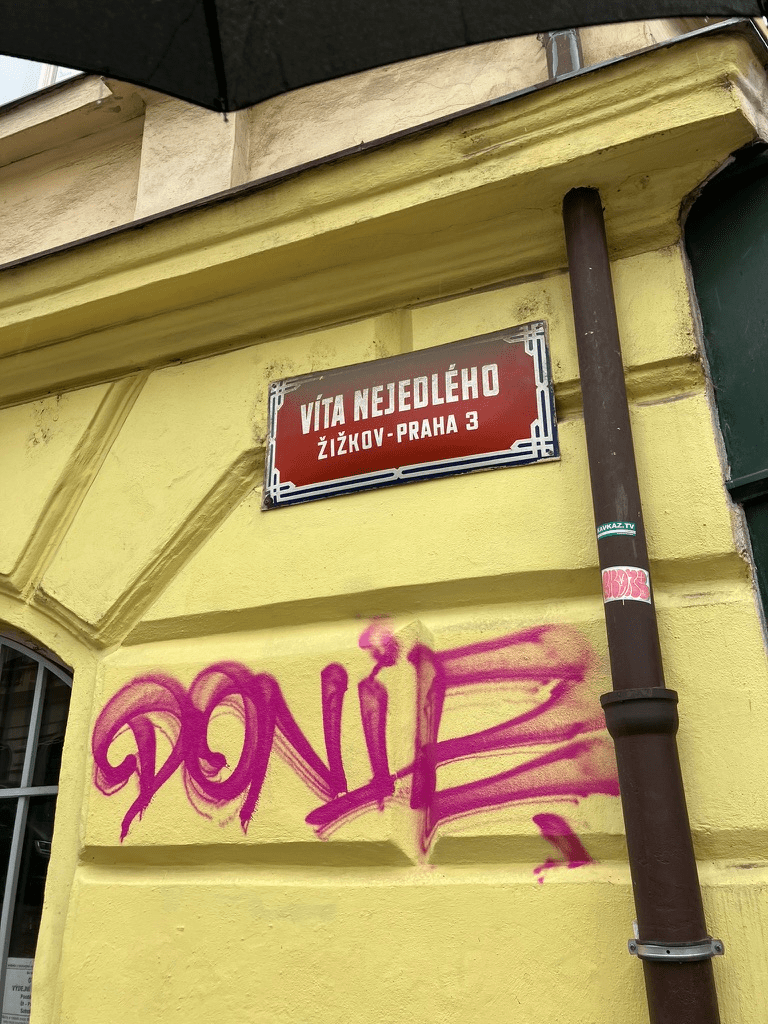
This one’s been through its fair share of other names.
Until 1940, and again from 1945 to 1947, it was Veleslavínova, after Daniel Adam z Veleslavína (1546-99), lexicographer, publisher, translator and secret member of the Unitas Fratrum (https://whatsinapraguestreetname.com/2022/11/26/prague-3-day-83-ceskobratrska/).
From 1940 to 1945, it was Zelenkova, after Jan Dismas Zelenka (1679-1745), a Baroque composer who spent his professional life in Dresden.
In 1947/48, it was Lokvisova, after Martin Húska (died 1421), a Táborite priest known as ‘Loquis’ because of his oratorical ability.
Vít Nejedlý, also a composer, was born in Smíchov in 1912, graduating from Charles University in 1912 with a dissertation on the modern Czech harmonica.
Active as a left-wing student, he moved to the Soviet Union when the Nazis occupied Bohemia and Moravia, and became a member of the Union of Soviet Composers.
He was a specialist in the ‘mass song’ genre, mass songs (intended to be sung by the ‘broad masses’) being the type of songs that the Soviet authorities would want to be sung at rallies and demonstrations.
Here’s one:
In 1943, he became commander of the Music Platoon of the First Czechoslovak Independent Brigade.
As the Brigade made its way to Czechoslovakia, he died of typhoid at Dukla Pass (Dukelský průsmyk), on the Polish-Slovakian border in January 1945.
As your regular reminder that Czech surnames are the best, ‘nejedlý’ translates as ‘inedible’. I wonder if this is why the street-naming authorities decided this street should bear his first name as well.

 What's in a Prague street name
Leave a comment