Originally published on Twitter on 8 September 2022.
Kubelíkova was built in 1885.

Until 1930, this was Libušina, after Libuše, ancestor of the Přemyslid dynasty and of the Czechs.
So the number of streets named after women in Prague 3 has actually gone *down* over the years. Gah.
From 1930 to 1947, it was Dvořákova, after Antonín Dvořák, (1841-1904), the most performed Czech composer worldwide.
Jan Kubelík was born in Michle (now in Prague 4) in 1880. At the age of twelve, he was already studying violin at Prague Conservatory, despite officially being too young to do so.
His tutor there was Otakar Ševčík (coming soon to this series). Kubelík graduated in 1898 with a performance of Paganini’s violin concerto in D major.
In 1901, he performed 78 concerts in the USA. A year later, he brought the Czech Philharmonic Orchestra to London at his own expense.
Obviously not short of money, he lived in a castle in Orlová in Slovakia, then in a villa in Opatija on the (now-)Croatian Adriatic, and then in Rotenturm Castle in Burgenland, Austria, before returning to Czechoslovakia in 1938.
During the occupation, he played concerts with the Czech Philharmonic, with the last one being in May 1940. He died of cancer in Prague in December of the same year.
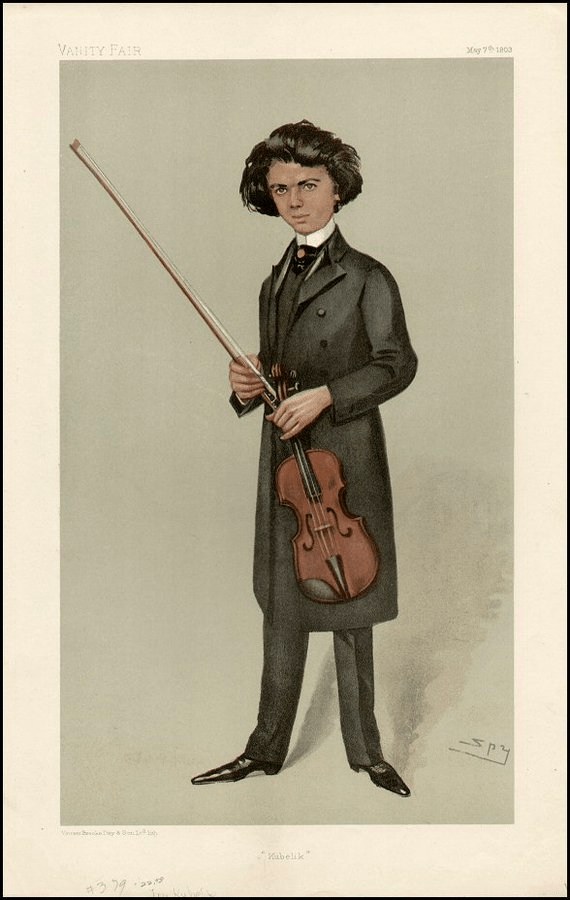
Here’s a caricature of Kubelík from a 1903 edition of Vanity Fair.
And a compilation of his earliest recordings: https://open.spotify.com/album/49D52ataDOLT4h6RbPwd3P?si=sHOa0RJSQt-I78u5aVZCG
With his wife, Countess Marianne Czáky-Széllová, niece of Kálmán Széll (Prime Minister of Hungary from 1899 to 1903), he had eight children, including Rafael Kubelík (1914-96), who himself became a conductor and composer.

 What's in a Prague street name
Leave a comment