First published on Twitter on 2 December 2022.
Šumavská was built in 1889.


Šumava is a mountain range covering the borderlands of the Czech Republic, Germany (Bavaria) and Austria. Many German speakers refer to it as the Böhmerwald – (the Bohemian Forest), although Bavarians, clearly wanting to take full credit, like to call it the Bayerischer Wald.
The earliest documented name for the forest is a Celtic one, Gabreta; the name ‘Šumava’ is used in Rerum Hungaricum Decades (Ten Volumes of Hungarian Matters) by the Italian writer Antonio Bonfini (1427‒1502).
‘Šuma’ is a Proto-Slavic word meaning forest – and is still the standard word for one in Bosnian / Croatian / Serbian, as well as in Macedonian.
The area was first inhabited in the 14th century BC, although major colonisation didn’t occur until the 12th-14th centuries AD, with German-speakers living side by side with Sorbs (more on them in an upcoming post).
Borders with Bavaria and Austria, ill-defined (and argued over) for centuries, were set in 1846 and 1862 respectively. Only a small part of the forest became part of Austria after WW1.
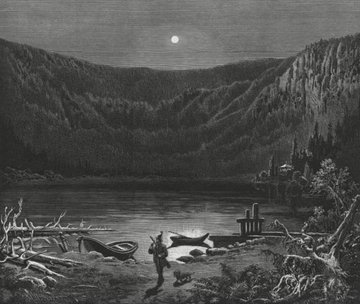
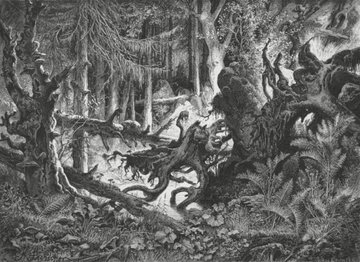
Czech artist Karel Liebscher (1851-1906) did some awesome illustrations of the Šumava.


The German population was expelled after WWII, and, with the Cold War, the border became heavily guarded and depopulated.
This has led to unexploded landmines and ammunition even to this day, but also to nature developing with relatively little human influence.
There were no open border crossings at all with West Germany until 1964.
This is how the border looked in a very snowy February 1990, immediately post-revolution:
With the fall of the Iron Curtain, the Šumava became a popular tourist destination, but also (in Železná Ruda, for example) a hotspot for prostitution, although this has subsided to an extent with CZ’s entry into the EU and the Schengen zone.
The highest point in the forest is Großer Arber / Velký Javor, in Bavaria; the highest point on the Czech side, Plechý, is also the highest point on the Austrian side (where it’s known as Plöckenstein), as it’s on the border.
Lovely video of the Šumava in the early 1980s here:

 What's in a Prague street name
Leave a comment