Originally published on Twitter on 30 December 2022.
Jugoslávská was built in 1884.

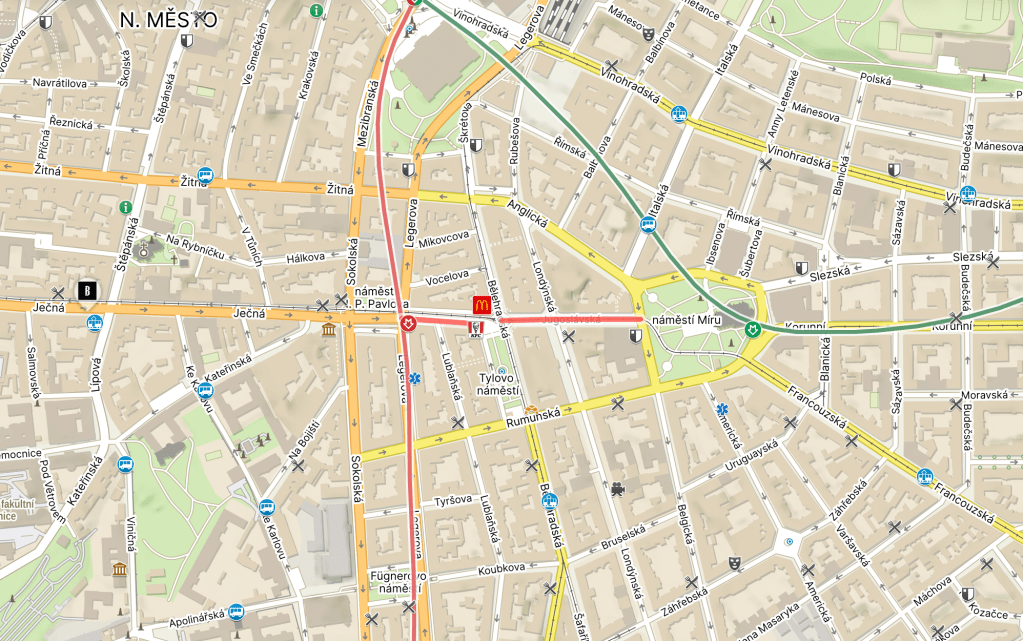
Until 1926, this was Karlova, after Karel IV, who will come up 1,926 times in the Prague 1 series.
It was named Jugoslávská along with all the other Allied streets in 1926, although, under the Nazi occupation, it was called Priennova. Günther Prien was a German U-Boat commander presumed killed on the U-47 submarine off the coast of Ireland in 1941.
But back to Yugoslavia…. We’ve had Bělehradská and Záhřebská. We’ve got (not really a spoiler) Lublaňská and Sarajevská coming up. So let’s use today for another round of Slavic false friends, this time between Czech and Bosnian-Croatian-Montenegrin-Serbian (BCMS).
With apologies to (and full acknowledgement of) the speakers of other languages in the region, I’m going to use ‘Balkan’ quite a lot in this thread. Hajdemo!
We’ve got presidential elections in the Czech Republic in January. Volím Vás is Czech for ‘I choose you’. Whereas, down in the Balkans, volim vas is ‘I love you’. Babiš’s current campaign seems somewhat geared at old dears who feel both these things.
It’s likely that a lot of people will find the final result úžasný (fantastic) in the Czech sense, and that an equal number will find it užasan (awful) in the Balkan sense.
Hopefully, everyone will have stopped arguing about the result come Croatian srpanj, which is a month before Czech srpen, though I fear they’ll still be going on about it in Croatian listopad, which starts a month before Czech listopad does.
(Serbian, Bosnian and Montenegrin, meanwhile, tax my brain somewhat less by doing januar, februar, mart, etc.).
Time is clearly much slower in the Balkans, as a Czech hodina, which lasts 60 minutes, is significantly shorter than a godina, which can last either 365 or 366 days.
Meanwhile, a Czech rok also lasts 365/366 days, whereas, in the Balkans, a rok is the point before which you absolutely must submit your dissertation, file your tax return, enter a prize draw which turns out to be a spam email, etc.
In Czech, the word slovo also means ‘word’, and consists of five písmen; in the Balkans, a word is a a reč or riječ, and each of those five components is a slovo.
In Czech, you can go to many a restaurant and order a kreveta, a prawn, although it’d be odd to order just one. In the Balkans, it’d be even odder, as kreveta is the genitive form of krevet, a bed.
Czech bread, chléb, is also hleb in Serbia, Bosnia and Montenegro. But in Croatia, it’s kruh, which Czechs know better as a ring or circle (which the Croatians call a krug).
In the Czech Republic, it’s quite normal to see a cloud (mrak) or two in the sky. However, it’d take quite a lot of these to create complete darkness – which is what Balkan mrak means.
In the Balkans, you can’t plivati (swim) everywhere, but it’s not generally seen as terrible behaviour. This is not true in the Czech Republic, where plivat means to spit.
If you’re looking for the hrana – the edge – in Czech, that might be because you like living on it. If you’re looking for hrana in the Balkans, it’s probably just a mealtime – the word means ‘food’ there.
If you *are* looking for an edge in the Balkans, the word you might want is rub. In Czech, however, a rub is the reverse side of something.
In Czech, an idea – nápad – can be good or bad. In the Balkans, a napad – an attack – is pretty likely to be a bad thing.
And if you’re looking for a pub in the Balkans, please don’t assume that the local word gospođa is the same as hospoda – a gospođa is a lady, and deserves to be treated accordingly.
Keeping with the ladies, in Czech, a májka is the thing you (have probably never) dance(d) around on 1 May – a maypole. It’d be a bit strange if you danced around a majka in the Balkans, though. She’s your mother.
If you were to move to Belgrade or Zagreb or Sarajevo, you’d probably find yourself a nice stan – a flat – to live in. That would be a less viable option in Prague, where a stan is a tent.
Then you’ve got the the ones which are clearly related – pravda is ‘truth’ in CZ, but ‘justice’ in the Balkans, while hledám is ‘I look for’, whereas gledam is I look *at*.
In Czech, a závodník is somebody who’s competing, typically in a race. In the Balkans, a zavodnik may or may not be competing against other people, but his aim is to get you into bed – he’s a seducer.
And someone who is pokojný is nice and peaceful in Czech, whereas someone who is pokojni in the Balkans is nice and peaceful in the ‘and will never wake up again’ sense, shall we say.
Hvala na slušanju i molim vas da ovo ne čitate neposredno prije nego što otputujete u Hrvatsku u ljeto 2023. To će vam potpuno uništiti odmor. I to prije nego spomenem hladna pića.

 What's in a Prague street name
Leave a comment