Originally published on X on 7 April 2023.
Trojanova was built in 1897.

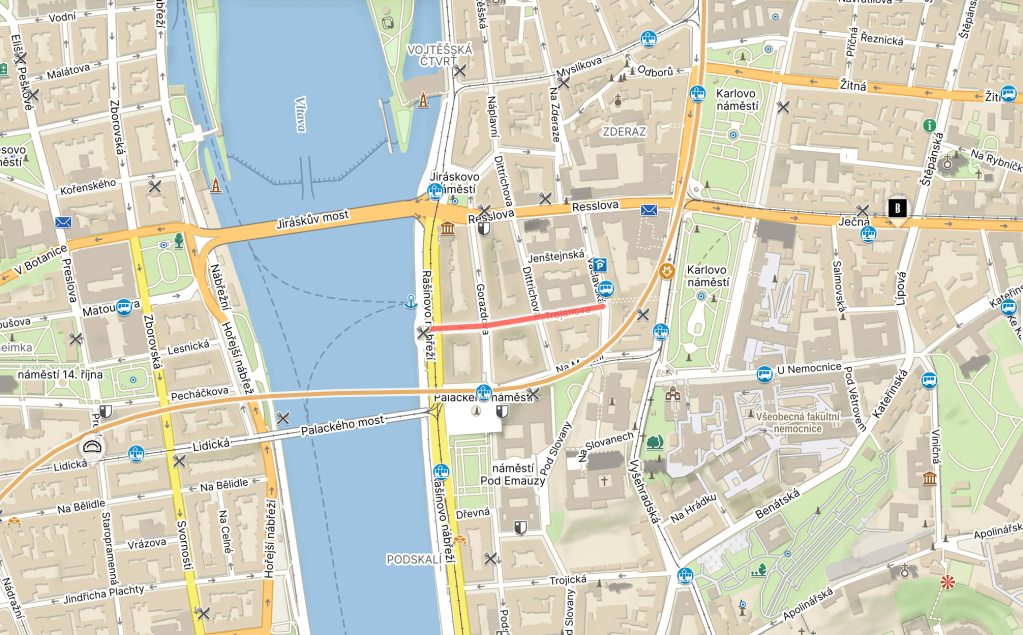
Trojanova replaced a smaller street called ‘Kočičí’ when the district was given a major facelift in the late 19th century.
Kočičí translate as ‘feline’ or ‘cat-like’, which is therefore the best street name ever, and, no offence to Mr Trojan or anyone, but I’m sad not to be writing about that today.
Alois Pravoslav Trojan was born in Knovíz (near Kladno) in 1815, and studied law at Charles-Ferdinand University in Prague.
This eventually led him to a job at the royal court prosecutor’s office in Prague.
Outside of working hours, he formed friendships with František Ladislav Rieger and Karel Hynek Mácha (https://whatsinapraguestreetname.com/2024/07/07/prague-2-day-62-machova/).
In 1845, he was one of the founders of Prague’s Měšťanská beseda (Citizens’ cultural association, intended to act as a counterpart to its German-speaking equivalent). Within a year, it had over 500 members.
He was one of the main organisers of the meeting at St Wenceslas Spa / Svatováclavské lázně on 11 March 1848 (which I’ll write a whole lot more about in Sunday’s thread).
It was he who presented the draft of the petition which demanded constitutional and legal freedoms for the Czech lands; he also travelled to Vienna to plead the committee’s case.
In June, he was a key participant in the Slavic Congress, and also entered the Austrian Constituent Assembly as a result of the 1848 elections.
His involvement in revolutionary activities would lead to his arrest in 1849, and, while he was freed soon after, he also ceased to be politically active until 1861, when he was elected to the Czech Provincial Assembly.
This was followed by his election to the Imperial Council on four occasions (the first in 1867), but, like his fellow Czechs, he didn’t attend sessions, as the Czech policy was one of passive resistance against Austria’s increasing centralisation.
The Czech side would change tactics in 1879, and started attending sessions of the Imperial Council. Trojan became leader of the Czech coalition in 1880.
Trojan would sit in the Imperial Council until his death in 1893; he’s buried at Vyšehrad.
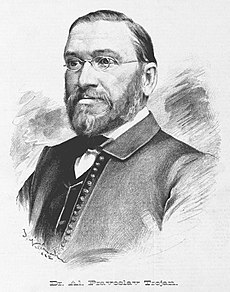
Outside of his political activity, he was known for promoting the Czech language, advocating for the division of Charles-Ferdinand University into Czech and German parts, and for being an executive on the board for construction of the National Theatre.

 What's in a Prague street name
Leave a comment