Originally published on X on 12 April 2023.

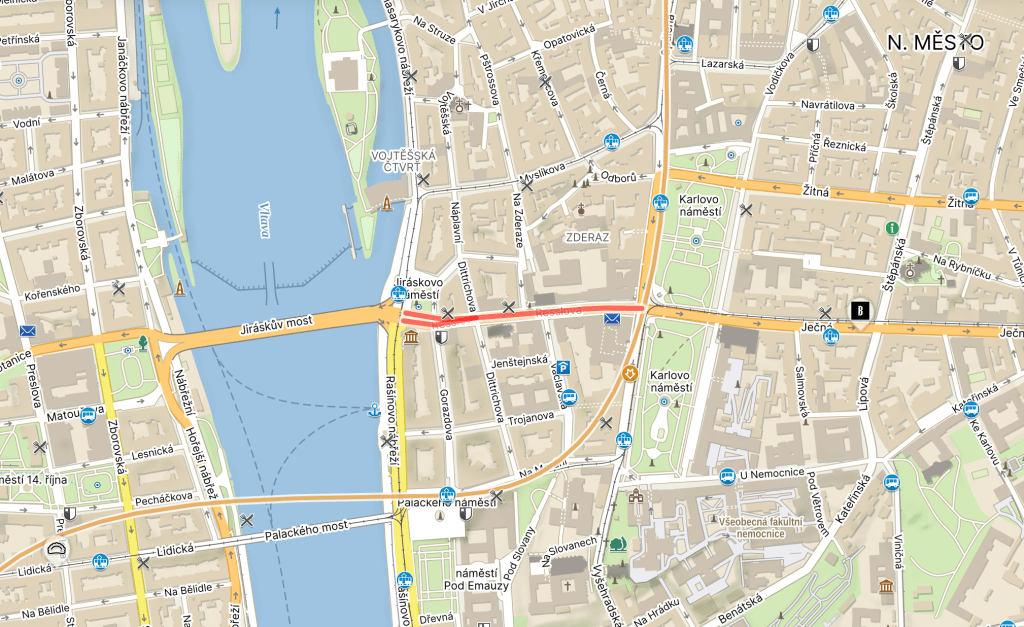
Until 1870, the street was known as U Hurta, Nad Hurtem, Hurtova or Hurtovská, all named after a building here (U Hurta) which hosted the municipal forge.
Josef Ressel, meanwhile, was born to a Czech-German family in 1793 in Chrudim, which garnered him a quick mention on https://whatsinapraguestreetname.com/2023/06/24/prague-3-day-177-chrudimska/.
After attending grammar school in Linz, he joined the artillery school in České Budějovice in 1809, but was deemed not physically strong enough to become an officer.
He subsequently studied medicine in Vienna, but dropped out and studied forestry instead. Upon graduation, he became a forester in Istria (nowadays shared by Croatia and Slovenia – Slovenian commemorative plaque below) and, from 1821, Trieste.
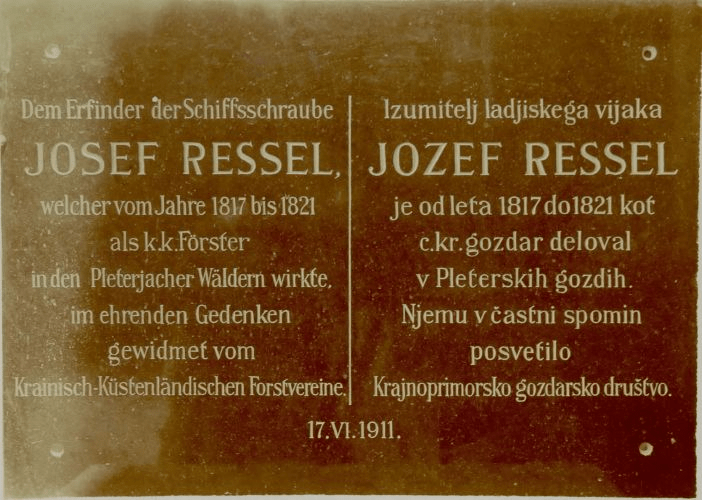
In Trieste, he invented a ship propeller, for which he received an imperial patent in 1827.
It’s admittedly hard to talk of someone as being *the* inventor of the propeller, as others elsewhere came up with similar ideas independently, but Ressel was the first to have his design brought to technical maturity.
After getting the patent, he tested his invention on Civetta, a steamer in the port of Trieste, in 1829; however, the steam engine broke down and the police banned him from continuing with his experiments.
Back when the Austrian Schilling was a thing, Ressel and the Civetta were shown on the 500 Schilling note.


In 1840, Ressel’s ideas were incorporated into the British steamer “Archimedes”. The British government offered £20,000 to the inventor of the ship’s propeller, as long as they provided proof.
Ressel sent his proof to London, but was told that the documents got lost along the way. The prize was ultimately given to five Brits.
Ressel died of malaria while in Ljubljana in 1857. Posthumously, in 1866, the American Academy of Sciences in Washington acknowledged him as the inventor of the ship propeller.

Other Ressel inventions include a dye extraction method (1825), a manual cylinder press (1826), a hydraulic steam engine (1828), rolling bearings (also 1828), and a mixture of ingredients to help preserve leather goods (1854).
Resslova is probably best known as the home of the Orthodox Church of St. Cyril and Methodius, where the agents involved in Operation Anthropoid put up their last stand (https://whatsinapraguestreetname.com/2024/08/22/prague-2-day-89-ciklova/ and https://whatsinapraguestreetname.com/2024/09/01/prague-2-day-149-gorazdova/).
The crypt of the church, where they hid, now hosts a museum in their honour: https://prague.eu/en/objevujte/national-monument-to-the-heroes-of-the-heydrich-terror-narodni-pamatnik-hrdinu-heydrichiady/

 What's in a Prague street name
Leave a comment