Originally published on X on 1 August 2023.

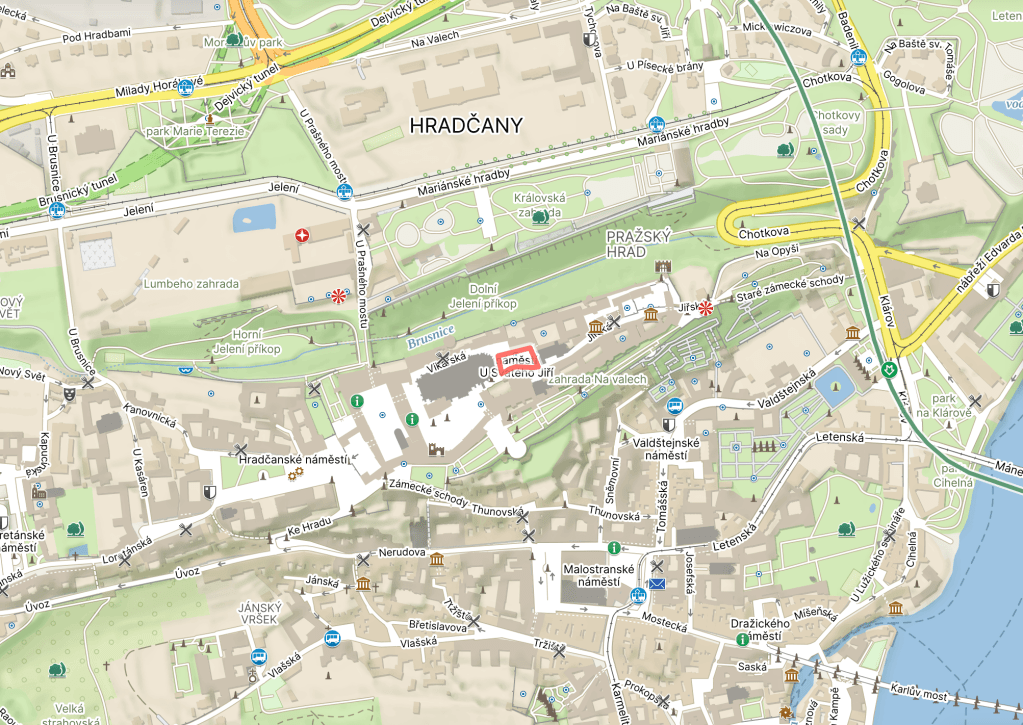
Before 1870, other variants of this name (Jiřské náměstí or Svatojiřské náměstí) were also in use.
The story goes that George was born into a Greek Christian family in Cappadocia (in what is now Central Anatolia, i.e. Central Turkey) around 270. His father was an officer in the Roman army.
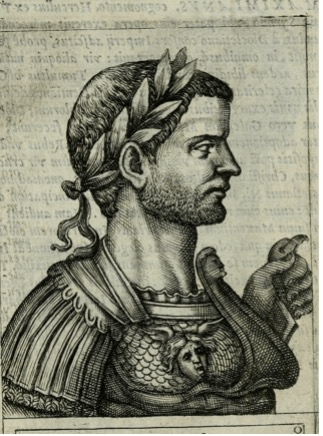
This inspired George to do the same once he was old enough; he became a tribune, and, later, a personal guard to Diocletian (Roman emperor from 284 to 305).
However, Diocletian was someone who took an awful lot of offence at the very existence of other religions; having persecuted the Manicheans in 302, he decided that his next target would be Christianity.
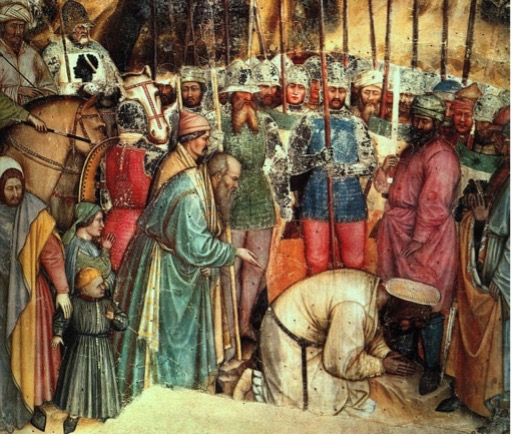
George was asked to participate in this, but refused, and was rewarded by being tortured and then beheaded in Lydda (now Lod, Israel) on 23 April 303. Hence 23 April being St George’s Day in England.
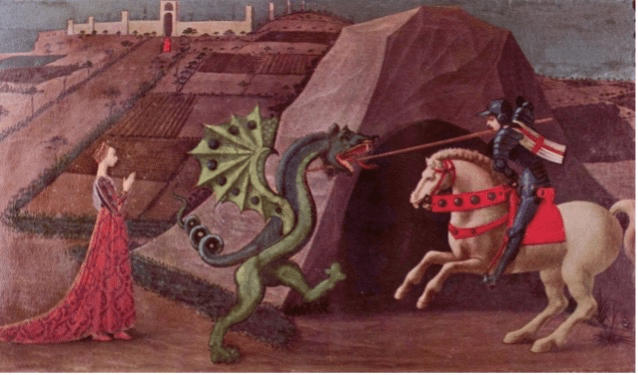
Even before Christianity, there was a legend about a dragon who insisted that the people of a village pay him tribute. When the people ran out of things to give him, the dragon started demanding human sacrifices again.
The people of the village were surprisingly OK with this, until the next victim on the list was a princess. At this point, a soldier tamed the dragon, and then killed him.

In the 11th century, a Georgian text (appropriately enough) attributed the story to St George, and this stuck.
(Painting from the 15th century by Paolo Uccello)
Nowadays, George is a patron saint of a fair few places. The most obvious one of these is Georgia – here’s a pic I took in 2014 in Tbilisi, on the Maidan, not realising at the time that the guy at the top was George himself.

Then there’s England, Portugal, Brazil, Aragon, the Balearic Islands, Valencia and Catalonia, where George is known as Jordi, and it’s traditional on 23 April to give your loved one a red rose (if they’re a woman) or a book (if they’re a man): https://booksandroses.cat/en/about-booksandroses/
George is also the patron state of a city beginning with M which is the capital of a country I’m still not ready to talk about in any detail.
There’ll be more on St George tomorrow – but for now, let’s focus on this very square.
We know that Prince Bořivoj had a church, dedicated to the Virgin Mary, built at Prague Castle some time after 884, and that this is the first documented church at the Castle.
Bořivoj’s son, Spytihněv I, would convert the area into a hillfort. When Spytihněv died, his younger brother, Vratislav I, took power, and also built a church dedicated to St George.
This was the main church in Bohemia until the bishopric of Prague was founded in 973 (during the reign of Boleslav II), and St Vitus’s Rotunda – where the cathedral now stands – became the bishop’s church.
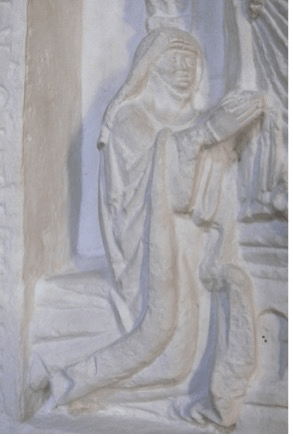
In the same decade, a convent was founded next door for Benedictine nuns. Boleslav’s sister Mlada became its first abbess (this is how her likeness is reproduced within the convent itself).
Burnt down in a siege in 1142, the complex was soon rebuilt, although it suffered a similar fate during the Hussite Wars (1420s) and again during the Malá Strana fire of 1541.
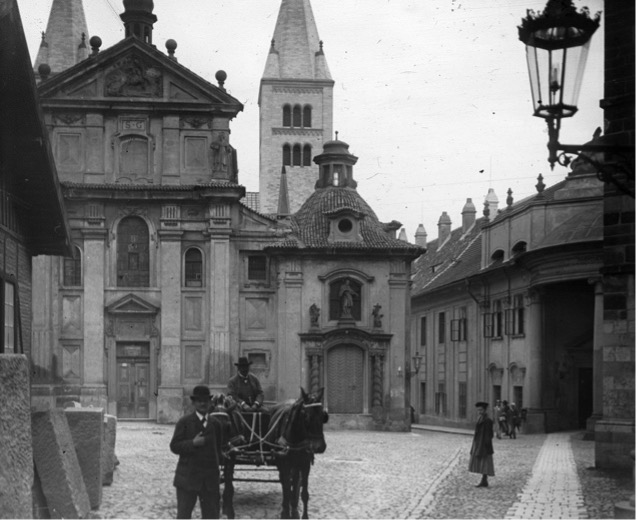
In the early 1600s, the basilica was given a renovation which resulted in it looking much like it does today.
It still houses the remains of Vratislav I, Boleslav II and Saint Ludmila, among others. The convent, meanwhile, would last until 1782.
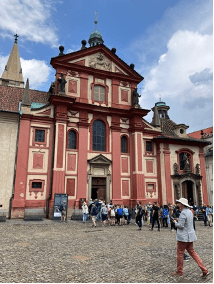
During the Nazi occupation, the square was known as Petra Parléře, after he who created St Vitus Cathedral, presumably because a patron saint of England was not to their liking.
After World War II, the basilica would be turned into a concert hall, and then an exhibition space. It still hosts one of the National Gallery’s exhibitions.

 What's in a Prague street name
Leave a comment