Originally published on X on 2 August 2023.

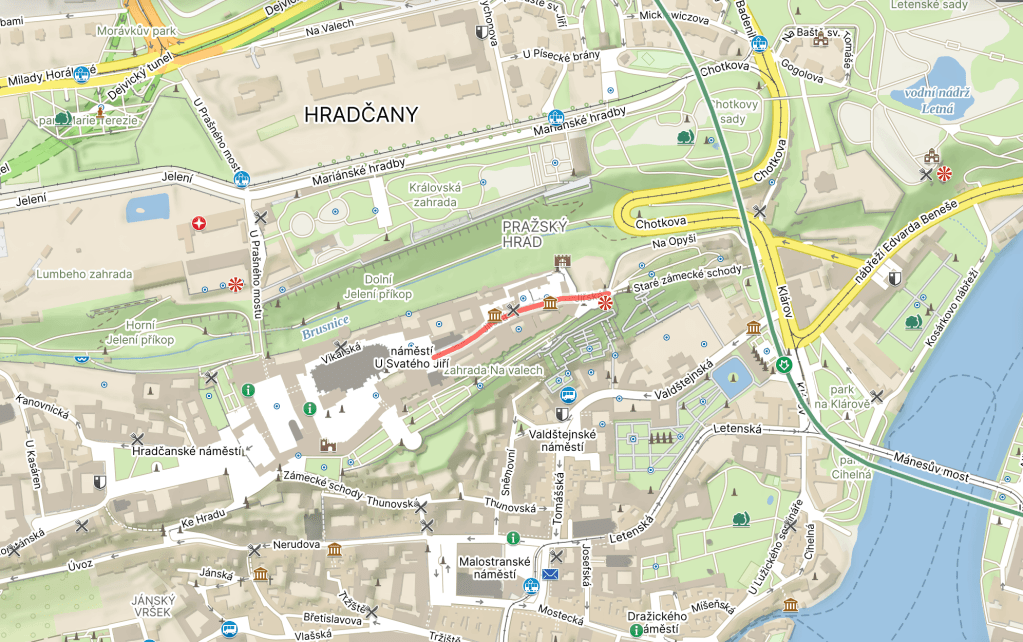
And, like yesterday’s (https://whatsinapraguestreetname.com/2024/09/02/prague-1-day-1-u-svateho-jiri-st-georges-square/), the street also had similar but not identical names before 1870: U sv. Jiří (as the square is called now), Proti klášteru sv. Jiří (Against St George’s Convent, which sounds a bit like a protest) and Svatojiřská.
It was also once known as K Černé věži, after the Black Tower. Which is this colour. And means I owe you an explanation.
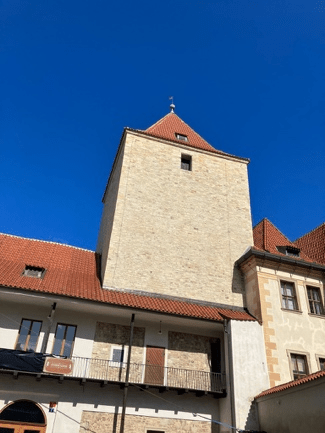
So: when a huge fire engulfed Malá Strana, and the Castle, in 1541, the tower turned black, and stayed that way for a long time.
We covered the basics of St George yesterday. So let’s take a look at his significance both here in the Czech Republic, and in the adjacent Slavosphere.
Svatý Jiří is the name of a municipality (population 291) just west of Ústí nad Orlicí, while Svätý Jur is a somewhat larger municipality (just under 6,000 people) 14 km from Bratislava.
Bulgarians have considered St George to be their protector for centuries; St George’s Day (Гергьовден, or Gergyovden) takes place on 6 May, which is when you’ll get military parades in Sofia:
St George / Sveti Đorđe is also a big deal among the Serbs, who also celebrate Đurđevdan on 6 May. It’s also a general spring festival in the Balkans.
And, most importantly, this is a tune: https://www.youtube.com/watch?v=5C3SKkNt828
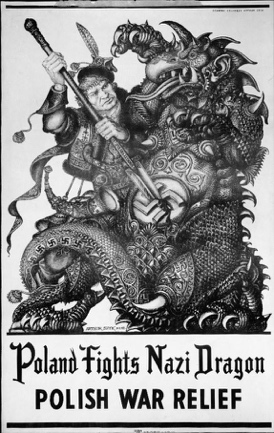
This is a 1943 picture by Polish-born Jewish artist Artur Szyk, by then settled in the United States and going by Arthur. It speaks for itself.
Wikimedia’s page titled ‘Category:Saint George churches in the Czech Republic’ lists a whopping 109 of them in the Czech Republic alone: https://commons.wikimedia.org/wiki/Category:Saint_George_churches_in_the_Czech_Republic
While he also appears on the flag of Třebenice (which amuses me slightly, please don’t take offence if you’re from Třebenice and/or a dragon), and the emblem of Vysoké Mýto (better hair, better camera stare, but less hilariously earnest).


Jiřská itself hosts many things, not all of them tourists. Number 1 is the Institute of Nobles / Ústav šlechtičen, originally known as the Rožmberský Palace, built between 1545 and 1574 by the eponymous noble family.
It underwent a major reconstruction under Maria Theresa in the 1750s and was used as an educational institution for impoverished young noblewomen until 1918.
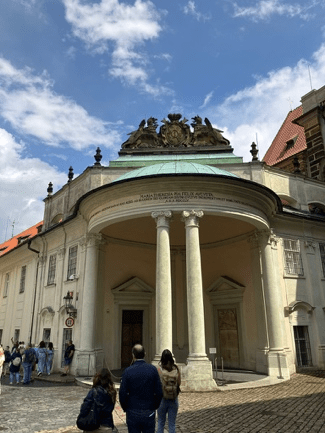
While number 3 is the Lobkovický palác / Lobkowicz Palace, originally built in the 1500s but given a Baroque restyling from 1651 to 1668.

Returned to the noble Lobkowicz family in 2002, it’s the only privately-owned building at Prague Castle, and now hosts a museum and concerts: https://www.lobkowicz.cz/en/lobkowicz-palace

 What's in a Prague street name
Leave a comment