Originally published on X on 5 August 2023.


You may have heard of Jelení příkop (and if you haven’t, just wait a week). You may also think that a moat is something that could do with a bridge above it. Luckily, in 1535, Ferdinand I agreed with you.
Originally known as the Dlouhý most (Long Bridge), it later became known as the Prašný most (Dust Bridge) – either because dust accumulated beneath it, because gunpowder was stored in the nearby Prašná věž (Dust Tower), or because there was a gunpowder mill underneath it.
Destroyed by the Malá Strana fire of 1541, it was repaired and renovated by Ulrico Aostalli, whose other work included the Royal Summer Palace at Prague Castle and the ballroom in the Royal Garden.
The bridge then got badly damaged in 1742 (blame the French), and then even more so in 1757 (blame the Prussians). It was then decided to replace the bridge with an embankment.
Between 1999 and 2002, the two parts of the moat were reconnected by a footbridge, meaning that, if you live on the number 1 tramline like I do, this will probably be the most practical way of entering Prague Castle.

One of U Prašného mostu’s most famous landmarks is Lví dvůr (Lion’s Court), a renaissance building also constructed by Ulrico Aostalli in the 1580s. It used to house lions, tigers, bears, leopards and an orangutan, later becoming a pub, and, as it is nowadays, a restaurant.
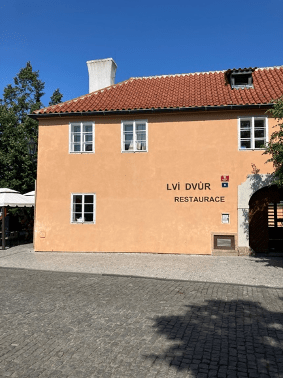
Rudolph II’s favourite lion – a gift from the Ottoman Empire called Mohammed – lived here, and Jan Kepler (also coming up soon) stated that the two of them had the same horoscope. They would later die within days of each other.

 What's in a Prague street name
Leave a comment