Originally published on X on 7 September 2023.


In the 1230s, Prague’s Old Town became a municipality. In the 1250s, the Lesser Town, better known as Malá Strana, would follow.
Meanwhile, the area to the west of Prague Castle remained forested, with a road leading to Strahov, and then to Břevnov. This would change in 1320, when Hynek Berka z Dubé, a knight, founded Hradčany.
In the same way that Afričan, Američan and Angličan give you a clear idea of where someone comes from, a Hradčan was someone who ‘belonged’ to Prague Castle.
As with so much, Hradčany underwent a lot of development under Charles IV, who would come to power in 1346.
It wouldn’t be until 1746, however, that Maria Theresa made Hradčany the fourth municipality of Prague (after the Old Town, New Town and Malá Strana); in 1784, Joseph II would merge all four into a single entity.
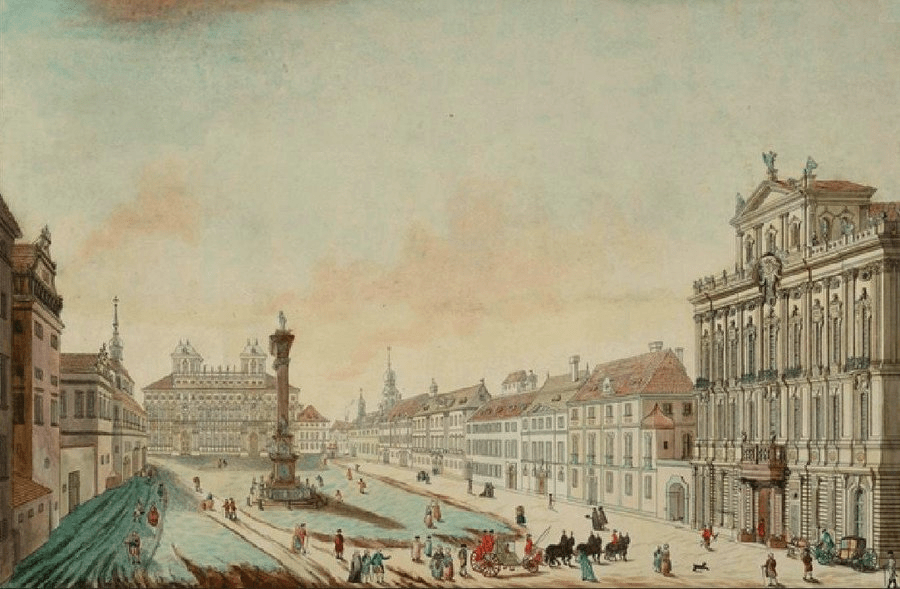
People quite like to go to Hradčanské náměstí to express their dissatisfaction with dissatisfying people: https://www.idnes.cz/zpravy/domaci/demonstrace-proc-proto-andrej-babis-milos-zeman-hradcanske-namesti.A170511_153149_domaci_fer
And to express their respect for more satisfying ones: https://tn.nova.cz/zpravodajstvi/galerie/8823-galerie-namesti/8d4ac34e-667e-4d34-b5ef-a3bd4a5e5a00#1
And to not get invited in by one of the dissatisfying ones:
It’s a good spot for a speech, too:
There’s a heck of a lot on Hradčanské náměstí other than the castle, so let’s take a look at that, while not forgetting, of course, to admire the castle itself, and the Matthias Gate, the oldest piece of secular Baroque architecture in Prague.

Salmovský palác (1800-11), which is currently owned by the National Gallery, was used, at different times, as an administrative building for the church, posh living space for faithful communists, and the Swiss Embassy.

Nearby, there’s a statue of Tomáš Garrigue Masaryk, unveiled in 2000. There are also posters of him which you will not enjoy at all if you’re somebody who doesn’t like being told what (not) to do.


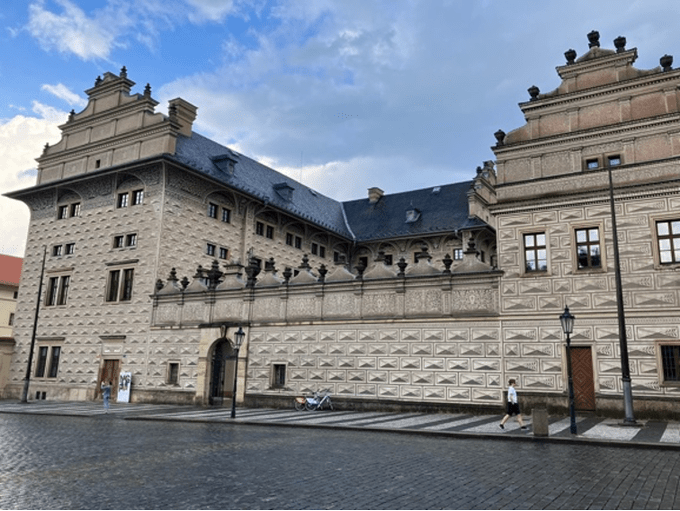
Schwarzenberský palác / Lobkovický palác (1545-67), owned by various very rich people for centuries, now hosts a permanent exhibition of the National Gallery and the Imperial Armory, a permanent exhibition of the Military Historical Institute.

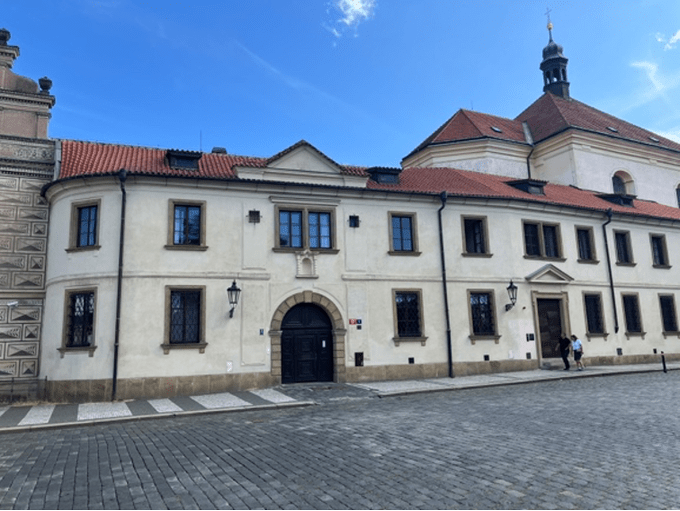
Klášter bosých karmelitánů / Convent of the Discalced Carmelites contains St Benedict’s, once the parish church of Hradčany. The nuns moved elsewhere in 2020, largely because of the noise; it’s now a spiritual centre, Fortna: https://fortna.eu.

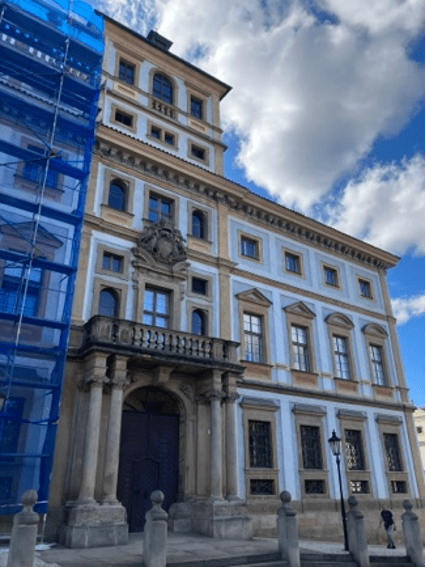
Toskánský palác (the Tuscan Palace) / Thun-Hohenštejnský palác, mainly built in the 1700s, is used by the Ministry of Foreign Affairs.
Martinický palác contained apartments for rent until 1967; after reconstruction, it was then the seat of the Office of the Chief Architect of the Capital City of Prague from 1974 to 1994. And can now be hired for weddings.
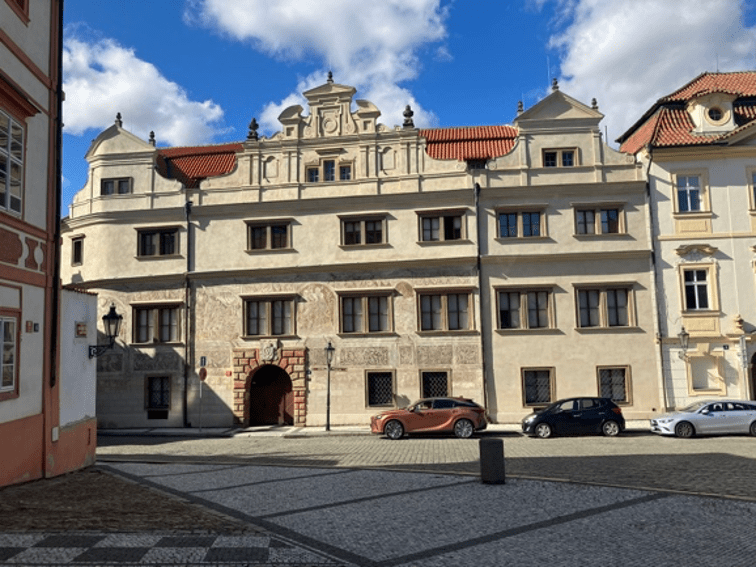
Sasko-Lauenburský palác is actually two Renaissance houses connected in 1552; the most famous resident of either house was probably Peter Parler, creator of St Vitus’ Cathedral and Charles Bridge. He died in Prague in 1399.

Losenovský palác / U Labutí is another case of two Renaissance houses being joined together; it was once lived in by a diplomat called Josef Korbel, and, therefore, by his daughter, one Madeleine Albright.
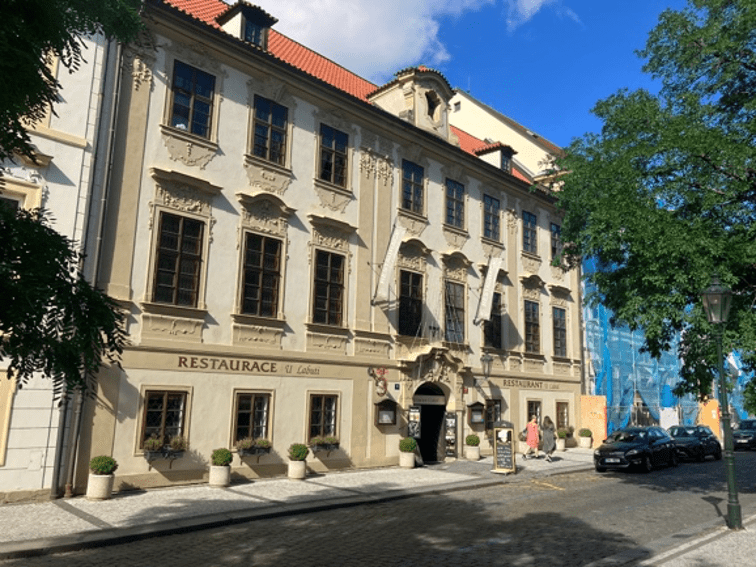
Šternberský palác, whose construction ended in 1707, is used by the National Gallery, having hosted exhibitions of the National Museum as early as 1821. Former inhabitants include Václav Hanka (https://whatsinapraguestreetname.com/2024/08/22/prague-2-day-91-lumirova/).

Arcibiskupský palác / The Archbishop’s Palace is lived in by… yeah, you’ve guessed.

Also lived in by men of a religious background were the Kanovnické domy / Canon houses, although most were destroyed in the Malá Strana fire of 1541.

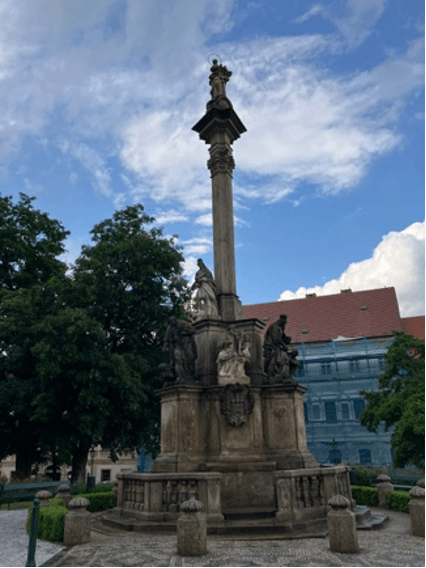
The Mariánský morový sloup / Marian Plague Column, including Saints Vitus, Wenceslas and Adalbert, completed in 1736, commemorates where religious services were held during the Great Plague of 1713/4.
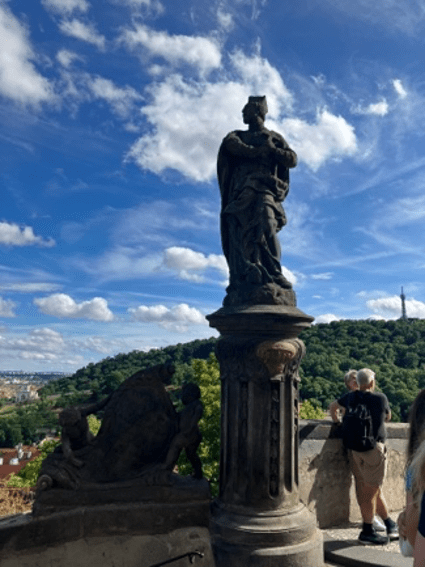
And then there are statues of St Wenceslas (commonly known as ‘Rybář’ / ‘The Fisherman’ because of his banner, and of one St. Filip Nerejský, largely of interest because we can’t quite agree who created it.
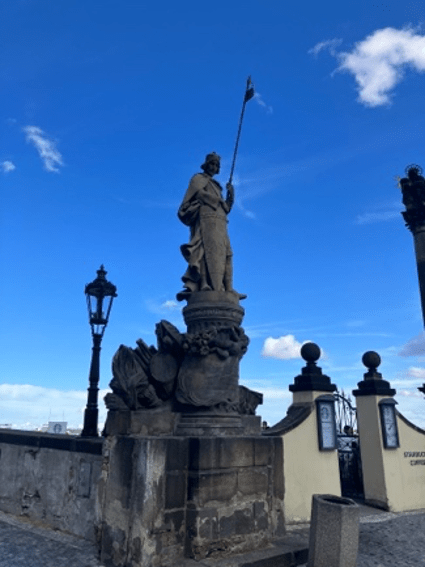
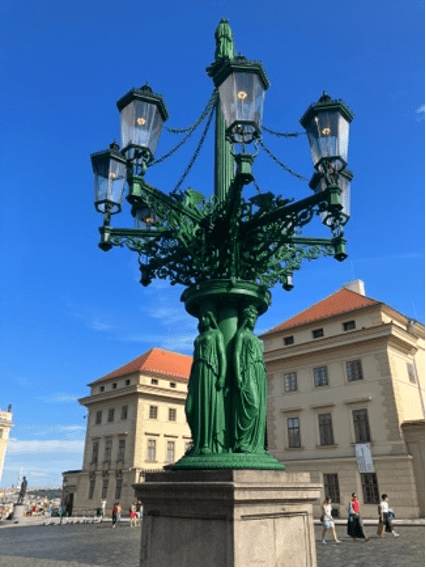
There’s also this lamppost, which is probably a bit nicer than the one nearest to your home.
End of tour.

 What's in a Prague street name
Leave a comment