Originally published on X on 6 August 2023.
At the end of the Thirty Years’ War, if you’d asked a Swede what he thought about Prague, he might well have said ‘Det är verkligen lätt att komma in i staden och belägra den. Inga problem med det alls. Lokalbefolkningen verkade dock inte gilla oss’.
In translation: ‘It’s really easy to enter the city and besiege it. No trouble with that at all. Locals didn’t seem to like us though’.
Emperor Ferdinand III, who the locals didn’t seem to like much either, also noticed this, and asked military theorist Raimondo Montecuccoli for advice. Montecuccuoli suggested the transformation of Prague into a bastion fortress.
The building of the ramparts – also spearheaded largely by Italians – began in 1653 and took until 1730. Most of the bastions were dedicated to a specific saint.
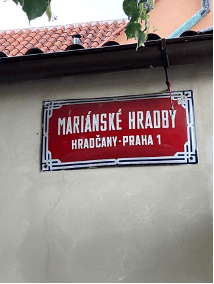
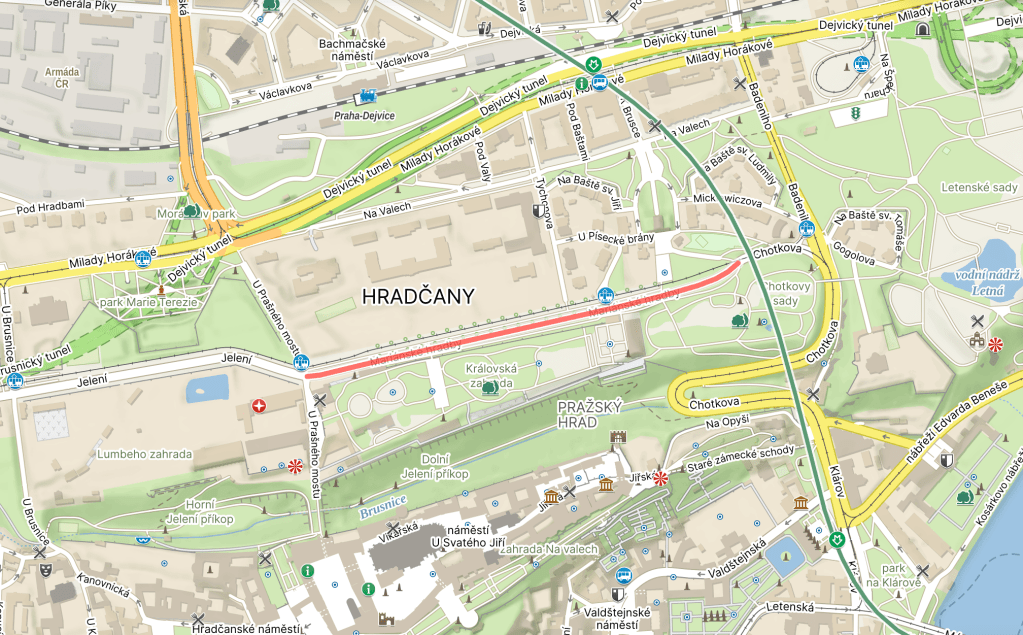
In 1735, this section of the ramparts was named Mariánské hradby, after a chapel dedicated to the Virgin Mary and located by the Bruska / Sand Gate.
There was just a slight problem: the ramparts couldn’t really be defended successfully in the case of heavy artillery fire, and not all the sections were well guarded.
On the other hand, while Prague was captured on three occasions between 1742 and 1744, the walls were only breached twice and the city only fell into enemy hands once (in 1744). They also resisted the attempted attack by Friedrich of Prussia in 1757.
In 1866, when the Prague fortress ceased to exist, the walls, already in a state of disrepair, were no longer used for military purposes (the nature of war had changed a lot since their construction, in any case), and the area, in parts, became residential.
Although destruction of the ramparts began in 1874, seven bastions survive in Prague 1, and another seven in Prague 6.
The lucky saints whose bastions survive are Charles (IV), Lawrence (V), Adalbert (VI), Norbert (VII), Francis Borgia (X), the Virgin Mary (XII), Benedict (XIII), Wenceslas (XIV), George (XVI), Ludmila (XVII), Thomas (XVIII) and Mary Magdalene (XIX).
There is also one surviving bastion devoted to a hospital (VIII), and remnants of one known as the ‘Stone Bastion’ (XI).
Commiserations go to John (I), James (II), Dominic (III), the distinctly non-saint Strahov (IX), and to all the saints, really, as bastion XV was known as bastion Všech Svatých.
Did you know that Svatý Vavřinec is actually St Lawrence? I most certainly did not.

 What's in a Prague street name
Leave a comment