Originally published on X on 24 September 2023.

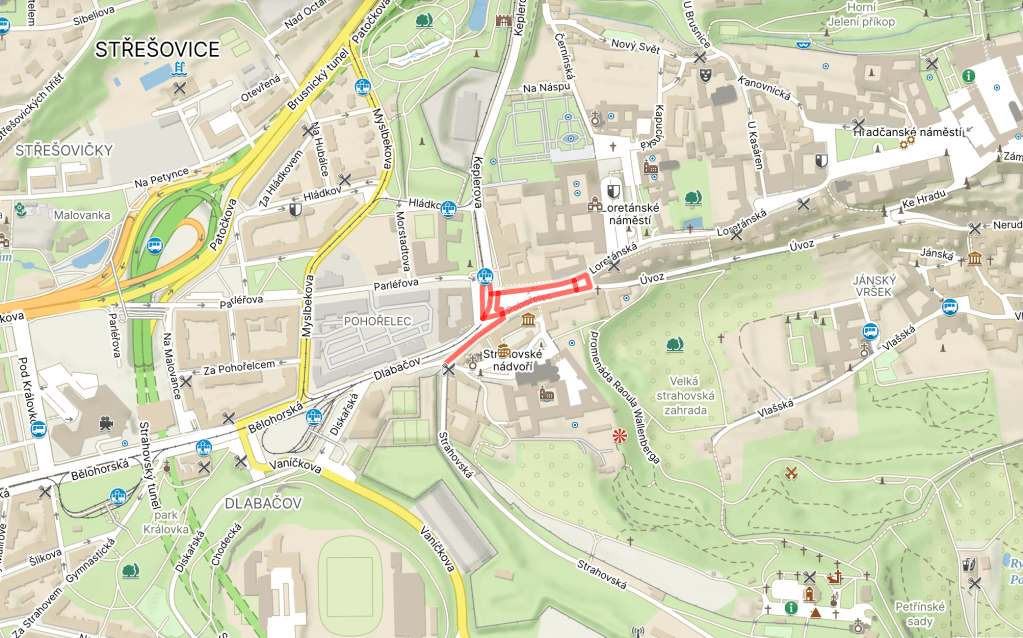
In 1091, Kosmas’s Chronicle referred to a market settlement here. However, it was destroyed in a fire a few years later, and, when the market was rebuilt, it was placed on the other side of the Vltava.
Pohořelec – a name used for the area since the 1300s – derives from the verb hořet, to burn. In modern-day Czech, pohořet can be translated as ‘fail’, ‘come unstuck’ or ‘come a cropper’.
True to its name, Pohořelec would also get burned down by the Hussites in the 1420s, and again in 1541, when a huge fire engulfed Malá Strana and Hradčany.
The most spectacular building on Poheřelec is probably the former barracks, built in Neo-Renaissance style and owned by the Ministry of Defence, but currently out of use.


Kučerův palác / Kučera Palace, at number 22, was restored to its original Baroque appearance in the 1990s. It’s now the office address of the clothing company Vermont (you may have been to one of their GANT stores).

Šlikův palác / Šlik Palace, at number 25, was the city orphanage from 1875 to 1913. It had also been the birthplace of the founder of the ČSSD, Josef Boleslav Pecka-Strahovský, in 1849.

No longer around is the house which Tycho Brahe lived in from 1599 to 1601, and used as an observatory (given some of the views from round here, a good choice).
Ditto a statue to Josef Jiří Švec, who fought in the Battle of Zborov / Zboriv as part of the Czechoslovak Legion in 1917.

Pleasing neither to the Nazis (who removed it) nor the Communists (who destroyed it), there are those who hope a replica will one day appear on the spot: https://www.vets.cz/vpm/mista/obec/237-praha-1/Poho%C5%99elec/

 What's in a Prague street name
Leave a comment