Originally published on X on 19 October 2023.
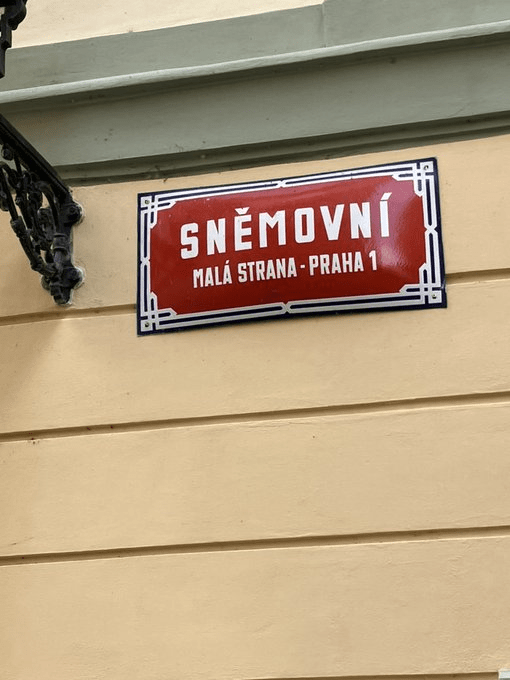

Buckle up, kids, this one probably has a link to many of your least favourite Czechs. Because sněmovna is short for Poslanecká sněmovna, or ‘Chamber of Deputies’.
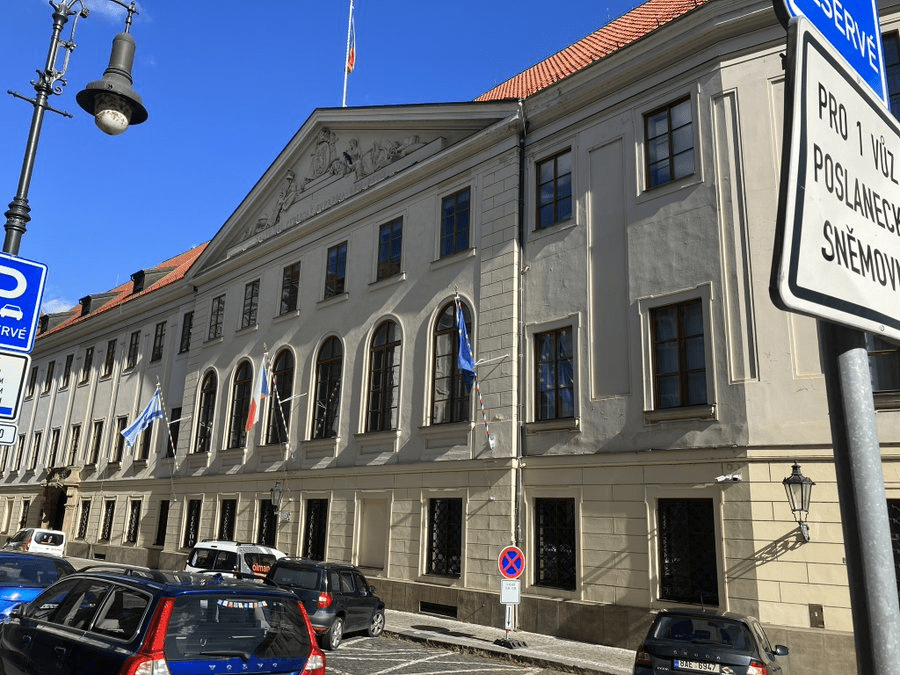
In 1650, one Countess Markéta Anna Thunová purchased a building here, and the family bought two more in 1662 and 1694.
Combined and reconstructed, they came to be known as Thun Palace. If you’re confused, you should be – that’s also the name of the British Embassy, which is really just a matter of metres away: https://whatsinapraguestreetname.com/2024/09/08/prague-1-day-41-thunovska/
From 1779 until 1794 (when it was ruined by fire), the palace hosted an opera company.
In 1801, the similarly-named Anna Marie Thunová sold the building to the Czech Estates, who used it as office space for several decades before, in 1861, it became the Chamber of Deputies.
In 1918, it was here that Tomáš Garrigue Masaryk was proclaimed President, and, in the years after that, Thun Palace was the meeting place of the Senate, rather than the Parliament.


Serving as government ministries in the 1950s and 1960s, the building became the seat of the Czech National Council in 1968, and, since 1993, it’s been the Czech Chamber of Deputies.

Across the road at number 3 is Kolowrat Palace, which hosts the Parliamentary Institute, a scientific, information and educational centre for the Chamber of Deputies, some of whose members would, let’s be fair, benefit from a bit more science, information and education.

While number 5, Lažanský Palace, was lived in by writer, artist and director Jiří Brdečka for a couple of decades before his death in 1982.

And number 7 is the Honorary Consulate of Monaco.


(For those wondering – i.e. no-one – the Czech consulate’s address in Monaco is 15, av. de Grande-Bretagne, MC 98000 Monte-Carlo)
Number 13, the Schützen Palace, has an impressive history but is now looking decidedly out of use, and could do with a bit of love (or an investor who is so rich that he/she is no longer familiar with the concept).

Whereas Fünfkirchen House, at the top of the street, is probably most famous for giving the street its original name, and fans of Ye Olde Prague Street Signs will enjoy seeing another one here.
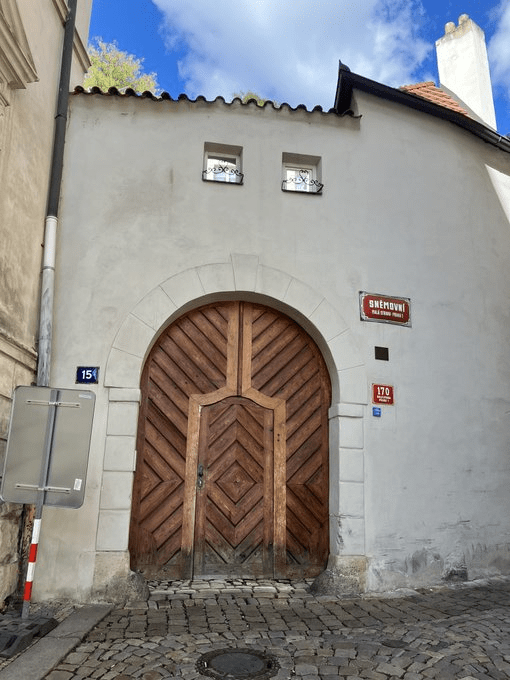

It was also the birthplace of Gelasius Dobner (1719-1790), Enlightenment historian and founder of modern critical Czech historiography.
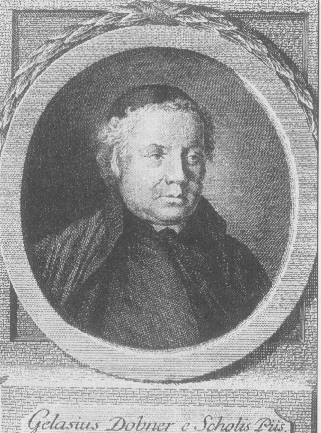
He has a street too, but don’t expect a thread on that just yet – it’s in Prague 17.
But do take this as your confirmation that I *totally* intend to get on to Prague 17 one day.

 What's in a Prague street name
Leave a comment