Originally published on X on 5 January 2024.
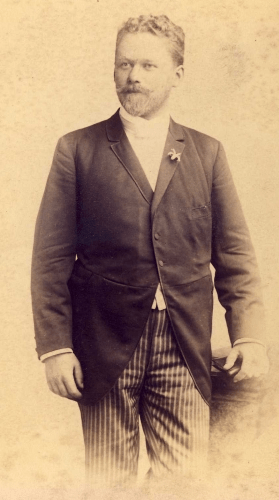
Václav Havel was born in 1936 in Prague. His family was well-off and well-known: his grandfather Vácslav (1861-1921) had built Lucerna, while his father (also Václav; 1897-1979) had created Barrandov Terraces.
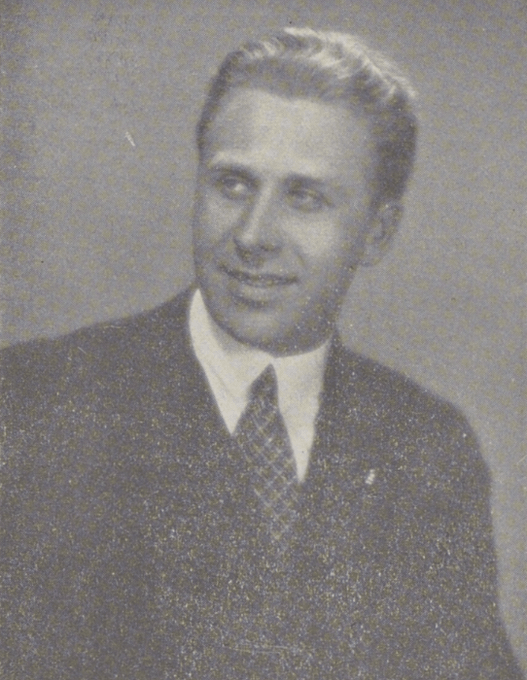
Meanwhile, his maternal grandfather, Hugo Vavrečka (1880-1952), had been a renowned war correspondent, and was also the first Czechoslovak ambassador to Hungary, before carrying out the same role in Austria.
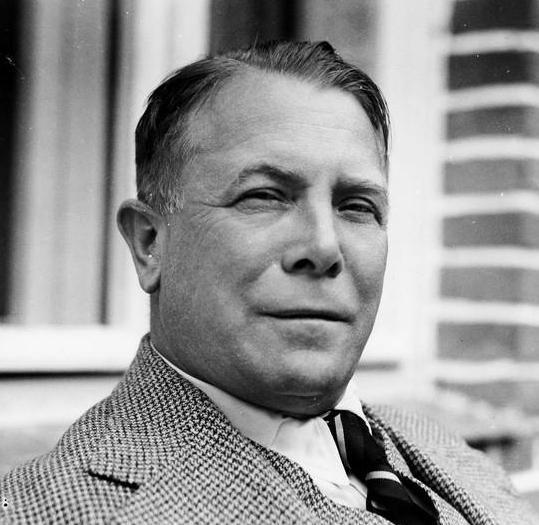
Struggling to get into the secondary school of his choice due to his bourgeois background, Havel, in 1951, started training as a chemical laboratory technician while also attending evening classes on Štěpánská (https://whatsinapraguestreetname.com/2024/09/01/prague-2-day-167-stepanska/), graduating in 1954.
He started studying economics at the Czech Technical University (ČVUT) in 1955, but dropped out in 1957 and tried, unsuccessfully, to get a place at the Film and TV School of the Academy of Performing Arts (FAMU).
After his military service (1957-9), Havel got a job as a stage technician at the ABC Theatre on Vodičkova, before switching to Na zábradlí (on Anenské náměstí) in 1960.
It was at the latter theatre that Havel’s second play, Zahradní slavnost (The Garden Party), was premiered in 1963 (see https://www.youtube.com/watch?v=A5P4s_APdaE). He eventually became the theatre’s dramaturg.
A few months after the premiere, Havel married Olga Šplíchalová at Žižkov Town Hall. You can learn more about her here: https://whatsinapraguestreetname.com/2022/11/20/prague-3-day-64-olgy-havlove/.
Havel got on the authorities’ radar in June 1967, when he made a speech at the Congress of Czechoslovak Writers criticising censorship (https://archiv.hn.cz/c1-54248810-1967-projev-na-sjezdu-spisovatelu). Originally on the list of candidates to lead the Union of Czechoslovak Writers, he was promptly removed from it.
During the Prague Spring in the following year, he became head of the Circle of Independent Writers, and demanded a multi-party political system.
Once the Prague Spring was crushed, Havel’s works were no longer allowed to be performed or published. Having a certain degree of financial independence due to his plays’ international success, he took a job in a brewery and published his new plays in samizdat.
He was one of the founders of Charter 77, a civil rights movement formed in part as a response to the imprisonment of the Plastic People of the Universe in 1976. The founding of the Charter would result in Havel’s imprisonment in 1977 & 1978: https://edu.ceskatelevize.cz/video/15230-vaclav-havel-a-charta-77.
Undeterred, Havel founded the Committee for the Defense of the Unjustly Prosecuted (VONS) in 1978, which campaigned for the rights – and the release – of political prisoners. This would lead to his longest stay in prison – 45 months from 1979 to 1983.
In 1988, Havel joined the Czech Helsinki Committee, which monitored human rights, and, on 10 December, gave a speech at a demonstration on Škroupovo náměstí (https://whatsinapraguestreetname.com/2023/02/26/prague-3-day-145-skroupovo-namesti/).
Two months later, he was imprisoned again following a police crackdown during Palach Week, on the 20th anniversary of Jan Palach’s self-immolation. Released on parole in May, he helped draft the Several Sentences petition, published in June.
On 17 November 1989, the police violently dispersed a student demonstration. Within two days, Havel had co-founded the anti-totalitarian Civic Forum (OF); by the 21st, he would be addressing a packed Wenceslas Square.
On the 28th, the Communist party relinquished power after 41 years. Of the many, many things this meant, one was that Czechoslovakia would need a new president. Havel was nominated on 8 December, and inaugurated on the 29th.
In Havel’s first term, he helped pave the way for free elections, democracy, and the withdrawal of Soviet troops; within a year, Pope John Paul II, George Bush and the Dalai Lama had all visited Czechoslovakia, and Havel had spoken at the US Congress.
However, this term was also marked by a somewhat generous amnesty in 1990 and tensions between the Czech and Slovak Republics (Havel wanted them to remain as one state).
In July 1992, after Slovakia issued its declaration of independence, Havel resigned, not wanting to oversee the breakup of the federation: https://edu.ceskatelevize.cz/video/4197-abdikace-prezidenta-vaclava-havla
When the Czech Republic became independent on 1 January 1993, Havel became its first president, and would remain in that position for two terms, i.e. ten years.
In this time, the Czech Republic joined NATO, and made preparations towards becoming a member of the EU. Havel also addressed the thorny topic of Czech-German relations, an area where his two successors seemed quite happy to aggravate matters.
Olga died of cancer in January 1996; in the same year, Havel would be diagnosed with lung cancer.
In January 1997, Havel married his second wife, Dagmar Veškrnová, again at Žižkov Town Hall: https://ct24.ceskatelevize.cz/clanek/archiv/vaclav-havel-se-ozenil-s-hereckou-dagmar-veskrnovou-168412.
After leaving office in 2003, Havel remained politically engaged, particularly concerning human rights in Myanmar, Belarus and Kurdistan. He also wrote two more plays, including Leaving / Odcházení, which he directed a film version of in 2011.
Havel died on 18 December 2011, aged 75, as a result of a respiratory illness which had been caused or aggravated by his various stays in prison. Deservedly, there was an immense outpouring of grief.
There are many places named after Havel, both in the Czech Republic and internationally; if you fly into Prague, his name will be the first one that you see.
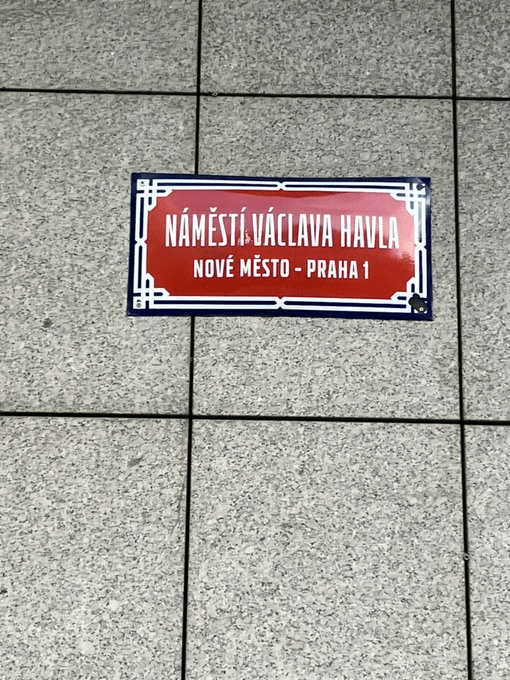
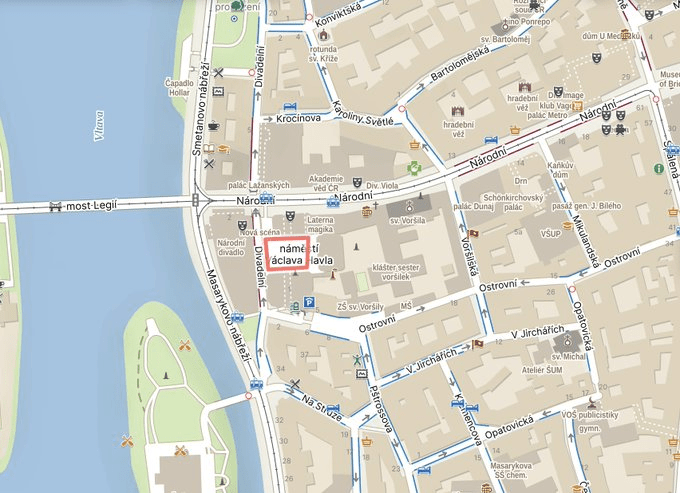
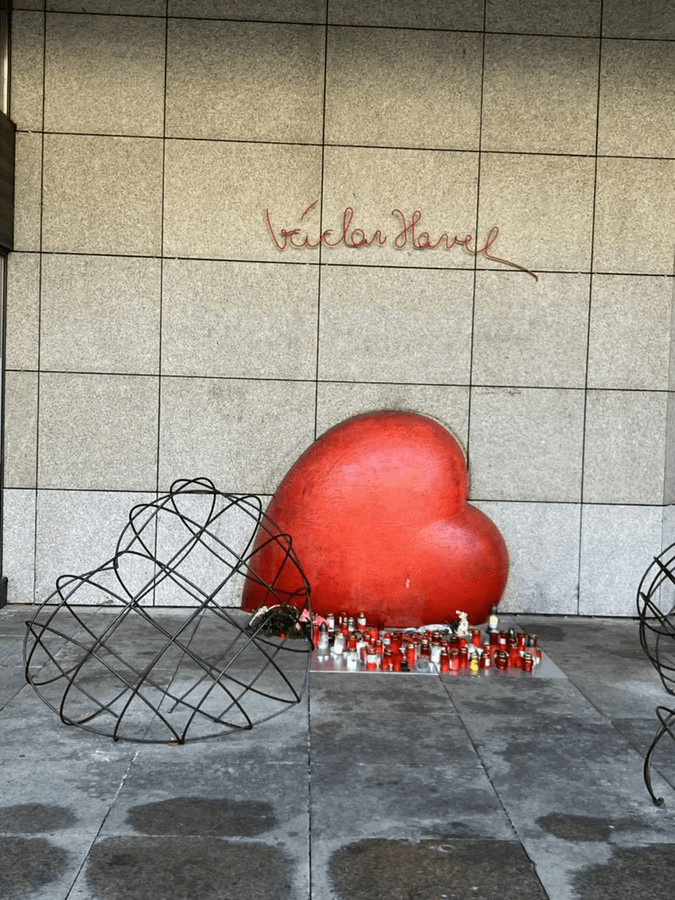
This square, meanwhile, is the ‘piazzetta’ of the National Theatre, designed in 1981 and given its current name in 2016. It includes Heart for Václav Havel, by the sculptor Kurt Gebauer.
This is obviously a very long thread, but even more obviously feels like it doesn’t go into enough detail.
Update, March 2024: on the second anniversary of the Russian attack on the theatre in Mariupol, Czech-Ukrainian initiative organised an event here to commemorate the children, and adults, who lost their lives due to this senseless and reprehensible war. Слава Україні. https://www.ceskenoviny.cz/zpravy/2493618

 What's in a Prague street name
Leave a comment