Originally published on X on 16 February 2024.
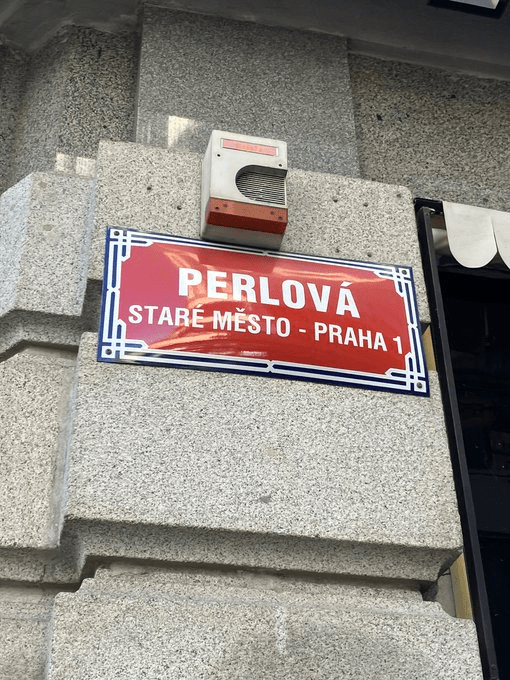

In the Middle Ages, this street was known as ‘U písku’ (‘By the sand’), because the terrain nearby consisted of sandy fields.
Charles IV ordered that a monastery and church be built on those fields, and you can read about the result on https://whatsinapraguestreetname.com/2024/09/15/prague-1-day-112-jungmannovo-namesti/.
There was a gate on the southern side of the street, leading to the monastery, so the street became known as ‘U fortny k Panně Marii Sněžné’, or for those who didn’t feel like saying that all the time, ‘U fortny’ (fortna being derived from the German Pforte).
In 1641, one Vojtěch Had z Proseče bought a house on the street. He was ennobled in 1649, and decided to be known as Vojtěch Had z Proseče a z Perlštejna.
That last addition to his name is the most likely reason for the street now being called Perlová.
Number 10 – clearly not the version that Sir Had lived in – was, from 1865, the first headquarters of the Mortgage Bank of the Kingdom of Bohemia / Hypoteční banka Království českého.

By 1890, however, they had enough cash to move to Senovážné náměstí: https://whatsinapraguestreetname.com/2024/09/19/prague-1-day-132-senovazne-namesti/.
In the 1990s, Perlová (colloquially Perlovka) was notorious as Prague’s main hotbed of prostitution: https://medium.seznam.cz/clanek/jaroslav-kral-historie-prazske-prostituce-soukrome-privaty-zavisle-na-karlaku-i-perlovka-17769
There wasn’t any sign of this when I was there recently, but there was a man who was very stressed and in a hurry, and who got very sweary when I (a few metres in front of him) stopped to take some photos of buildings and he couldn’t get past (note: he could).

 What's in a Prague street name
Leave a comment