Originally published on X on 25 April 2024.


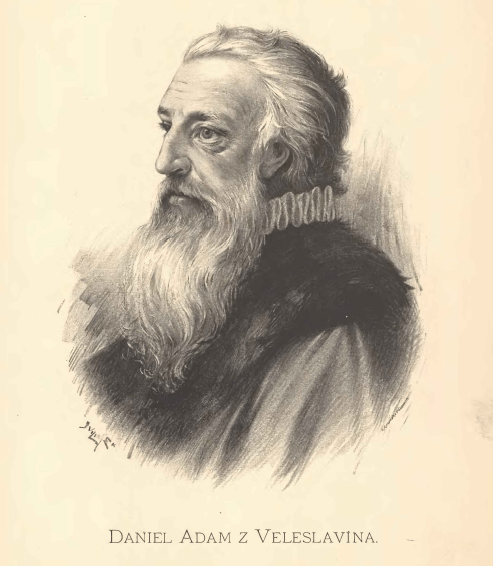
Daniel Adam was born into a well-off family in Prague in 1546.
After studying history at Prague University, he lectured there from 1569 to 1576.
Also in 1576, he married Anna Melantrichová, daughter of the famous publisher Jiří Melantrich (https://whatsinapraguestreetname.com/2024/10/14/prague-1-day-194-melantrichova/), and started to work at his father-in-law’s printing house.
In 1578, he published Kalendář historický, which went through the days of the year and described the historical events that happened on them (i.e. this would probably have been my favourite book ever if I’d been around then).
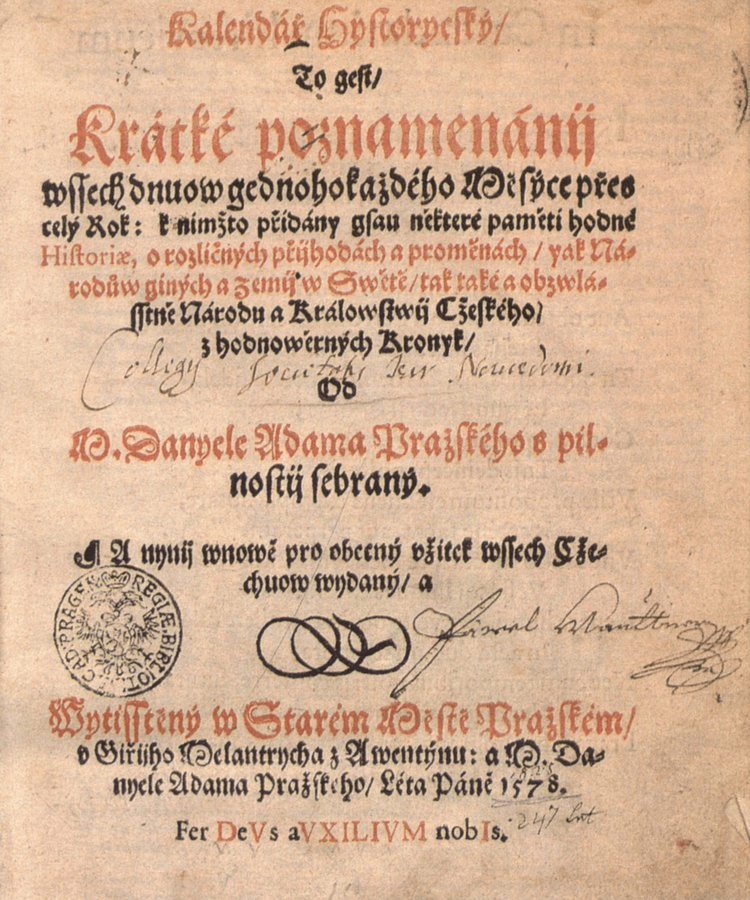
In the same year, he added ‘z Veleslavína’ to his name, after his father’s birthplace.
Melantrich died in 1580, and left the business to his son, Jiří, who didn’t do a very good job of it. So, when Jiří also died prematurely in 1586, Adam took over.
This proved to be a good move – over 130 high-quality publications were released as a result, of which almost half were in Czech (which was not usual at the time).
Additionally, he was one of the first to publish sheet music, and also published a Czech-Latin-Greek-German dictionary.
In 1595, Adam moved just outside of Mladá Boleslav; four years later, while in Prague, he caught a fever and died.
The printing house would then be run by his widow and her second husband, Jan Bohutský.
Just after Bílá Hora in 1620, it was given to the Jesuits, who were unable to make it reach its past glories.
There’s a monument to Adam in Veleslavín (of ‘Nádraží’ fame) in Prague 6. Looking forward to sharing a photo of that with you all in 2028 or so (we laugh now, but one day we’ll wake up and realise it’s almost 2029).

 What's in a Prague street name
Leave a comment