Originally published on X on 2 June 2024.
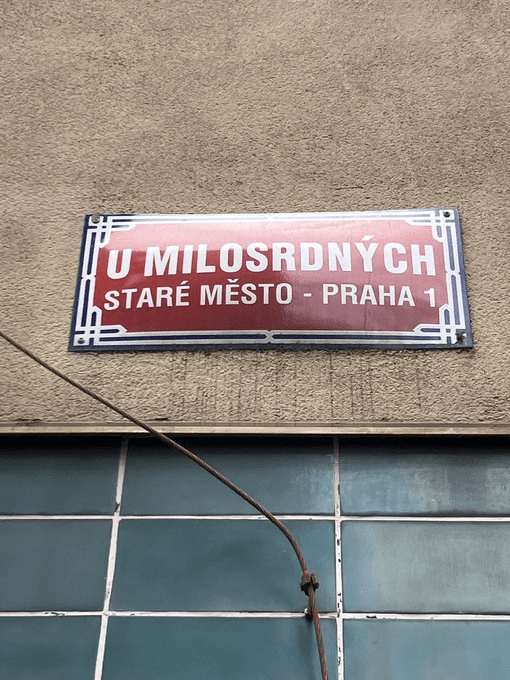

Originally, the street was known either as U svatého Kříže – after a now-defunct church of the Holy Cross – or as U svaté Anežky (see yesterday: https://whatsinapraguestreetname.com/2024/11/05/prague-1-day-243-anezska/).
Around 1350, a hospital was built here, founded by one Bohuslav z Olbramovic, and completed at the instigation of Arnošt from Pardubice, the first Archbishop of Prague.
He consecrated the hospital’s chapel – Kaple svatého Šimona a Judy / the Chapel of Sts. Simon and Jude – in 1354.
In 1615, the chapel was purchased by Václav Vilém z Roupova, a Czech noble and one of the leaders of the anti-Habsburg rising in 1618-20 (who fled afterwards and avoided execution).
He initiated the conversion of the chapel into a church for the choir of the Church of the Brethren, but the vault collapsed in 1617, and, after consecration in 1620, time wasn’t exactly on the non-Catholics’ side.
The site was taken over by the Order of Merciful Brothers – Řád milosrdných bratří – at the end of 1620, and they set about building a monastery.
The order – officially known as the Hospitaller Order of the Brothers of Saint John of God (and colloquially in Italian as the Fatebenefratelli – ‘Do-good brothers’) – had been founded in Italy 1572 by the Portuguese soldier turned healthcare worker, João de Deus.

The Monastery of the Merciful Brothers and the new monastery church of Saints Simon and Jude were ready by about 1653; they underwent Baroque reconstruction in the early 1700s.


Meanwhile, the order increased the capacity of the hospital – by 1703, it had an extra floor and could accommodate almost 90 patients. It continued to grow in importance as it became a branch of Prague University’s Faculty of Medicine.
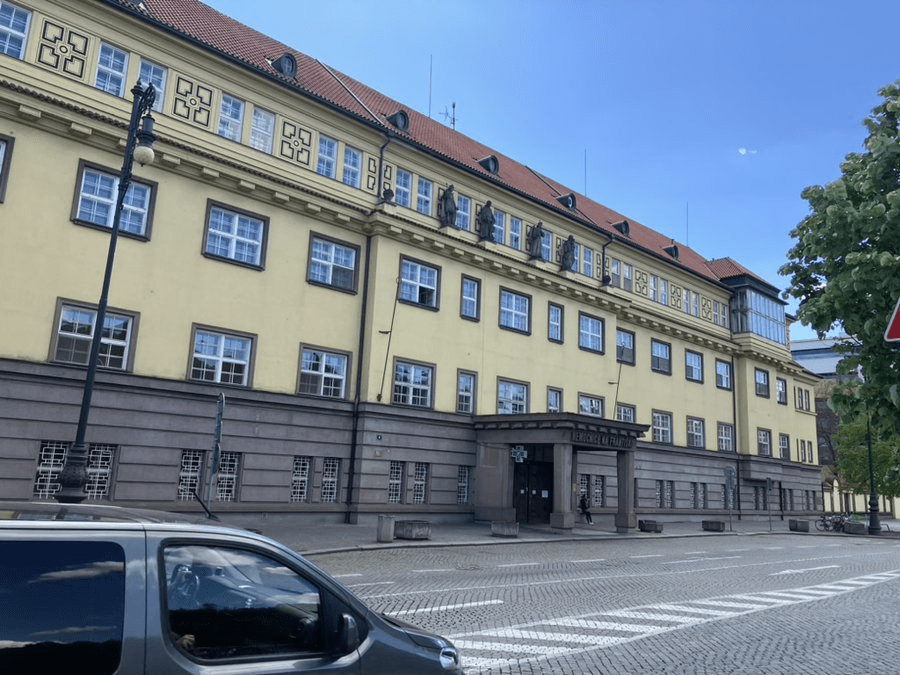
In the 19th century, Franz Joseph II supported the hospital, which eventually had capacity for 200 patients, making it the largest hospital in Bohemia.

The front of the hospital was completed in 1926.
Nowadays, it’s the most important Czech institution for the treatment of breast cancer, and its orthopaedic department is frequently used by top athletes. The hospital treats over 80,000 people annually.
Back to Simon and Jude: a plaque on the south side of the church says that both Joseph Haydn and Wolfgang Amadeus Mozart played its organ when they visited Prague.
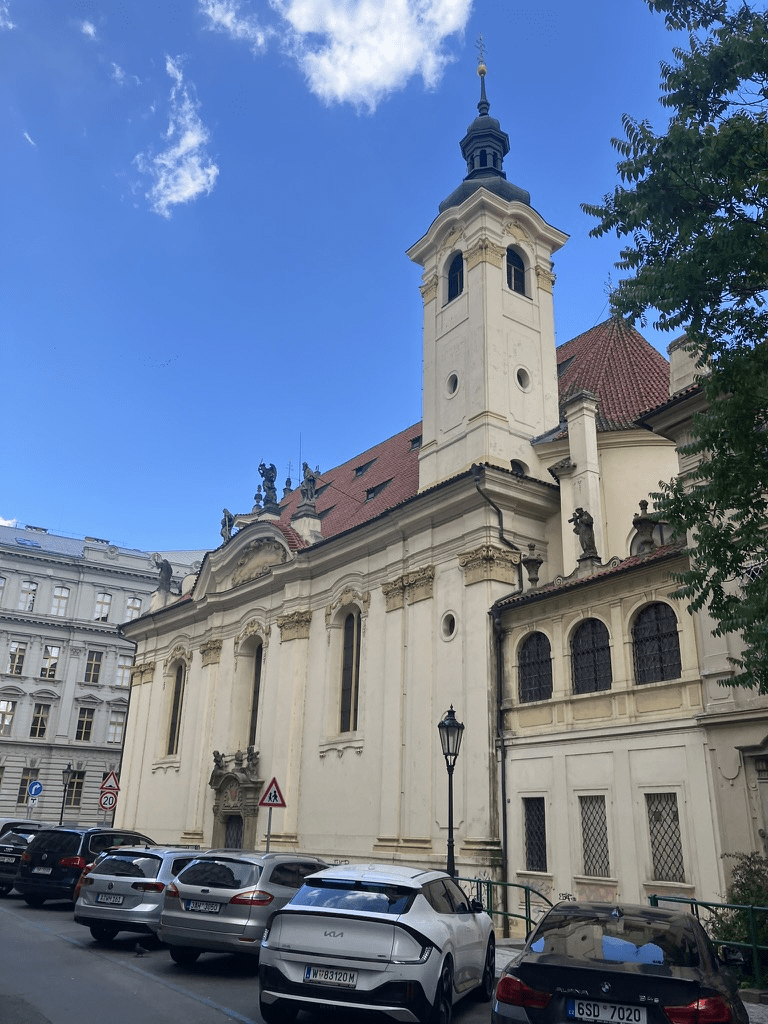
Inevitably, the Merciful Brothers were thrown out by the Communists in 1950; nowadays, the church is often the site of concerts by the Prague Symphony Orchestra: https://www.fok.cz/en/church-st-simon-and-st-jude.

 What's in a Prague street name
Leave a comment