Originally published on X on 3 June 2024.


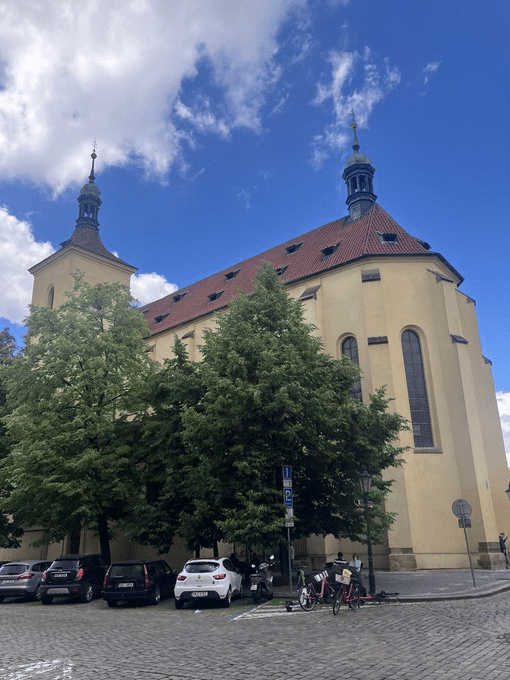
Svatý Haštal is Saint Castulus, chamberlain to Emperor Diocletian.
He sheltered Christians in his home, converted many people to Christianity, and also arranged for people to be baptised by Pope Caius.
He was thanked for this by being being buried alive in a sandpit in 286. His wife, Irene of Rome, who tended to Saint Sebastian (as pictured), would be martyred two years later.

An archaeological survey carried out in the 1990s revealed remnants of a church building here from the 1100s, although the first mention in writing (by Václav I) dates from 1234.
A new, Gothic church was built in the 1300s; that, too, was replaced by a Romanesque church (built between 1375 and 1399).
During the Hussite wars, the church was damaged not only by fighting, but also by floods; it remained Hussite until 1624, when it was handed over to the Catholics.
The church burned down in a fire in 1689, which was followed by five years of reconstruction; its current interior dates from 1730 onwards, with a major renovation taking place in 1883.

These insides include the supposed remains of Saint Castulus, brought to Prague and donated to the church by Charles IV.
I would ask how the remains survived the Hussites, flooding and fire, but then I guess the Lord works in mysterious ways.
The street was originally called ‘U starého Haštala’ (Old Castulus), and then Haštalský plácek, before receiving its current name in 1926.
Castulus, meanwhile, is the patron saint of shepherds, and should be invoked when you’re worried about lightning, wildfires, drowning, cowherds, having your horse stolen, or erysipelas, a form of cellulitis.

 What's in a Prague street name
Leave a comment