Gončarenkova was built in 1934.
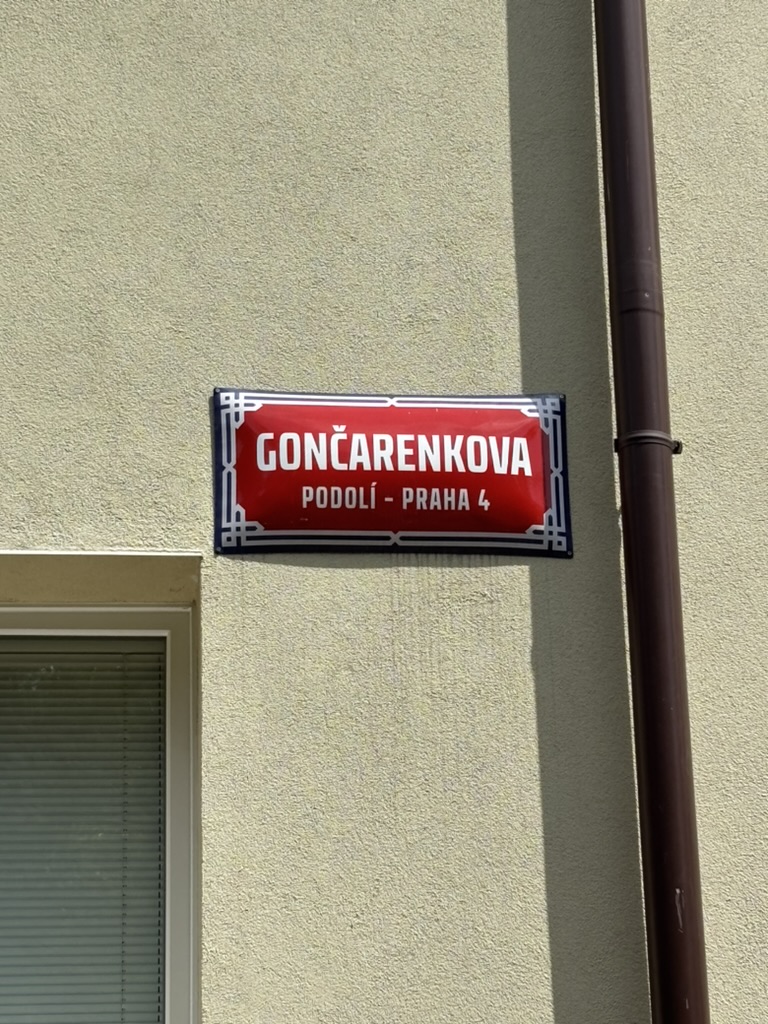

From 1934 to 1952, the street was called Podhájská; from 1952 to 1957, it was called Na Zvoničce; from 1957 to 1973, it was called Na Zvoničce II. I’m saying nothing about those names, as all will become clear in the next few days.
Ivan Hryhorovych Hončarenko was born in Sushylyne, a village in Sumy Oblast, Ukraine, in 1920. In 1940, he joined the Red Army.
Graduating from military school in 1941, he was assigned to a tank brigade on the Central Front, where he fought from June to December of that year.
In 1944, Honcharenko became commander of a tank in the 1st Tank Battalion of the 63rd Guards Tank Brigade “Chelyabinsk”.
In April 1945, he distinguished himself in battles for the liberation of the Ukrainian SSR and Poland, as well as in street battles in Berlin. In the following month, the Prague Uprising would occur (see https://whatsinapraguestreetname.com/2025/02/05/prague-4-day-25-5-kvetna-5-may/ for a primer).
In the very early hours of 9 May 1945, a reconnaissance platoon of three tanks made up the first group of Soviet troops to enter Prague (from the north-west). Honcharenko was in charge of one of these tanks.
The Germans had signed an unconditional surrender on 8 May, and most of them left Prague on that night. One German unit remained, and spent the night at Klárov (https://whatsinapraguestreetname.com/2024/09/08/prague-1-day-51-klarov/).
The three Soviet tanks set out from Prague Castle (https://whatsinapraguestreetname.com/2024/09/02/prague-1-day-1-u-svateho-jiri-st-georges-square/), moving along Chotkova (https://whatsinapraguestreetname.com/2024/09/07/prague-1-day-10-chotkova/).
The purpose of this journey was to reach Mánes Bridge (https://whatsinapraguestreetname.com/2024/09/08/prague-1-day-57-manesuv-most/) and ensure the rest of the tank brigade a smooth journey to the city centre on the other side.
The three tanks drove right in front of German self-propelled guns; at least one of the Germans opened fire.
Honcharenko was ejected from the commander’s hatch. He was killed by shrapnel and the explosion of a German anti-tank shell. He was 24 or 25.
Honcharenko was posthumously awarded the Order of the Patriotic War, 1st degree.
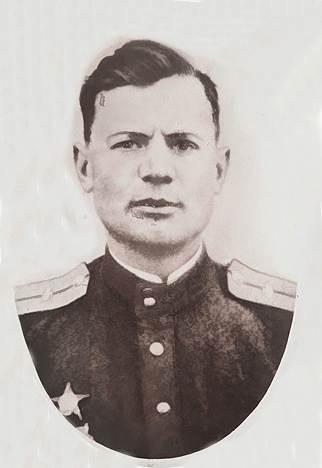
He was buried in a mass grave in front of the Rudolfinum on Smetana Square (which was later renamed after fallen Soviet soldiers in 1952, and is now https://whatsinapraguestreetname.com/2024/10/22/prague-1-day-211-namesti-jana-palacha/).
The grave outlived the Velvet Revolution; in 1998, construction of an underground garage meant that all remains of Soviet soldiers were transferred to the Soviet war cemetery at Olšany.
But let’s rewind a little.
On 29 July 1945, meanwhile, the Monument to Soviet Tank Crews was erected on present-Náměstí Kinských (in Smíchov); the square (which will get its own post in… 2027, at this rate) would be renamed in 1952 as náměstí Sovětských tankistů, which barely needs translating.

The dedication ceremony was led by Ivan Koněv, who has the unique feat of being the person who the first ever street I wrote about was named after, and the first ever person whose street has since been renamed (https://whatsinapraguestreetname.com/2022/11/18/prague-3-day-1-konevova/).
In 1956, when Soviet tanks entered Budapest, the regime had all the engine parts and transmission removed. It’s almost like they realised the population wasn’t that into them and would like an opportunity to take action against them, isn’t it?
(tank pictured in 1961; credit to FOTO:FORTEPAN / Gyöngyi)

After the Velvet Revolution in 1989 – by which time Soviet tanks were mainly associated, in the public imagination, with the invasion of 1968, rather than 1945 – it was pretty clear that this monument was no longer welcome.
One night in April 1991, a 23-year-old art student, one David Černý, painted the tank pink. The Soviet Union – about as dynamic as the tank by this stage – protested, Černý was charged with hooliganism, and the authorities had the tank painted green again.
These quite incredible pictures have been shared on Wikipedia by a user called Meloun1212, to whom I am infinitely grateful.


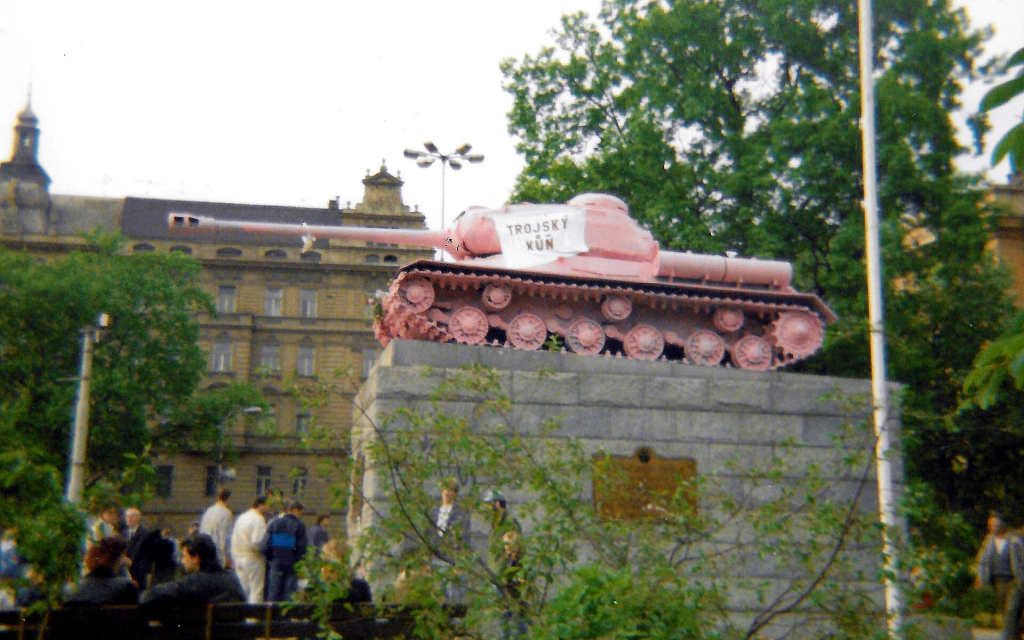
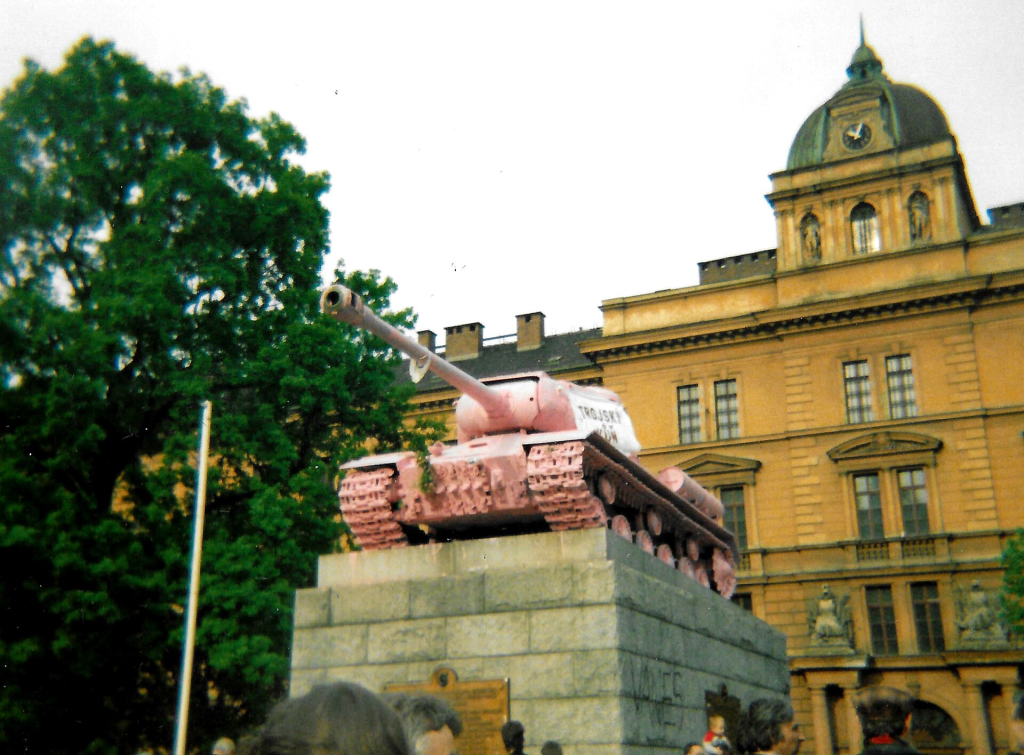
In June 1991 – by which time Černý had been freed – the tank was moved to Kbely Military Museum, and then to Military Technical Museum in Lešany.
In 2005, a motion to have the monument restored was put forward by the Communist Party, for whom ‘ability to read the room’ was clearly not a prerequisite for membership.
In 2011, David Černý, by this time celebrated as a rebel rather than imprisoned as a hooligan, painted the tank pink again, and it was given an outing on the Vltava to celebrate twenty years since Soviet tanks had left Czechoslovakia.
In 2022, Černý painted the torso of the tank blue and yellow in support of Ukraine, a country where the moment at which Russian tanks leave cannot come soon enough: https://www.expats.cz/czech-news/article/david-cerny-s-iconic-soviet-tank-painted-blue-and-yellow-to-support-ukraine.
Several pics of the tank through the ages are on this recent article by ČT24: https://ct24.ceskatelevize.cz/clanek/domaci/tank-cislo-23-ruzovy-osvoboditel-ktery-nikdy-neosvobozoval-359334.

 What's in a Prague street name
Leave a comment