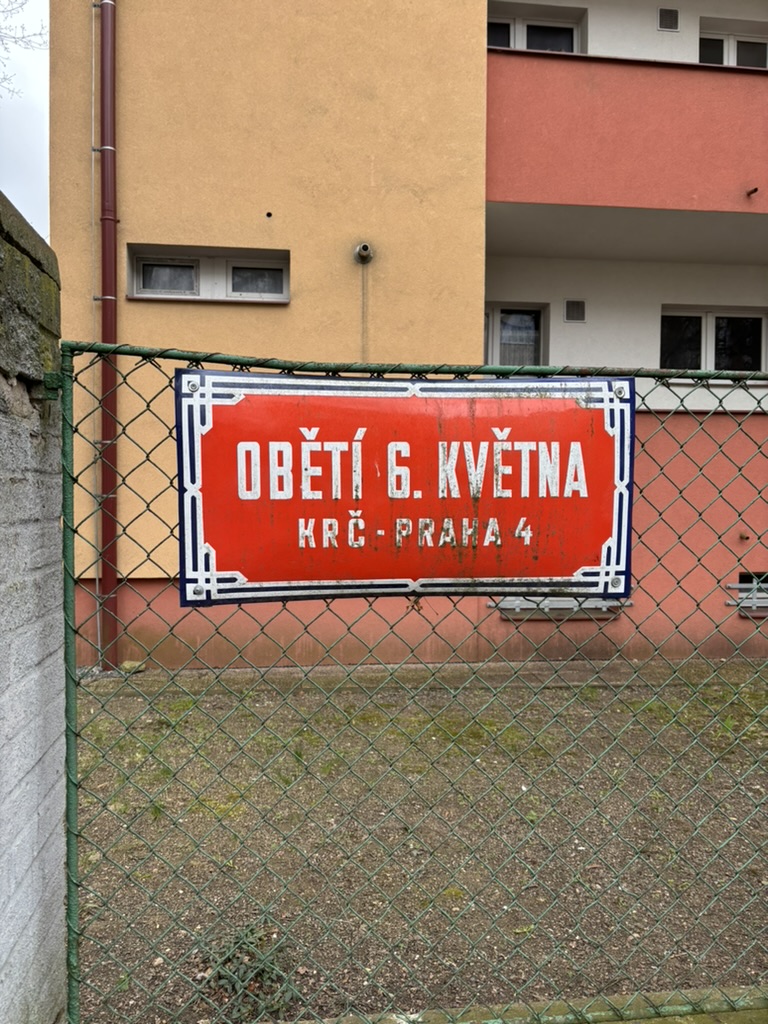
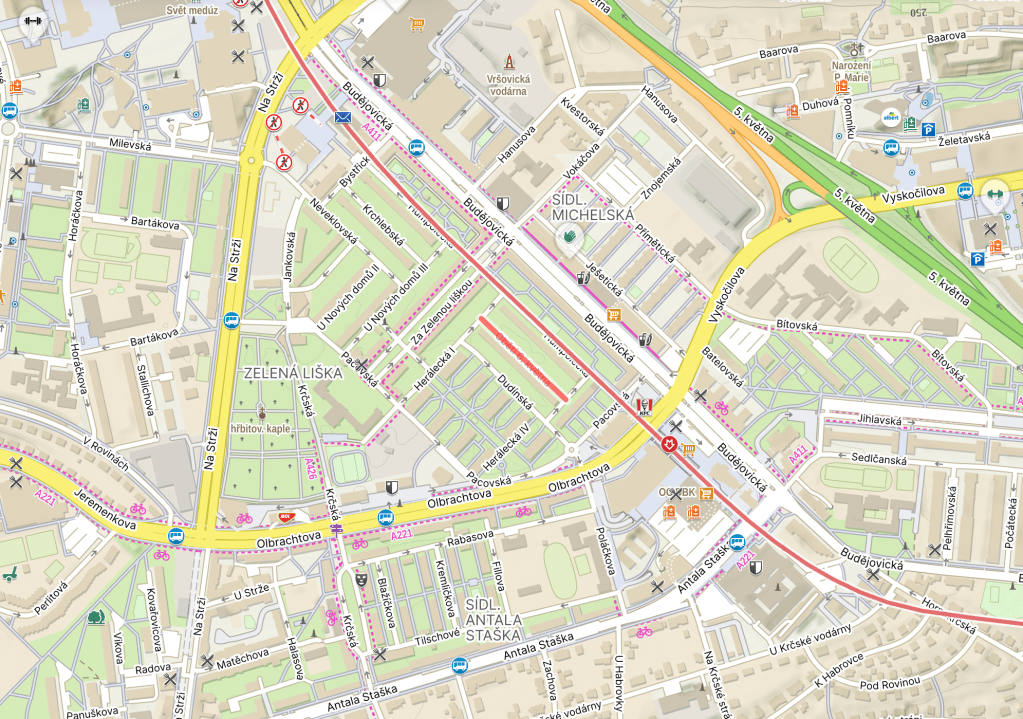
Obětí 6. května was built in 1941.
The Prague Uprising, an attempt by the Czech resistance to liberate Prague from six years of occupation, broke out on 5 May 1945. You can read about its first day on https://whatsinapraguestreetname.com/2025/02/05/prague-4-day-25-5-kvetna-5-may/.
On the night of the 5th and 6th of May, almost 1,600 barricades were erected in Prague after a radio broadcast by the Czech National Council warned that a German attack was imminent.
On the 6th, German aircraft started to bomb Prague; however, the fact that they were also fighting the Russian Liberation Army (who had largely blocked the Germans from entering Prague West) meant that planned carpet bombing couldn’t take place.
It was also on 6 May that General George S. Patton’s Third American Army liberated Plzeň, leading to rumours that they would soon do the same for Prague.
Patton wanted it to happen; Churchill (who has his own square on https://whatsinapraguestreetname.com/2023/01/13/prague-3-day-126-namesti-winstona-churchilla/) did too, but President Eisenhower, for political reasons, said the liberation of Prague should be left to the Red Army.
Those ‘political reasons’ being the fact that the Americans needed the Russians’ help in the ongoing war against Japan in the Pacific.
The Red Army set out for Prague on the 6th, but met with heavy German resistance around Dresden and the Ore Mountains (Krušné hory). The First Battalion entered Prague around midday.
Meanwhile, the Germans committed atrocities in the neighbourhoods that they occupied – including Krč, and including indiscriminate attacks against people who weren’t even involved in the uprising or at the barricades.
In the evening, a group of drunk German soldiers went to a residential building in Úsobská street; its residents hid in the basement, thinking this would keep them safe. However, the Germans found them and shot 35 of them dead.
Those killed included a heavily pregnant German mother of two. 12 people played dead, but survived and would later provide eyewitness accounts of the killings.
Then, the Germans went through the cellars, finding the residents of the neighbouring building, and murdered a further 16 of them. Six of them were children; one of them was three years old. Five were women, one of whom was also heavily pregnant.
Úsobská was renamed to ‘Obětí 6. května’ (Victims of 6 May) in 1948. Nobody was ever caught or convicted for the killing of 51 innocent people.
This shouldn’t really need saying, but: if we could get rid of everyone who commits war crimes, get rid of everyone who is OK with war crimes taking place, and then wipe the rest of our minds so we had no recollection of any of those people every having existed, it would solve so much.

 What's in a Prague street name
Leave a comment