Originally published on X on 1 April 2024.
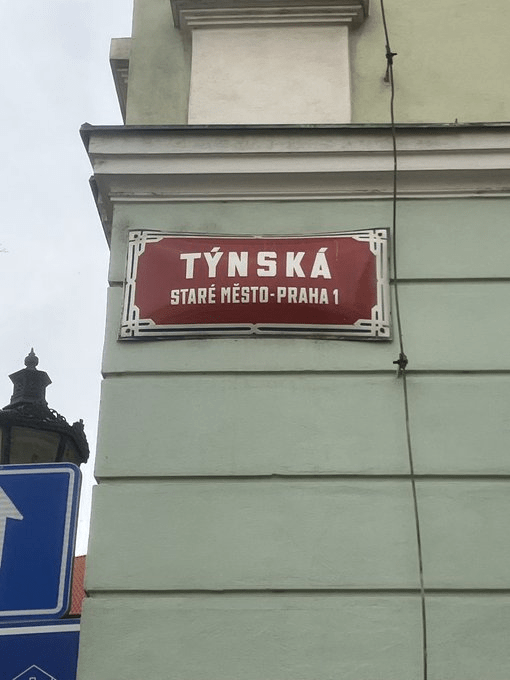

In 965, Ibrahim ibn Yaqub, an Arabic-speaking, Sephardi Jewish traveller (and probable merchant) whose family came from what is now Tortosa in Catalonia, travelled to Prague.
He wrote about his trip – and what he wrote is the oldest written reference to Prague that we have.
He wrote that it was ‘the largest city in terms of trade’ with a market where people sold and bought slaves, tin, furs and food.
It’s highly possible that he was talking about this spot here.
Even if he wasn’t, a market definitely existed in this spot by the 1100s. It had a ‘merchant’s centre’ which was fortified, with a moat, walls and two gates, and anyone who wanted to enter had to pay a fee – or Ungelt (in German).
However, once traders had paid this, it was worth it – they could sleep here, as could their horses, for whom there was a stable, and they could store their supplies. So important was the centre that it had its own Romanesque church (dedicated to the Virgin Mary) and a hospital.
As for the Czech name, there’s an Old Slavic word – tynъ – which means ‘wall’. It’s assumed that this is of Germanic origin, an origin which has since given us the German ‘Zaun’ (wall), the Dutch ‘tuin’ (garden), and – wait for it – the English ‘town’.
As the Old Town grew in importance, the original church was replaced by an Early Gothic church in 1256, but, by the mid-1300s, the parishioners were quite flush with cash and decided to fund something even grander.
Construction was initially led by Matthias of Arras (responsible for the early stages of St Vitus’ Cathedral) and Peter Parler (who took over work on St Vitus’ after Matthias died, and was also responsible for Charles Bridge). It was ready for use – if not complete – by 1380.
The church fell into Hussite control (from 1427, its vicar was Jan Rokycana – https://whatsinapraguestreetname.com/2022/11/19/prague-3-day-19-rokycanova/), but the ensuing wars, combined with the fact this construction was taken a bit more seriously than that of a panelák, meant that it wasn’t completed until 1511.
More gruesomely, the roof of the church couldn’t be built as planned, as, in 1437, Emperor Sigismund – not, shall we say, a Hussite stan – had decided that the timber meant for this job should be used to build gallows for the execution of Jan Roháč (https://whatsinapraguestreetname.com/2022/11/25/prague-3-day-81-rohacova/).
After the Battle of Bílá Hora in 1620, the church was, like Bohemia itself, subject to forced recatholicisation – the statue of George of Poděbrady (the only Hussite king) was replaced by a relief of the Madonna, and Rokycana’s tombstone was destroyed, as were his remains.
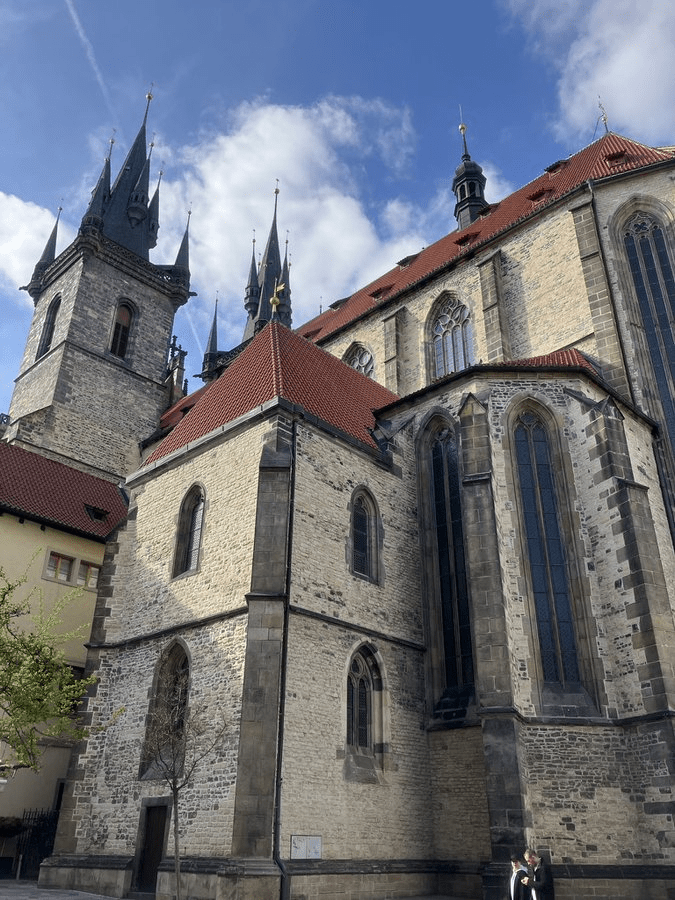
After the Thirty Years’ War, the interior was redone in Baroque style, but the church suffered fires in both 1679 and 1819. It always seems to have some kind of renovation going on.
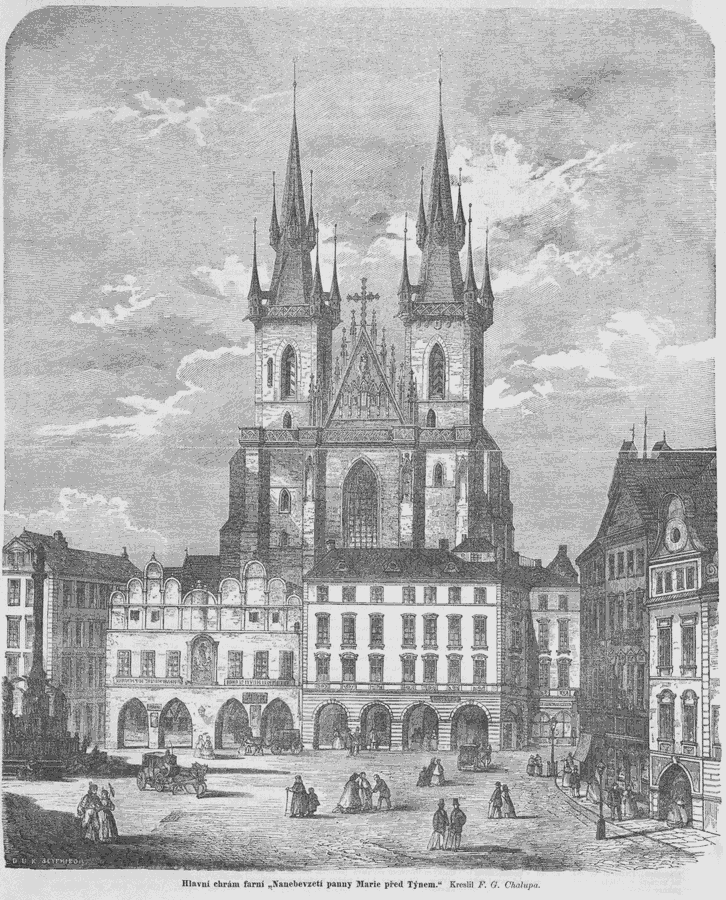
Back to the Ungelt/Týn, wealthier Prague residents would start to build their own homes around the market in the 1300s (though none of these are the originals because, yes, fires).
After the Hussite Wars, Prague’s position as a centre of international trade had been massively screwed, and the Ungelt became a place for domestic trade only.
In 1774, the customs office moved to Haštalská, and Ungelt/Týn became neglected. After reconstruction work, it was opened to the public again in 1996.
Number 2 (or, if you prefer, number 14 on Old Town Square) is the Týnská škola / Týn School, which operated from 1394 until 1842. Teachers here included both Jan Rokycany and Matěj Rejsek (https://whatsinapraguestreetname.com/2024/08/19/prague-2-day-76-rejskova/) of Powder Tower fame (https://whatsinapraguestreetname.com/2024/10/10/prague-1-day-181-u-prasne-brany/).
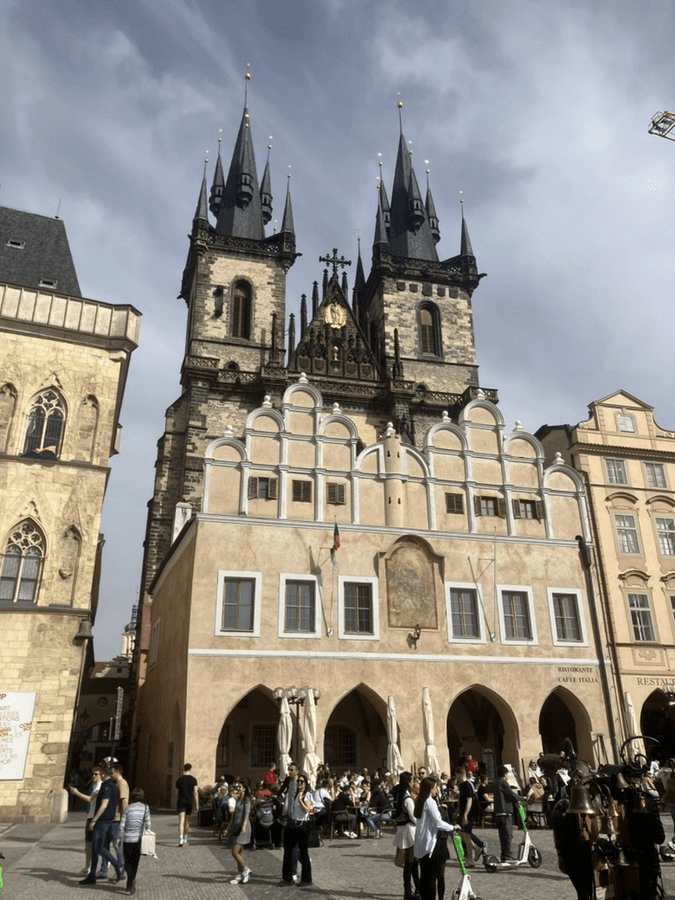
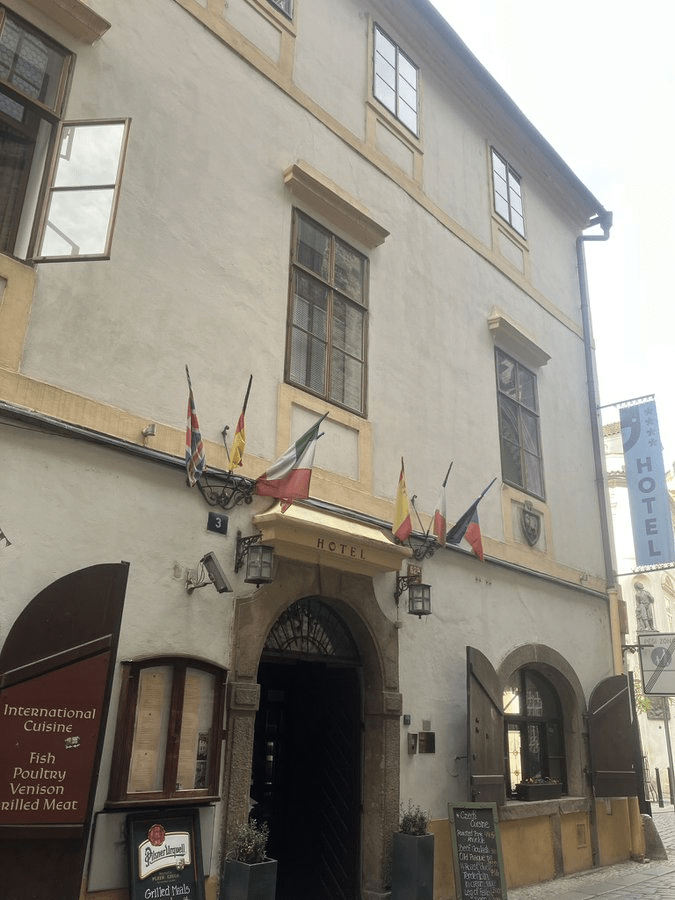
Number 3, U Černého slona (The Black Elephant), is now a hotel whose website says it’s had some pretty important guests (Tycho Brahe, Václav Havel, Madeleine Albright).
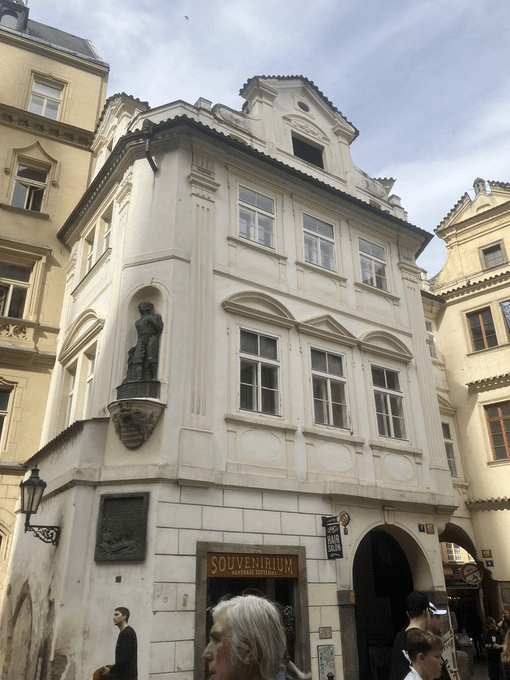
While number 7, Palác Budovců z Budova, is named after one of its owners, Václav Budovec z Budova, who would be executed just a stone’s throw away on Old Town Square in 1621, four years after he purchased the house. He’s commemorated by a statue on the façade.

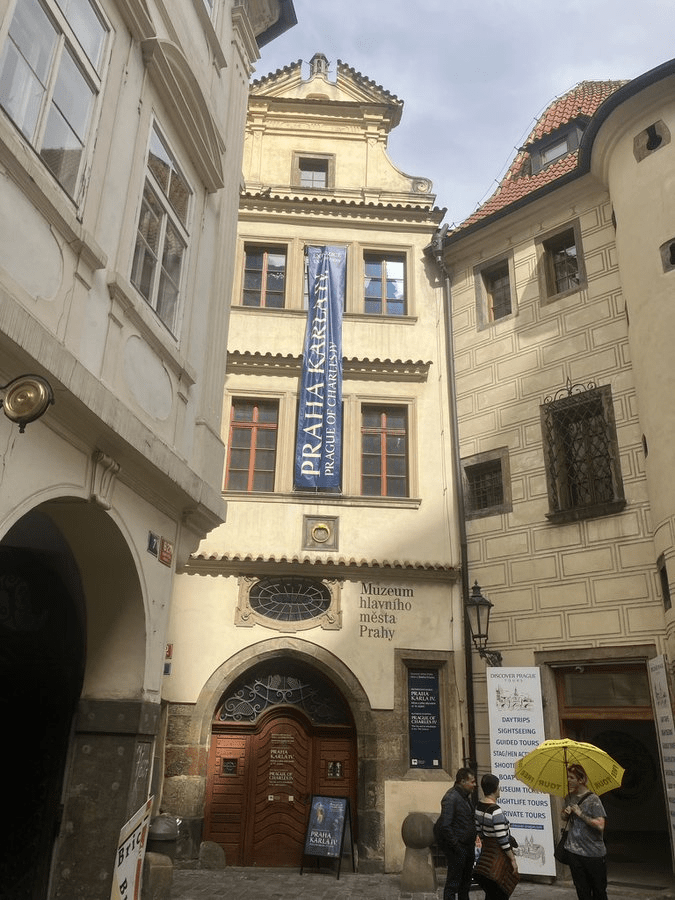
And number 6, U Zlatého prstenu (The Golden Ring), was reconstructed by the Czech-Croatian architect Vlado Milunič in the 1990s. Since 2016, it’s been part of the Museum of the Capital City of Prague.
Finally, U Černého jelena / The Black Stag was the birthplace of painter Karel Škréta (https://whatsinapraguestreetname.com/2024/02/18/prague-2-day-34-skretova/), and this, too, is commemorated by a plaque.
There are two more streets named after Týn – including one which is the complex itself – so expect to see some of these buildings from slightly different angles in future posts.

 What's in a Prague street name
Leave a comment