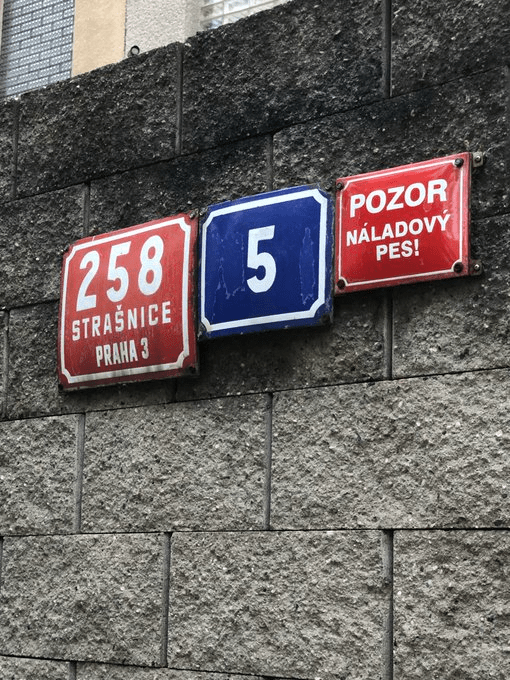
I was going to say that this means ‘In the lakes’ and move on, but that would be v jezerech with a second e and not an á.
One lake is a jezero, two lakes are jezera, and a small lake or pond or lakelet (or ‘tarn’, apparently) would be a jezírko.
But a jezera (singular, and presumably feminine, whereas jezero is neuter) is something I can’t find a reference to. So either this does mean ‘in the lakes’, or jezera (singular) is an archaic term.
In any case, it appears that the land was wet round here at some point.
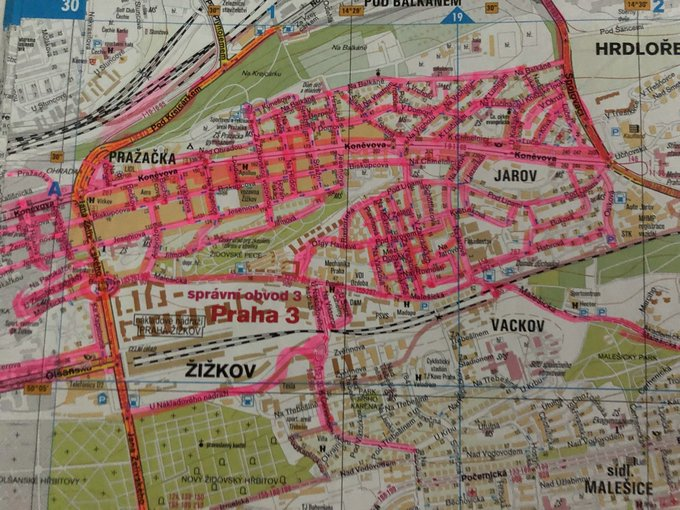
Jarov was the name of a construction collective which, in 1914, started building family houses around this area.
From 1959 to 1963, a housing estate (sídliště) was built round here. It includes the local student dormitories on V Zahrádkách.
Most readers will see the word ‘Jarov’ and wonder if it’s time to get their car serviced, and maybe pop into Kaufland afterwards.
* Hrdlořezy is Prague 9; ‘What’s in a Prague 9 street name’ will be starting on whatever has replaced the thing that replaced the thing that replaced the thing that replaced Twitter in approximately 2055 (I wrote that in May 2022, not realising it would already sound prescient before the end of the year).
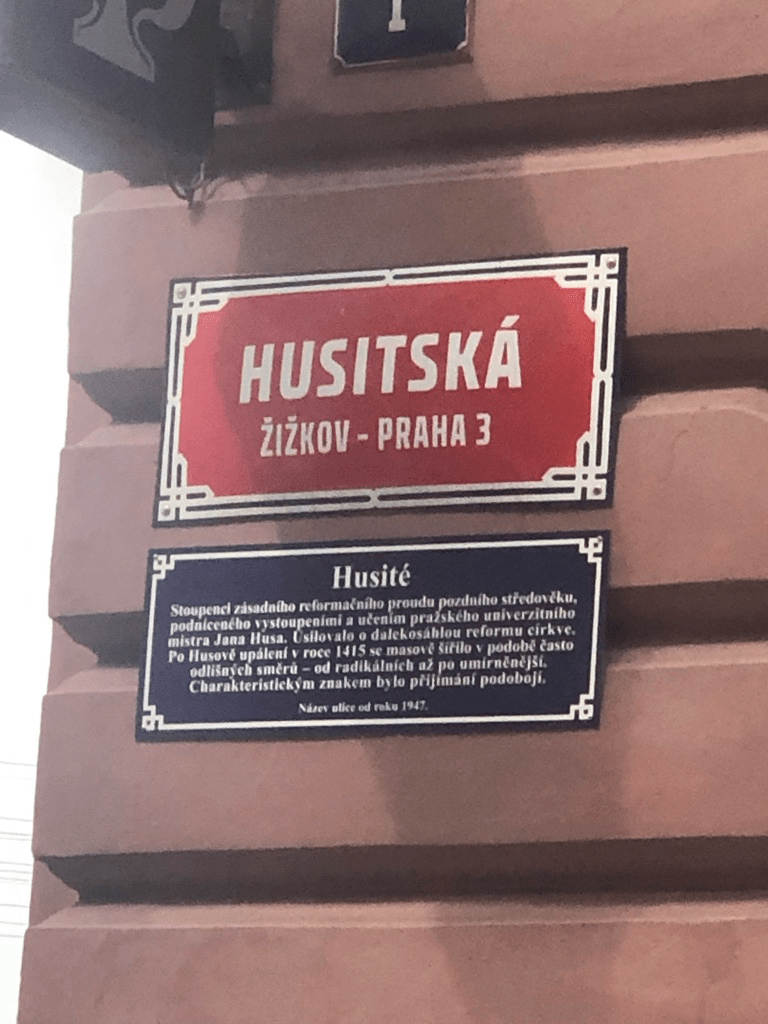
Road leading off Koněvova in ‘not named after a Hussite’ shocker.
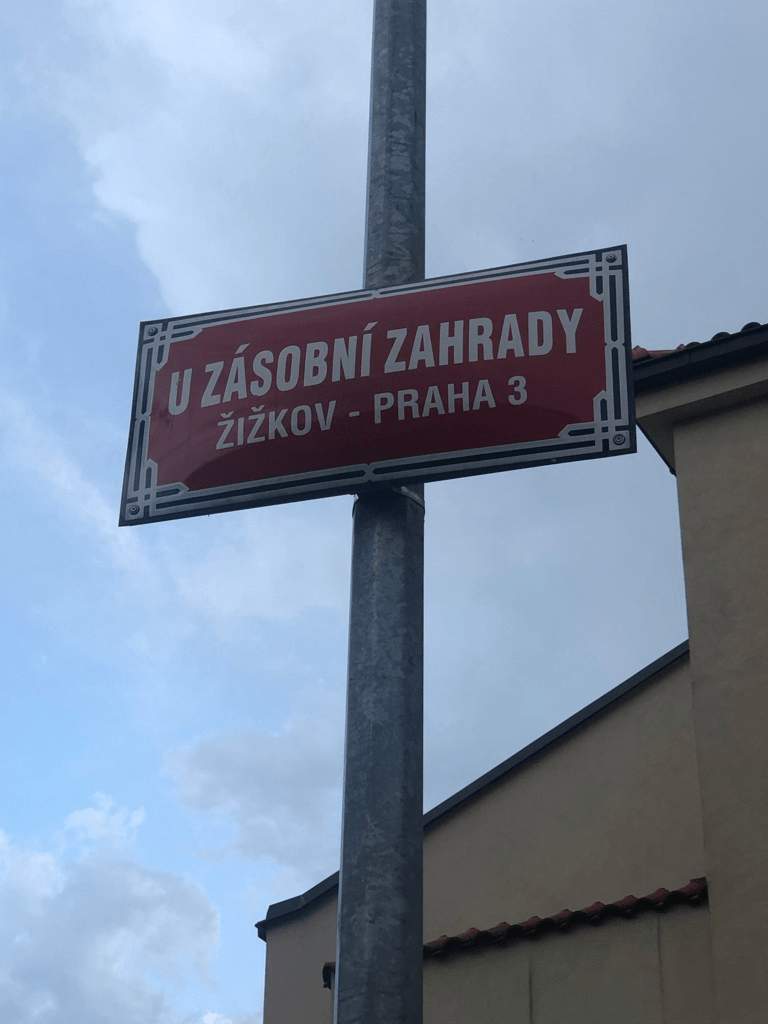
V Zahrádkách translates as as ‘in the gardens’. But a zahrádka is smaller than a zahrada (the standard term for ‘garden’). So it’s a small garden, a back garden, or, if you’re feeling British, perhaps an allotment.
As someone who has to walk up this road to get to the local tram stop, I can promise that it has many nice-looking family houses. The gardens belonging to these houses gave the street its name.
I’m incredibly hungover after a wedding yesterday, and the fact that today’s posts are so short is a happy coincidence.
As one of the leaders of the Bohemian Revolt, Jesenius was arrested after the Battle of Bílá Hora. He suffered a particularly gruesome execution on 21 June 1621 on Old Town Square.
First, his tongue was cut out, and then he was beheaded. After the execution, his body was quartered and then woven into a wheel. His head was displayed on Old Town Square as a warning for ten years.
EuroCity train EC 280/281 (which goes from Prague to Budapest via Bratislava) is named after him, reflecting his Slovak and Hungarian roots.
Matěj Louda z Chlumčan (died 1460) was commander of Písek, a Hussite warrior and diplomat, and owner of a farm in Chlumčany near Louny.
He studied at Charles University. He didn’t complete his studies, but he did became aware of Jan Hus’s teachings while there.
For his bravery in the Battle of Vítkov Hill (1420), he was given a house on Řetězová (in the Old Town), but instead moved to Písek.
After being captured at the Battle of Lipany (1434), he moved to the more moderate side of the Hussite spectrum and became a diplomatic negotiator in Basel.
This won him the approval of Sigismund, who named him Hofrichter of the royal cities. He then became a burgher in the Old Town, founding a dormitory (kolej sv. apoštolů) for poor students.
It’s named after John Wycliffe (1320-1384-ish), an English theologian, and one of the first to translate the Bible into Middle English, though historians say he may not have done much of the translation himself.
Wycliffe also wrote that papal claims of temporal power had no foundation in the Bible, and that the Bible, not the Pope, set the standard for Christian belief and practice.
He believed that anyone who wanted to read the Bible should be able to, hence the translation. He was also of the opinion that the Church should be poor and not flaunt its wealth so much.
In 1407, England’s parliament banned English-language Bibles, and Wycliffe’s followers were imprisoned. Pope Alexander V issued an edict against Bible’s that weren’t in Latin, and Wycliffe’s works were burned.
This served to inspire a rector at Charles University, who was dissatisfied with the privileges of the clergy, and who wanted the Bible to be translated into Czech. This rector was one Jan Hus.
In the same year that Jan Hus was executed (1415), Wycliffe was declared a heretic and all his writings were banned.
Secret shame: it wasn’t until writing this that I realised ‘Wycliffe’ isn’t pronounced ‘why-cliff’.
Zbyněk Buchovec z Buchova (died 1436?) was a Hussite warrior and commander (hejtman).
Coming from a peasant family, he was elected one of the four governors of the newly founded town of Tábor in 1420 (one of the other three being Jan Žižka).
In December, he led a camp expedition against Příběnice Castle, which the Hussites managed to conquer. Buchovec subsequently manned it with his garrison.
In February 1422, he represented Jan Želivský in arbitration procedures to settle the political and religious situation in Prague. Their side acknowledged the Lithuanian duke Sigismund Korybut (Zikmund Korybutovič) as governor of Prague and Bohemia.
(Sigismund, however, was recalled by the Pope and left again in 1423).
The last mention of Buchovec as a governor of Tábor dates from 1425.
Until 1952, the street was called Kostkova, named after the Kosteks of Postupice, a Czech ruling family founded in the 14th century. The name change presumably arose because they were filthy rich and, you know, communism.
The name has nothing to do with Greece, which is Řecko in Czech (sometimes when I’m whizzing past here on the tram, I mistakenly think it’s called Řeckova, and yes, that name would make no grammatical sense).
Jan Reček z Ledče was a maltster and a well-to-do citizen of Prague’s Old Town in the 15th century. In 1438, he founded Collegium sanctissimae virginis Mariae domus nationis Bohemicae, one of the most respected colleges within Charles University.
Later, it became more common to simply refer to it as Collegium Reček. It hosted twelve carefully selected (Hussite) students from the Kingdom of Bohemia; they studied Liberal Arts and Theology. It was located on Karolíny Světlé.
Addendum: I can categorically state that the trams round here do anything but ‘whizz’. But my Lítačka is still an absolute steal (for now), so I’ll take it.
Jan Želivský (1380-1422) was a priest during the Hussite Reformation, with a taste for somewhat apocalyptic sermons.
On 30 July 1419, he led a Hussite procession through Prague. Someone in the New Town Hall on Karlovo náměstí (Charles Square) threw a stone at the procession, possibly hitting Želivský himself.
The Hussites stormed the town hall and defenestrated seven members of the city council, including the judge and the chief magistrate.
Rumour has it that all this then made King Wenceslaus IV die of shock eighteen days later.
What is less debatable is that the defenestration kicked off the Hussite Wars, which lasted until 1436 and in which Želivský fought.
After a defeat at the hands of Frederick I of Saxony at the Battle of Brüx in 1421, Želivský was removed from command.
In 1422, he was arrested by the Prague town council and was beheaded.
Zelenky Hajského was built, with a different name (see later), in 1908.
Jan Zelenka (1895-1942), born in Kamenný Újezd, but spending most of his life in Prague, was a primary school teacher, and, later, member of the Czech resistance in WW2.
From 1925, he worked in a newly-built school in Háj u Duchcova, where he was also actively involved in the local Sokol organisation.
When Háj, along with the rest of the Sudetenland, was annexed by Germany in 1938 as a result of the Munich Agreement, he returned to Prague.
From January 1939, he lived with his family in a flat on Biskupcova, where they were neighbours with the Moravec family (Marie, Alois, Miroslav and Vlastimil).
In 1941, Zelenka helped form Jindra, a Sokol-based resistance organisation, and then formed the Říjen (October) strike group. Around this time, he started using the pseudonym Hajský.
From spring 1942, Říjen worked closely with paratroopers Gabčík and Kubiš from Operation Anthropoid. Zelenka gave them shelter and contact with a former pupil who had detailed records of Reinhard Heydrich’s daily movements.
After Heydrich’s assassination, Zelenka was betrayed and, when the Gestapo tried to arrest him (17 June 1942), he committed suicide by swallowing cyanide.
His son Jan did the same; his wife Františka did not. She was arrested and executed at Mauthausen on 24 October.
The Moravec family also helped the paratroopers, and met a similar/identical fate to the Zelenkas: Marie also committed suicide by poison to avoid arrest on 17 June, whereas her husband Alois and son Vlastimil were executed at Mauthausen on the same day as Františka.
One of the organisational units of the Czech Sokol Community now bears Zelenka’s name.
Before 1948, this street was called Svatoplukova, presumably after Svatopluk of Bohemia, ruler from 1107 to 1109. Or possibly Svatopluk of Moravia, Prince of Great Moravia from approximately 870 to 894.
Diviš Černín z Chudenic (1565-1621) was a member of the Czernin family, one of the most prominent in the Kingdom of Bohemia.
Diviš presumably converted to Catholicism to further his career, and became a commander (hejtman) at Prague Castle, maintaining the role even after the second Prague defenestration in 1618.
He wasn’t considered a rebel until late 1620, but, in February 1621, he was arrested and imprisoned in the White Tower at Prague Castle. His ‘crime’ was obeying an order to let rebels into Prague Castle on the day of the defenestration.
On the day of the execution, he received a partial pardon. Horrifyingly, the meaning of ‘partial pardon’ in this case is ‘you only get beheaded instead of quartered or hanged as well as beheaded’.
It also gave the Habsburgs a bit of ‘Look, we’re not just killing Protestants!’ leeway. Or, rather, it was meant to.
People can be really be quite awful, can’t they.
From 1940 to 1945, the street was Žalanského, after Havel Žalanský-Phaëthon (1567-also 1621), a Czech Protestant clergyman and writer who died immediately before the mandate to expel non-Catholic clergy.
Ostromeč is a former castle, located north of the village of Hrazany in the Příbram district.
Its foundations were laid in 1424 under the Hussite leadership of Jan Hvězda of Vícemilice.
It was raided and demolished just four years later, but was then restored. Only to be raided and demolished *again* in 1435, with its treasures being sent to Konopiště.
In 1450, Zdeněk Konopišťský of Šternberk rebuilt the castle as a military support point, from which he made successful raids in the region.
The Bohemian Diet, not appreciating these threats to its power, decided to destroy the castle in 1471 – but it survived this siege.
However, the castle ceased to be used around the year 1500, and records from 1542 describe it as ‘desolate’.
Relics of the buildings and the fortifications remain; they have been protected as a cultural monument since 1965.
Bonus previous name material: this was Šlikova until 1940, and again from 1945 to 1947 (the Šliks were a noble family, particularly prominent in the 15th and 16th centuries).
Under the Nazi occupation, the road was called Melanchtonova. Philip Melanchthon (1497-1560) was a German Lutheran reformer with (from what I can see) no obvious links to the Czech Lands.
Jan Rokycana, or John of Rokycany (c. 1390 to 1471), was a priest, archbishop and chief organiser in the Hussite church.
He entered the Augustinian monastery in his hometown in his youth, then moved to Prague to study at Charles University and graduated in 1415.
A moderate Hussite, he became vicar of Týn church in 1427, and became head of the Orphans, a left-wing Hussite group, in 1432.
In 1436, he became archbishop of Prague, but was driven from Prague by Emperor Sigismund the following year.
He returned in 1448, supported by George of Poděbrady (Jiří z Poděbrad), whose advisor he became.
The sources I used for today’s posts (Czech / English Wikipedia and Britannica) give disconcertingly different biographies. So much so that I emphatically did not enjoy writing this.
Please don’t quote today’s posts as a source, like, ever.
The English Wikipedia page even has a warning message stating that the Czech Wiki contradicts other available information.
I hope tomorrow’s street will be easier than this.
Part of modern-day Rokycanova existed as a separate street, Všehrdova, from 1880 until 1947, before two became one.
We’ve reached the western end of Koněvova, so now we’re crossing the road and it’s time for Chlumova, built in 1872.
Jan Kepka z Chlumu / John of Chlum (date of birth unknown) came from the Česká Lípa region (the modern village of Chlum has 259 inhabitants).
In youth, he joined the army of King Sigismund, largely due to lack of funds. In 1414, Sigismund called Jan to Bologna and sent him to accompany Jan Hus at the Council of Constance, where the latter would ultimately be commended as a heretic.
The two became friends. Right up until Hus’s execution in 1415, Kepka protested against the Council’s verdict, publicly blaming the Pope and twice nailing a written protest to the door of the Church of Constance.
Kepka was reportedly the last person to shake Hus’s hand before he was killed.
In the last decade of his life, Kepka became burgrave of Mělník and acquired a castle, subsequently destroyed in battle. He died in 1425.
Part of the street was initially called Želivského; this became part of Chlumova in 1951.
Part of the Hussite Wars (specifically the Fourth Crusade), it was fought between the Hussites and armies led by Cardinal Henry Beaufort of England and the Archbishop of Trier.
Putting it briefly: the Hussite movement aimed to reform the Catholic Church and was based on the ideas of the theologian Jan Hus. This guaranteed them a range of internal and external enemies.
The crusaders placed their camp north of Tachov; however, fear and demoralisation caused many of them to flee. When the Hussites invaded on 4 August, it was a pretty easy victory. Casualties were in the hundreds, mainly on the Crusaders’ side.
The Hussites gained an aura of invincibility, and there were no further Crusades until 1431 (again, see Domažlice).
Full disclosure: this is *really* not my area of expertise (I said in May 2022… it became something more of an area of expertise as this series went on). But, with more Hussite-related street names to come, I’m quite looking forward to putting pieces of this story together in my head.
It’s named after Lukáš Pražský / Luke of Prague. Lukáš (d. 1528) was a bishop of the Unitas Fratrum (Jednota bratrská), otherwise known as the Moravian Church.
He joined the UF shortly after graduating from Charles University in 1481, and was frequently sent abroad to negotiate on the Church’s behalf.
The Church went into a schism in 1495, divided between its early members, who held seclusionary views, and those like Lukáš, who favoured a more secular education for members. The latter side prevailed.
Lukáš was elected to the inner council of the Church in 1494; he was at its head when the Protestant Reformation began and had direct contact with Martin Luther.
Bonus previous name material: until 1940, this was Thurnova, after Count Jindřich Matyáš Thurn-Valsassina (1567-1640), a leader of the Protestant Bohemian Revolt against Ferdinand II, and author of the cheerily-titled Defensionsschrift (“Writing about Defenestration”).
From 1940 to 1945, it was Liberdova, named after Jan Liberda (1700-42), an evangelical preacher and writer who took exile in Berlin, where he, with other exiles, founded the Bethlehem Church (or the Bohemian Church) in Friedrichsstadt.
This will explain why the street was given his name during the Nazi occupation.
The Church was destroyed in an Allied air raid in 1943.
Liberda became Thurnova again in 1945, before getting its current name in 1947.
Václav Hájek z Libočan – or, if you prefer, Wenceslaus Hájek of Libočany (died 1553) was a chronicler and author of the Czech Chronicle (Kronika česká, 1541).
Originally a Protestant, he converted to Catholicism in 1521; from 1524, he worked as a preacher at St Thomas’s Church in Malá Strana. It seems he got into quite a lot of disputes and therefore was forced to change positions frequently.
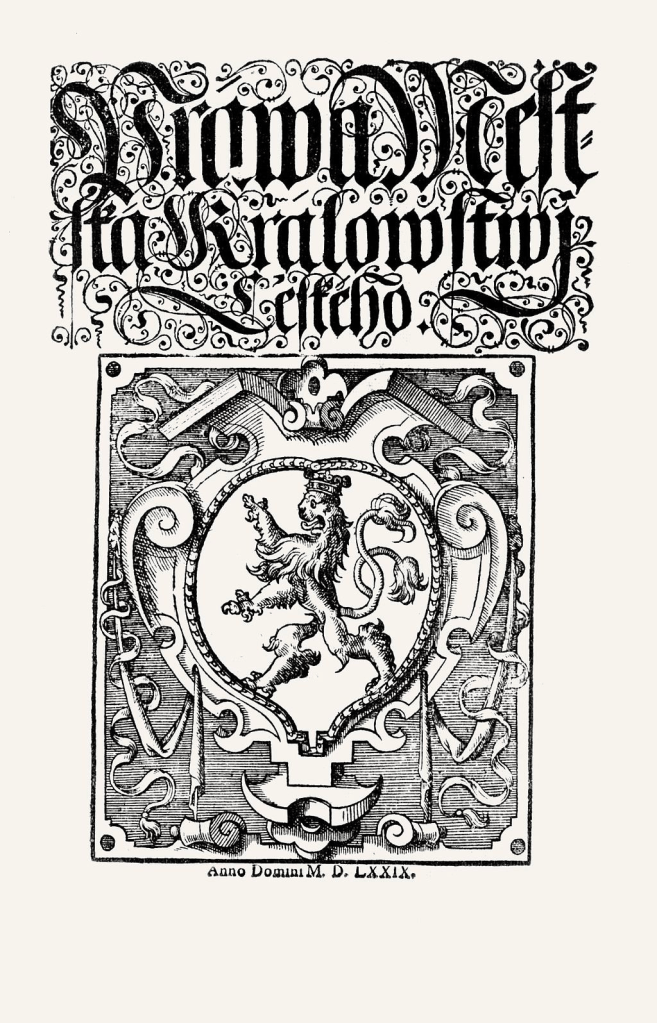
The Czech Chronicle (Kronyka Czeska, to use the spelling applicable back then) covers the history of the Czech lands from the arrival of the Czechs in the 600s to the coronation of Ferdinand I in 1527. It was written between 1533 and 1539.
Despite its huge popularity (including translations into German), its accuracy was questioned from the start. In the 19th century, historian, politician and ‘Father of the Nation’ František Palacký pronounced a particularly damning judgement on it.
Proof: ‘History as a whole, and Czech history, know no greater pest than this man, who […] set out, with unprecedented shamelessness […] to invent and tell extraordinary stories, but also to attribute them to original written sources which were fictional’.
Not a five-star review on Amazon, then.
However, the Chronicle remains a useful snapshot both of a contemporary, non-Germanised form of Czech, and of the mood of the time in which it was written.
Domažlická was built in 1904, which counts as old compared to what we’ve covered so far.
Domažlice, population 11,000, is a town in the Plzeň region, converted into a fortified royal town in 1265 by Otakar II of Bohemia. Its German name is Taus.
At the Battle of Domažlice in 1431, Prokop the Great (a Hussite General) defeated the crusaders of the Holy Roman Empire.
The city declined in importance in the 1600s, but bounced back in the 1770s thanks to its textile industry.
Domažlice was a pivotal location during the Czech National Revival.
Of its most famous sons and daughters, you’re most likely to know author Božena Němcová and philosopher Ladislav Klíma.
It was also the scene of a large protest demonstration against the German occupation in August 1939 (the St. Lawrence pilgrimage).
In 2005, a mass grave was found on the town’s outskirts, mainly containing members of the Sturmabteilung.
I have a vague memory of Domažlice being the most COVID-ed town in the Czech Republic at the very beginning of the pandemic, but I may be wrong.
*checks old copies of Respekt*: ah, correct.
Domažlice looks nice. But that’s all the spring 2020 talk I’m willing to engage in.
Pražačka was built in 1947. It’s named after *another* farmstead (and vineyard) that no longer exists.
The origin of the name ‘Pražačka’ isn’t clear, but original maps list the name as ‘Brasatscha’ – so, surprisingly, the name probably doesn’t have anything to do with ‘Praha’.
The vineyard was first documented in the 16th century. By 1785, there was a building, which was later extended to form a large farmyard – large enough to be visible from Karlín.
From 1800 onwards, the homestead was owned by the Stome family (Jan Stome was a wealthy baker who owned a mill on the Vltava).
As Žižkov’s population increased thirtyfold in the forty years to 1900, farming became a less viable option and activity on the farm was gradually reduced.
The Stome family owned Pražačka until 1947, when it was demolished and replaced by the streets that you see now.
Appropriately for current anniversaries (at the date of posting on Twitter, it was exactly 77 years since the Prague Uprising), here’s a picture of the settlement in May 1945, taken from https://nakrejcarku.info/historie-prazacky/….
Pod Krejcárkem was built in 1962, and translates as ‘Under Krejcárek’.
Krejcárek was an emergency colony (i.e. a residential area, akin to a shanty town, built to deal with a large influx of workers moving to Prague).
It was established as a garden centre in 1922 (when emergency housing wasn’t yet permitted), until landowner Václav Stome began renting family lands of the nearby Pražačka farm to those who couldn’t afford other housing.
Over the years, 150 houses were built in the area. Unlike many other colonies, it had water, electricity and telephone access, which may be why it lasted longer than most – until the 1970s.
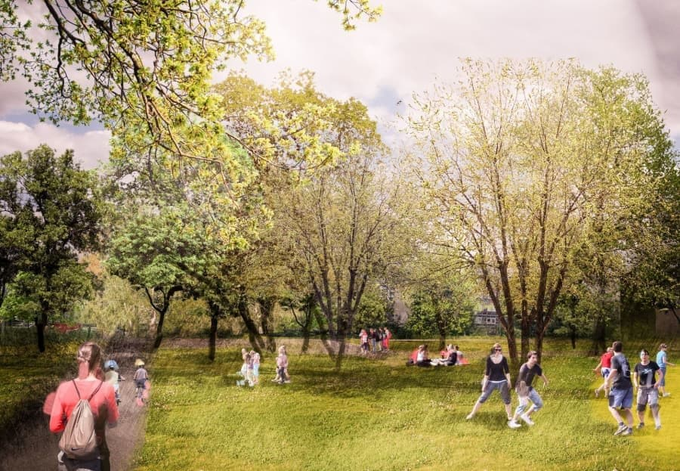
In the 1970s, it was razed to the ground and replaced with a grove, which is the only forested area in Prague 3, and is connected to the park on Vítkov Hill.
The project was part of ‘Akce Z’, unpaid employment of the population during communist Czechoslovakia (basically civic conscription), carrying out tasks which the state or municipal administration hadn’t managed to do.
In terms of trees, its main inhabitants are Scots pines, heart-shaped lindens and red oaks. It’s also a refuge for blackbirds, thrushes, finches, shrews, hedgehogs and weasels, among others.