What's in a Prague street name

Every street in Prague, one by one.

  • Originally published on Twitter on 4 May 2022.

    Built in 1975, Na Ohradě the newest street that I’ve written about to date.

    Like yesterday’s Vápenka, Ohrada is a former homestead, founded somewhere around the year 1400, and containing a large vineyard.

    An ohrada is a fence, a barrier or an enclosure. Presumably there was one around the vineyard.

    The first documented owner was one Pavlík Svachov; he solid it to a shopkeeper called Zikmund, and it was later owned by a Jan Wolf. The first written record referring to it as Ohrada dates from 1455.

    Documents from 1785 stated that Ohrada consisted of three buildings; in 1908, each was owned by a married couple: the Hlaváčeks, the Kasls and the Oppels.

    The land was purchased in the early 20th century, followed by the homestead, which was subsequently demolished.

    Trolleybuses ran at Ohrada between 1951 and 1966; Prague stopped using trolleybuses entirely in 1972, although they made a comeback in 2017 (but not at Ohrada).

  • Originally published on 3 May 2022.

    Na Vápence was built in 1925. Vápenka translates as ‘lime works’ or ‘limekiln’; it was also the name of a farmstead lying where the street is now.

    Presumably there was formerly a limestone quarry in the area, hence the name of the settlement. Apparently it stretched across Židovské pece towards the northern border of Nákladové nádraží Žižkov (Žižkov freight railway station, which we’ll get to).

    The settlement, which is mentioned in 18th century texts, had a courtyard which disappeared after World War II, when the freight railway station was expanded. The courtyard also contained a hotel (‘Hotel Siege’).

  • Originally published on Twitter on 2 May 2022.

    Za Žižkovskou vozovnou was built in 1925. The name is fairly unambiguous this time: ‘behind Žižkov Depot’.

    Vozovna Žižkov / Žižkov Depot is one of Prague’s seven tram depots, and the second-oldest, as it was built in 1912. It’s the only depot to have a circular track in its yard.

    This is often where the trams stop when there are works on the line in the summer. This tends to be when it’s 30+ degrees outside and walking the last couple of stops feels like a challenge because you’ve just been in the beer garden for five hours.

    Again, there’s a grammatical difference between the street name and what it’s named after: the road is behind Žižkovská vozovna even though that is actually known as Vozovna Žižkov.

  • Originally published on Twitter on 1 May 2022.

    Na Hlídce was built in 1925.

    It’s the same story as yesterday’s: when this area of Prague (Balkán) was urbanised after World War I, many of the inhabitants were state employees and the street name reflected their jobs. Na hlídce means ‘on watch’ or ‘on guard’.

    The nominative form is hlídka.

    A stávková hlídka is a picket, and policejní hlídka means ‘police patrol’. Linking this to yesterday’s street again, hlídka and stráž can be regarded as synonyms, although I assume there are fundamental differences.

    The person carrying out the hlídka would (if male) be called a hlidač. A noční hlídač would be a night watchman.

    The feminine form is hlidačka, which is also used to mean ‘babysitter’.

  • Originally posted on Twitter on 30 April 2022.

    Strážní was built in 1925. It’s also the name of a nearby tram stop.

    The area to the north-east of here (and immediately north of all the streets we’ve covered so far) is known as ‘Balkán’. It wasn’t urbanised until after World War I and most of the inhabitants were state employees.

    And many of the streets were named after their professions. For example, a stráž is a guard. Other examples to come, no doubt.

    For vocab fans, a vězeňská stráž is a prison guard, a pobřežní stráž is a coastguard, a tělesná stráž is a bodyguard and a strážmistr is a police constable.

    Though it appears that a ‘bodyguard’ can also be an osobní strážce, and it certainly was in 1992.

  • Originally published on Twitter on 29 April 2022.

    Hraniční was built in 1925.

    ‘Border Street’ is so called because it lies on the border between the districts of Žižkov and Vysočany.

    I’m very much guilty of assuming that Praha 3 = Žižkov and Žižkov alone, but no, it’s got parts of Vinohrady, Vysočany and Strašnice too, though those districts are mainly in Praha 2, 9 and 10 respectively. Vysočany is to the north.

    Fun language fact: Vinohrady, Vysočany and Strašnice are all plural. So, while we would happily say ‘Vinohrady is…’, etc., Czech speakers have to say ‘Vinohrady jsou…’, i.e. ‘Vinohrady *are*’.

    I find the very brief English-language Wikipedia page for Žižkov hilarious. It includes this: “Like many districts of the city, Prague 3 is socioeconomically diverse. The western part of Žižkov is known for its high concentration of brothels, strip clubs and cheap bars. Yet only a short distance away are nice apartments and a new shopping mall with expensive stores.

  • Originally posted on Twitter on 28 April 2022.

    Šikmá was built in 1930. This street heads north-west off of Koněvova, whereas the streets we’ve covered so far point north-east.

    So it’s appropriate that ‘šikmý’ is an adjective that translates as ‘oblique’, ‘slanting’ or ‘inclined’.

    The most famous thing that uses the adjective is not this particular street, but the Šikmá věž v Pise, which you can see below. It is not in Žižkov but does reflect how I’m feeling on day three of Covid.

  • Originally published on Twitter on 27 April 2022, when I’d just tested positive for COVID. This may get mentioned a couple of times.

    ‘Na vrcholu’, built in 1962, means ‘at the top’. You would think this was the top of something quite momentous. But it seems it’s just at the top of Koněvova.

    This isn’t really bringing the goods. However, Google did decide ‘na vrcholu praha 3’ should take me to http://sputnici.cz/Uvod/, the delightful website of Sputnici, a Vinohrady rock ’n’ roll band which was active from 1959 to 1963.

    So that’s a nice little rabbit hole to go down later. Also, the wall which includes the ‘Na vrcholu’ street sign is pretty awesome.

  • Originally posted on Twitter on 26 April 2022.

    K Lučinám was built in 1962.

    Like ‘luka’, a ‘lučina’ is a meadow, but the word is archaic enough to not even appear on Seznam Slovník.

    But it does appear in the Czech national anthem: ‘voda hučí po lučinách’ (water streams across the meadows), otherwise knows as ‘Line Two’.

    While ‘u’ indicates you are in/at a place (as in https://whatsinapraguestreetname.com/2022/11/18/prague-3-day-2-u-knezske-louky/), ‘k’ indicates motion towards it.

    So yesterday’s street is literally where the meadow is. Today’s street heads towards it. And while yesterday’s street is a singular meadow, lučiny (dative: lučinám) are plural.

    We may never know how many meadows there actually were.

    Many Czechs know Lučina mainly as a cream cheese. CZK 22.90 from Tesco if you’re hankering for some. (At least it was in April, and inflation is ridiculous lately)

  • Originally published on Twitter on 25 April 2022.

    ‘U kněžské louky’ was built in 1931. It roughly translates as ‘at the priestly meadow’, and was named after the original name of the land.

    If anyone can explain why it’s ‘louky’ with an ‘ou’, when the nearby tram stop (Kněžská luka) only has a ‘u’, you will make my day, thanks.

    18 November 2022: wow, these things were a lot shorter when I started.

  • Starting off where it all began – this was originally posted on Twitter on 24 April 2022.

    Here begins a series in which I walk along the very long street immediately to the north of my flat and examine the names of the streets leading off it, one by one.

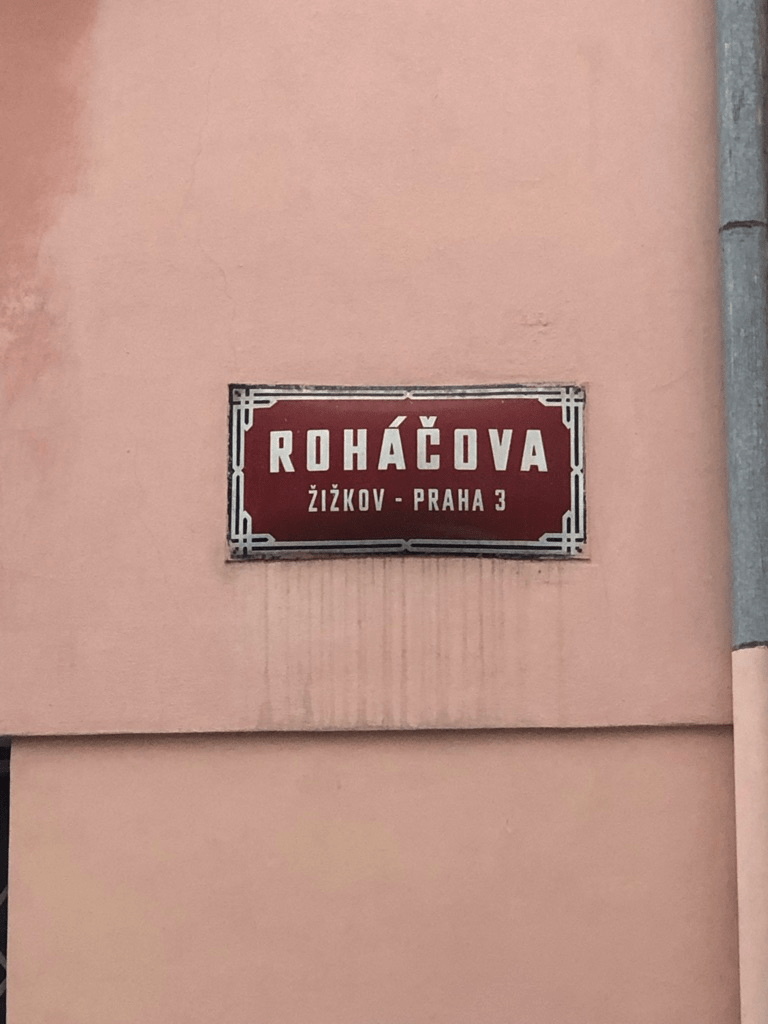
    We’ll start with the very long street itself, especially as its name is somewhat controversial (evidence included in second pic), so, without further ado, I give you Koněvova.

    It was called Vídeňská silnice (Vienna Highway) until 1872-ish, Poděbradova (Poděbrady Street) until 1940, and again between 1945 and 1946. In the intervening years, under the Nazi occupation, it was known as Brünner Straße (Brno Street).

    Ivan Konev (1897-1973) was a Soviet general and Marshal of the Soviet Union. He led Red Army forces on the Eastern Front in WW2.

    He entered Prague with the Red Army on 9 May 1945, the final day of the Prague Uprising (which didn’t stop the Red Army for taking credit for the preceding successes of the Uprising either).

    In 1956, Konev became commander of the Warsaw Pact armed forces, and led the suppression of the Hungarian Revolution and the Prague Spring. And yet this street is still named after him.

    Which is why petitions sometimes happen: https://english.radio.cz/residents-seek-change-name-street-honouring-red-army-commander-8125346…. Though it could be a bureaucratic nightmare (it really is that long a street).

    Continuing with a shorter street and shorter story tomorrow.

  • Hey. You may have come over here from my Twitter account, in which case you can feel free to skip this part (let’s be fair, you’re free to skip if no matter where you’ve come from).

    My name’s Ed, I’m British, I’m 40 at the time of writing if not necessarily at the time you’re reading this, and I’m lucky enough to call Prague home. For several years now and hopefully also for all the years to come.

    In April of this year, I got the idea of researching all the streets in my immediate vicinity (Žižkov in Prague 3), finding out how they got their names, and then writing about them on my Twitter (https://twitter.com/ed__ley), one street a day. What started out as an OCD-fuelled experiment (‘What’s in a Prague 3 street name’) turned into something that was just too interesting to stop, and about 6.3 months later, I’d got through the entire district. And people started taking an interest, especially towards the end.

    Season 2, AKA ‘What’s in a Prague 2 street name’, started just under two weeks ago, and people seem to be enjoying it. It’s connecting to me to interesting people in a way which I never knew was possible. So of course this would be the moment at which Twitter would decide to possibly go to sh*t (side note: there are too many people who get a kick out of the idea of being part of the Apocalypse, aren’t there).

    I don’t know what the heck is going to happen with Twitter, although I do know that I’m not fully sold on Mastodon yet, let alone anything else – so the obvious, constructive thing to do is to take my posts about the streets of Prague, past, present and future, and make them into a website. Because I love writing about these streets too much to stop just yet.

    Watch this space.