A ‘strouha’ is an artificial or natural flow of water. It can be used to drain water, or to power a mill. I’m going to go with ‘gully’ as a reasonable English translation.
I’m also going to assume it comes from the same Old Slavic source as Struga in North Macedonia. Here’s a photo from a rather fraught day in August 2008 when I was trying to go from Ohrid to Albania (for the first time) from there. I succeeded.
‘Bez’ translates as ‘Sambucus’, a genus of about 20-30 flowering plants which are commonly referred to as ‘elder’.
In Czechia, there are three native species: the black elderberry (Sambucus nigra / bez černý), the Sambucus ebulus / bez chebdí) and the red elderberry (Sambucus racemosa / bez červený). And, obviously, this is, or was, an area filled with them.
For those wondering, yes, ‘Sambuca’ can be spiced with elderflower, but isn’t required in its legal definition.
Branické náměstí is pretty small, and currently feels even smaller, because it’s fenced off (pics of Jan Hus behind bars below).
It was recently given a facelift which was completed in August 2025 (about a year later than intended), but the square has several private owners who have to comment on the works by a certain deadline, and only after that can it be opened to the public.
One rather wonders what would happen if one of them chose to object.
A ‘mýto’ is a toll. We’re near the Vltava, and, historically, this is where tolls were collected.
By the mid-19th century, the entire area was called ‘Za malým mýtem’, literally ‘Behind the small toll’.
Those who think it may be unusual to name a place after a toll may do well to think of Vysoké Mýto, a town of 13,000 people in the Pardubice Region. It was founded by Přemysl Otakar II (https://whatsinapraguestreetname.com/2025/01/06/prague-4-day-6-otakarova/) in the mid-1200s and, once upon a time, was a major trading centre. in the mid-1200s and, once upon a time, was a major trading centre.
The town is so-called because only the monarch was allowed to impose tolls there.
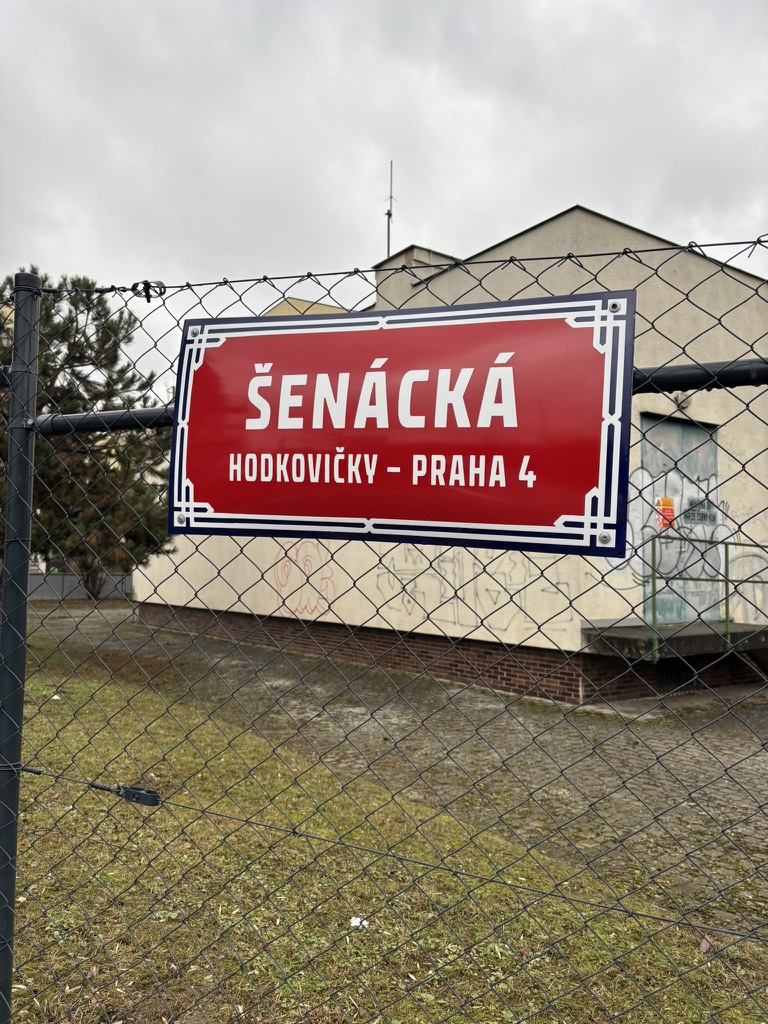
‘Za mlýnem’ translates as ‘Behind the mill’, and so we need to talk about Kunratický potok.
In Praha-Kunratice (south-east of here, and a separate urban district from the Prague 4 urban district, but part of the Prague 4 municipal district – it’s complicated), a stream (potok) originates.
Around here – specifically where the street intersects with Nad strouhem – a water mill once stood; there’s a written record from 1734 referring to both it and a water miller called Josef Vrabec.
From 1910, a bakery also operated here.
Publicly available sources about the mill seem very limited indeed, but the fact that I’ve found a list of owners up until 1938 suggests that the construction of the street led to the destruction of the very thing it was named after. Which is a bit dispiriting.
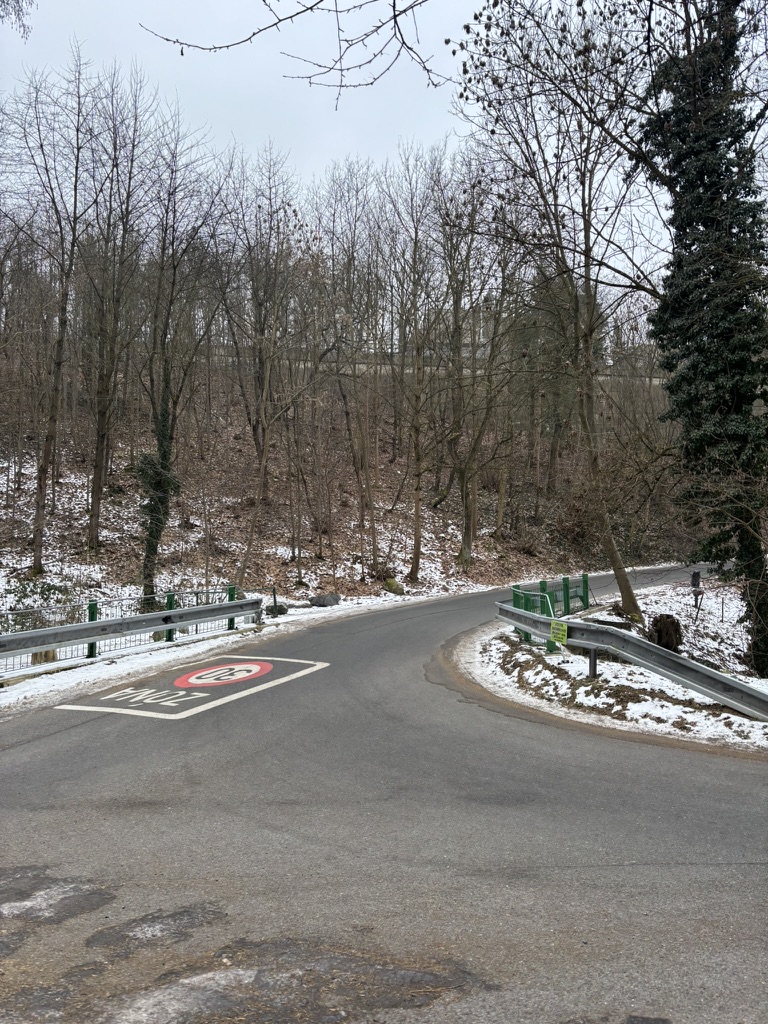
To make up for that, here are some pictures of how the stream looks round here.
A ‘zelinář’ is a market gardener (as well as translating as ‘greengrocer’) – and this street reminds us that, while there’s been a lot of talk in recent posts about vineyards, the area was also once known for its vegetable gardens.
Pobřežní cesta was named in 1938. I couldn’t find a street sign, so here’s the nearby tram stop instead.
‘Pobřežní cesta’ translates as ‘coastal road’ if you’re by the sea. We’re not. So I guess we can make do with ‘river bank road’. And this street – more of a path – does exactly what it says.
(I’ve been resisting the urge to include a ‘Not everything in Prague is about Vinohrady, you know, expats’ in all three of these posts, and can hold it in no longer)
Originally, it was three separate streets. The first one was called Hlavní, because it was the main street in, yes, Braník (which wasn’t yet part of Prague).
The third one was nameless. All three were consolidated as Branická in 1935.
The earliest mention we know of for Braník is from a charter dated 1088 which refers to ‘Branice’. It’s most likely linked to the defensive role the village played (‘branný’ translates as ‘defense’, as in ‘branná povinnost’ – compulsory military service.
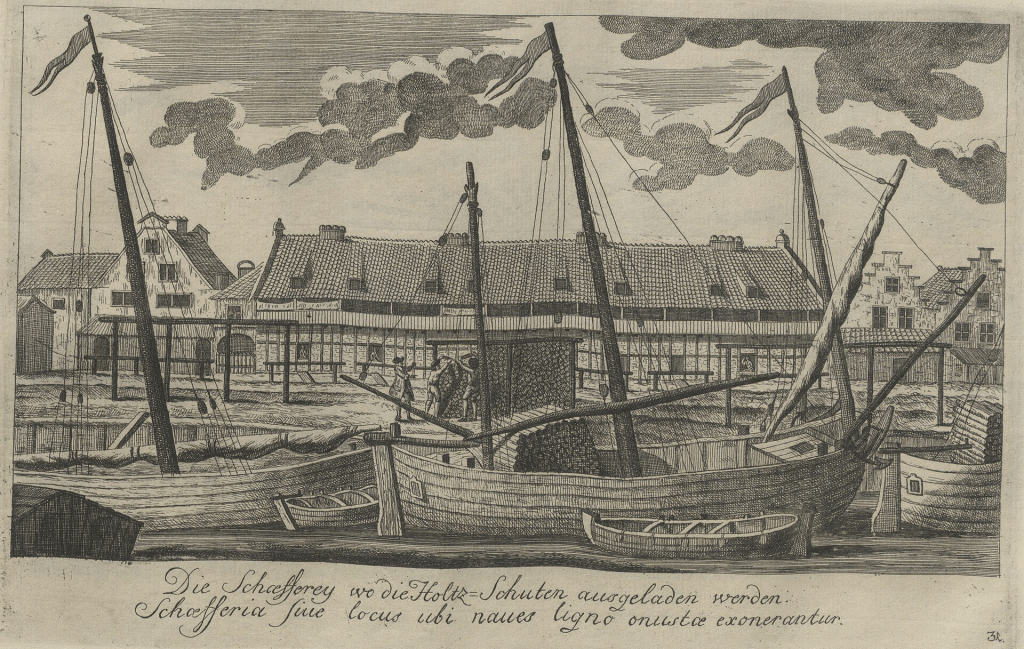
In the 1300s, Braník alternated between belonging to royalty and to various monasteries; duty on driftwood collected here went to the canons of Prague Castle.
After the Hussite Wars, Braník belonged to Prague’s Old Town; it would be confiscated in 1547, although the Old Town would get it back twelve years later.
A street with this name was founded in Braník in 1935, but was destroyed in 1990 during construction works.
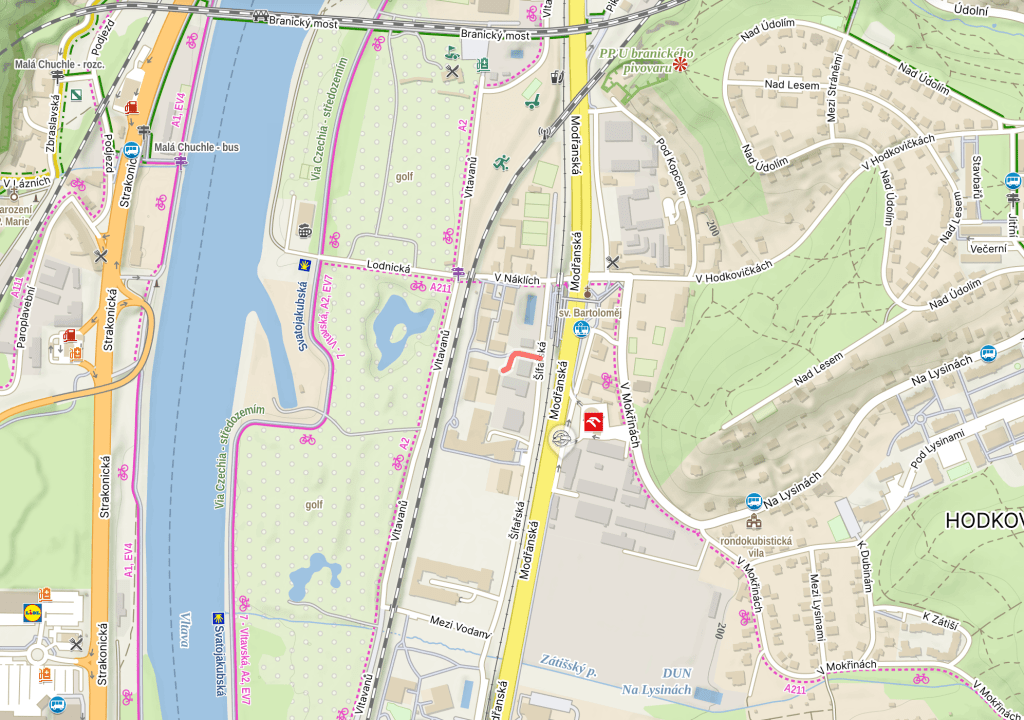
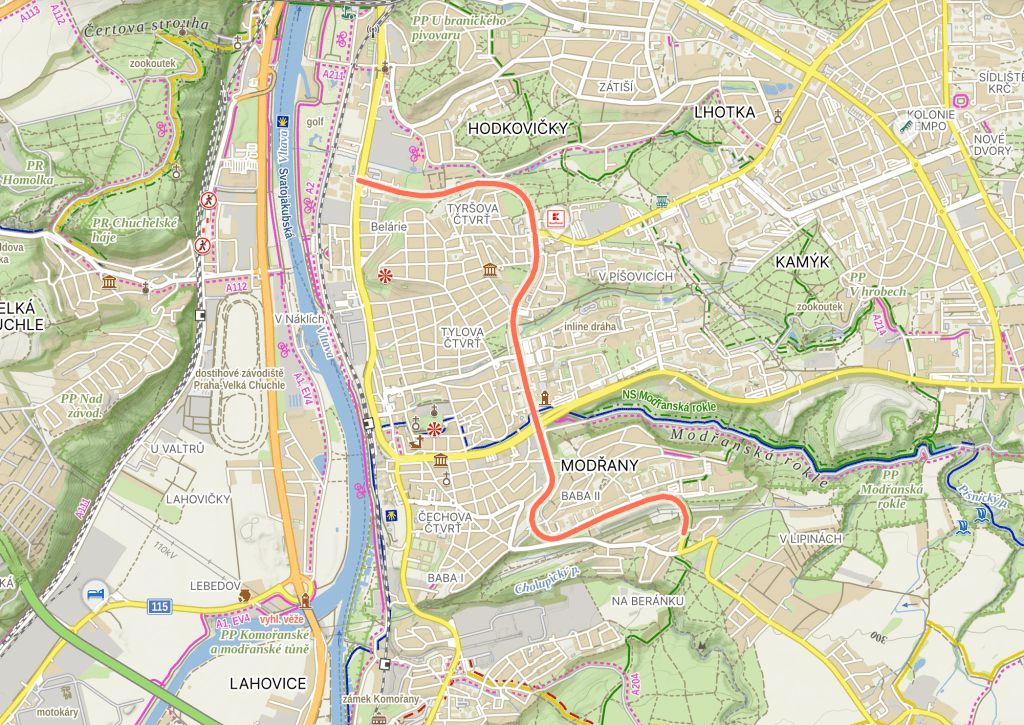
In 1991, this street – about a kilometre away from the original Jiskrova – was given the name instead. Internet searches indicate that it was originally part of Modřanská (https://whatsinapraguestreetname.com/2025/09/29/prague-4-day-185-modranska/), but the map above isn’t helping me to visualise that successfully.
Jan Jiskra z Brandýsa was born into a noble Moravian family around 1400. He gained military experience as a youth, both in Italy and in the Czech Lands.
During the Hussite Wars, he fought as a moderate, defending Plzeň from more radical factions. After them, he started to serve Sigismund, who was not only King of Bohemia, but also of Hungary and Croatia, as well as being Holy Roman Emperor.
He helped Sigismund’s efforts against the Turks, mainly around Belgrade.
Sigismund died in 1437 while en route from Prague to Hungary, leaving behind one adult child, Elizabeth.
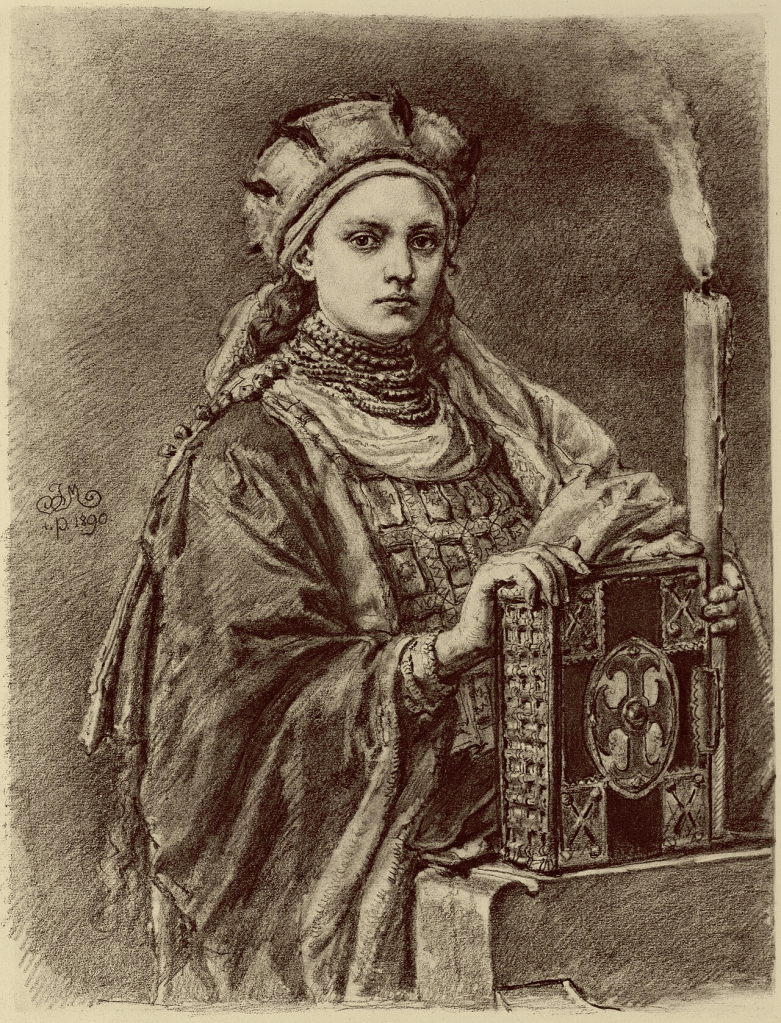
The Catholics and moderate Hussites supported putting Elizabeth’s husband, Albert of Austria, on the throne (both are pictured below); the more extreme Hussites wanted Casimir, brother of Władysław III, King of Poland.
Albert died in 1439 while travelling back from an unsuccessful expedition against the Turks in Hungary. His son Ladislav was born after his death, and consequently became known as Ladislav Pohrobek (Ladislav the Posthumous).
When Ladislav was three months old, Elizabeth had him crowned King of Hungary; the Hungarian nobility wanted Władysław III. Elizabeth fled Hungary for Upper Hungary, i.e. present-day Slovakia. She also asked Jiskra to protect her son’s interest.
Jiskra managed to get an army of 5,000 Hussites together, and promptly occupied large parts of Upper Hungary, thereby cutting Poland and Hungary off from each other.
Władysław III disappeared following the Battle of Varna in 1444; Elizabeth had died in 1442. Jiskra became Chief Captain of Upper Hungary in 1445, but spent much of the next few years in on-off conflicts with János Hunyadi, who served as regent of Hungary under the still very young Ladislav.
Hunyadi resigned the regency in 1453; Ladislav stripped Jiskra of his position and property in Hungary, but called him back into service a year later to help against the former Hussite fighters who were plundering Upper Hungary.
Ladislav died unexpectedly in Prague in 1457, aged just seventeen. Jiskra opposed the new King of Hungary, Matthias Corvinus. He eventually capitulated in 1462, and agreed to pay tribute to Matthias.
In 1467, Jiskra represented Matthias Corvinus in peace negotiations with the Turkish Sultan, Mehmed II. We don’t know when he died, but there’s a text from 1468 referring to him being alive, and one from 1471 saying he was deceased.
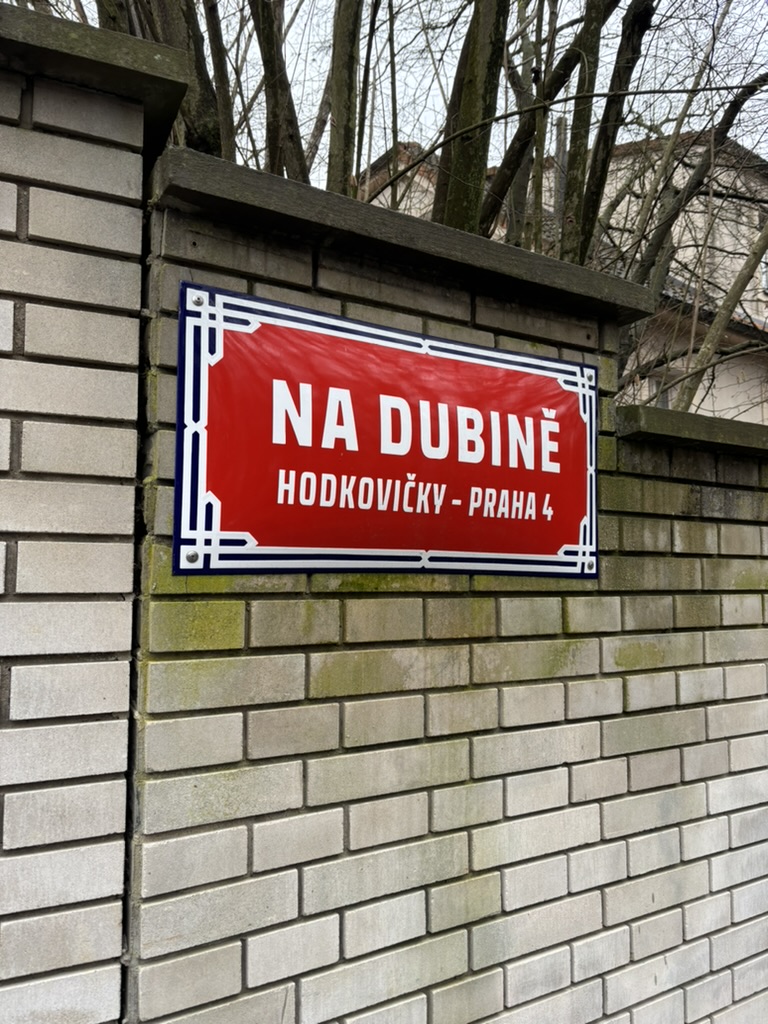
A ‘vinohrad’ is a vineyard, and, as mentioned in several posts to date, this area used to be full of them. The street, we have to assume, is located below what used to be one.
A ‘vlna’ is a wave (it also translates as ‘wool’, but not here).
If you’re into the radio and living here, you may know, or want to know, the phrases ‘krátké vlny’ (short wave), ‘střední vlny’ (medium wave) and ‘dlouhé vlny’ (long wave).
And if you’re into physics, you might want to know ‘tlaková vlna’ (shock wave).
If you want to talk about Prague in 2002 or 2013, you may end up mentioning a ‘povodňová vlna’ (flood wave).
And if you’re one of those Praguers who wants to believe they are living in the dirtiest, worst, most dangerous city on earth, and get very upset if you point out that’s a load of bull (I know these people and so do you), you may rant about the smallest sign of a ‘vlna zločinnosti’ (crime wave).
And if you’ve ever gone to a sporting event, you may have ended up being part of a ‘mexická vlna’, which I’m not going to patronise you by translating.
Meanwhile, something that is wavy or undulated would be ‘vlnitý’, as in a ‘vlnitá čára’ (a wavy line) and as in this street.
One last bit of vocabulary for today: ‘vlnitý plech’ is corrugated iron.
Ryšánka has also given its name to the surrounding area. The number 13 tram ran round here from 1938 to 1970, when it was closed, as the red line of the metro was under construction, and the authorities decided that having several metro stops near(-ish) made the tramline redundant.
Having spent many recent weekends round here to take photos and do research, I can confirm that I would quite like it if those trams still existed.
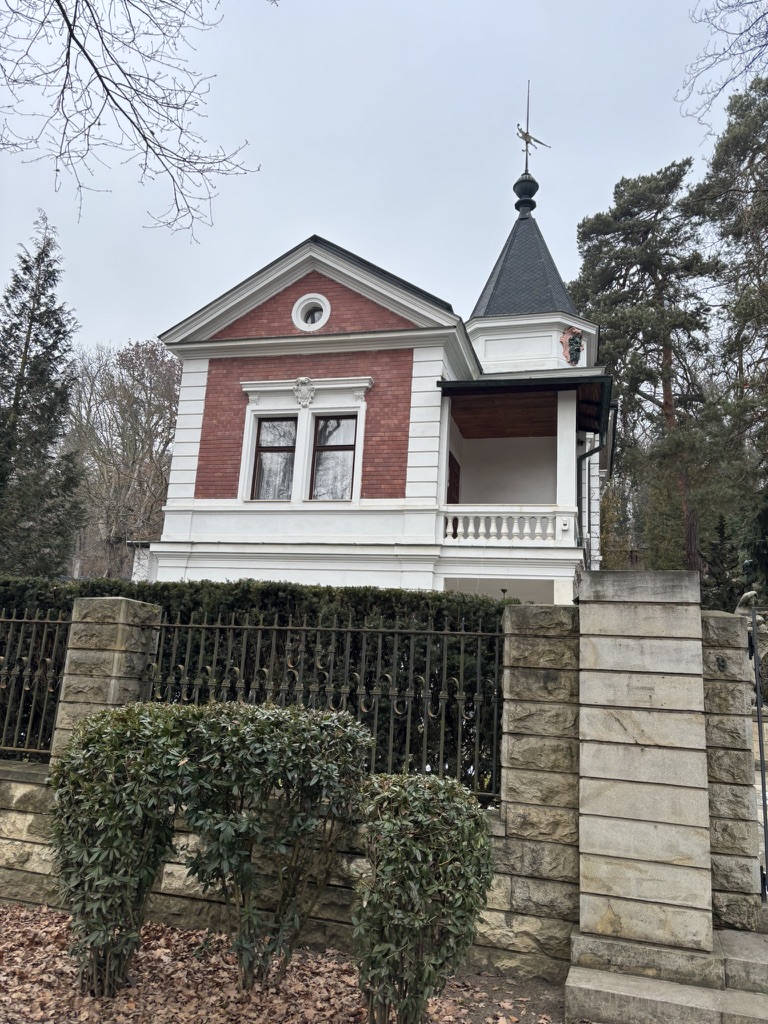
The residential building was converted into a chateau around 1860; the owner at the time was one Mr Ryšánek. The farmstead, which had initially been known as simply ‘Na Vinici’ (In the vineyard), was named after him.
The final owner of the farmstead was Maxmilián Sanleque, who used it as his summer residence until 1945. His ancestors had arrived in Prague from France just before the French Revolution.
Sanleque himself fled in 1945 because he had just applied for German citizenship and feared the Czechs’ reaction to this. Among the documents he left there before he fled was a letter written by King Louis XVI (guillotined in 1793).
Falling into disrepair after this, the complex underwent major renovations from 1977 to 1984. The company responsible for these, PRAGOPROJEKT a.s., still has the address as its headquarters.