Ševce Matouše was built in 1935. I just wrote this entire post, then it disappeared when I was about to post it, so I feel like I was also built in 1935 right now.
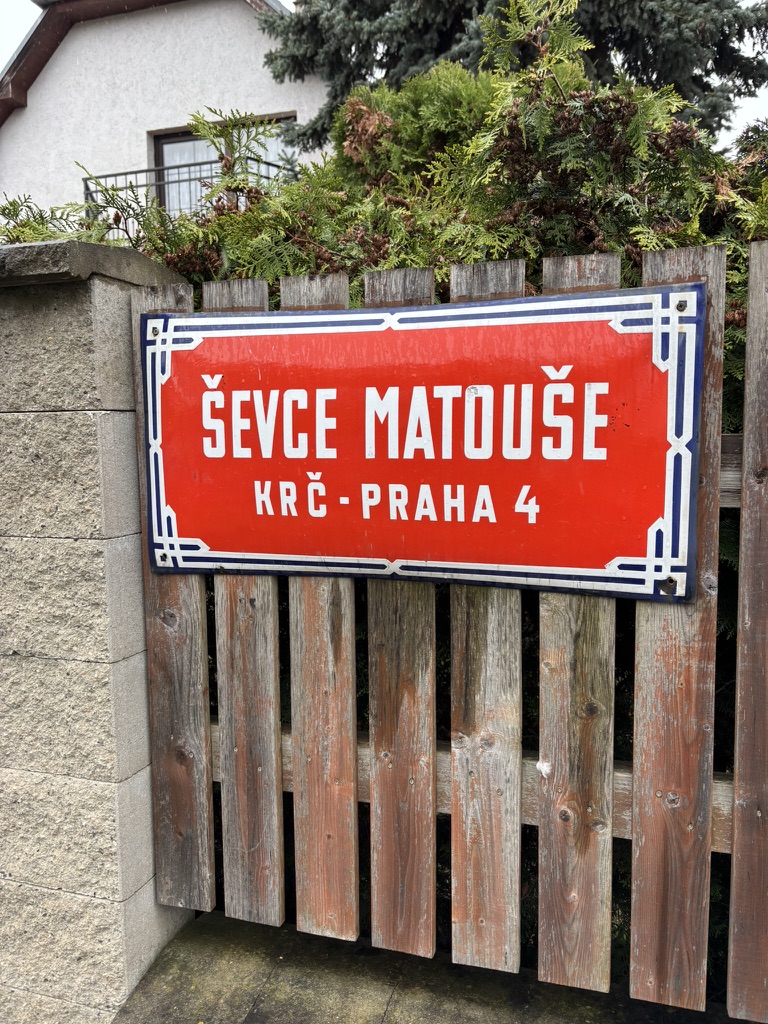
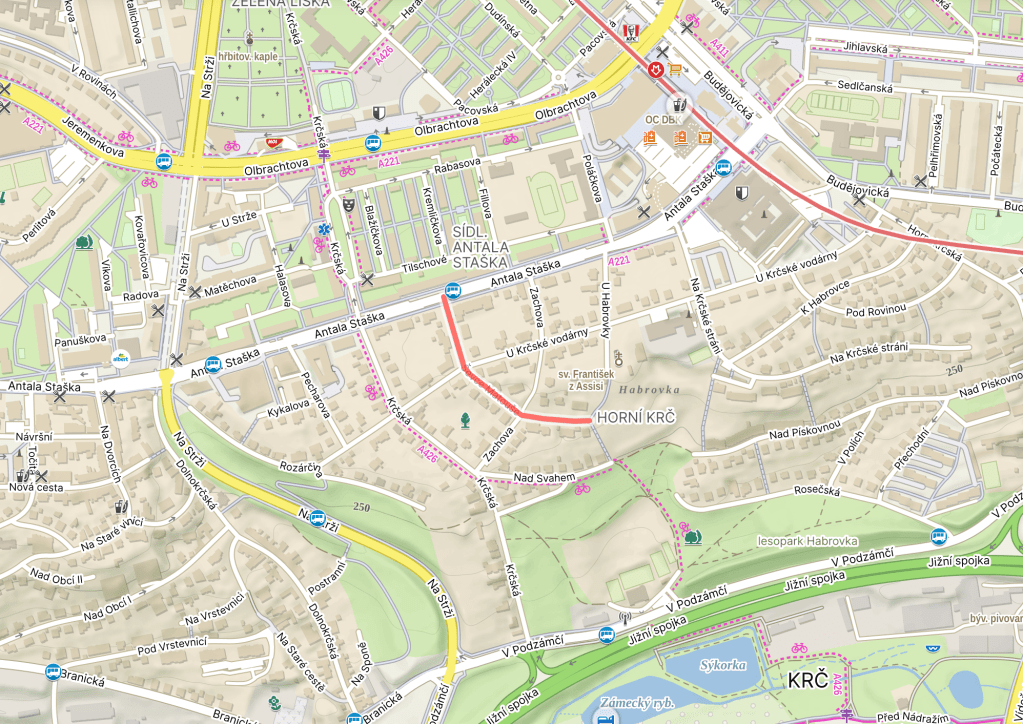
Until 1952, it was called U krčské vodárny IV, which we’ll get around to soon enough, as there’s still a street called that nearby (with out the IV).
Meanwhile, a švec is a shoemaker (if you’ve wondering why the ‘e’ is in a different place in the street name, you try dealing with the Czech declension system and saying ‘švce’ five times in a row).
And ‘Matouš’ is a biblical name, equivalent to English ‘Matthew’, among others.
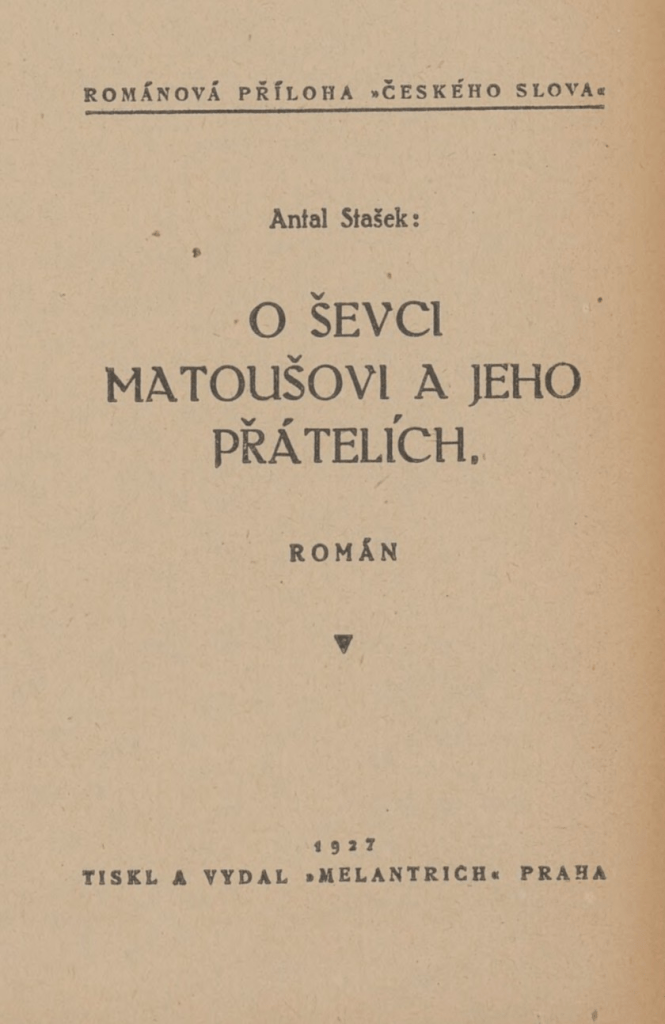
Putting all this together, O ševci Matoušovi a jeho přátelích (About the Shoemaker Matouš and His Friends) is a novel by Antal Stašek, whom we discussed recently (https://whatsinapraguestreetname.com/2026/05/07/prague-4-day-378-antala-staska/).
It was serialised in the daily newspaper České slovo from 1927, and published in book form in 1932. Very intentionally, its events are take place around 1848.
Matouš Štěpánek starts the book as a schoolboy with two traits: a feeling for justice and a bit of a temper. This clearly comes from his father, who ends up serving a prison sentence for taking justice into his own hands after Matouš is caned by his teacher.
Matouš later leaves for Hungary, where he broadens his horizons – and linguistic skills – and decides that his life goal is to help achieve equality between people.
Back in his home village, Matouš falls for a cheerful, energetic local girl, Růza Kyklová. Unfortunately, another local shoemaker, Jíra Macháček (much more uptight and humourless) feels the same way.
Růza declares that she’ll marry whichever of the two men gets a job as a teacher at the local school. In the meantime, Matouš goes to Prague to take part in the barricades during the Prague Uprising.
Fake news, stating that Matouš has been killed in a duel, reaches Růza; she therefore chooses to marry Jíra. However, Matouš is merely injured, and when he returns, he becomes disillusioned with life and rebels against the authorities.
This lands him in prison on several occasions; during one of these, both his parents die, and, one time when he returns home, he finds his home has been burnt down by a loan shark, so he goes off to live in the forest.
While there, he meets up with Růza, whose marriage to Jíra is not what she had hoped for. Matouš and Růza start a relationship and have a child together; however, Matouš ends up in prison again and Růza and child end up in poverty.
Taking pity on his estranged wife, Jíra goes to help her, but, despite a visit at Christmas, Růza dies. Matouš escapes from prison around the same time, and, realising he has no reason to stay, sets off abroad.
O ševci Matoušovi a jeho přátelích stands out for its autobiographical elements (some characters are people whom Stašek knew as a child) in his home village of Stanový), its use of phrases and features of other Slavic languages, and its fairytale-like quality.
It was made into a film in 1948.


Leave a comment