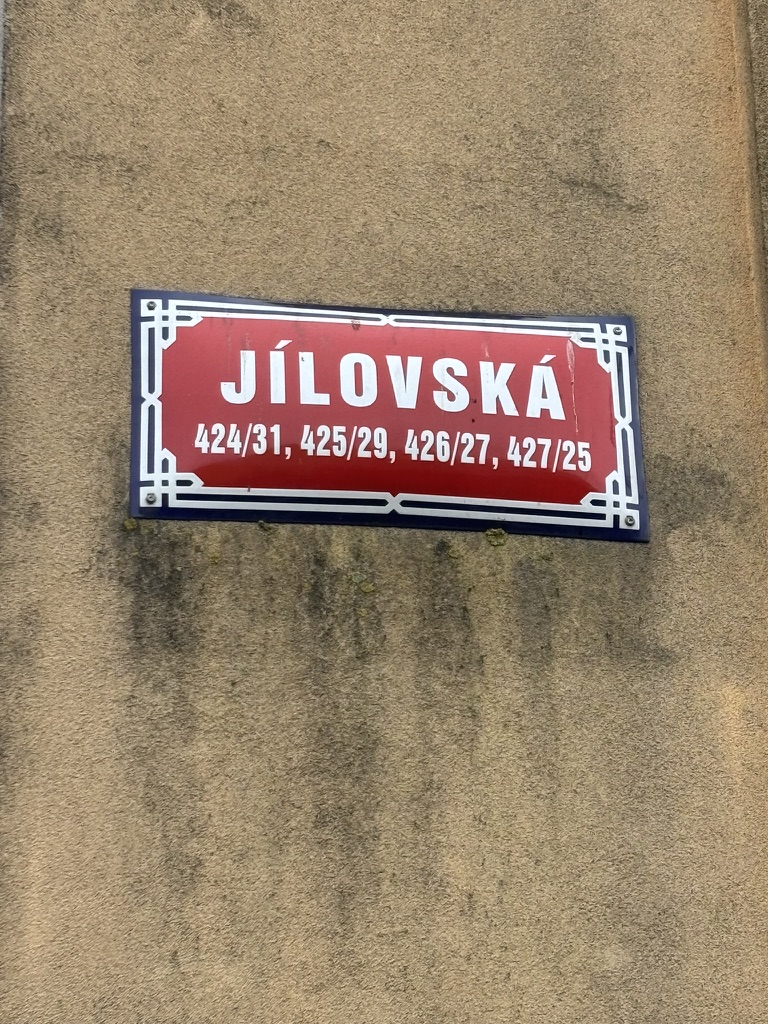
‘Jasná’ translates as ‘clear’ or ‘bright’ or ‘radiant’, which whoever named the street clearly thought was one of its main characteristics.
In 1960, the street, originally known as Jasná, was split into Jasná I and… well, you might have guessed and are more than welcome to skip the post for the second part when I reach it.
It’s pretty, well, clear.
In 1971, two fourteen-year-olds, David Vávra and Milan Šteindler, founded a theatre called Divadlo Sklep (The Cellar Theatre), so called because it was originally located in the basement of Vávra’s grandmother’s house.
Originally performing for friends only, it went public in the late 1970s. Then, in 1980, it moved to the Dobeška Theatre, on this street. It’s still there.
But oaks aren’t just important to the Slavs – the oak is the national tree of Bulgaria, Croatia, Poland and Serbia, yes, but also of Germany, Latvia, Lithuania, Spain, the United Kingdom and United States.
In April, oak trees often shed their leaves and grow new ones. This is why the Czechs call the month ‘duben’.
In terms of round here, ‘U dubu’ translates as ‘by the oak tree’, an erstwhile local name whose origins are self-explanatory.
Oh, and song alert.
Before we finish: in Irish, a grove consisting of oak trees is called a ‘doire’ – which is where Derry gets its name.
From 1904 to 1910, he studied civil engineering at Prague’s German Technical University, while taking part-time architecture classes at the Czech counterpart.
This was followed by further studies – of philosophy and art history at Charles University – from 1911 to 1913, and, after military service on the Russian and Serbian fronts in WW1, architecture at the Academy of Fine Arts (1919 to 1922).
In 1921, Roškot became a founding member of the Association of Building Design (soon renamed as the Association of Architects).
His architecture was based around reimagining urban areas in the form of ideal geometric formations.
Internationally, he got attention for his Czechoslovak pavillions at World Exhibitions in Milan (1926), Chicago (1933; picture one) and New York (1939; picture two; noticeably, the pavilion represented the whole country despite the Nazis having recently dismembered it).
He also built several residential buildings around Prague – I would love to share links to the streets they’re on, but this will have to wait, as they’re mainly in Prague 6, 7 and 10.
However, the building of his you’re most likely to recognise is somewhat out of the centre. It was opened in 1937, and, until 2012, went by the name of Prague Ruzyně International Airport.
While the architect Adolf Benš was responsible for the main building, Roškot prepared the overall layout of some of the other airport buildings, including houses for the airport director, administrator and gatekeeper.
Neither was responsible for these new machines that everyone was having a hullaballoo about last weekend, so please take your rage elsewhere and keep trying to find a time machine that can take us back to 2016 and do that year differently.
Roškot also designed what is now the Ministry of the Interior in Prague 6 (picture from 25 February 2023, during a commemoration of the first anniversary of the full-scale Russian invasion of Ukraine).
When he designed it, it was scheduled to be the Supreme Accounting and Auditing Office.
His most famous work, though, is probably the Roškot Theatre in Ústí nad Orlicí, opened in 1936 (postcard from around that time).
Roškot died in Paris in 1945, and a posthumous exhibition of his work took place in Prague a year later.
His sister, Anna Roškotová (1883-1967), was a renowned painter.
Adolf Born was born in České Velenice in 1930 – which was formerly one town along with Gmünd, which is now not only a separate town but is across the border in Austria.
In his late teens, he started studying art education at the Faculty of Education at Charles University, but changed his plans a couple of times and ultimately graduated from the Academy of Fine Arts in 1955.
He studied there in the Department of Caricature and Newspaper Drawing, and I can’t be the only one reading those words right now and suddenly wanting to go back to university.
After his studies, Born made a living by providing illustrations for books and drawing caricatures for newspapers. In 1966, he and the American illustrator Gene Deitch animated the first ever screen adaptation of The Hobbit.
From 1973, the Czechoslovak authorities banned Born from presenting his works at exhibitions or in the press, and he started to focus on book illustrations and animations.
Most famously, he was responsible for the design of Mach a Šebestová, a 1982 animated series about two students and a magic telephone receiver.
From 1992 – i.e. post-censorship – Born created postage stamps for Czech Post; he also designed costumes and sets for the Czech National Theatre.
If you go to a bookshop looking for a copy of Knihy džunglí – Rudyard Kipling’s The Jungle Book – and you come across this version, you’ll have one of Born’s last works. He illustrated it in 2015, and died in the following year.
When the park opened in September 2020 (for all the use it presumably got in the nine months after that), it was called ‘Přátelská zahrada’, or ‘Friendly park’. It was renamed after Born in 2024.
Mikhail Ivanovich Savelyev was born in 1896 in Poyarkovo, a village in Ryazan Governorate, Russia. From the age of twelve, he worked in a butcher’s shop in Moscow.
In 1915, he was drafted into the army; after the October Revolution of 1917, he was involved in the disarmament of counterrevolutionary officers.
Savelyev stayed in the army and was continually promoted; fast forwarding almost thirty years, his troops had, by May 1945, taken Bucharest, Levice (Slovakia), Brno, Vienna and Budapest.
This is also why this street is named after him: on 9 May 1945, the 5th Guards Tank Corps, of which he was commander, entered Prague.
Hey, Prague 4! Can you get these people a street sign, or, if there is one, place it where it’s not covered by greenery (while please not getting rid of the greenery)?
‘Křovina’ translates as ‘shrub’, ‘bush’ (both individual) or ‘shrubbery’ (general). The area round here, covered in the stuff, was also once known as V křovinách.
Synonyms include ‘keř’ and ‘křoví’, although the latter has some interesting additional meanings that the other words don’t.
On stage, it can designate a ‘foil’, i.e. a character who contrasts with the protagonist (Sancho Panza comes to mind); also on stage, but not at the theatre, it can denote the back-up singers.
It’s nothing to do with a ‘sraz’, i.e. a meeting. A word that I learned a few years back when somebody clearly got a digit wrong in someone else’s mobile number and kept asking me if I had any information about the ‘sraz’. I didn’t, but I hope whoever it was did eventually meet.
‘Zapadlá’ is an adjective with many potential translations, including (but not limited to) ‘fallen’, ‘remote’, ‘out-of-the-way’, ‘sunken’ and ‘deep-set’.
In 1925, when this was becoming a truly residential area, it was decided that this was a good way to describe the street in relation to all the construction taking place.
It fits in with my perception of the area, i.e. I would love to own one of the villas round here, but I think I love knowing I can walk less than ten minutes from home and get a decent coffee served by a friendly person even more.
Čapek said that – as is the case for so many of streets we’ve covered so far – Na Dobešce is named after a former farmstead called Dobeška (Dobeš is an old Czech variant of the name Tobiáš).
I always try to avoid taking photos of people’s homes that could be deemed intrusive – hence these two not showing you a great deal – but number 1, Na Dobešce is interesting.
It was built by Jan Kaplický (1937-2009), who you might know best for his Neofuturistic Selfridge’s Centre in Birmingham, and whose plan for a National Library in Prague was commissioned in 2007, but cancelled in 2008.
Just before Kaplický moved to the UK in 1968, he created this house for two friends of his parents, the painter František Dvořák (1925-2002) and his wife Ludmila.
A ‘háj’ is a a grove; you may also know its diminutive form, ‘hájek’ (but note that, no, Mexican-American actress and producer Salma Hayek doesn’t have secret Czech roots – her father is of Lebanese descent).
This area used to be a grove; while there’s still a good deal of greenery around here, the grove itself is no more.
People familiar with Prague are most likely to hear ‘Háje’ and think of the last stop on the red line of the metro, in Prague 11. This pic is from when I decided to take a picture of every metro station in 2009 – looking back, a clear precursor to this series.
As well as Honcharenko, the crew of tank no. 24 included a loader, Nikolai Kovrigin. According to an article published earlier this year by a local newspaper in Samara, he was 19 and came from a village called Borskoye.
He was believed to have been killed, but, according to a 2013 article from the same paper, was found to be alive and back in his home village in 1965.
I don’t expect to get any further details, nor do I unquestioningly believe these articles, but I do know that, when your searches reveal just how many men called Nikolai Kovrigin have died in battle, let alone all the other names, it reconfirms just how f**king pointless all this fighting is.
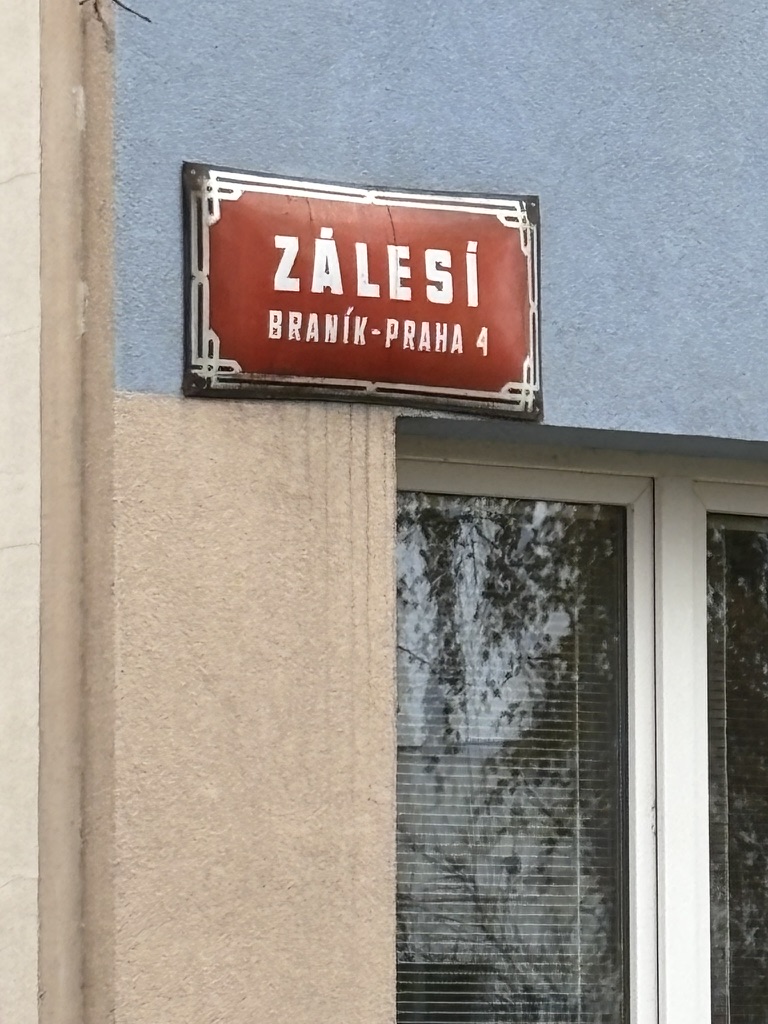
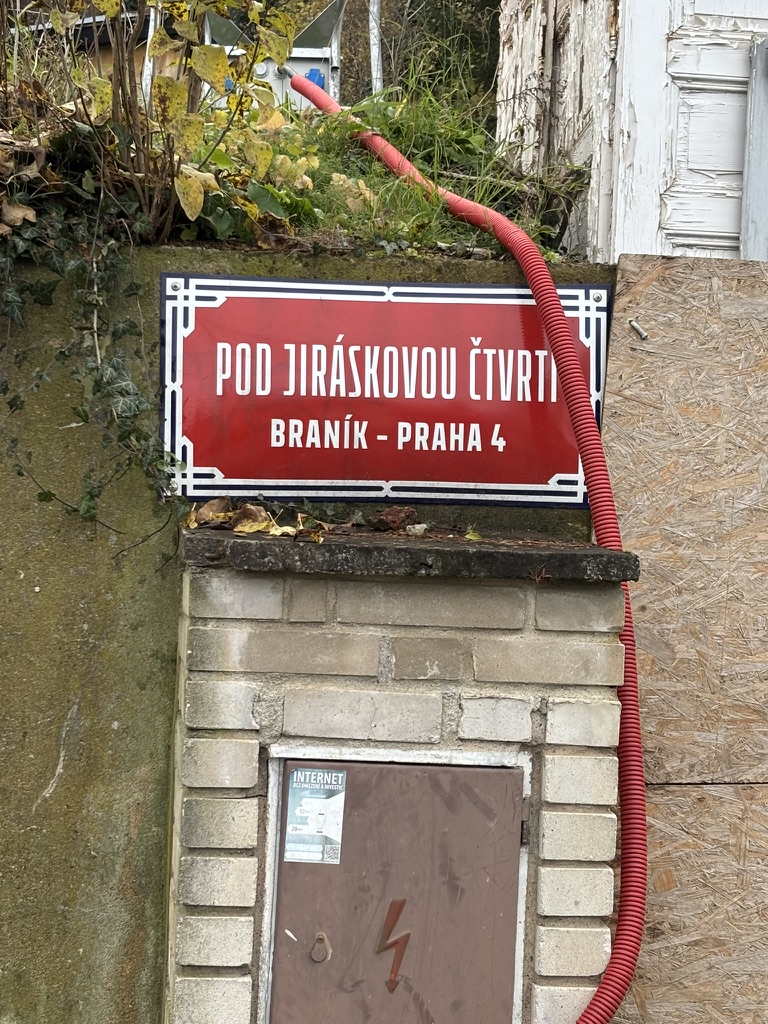
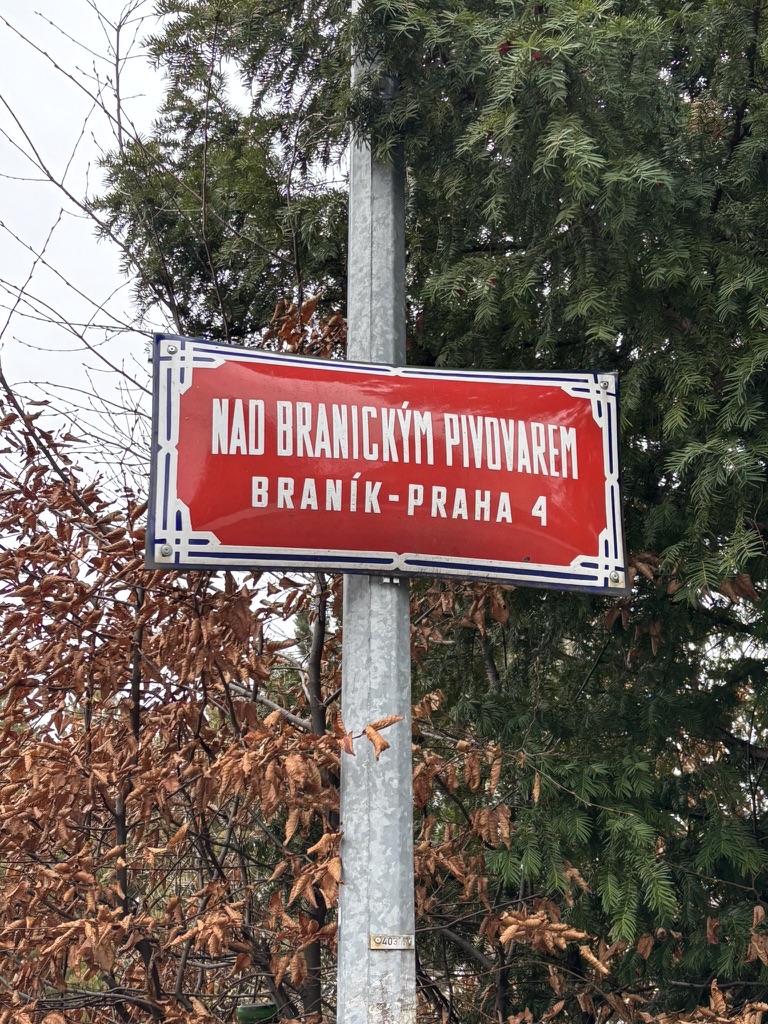
Braník is known for the Branické skály, or the Braník Rocks, designated as natural monument in 1968.
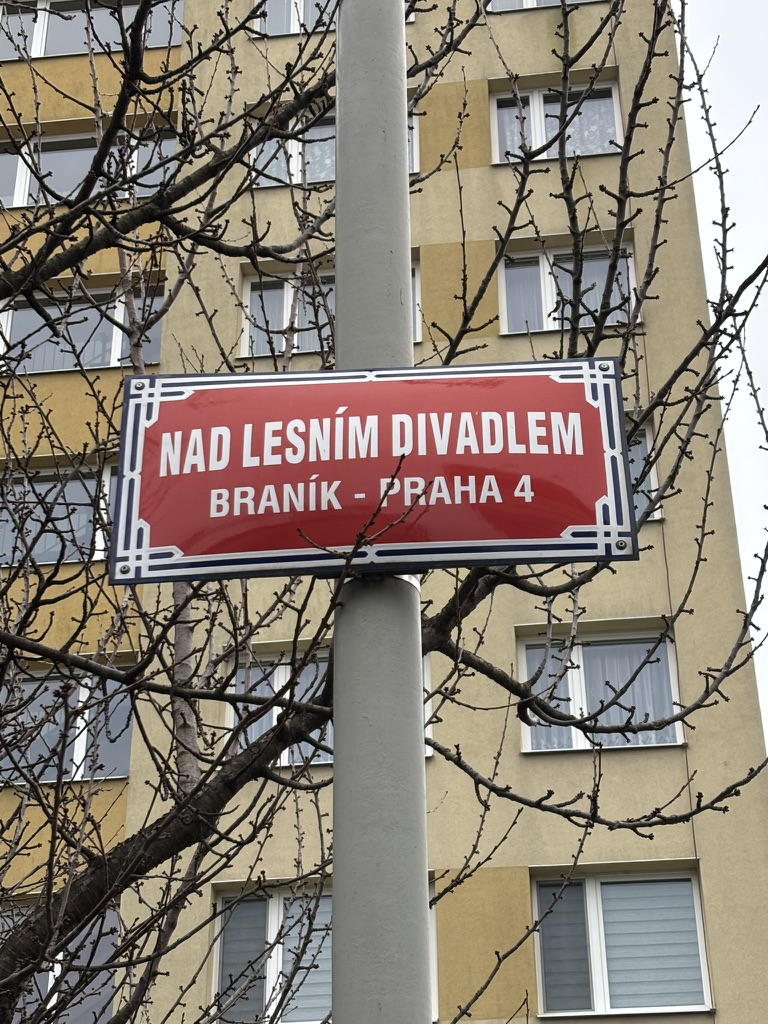
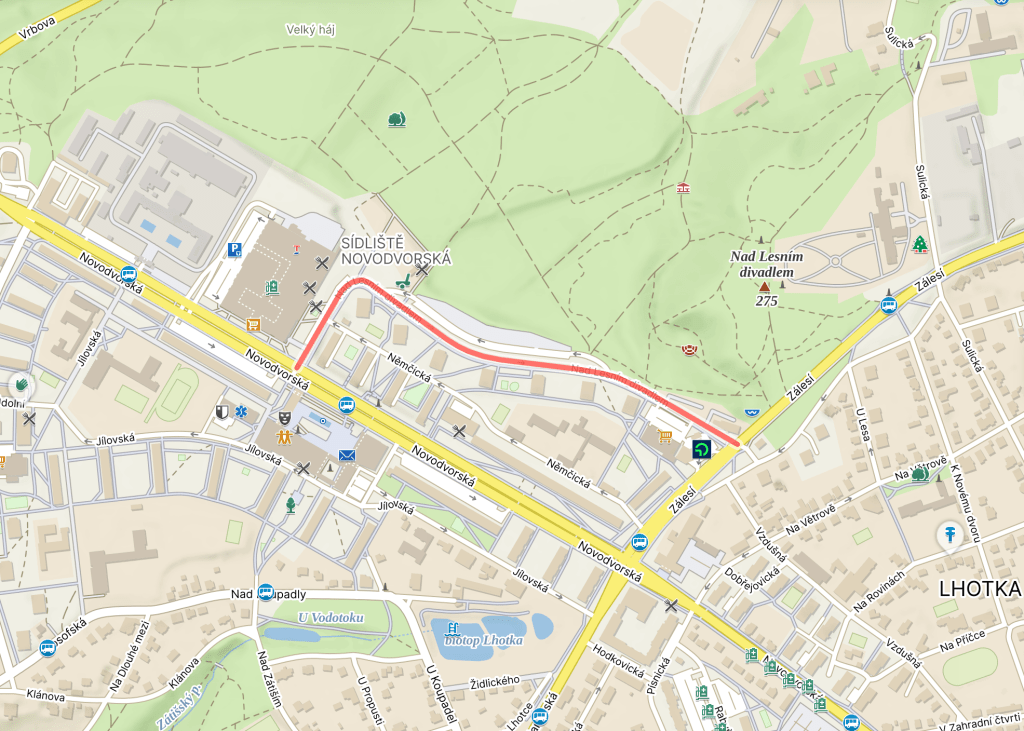
From the 1700s (maybe earlier) until 1928, limestone was mined round here. Mining involves quarries, and the Czech for ‘quarry’ is ‘lom’ – hence this street being ‘Above the quarry’.
However, wander along Nad lomem, and you might find yourself paying less attention to the landscape and more attention to some seriously swish houses.
One of these is the Prager and Louda Villa.
In 1968, the architect Karel Prager – known for, erm, not universally loved buildings such as the New Stage of the National Theatre (see below and/or https://whatsinapraguestreetname.com/2024/09/14/prague-1-day-105-divadelni/) and the new building of the National Museum – built the villa to live in.
It was shaped like a cube and had a flat roof. In 1978, his son-in-law, Jan Louda, added a half-cylinder, made of metal, to the roof, an extension so big that it added two floors to the building.
‘Vysoká cesta’ translates as ‘high road’, and, in relation to the terrain directly to the west, this is accurate.
Though it kind of blows my mind that anywhere that looks like this qualifies for street status at all.
My mind is equally blown by the villa at number 24 – creatively referred to online as ‘Vila na Vysoké cestě’ – mainly because it took me a fair bit of time to identify where number 24 was at all, only to realise it looks like this.
The family house was built in the first quarter of the 1800s; only the perimeter walls are still standing.
From 1958 to 2012, it was listed as an immovable cultural monument, as it demonstrates Braník’s classicist suburban development, as well as the integration of housing into the landscape.
It’s a heck of a lot more integrated into the landscape than ever now, you could say.
Modřany was completely burnt down during the Hussite Wars, and, in 1429, was the site of fighting between Hussites and Catholics. The parts of Modřany which had belonged to Vyšehrad became the property of Prague’s Old Town.
They would then lose it again in 1547, as punishment for resisting against Ferdinand I and the Habsburg regime in general.
In the 19th century, Modřany – rural up until this point – became a suburban area. It became an independent parish in 1855, had passenger trains to Prague from 1881, and acquired its own post and telegraph office in 1891.
It wasn’t until 1968 that Modřany officially became part of Prague.
There’ll be a lot more to say about Modřany when we start walking down its streets – but, as it’s in Prague 12, I’m in the slightly terrifying position of saying, for the first time ever, ‘I’ll do that in the coming decade’.
In the meantime, that’s us done with Podolí! Braník coverage begins tomorrow.
When rafting became less important, the island became something of a sports centre; it has clubhouses, shipyards and other sports facilities for rowing.
I don’t know if it has a street sign, and felt like I might be walking on private property anyway, as fairly well proven by this picture, so I decided it was wise to stop looking for one.
Regular broadcasting started in 1954, the first live broadcast (an ice hockey match vs. a Swedish team) happened in 1955, and by the end of the year, there were also studios in Bratislava and Ostrava.
In December 1957, the television and radio companies were separated – and Československá televize (ČST) came into being. Further studios appeared in Brno (1961) and Košice (1962). The station got its first logo in 1963.
It was around this time that the complex at Kavči hory – the reason why we’re talking about this today – started to be built, although the first operations there wouldn’t start until 1970, and full operations wouldn’t commence until 1979.
Regular colour broadcasting began in 1973 on the second channel (which had been launched in 1970, also the same year as the first colour broadcast – a skiing competition); in 1979, a separate building for the newsroom was put into operation.
This is the logo as it looked in 1980, and would look for another ten years.
During the Velvet Revolution, ČST reported extensively, and its staff made a conscious decision to side with the demonstrators. Inevitably, the aftermath of the revolution meant that a lot of the old guard got replaced.
In 1990, a third channel – OK3, mainly broadcasting foreign content, and since replaced by ČT3 – was launched. The second channel was divided into two – one Czech and one Slovak.
By January 1992 – so, a year before the Velvet Divorce – Slovenská televizia (STV) and Česká televize (ČT) – were already in existence. ČST’s sole function was to produce news content, and it was dissolved – along with Czechoslovakia – on 31 December 1992.
For a real piece of history, this is how the TV guide looked on 31 December 1992, and how it looked on 1 January 1993.
ČT3 closed down at the end of 1993 to make way for Nova, the country’s first private television station (extremely 1993 logo of ČT below).
While this logo is from 1997, and is also quite 1997.
Moving with the times, ČT first tried its hand at digital and internet broadcasting in 2000 – but then it got attention for other reasons.
In December, a new director general and director of news were appointed; many staff didn’t approve, so much so that, while the new team got on with broadcasting on terrestrial television, the rebels broadcast their own news programmes via satellite.
The Czech Parliament sided with the rebels; dismissal of the Czech Television Council and a new interim director general resulted in the strike ending in February 2001.
Further channels have appeared since: the news channel, ČT24 (2005), ČT sport (2006), kids’ channel ČT 😀 (2013) and the cultural ČT art (2013). ČT3, meanwhile, made a temporary comeback from 2020 to 2023, initially to give people a nostalgia kick during lockdown.
In terms of viewership, ČT comes first if you consider the entire day, second if you consider primetime only, and its news service has been considered the most trustworthy news medium in the country.