What's in a Prague street name

Every street in Prague, one by one.

  • Originally published on X on 13 May 2024.

    Duch svatý, or svatý Duch, is not an obscure saint, disappointing as that is for those of us who were hoping Duch was a Celtic missionary or something. He’s the Holy Spirit.

    The Church of the Holy Spirit was built at some point between 1325 and 1350; it originally had a neighbour, the Benedictine Convent of Divine Mercy (Benediktinský klášter Božího Milosrdenství).

    Both were sold off during the Hussite wars, but the church was later restored.

    At the end of the 1500s, the convent came under the control of the Benedictine nuns from St George’s Convent at Prague Castle (https://whatsinapraguestreetname.com/2024/09/02/prague-1-day-1-u-svateho-jiri-st-georges-square/).

    Eventually, the monastery/convent was discontinued, but the church survived. There were extensive repairs after a fire in 1689.

    During the clean-up of the Old Town in the early 20th century, the church was one of the rare buildings that benefited: its foundations were strengthened and remains of older buildings were discovered.

    Before that, the church had also done relatively well out of the closure of other churches in the area in the 1780s, as it gained some of the better parts of their insides.

    Since 2015, the church has served the Armenian Apostolic Church (Հայաստանեայց Առաքելական Եկեղեցի / Hay Aṙak’elakan Yekeghetsi).

    An orchestra that a friend of mine plays in gave a concert in the church last November, meaning I was lucky enough to see its insides, which are quite fine (and also excellent for language enthusiasts). Apologies for the lack of photos.

  • Originally published on X on 12 May 2024.

    Bělidlo’ is bleach, whitener or a bleaching agent.

    It can also be used to denote a bleachery, the part of a textile factory where chemical bleaching of textiles is carried out.

    If you recognise the word, it might be because you’ve read Babička (https://whatsinapraguestreetname.com/2024/08/25/prague-2-day-110-bozeny-nemcove/), as part of the story took place in a building called the Staré bělidlo / Old Bleacher.

    Where number 11 on Bílkova stands now, there was once a building called U Bílků. It’s believed that its name derived from ‘bělidlo’, and that this also led to the street name.

    I’d have assumed that it was named after a Mr Bílek, but there you go.

    The street was created in 1893 after the rehabilitation (asanace) of Josefov.

    Originally, the western part was called ‘Masařská’ after its meat shops, the middle part was called Scheplsova after a spa owned by a Mr Scheples, and the eastern part was called V cípu.

    As is this street, which I covered previously: https://whatsinapraguestreetname.com/2024/09/23/prague-1-day-140-v-cipu/.

  • Originally published on X on 11 May 2024.

    Miloš Forman was born as Jan Tomáš Forman in Čáslav (https://whatsinapraguestreetname.com/2023/07/02/prague-3-day-178-caslavska/) in 1932.

    His mother, Anna, was arrested by the Nazis for lying about her involvement in the distribution of anti-Nazi leaflets, and died of typhus at Auschwitz-Birkenau in 1943.

    His father, Rudolf (actually not his biological father, as he later found out), was also arrested for being part of a resistance group, and died at the Mittelbau-Dora concentration camp in 1944.

    An orphan by the age of 12, Forman grew up with relatives in Náchod and Poděbrady; he went to a grammar school in the latter which was also attended by Václav Havel (https://whatsinapraguestreetname.com/2024/09/14/prague-1-day-104-namesti-vaclava-havla/).

    Forman then studied at the Film and Television Faculty of the Academy of Performing Arts in Prague (FAMU), and worked as an assistant to Alfréd Radok, creator of the Laterna Magika.

    Forman and cameraman Miroslav Ondříček first attracted attention with Konkurs (Talent Competition), a medium-length film released to theatres in February 1964.

    In the same year, his Černý Petr (Black Peter) – about a Czech teenager working in a grocery store – won the Golden Leopard prize at the Locarno Film Festival.

    Then, in 1965, Lásky jedné plavovlásky (Loves of a Blonde) – about a young woman working in a shoe factory – was nominated for Best Foreign Language Film at both the Oscars and the Golden Globes.

    There would also be an Oscar nomination for 1967’s Hoří, Má Panenko (The Firemen’s Ball), set at a volunteer fire department’s annual ball. This was Forman’s first colour film.

    In 1968, Forman went to Paris to discuss production of an upcoming film; during his stay, Russian tanks invaded Czechoslovakia. His film studio claimed he had left the country illegally and fired him; he therefore emigrated to New York.

    His American career didn’t get off to the best start – Taking Off (1971) won a prize at the Cannes Film Festival, but was not a commercial success, so much so that Forman ended up owing the studio money.

    Much greater success came with 1975’s One Flew Over the Cuckoo’s Nest, with its five Oscars: Best Director, Best Actor, Best Actress, Best Picture and Best Adapted Screenplay. Only two other films have ever won in all these categories.

    This was followed by a film adaptation of the musical Hair (1979) and of the historical novel Ragtime (1981).

    However, the next huge success would come in 1984, with the film version of Peter Schaffer’s play Amadeus. The film grossed over USD 90 million, and won eight Oscars (across all ceremonies, it won 40 of the 53 awards it was nominated for).

    Forman was allowed to return to Czechoslovakia for filming – this mainly took place in Kroměříž, although you’ll also see Prague locations in the film: https://movie-locations.com/movies/a/Amadeus.php.

    In 1989, Forman’s adaptation of Les Liaisons dangereuses, Valmont, was overshadowed by Dangerous Liaisons, an adaptation by Stephen Frears which had been produced in the previous year.

    Later productions, such as The People vs. Larry Flynt (1996), Man on the Moon (1999), and Goya’s Ghosts (2006), would garner mainly positive reviews, but would struggle at the box office.

    Forman died after a short illness in Danbury Hospital, Connecticut, in 2018 (his home was nearby, in Warren, and he’s also buried in that town): https://www.bbc.com/news/entertainment-arts-43767278. He had become a US citizen in 1977.

    The piazzetta here in Prague, in front of the Hotel Intercontinental, was named after him a few months after his death: https://www.ceskatelevize.cz/porady/10116288835-z-metropole/218411058230042/cast/651576/.

  • Originally published on X on 10 May 2024.

    Alžběta Dorota Pechová was born in Prague’s Old Town in 1847, the seventh of her father’s eight children (he was married twice).

    Her father believed that his family was from Krásná Hora, near Příbram – apparently, this wasn’t actually true, but it did result in the pseudonym which Alžběta later adopted.

    Eliška attended a German-language grammar school in Prague, and later became a member of the Ruchovci (a group of Czech writers who aimed to promote Czech literature and avoid foreign literary influences).

    Her work to promote Czech literature over its German counterpart included a series of novels aimed at teenage girls.

    In 1871, Krásnohorská co-founded the Czech Women’s Production Association with Věnceslava Lužická and Karolina Světla (https://whatsinapraguestreetname.com/2024/09/28/prague-1-day-153-karoliny-svetle/).

    Two years later, she would found a women’s magazine, Ženské listy.

    At this time, Prague lacked a Czech-language state grammar school for girls, so Krásnohorská started a petition for one, gaining almost 5,000 signatures. Because many people’s heads were still in the Dark Ages, this didn’t work out.

    Therefore, in 1890, Krásnohorská decided she would open a private girls’ school instead. Minerva opened on Pštrossova (https://whatsinapraguestreetname.com/2024/09/13/prague-1-day-97-pstrossova/) in September, the first private school of its kind in Central Europe.

    Krásnohorská was active in literary criticism, and was also one of those who defended the authenticity of these manuscripts (possibly still my favourite post to date?): https://whatsinapraguestreetname.com/2024/08/22/prague-2-day-91-lumirova/.

    She wrote quite harshly about T. G. Masaryk – who rightly thought they were a fake – though that didn’t stop him from later making her the first female member of the Czechoslovak Academy of Sciences and Arts.

    She also wrote libretti for operas – four for Karel Bendl, four for Bedřich Smetana, and one for Zdeněk Fibich, and translated works including Lord Byron’s Childe Harold’s Pilgrimage.

    Suffering from joint pain since her youth, and never having children, Krásnohorská became increasingly dependent on her friends in old age. She died on Černá (https://whatsinapraguestreetname.com/2024/09/14/prague-1-day-101-cerna/) in 1926.

    The most distinctive buildings in the street that’s named after her are probably the Cubist ‘Teachers’ Houses’ designed by Otakar Novotný and built between 1919 and 1921.

    Goodness, I love Cubist buildings. If you’re ever planning on writing an article on why Cubism is problematic and we shouldn’t be a fan of it, you may well have your reasons for doing so, but please block me in advance.

  • Originally published on X on 9 May 2024.

    Pierre Curie was born in Paris in 1859. He was educated at home by his parents (his father was a doctor), and took his baccalaureate in science when he was 16.

    Two years later – when he was just 18 – he would already have a degree in physical sciences from the Paris Faculty of Sciences.

    Meanwhile, Maria Skłodowska was born in Warsaw, then part of the Russian Empire, in 1867. Both her parents (pictured) came from families who had lost their property and fortunes due to their support for an independent Poland.

    She studied at the Flying University, an underground institution (the ‘official’ universities didn’t allow women to enrol), along with her sister Bronisława (right), who went to study medicine in Paris.

    In 1891, Maria would join her; in France, she came to be known as Marie. She obtained a degree in physics from the University of Paris in 1893, followed by a master’s in mathematics in 1894.

    A mutual friend, the Polish physicist and diplomat Józef Wierusz-Kowalski, introduced Pierre and Marie to each other. They would marry in 1895, the same year in which Pierre received his doctorate.

    Also in 1895, Wilhelm Röntgen discovered X-rays, and, in early 1896, Henri Becquerel started experiments which would lead him to conclude that uranium salts emitted rays of their own accord.

    Using an electrometer which Pierre had developed with his brother in the early 1880s, Marie discovered the uranium rays could make the surrounding air conduct electricity, and hypothesised that radiation came from the atoms themselves.

    In 1898, she discovered that thorium was also radioactive. Pierre dropped his research to join his wife on hers.

    In the same year, they would announce the discovery of two more elements: polonium, named after her native (and partitioned) Poland, and radium; they also coined the term ‘radioactivity’.

    They published 32 scientific papers in the next four years, one of which stated that exposure to radium caused tumour-forming cells to be destroyed more quickly than others.

    In June 1903, Marie received her doctorate, and the couple went to the Royal Institution of Great Britain in London to give a speech, although Pierre was only allowed to speak, because sexism and some people generally being awful.

    In December 1903, Pierre, Marie and Henri Becquerel received the Nobel Prize for Physics. Marie was the first woman to win a Nobel prize, although – more sexism alert – a committee member had to lobby hard for her to be nominated at all.

    In 1906, Pierre was struck by a horse-drawn vehicle on the Rue Dauphine in Paris and died instantly. He was 46.

    A devastated Marie was given the chair of the physics department at the University of Paris, becoming the university’s first female professor.

    In 1909, she founded the Institut du Radium, now known as the Curie Institute; in the following year, she managed to isolate radium. The term ‘curie’ was first attributed to a unit of radioactivity in 1910, too.

    However, large chunks of the French public continued to see her as ‘not one of theirs’, especially when she was revealed to have had an affair with Paul Langevin, a former student of Pierre’s who was separated, but not divorced from, his wife.

    In 1911, Curie would win a second Nobel Prize, this time in chemistry. The chair of the Nobel Committee encouraged her not to turn up to collect her prize, given her private life; she ignored him.

    During World War I, Curie created mobile radiography units (‘petites Curies’), used to treat an estimated one million French soldiers.

    In 1921, Curie visited the White House and also turned down the Legion of Honour (possibly thinking France’s gratitude was a case of too little, too late); in 1922, she joined the League of Nations’ International Committee on Intellectual Cooperation.

    Curie died in 1934 from aplastic anaemia (when the body fails to produce enough blood cells); a study in 1995 concluded that this was more likely due to her use of radiography in WW1, rather than exposure to lethal levels of radiation during her experiments.

    In 1935, her daughter and son-in-law, Irène and Frédéric Joliot-Curie, would receive the Nobel Prize in Chemistry for their discovery of induced radioactivity.

    Both Marie and Pierre were buried in Sceaux, in the southern suburbs of Paris; their remains were transferred to the Panthéon in 1995.

    Her name has been given to an EU fellowship programme, a metro station in Paris, numerous academic institutions, and a British charity providing hospice care.

    She’s also on French fifty cent coins, having previously been on French 500 franc notes when those were a thing.

    Náměstí Curieových was given its current name in 1960. Before that, it was called Janské náměstí, apparently because John of Nepomuk’s body was fished out of the Vltava here in 1393.

    The square includes the entrance to the Law Faculty of Charles University; the faculty was founded in 1348, but the building was created between 1924 and 1931.

    It was here that students were arrested by the Nazi police after the funeral of Jan Opletal (https://whatsinapraguestreetname.com/2024/09/18/prague-1-day-125-opletalova/) in 1939.

    There are also plaques commemorating those who died here during the Prague Uprising in May 1945, and those students executed by the Communists in 1949 / 1950.

    Across the road is what was opened in 1974 as Inter-Continental Praha, and is apparently due to reopen as Fairmont Golden Prague sometime in 2024 (in other words, what you currently see is a building site).

  • Originally published on X on 8 May 2024.

    Svatopluk Čech was born in Ostředek, near Benešov, in 1846; his father, František, was a patriot who worked as a journalist in 1848/9, when the Austrian Empire’s  first elected parliament operated from Kroměříž.

    After finishing the Piarist grammar school in Prague (see https://whatsinapraguestreetname.com/2024/09/22/prague-1-day-137-na-prikope/), Čech started to study law.

    He contributed to Czech publications such as Ruch and Květy; he later became editor of Světozor (from 1871) and Lumír (from 1873 to 1876).

    He left his law degree behind for a few years to devote himself to his writing, but practised again from 1876 to 1879.

    Čech’s written works included epics, often about the Hussite Wars (such as his first poem, Husita na Baltu (Hussites on the Baltic), Adamité (The Adamites), and Žižka).

    Other works, such as Evropa and Slávie, were influenced by the political events of the day, and he published two volumes of poetry concerning the rebirth of the Czech nation.

    He’s arguably best known for Pravý výlet pana Broučka do Měsíce (Mr. Brouček’s True Trip to the Moon, 1888) and Nový epochální výlet pana Broučka (Mr. Brouček’s new epoch-making trip, also 1888).

    (if these have official English titles, please shout, of course)

    In these stories, the Mr Brouček goes the the Moon and to the day before the Battle of Vítkov Hill (1420) respectively, and is not much respected by those he meets in either case.

    The stories are seen as early examples of Czech science fiction.

    Čech died in Prague in 1908, and is buried at Vyšehrad. This bridge was named after him later that year.

    Construction of the bridge had started in 1905; of the bridges across the Vltava in Prague, it’s the shortest. However, it’s also one of the most interesting architecturally.

    For example, it has four bronze statues of women with wings, made by the sculptor Antonín Popp.

    As well as, on each side, statues of female torchbearers, and of hydras flanking Prague’s coat of arms (not that you can see that in the picture).

  • Originally published on X on 7 May 2024.

    Antonín Leopold Dvořák was born in Nelahozeves, in Mělník District, in 1841, as the eldest of nine children.

    He started learning the violin at the age of six, also studying music theory, piano and organ during his schooldays.

    In 1857, he went to Prague to study at the organ school (which would be incorporated into the Prague Conservatory in 1890), graduating two years later.

    Dvořák’s first documented compositions date from 1861, although these met with little response.

    In 1862, he joined the orchestra of the Provisional Theatre (https://whatsinapraguestreetname.com/2024/09/14/prague-1-day-105-divadelni/), playing the viola and staying with the orchestra until 1871.

    Dvořák also gave piano lessons, and fell in love with one of his pupils, Josefína Čermáková (standing); she rejected him, but, in 1873, he did end up marrying her younger sister, Anna (seated).

    They would have nine children, of whom six would survive into adulthood.

    Shortly after getting married, Dvořák started to work as an organist in St Vojtěch’s Church in the New Town (https://whatsinapraguestreetname.com/2024/09/12/prague-1-day-92-vojtesska/), and managed to devote more of his time to composing.

    From 1874 onwards, he started submitting compositions to be considered for the Austrian State Prize; his 1877 submission resulted in a letter from the Prague-born Eduard Hanslick, informing him that a certain Johannes Brahms was very impressed.

    Support from Hanslick and Brahms meant that, by 1878, Dvořák’s Slavonic Dances had been published by the Berlin publisher Simrock, and, by 1879, were being played in France, Britain and the US.

    In 1884, Dvořák went to London to conduct his own Stabat Mater in front of 12,000 people at the Royal Albert Hall. He developed close ties to the British classical scene, and would return to the country at least seven times (this is him and Anna in London in 1886).

    His Requiem, composed in 1890, was actually premiered in Birmingham, and only got its Czech premiere at the National Theatre in the following year.

    He received an honorary degree from the University of Cambridge in 1891.

    In the 1880s, Dvořák had also struck up a friendship with Pyotr Ilyich Tchaikovsky (https://whatsinapraguestreetname.com/2023/01/14/prague-3-day-135-cajkovskeho/), and, as a result, toured Russia in 1890.

    In 1892, Jeanette Thurber, the founder of the National Conservatory of Music of America, invited Dvořák across the Atlantic. He accepted, working as the Conservatory’s director until 1895.

    Returning to Bohemia, he composed two of his most famous operas, Rusalka and Armida, and became a professor at the Prague Conservatory.

    In 1901, there were national celebrations for his 60th birthday, he was knighted, and he also became director of the Conservatory (which, appropriately, has one of its entrances on this very embankment).

    Dvořák died of a stroke on 1 May 1904. His funeral took place four days later, and he was then buried at Vyšehrad. The embankment was named after him in the same year.

    Before that, it had been called Sanytrová dolejší (Lower Sanytrová), due to its proximity to what was once Sanytrová but is now https://whatsinapraguestreetname.com/2024/10/23/prague-1-day-212-17-listopadu/.

    Unlike many musicians discussed in these threads, it seems that Dvořák was a modest, uncomplicated personality, who loved nature and was also a major railway enthusiast.

    However, his love for nature was also accompanied by anxiety and panic attacks when in a city environment, which apparently got worse with the years.

    In 1969, Neil Armstrong took a recording of Dvořák’s New World Symphony – composed during his stint in the States – with him while on the Apollo 11 mission: https://www.wrti.org/arts-desk/2019-07-19/this-is-the-music-thats-traveled-to-the-moon.

    The Dvořák Museum in Prague is located a bit further south, not that I managed to mention it when I covered the street it’s on: https://whatsinapraguestreetname.com/2024/08/25/prague-2-day-111-ke-karlovu/.

    Although at least I managed to mention the statue on here: https://whatsinapraguestreetname.com/2024/10/22/prague-1-day-211-namesti-jana-palacha/.

    Prague Boats has its dock on Dvořákovo nábřeží, so you’ll see more boats in this spot than you will on other embankments in Prague.

    However, you might not even notice them because, like me, you’ll be too busy staring at some of the best views imaginable.

  • Originally published on X on 6 May 2024.

    A ‘břeh’ is a coast or shore (if you’re dealing with the sea), or a bank (if you’re dealing with a river, which we clearly are here).

    And the street is so called because it leads from the right bank of the Vltava to the Old New Synagogue (https://whatsinapraguestreetname.com/2024/10/26/prague-1-day-218-cervena/).

    In the Middle Ages, the southern part of the street was called Schielesova (presumably a Mr Schiesel owned some property here), whereas the southern part was called Břehová or Pobřežní (which means much the same thing).

    There was also a square round here until the early 20th century rehabilitation of the district, first known as V hampejze (‘hampejz’ means ‘brothel’), and later as Poštovské due to the local post office.

    Number 7 on Břehová is the Faculty of Nuclear and Physical Engineering of the Czech Technical University in Prague (or FJFI ČVUT v Praze, which isn’t really any snappier).

    Whereas I know I also took pictures of number 8 for a reason, but that reason might just be that it’s a very attractive building.

    Incidentally, ‘tichá voda břehy mele’ literally translates as ‘quiet water grinds the banks’, and is the Czech equivalent of ‘still waters run deep’.

  • Originally published on X on 5 May 2024.

    This might be the Old (Jewish) Cemetery, but it’s not the oldest in Prague – we know that there was another one in the present-day New Town, dating back to at least 1254: https://whatsinapraguestreetname.com/2024/09/14/prague-1-day-107-charvatova/.

    King Vladislav II had that one closed down in 1478. However, this cemetery wasn’t opened as a reaction to the closure of the other one – one of its graves dates back to 1439.

    On the other hand, it’s believed that the cemetery didn’t exist at the time of the 1389 pogrom (https://whatsinapraguestreetname.com/2024/10/26/prague-1-day-218-cervena/).

    Demand for space for graves meant that the cemetery was frequently expanding; many of the purchases of additional land were financed by Mordecai Meisel (https://whatsinapraguestreetname.com/2024/10/24/prague-1-day-215-maiselova/).

    However, when land couldn’t be purchased, there was a problem: Halacha (the collective body of Jewish religious laws) dictates that individual graves can’t be disturbed, and that the tombstones of the deceased must be preserved.

    Therefore, graves would be arranged in layers – as many as twelve, in some cases.

    In 1784, Joseph II decreed that burials in city centres had to be banned for reasons of hygiene; however, the final gravestone dates from 1787.

    A cemetery which had been opened to bury plague victims became the city’s new Jewish cemetery. It’s located where the Žižkov TV tower is now.

    Despite Halacha, the rehabilitation of the Old Town did result in the old Jewish cemetery being reduced in size in 1903, and part of its former land ended up being taken up by the Museum of Arts and Crafts. Protective walls were added a few years later.

    Notable people whose graves are here include the chronicler David Gans, Mordecai Maisel, and the rabbis David Oppenheim, Judah Loew ben Bezalel and Joseph Solomon Delmedigo.

    There’s a chance that you’ve read a novel that is named after this cemetery.

    The street also includes the Klausen Synagogue, the largest in the old Jewish town, and the only Baroque one.

    Next to that is the cemetery’s New Ceremonial Hall, built between 1906 and 1908 in Neo-Romanesque style. It was originally the place of last service for the deceased, but hasn’t served that purpose since WW1.

    It – like much everything in this thread – is now administered by the Jewish Museum.

  • Originally published on X on 4 May 2024.

    I’m not in Prague today, but if you are, and have cleaning tools and a ladder, here’s an idea for a fun day out.

    ‘Červená’ means ‘red’. Jewish butchers had their shops round here, and these were painted red.

    Originally, the street was called Řeznická (a ‘řezník’ is a butcher), though, for a time in the late 18th / early 19th centuries, it was called Nová Poštovská due to the post office being moved here from nearby Břehová (coming on day 220).

    The current street name came into use at the start of the 20th century, after the asanace / rehabilitation of the district.

    In the late 1200s, a synagogue was built here, originally called Nová škola due to there already being a Stará (old) škola on Dušní (which will be day 227).

    At Easter 1389, the Jews of Prague were accused of ‘vandalising the eucharistic wafer’, and a pogrom (Bloody Easter) occurred. Jews trying to enter the synagogue were murdered; it’s said that there were 3,000 victims. Many Jews fled to Hungary and Poland.

    It’s said that the synagogue bore traces of their blood until 1618. During the 16th century, when other synagogues started to appear in the district, it became known as the Old New Synagogue / Staronová synagoga.

    The synagogue was repaired in 1618, then restored in both 1716 and 1883. It was one of the buildings that wasn’t damaged during the great fire of 1689.

    It’s also been reconstructed several times since, for example in 1996-7, 1998 and 2006-7. It remains the oldest functioning synagogue in Europe.

  • Originally published on X on 3 May 2024.

    Paříž is the capital of Francie, and I’m now realising that I somehow haven’t been since 2016. Here are two photos from that day.

    I’ve mentioned the ‘asanace’ (rehabilitation) of Prague at the start of the 20th century several times, mainly to talk about things that were destroyed, but things were created, too – this boulevard being one of them.

    It’s hardly a small street, but apparently it was meant to be even longer – stretching as far as the National Museum and becoming Prague’s answer to the Champs-Elysées. But these things are usually only possible when financing is available and there is public support.

    The boulevard was originally called Mikulášská třída, named after the church on Old Town Square (https://whatsinapraguestreetname.com/2024/10/19/prague-1-day-205-mikulasska/).

    In 1926, it was renamed Pařížská, while Vinohrady got a French Street in the same year: https://whatsinapraguestreetname.com/2024/03/16/prague-2-day-45-francouzska/.

    For the story of the Great Allied Street Renaming Of 1926, see https://whatsinapraguestreetname.com/2023/12/23/prague-2-day-1-italska/.

    Anyway, Pařížská is meant to be all sophisticated and Parisian and stuff, and I will concede that its trees are nice. Streets in Prague 1 don’t tend to have enough trees.

    Pařížská also feature a lot of bling, which excites me somewhat less.

    Property rent here is a not-at-all alarming EUR 2,700 per square metre per year, making Pařížská the eleventh most expensive shopping street in Europe, and the nineteenth in the world: https://www.cushmanwakefield.com/en/czech-republic/news/2023/11/main-streets-across-the-world-2023.

    I recommend ignoring the shop displays and looking a bit further up instead.

    There’s also a fine synagogue which we haven’t covered yet – but tomorrow’s post will be remarkably short if I talk about it now, so see you tomorrow for that part.

    Finally, if I were ever to do What’s In A Paris Street Name, I would absolutely have to start with… maybe the best street name ever?

    (photo taken in 2011, as if part of me knew I’d be doing this series over a decade later)

  • Originally published on X on 2 May 2024.

    According to Christianity, Joachim lived from about 100-75 BC to about 10 BC, i.e. not quite long enough to become the world’s braggiest grandparent, because his daughter was Mary, and his grandson was, therefore, Jesus.

    Among the more well-known variants of his name, we have Joaquín (Spanish), Gioacchino (Italian), Aćim (Serbian), and Joaquim (Portuguese). In Czech, the name is written as Jáchym.

    That said, we don’t know who Jáchym of ‘this street’ fame was. It’s assumed that he was Jewish, and that he owned one of the houses here.

    Before the 20th century, the names ‘Joachimova’ and ‘Joachimská’ were in use.

    Jáchymova’s most famous building is the Talmud-Torah School at number 3. It operated as a Jewish religious school from 1905 to 1942.

    Nowadays, it hosts the Terezín Initiative, an association of former prisoners of the Terezín and Łódź ghettos, as well as the Czech office of the Jewish National Fund.

    Back to Joachim: his wife was St Anne, who, unlike her husband, actually *is* the source of a Prague 1 street name: https://whatsinapraguestreetname.com/2024/10/03/prague-1-day-163-anenske-namesti/.

  • Originally published on X on 1 May 2024.

    Mordecai Meisel was born in Prague in 1528 (the oldest mention of a member of the Meisel family living in Prague dates from 1425).

    Moredcai, meanwhile, is first mentioned in writing in 1569; he was a banker and businessman who eventually became a member of the court of Rudolph II.

    In 1576, he became a member of the council of elders of Prague’s Jewish community, and used his wealth to develop the Jewish Town.

    For example, he sponsored the construction of the Jewish Town Hall, opened in 1586. This is how it looked in the early 20th century.

    And this picture is (mainly) its newer section, built in 1908.

    To the left, he also built the High Synagogue (1568) as a place of worship for the town hall councillors. It was damaged by fire in 1689, repaired in 1754, and reconstructed in 1883.

    He also built Maisel Synagogue (1590-2), which bears his name and gives its name to the street. It too was badly damaged in the 1689 fire, and underwent a Neo-Gothic reconstruction in the early 20th century.

    Meisel also gave the Jewish Town paving stones, and supported scientists, artists and tradesmen, and even co-financed the construction of a church which we’ll discuss on day 226.

    Emperor Rudolph II gave Meisel the right to dispose of his property in whichever way he saw fit.

    Meisel died in 1601, and is buried in the Old Jewish Cemetery; Rudolph attended his funeral, but then did a massive 180, confiscating all his property within a matter of days.

    The street wouldn’t become known as Maiselova until 1901 – before then, the southern part was called Zlatá (Golden), and the middle part was called Malá Masařská (Small Butcher’s Shop Street, due to the presence of such shops round here).

    Meanwhile, the part near the synagogue was called Rabinská (‘rabín’ is Czech for rabbi), and the northern part was called Velkodvorská, after the Great Court Synagogue, which was founded after Meisel’s time, but was demolished in 1906 as part of the ’asanace’.

  • Originally published on X on 30 April 2024.

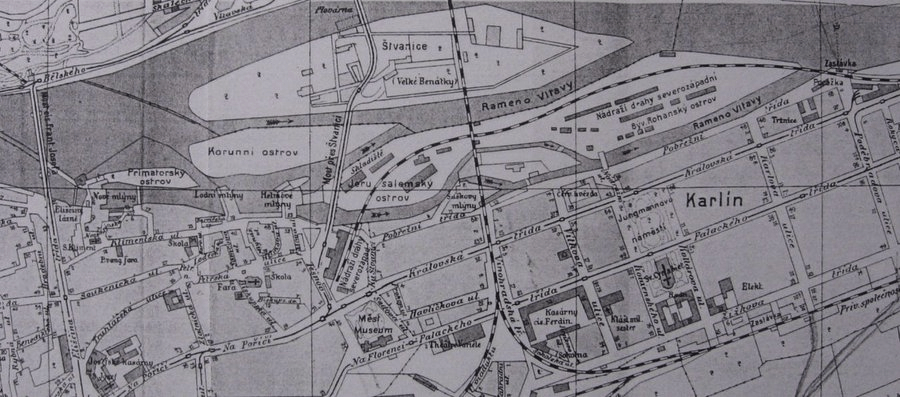
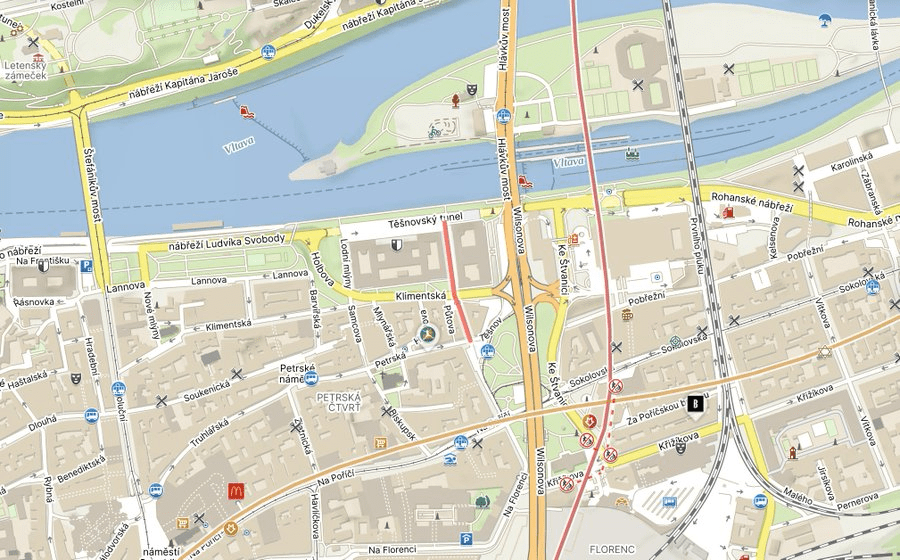
    Starting this story a bit to the north: Štvanice is an island between Karlín and Holešovice; you’re most likely to know it for its tennis arena which hosts the WTA Prague Open.

    Anyway, once upon a time, there was a ford at Štvanice, and there was a road which led from this ford to another one, namely the one where Mánesův most is now (https://whatsinapraguestreetname.com/2024/09/08/prague-1-day-57-manesuv-most/). Current-day Široká was part of that route.

    It was around here that Prague’s Jewish community settled. The area was probably known as V Židech, and the street came to be known as Židovská.

    Then, in 1535, the Pinkas Synagogue was founded by a prominent local citizen, Aaron Meshulam Horowitz, and probably named after his grandson, Rabbi Pinkas Horowitz.

    The street became known as Pinkasova.

    It’s managed by the Jewish Museum, and, from 1955 to 1960, its walls were decorated with the names of 77,297 Bohemian and Moravian victims of the Shoah.

    The memorial was closed to the public in 1968, and reopened in 1995.

    Later in the 1600s, the central part of the street was known as ‘Hlavní’ (because it was a main road), ‘Široká’ (because it was wide, or at least wider than the other streets in the area) or ‘Dlouhá’ (ditto, but replace ‘wide’ with ‘long’, and ‘wider’ with ‘longer’).

    And the eastern part was known as Černá (black – explanation presumably the same as for current-day https://whatsinapraguestreetname.com/2024/09/14/prague-1-day-101-cerna/).

    In 1850, the Jewish Town was named Josefov, after Joseph II (1741-1790), who not only closed down about a million monasteries (see every other post in this series), but also emancipated the Jews through his Edict of Tolerance (1782). The street was then renamed Josefovská.

    In 1958, the name ‘Široká’ was reinstated, supposedly to avoid confusion with this street across the river: https://whatsinapraguestreetname.com/2024/09/09/prague-1-day-61-josefska/.

    Walk closer to the river, and you’ll see another side of the Museum of Applied Arts (https://whatsinapraguestreetname.com/2024/10/23/prague-1-day-212-17-listopadu/).

    Then, at numbers 5 and 7, you have the Chevra Kadiš community and apartment building, built in 1910-1, and named after a funeral brotherhood founded by the Prague Jewish community in 1564 (‘Chevra Kadiš’ is Aramaic for ‘Holy Brotherhood’).

    Then, at number 13, U Dvou Malorusek was built in 1905-6 by Jiří Justich and Matěj Blecha for Tomáš Ryšánek, a director of sugar factories who had worked in Volyn and Podilia in Ukraine.

    The house was called ‘The Two Little Russian Women’ as a tribute to what Blecha called ‘Little Russia’; you can see them above the entrance. It might be time for somebody to propose a name change, as, no, Ukraine is not Little Russia, and never will be.

  • Originally published on X on 29 April 2024.

    A ‘rejdiště’ is a riding stable – in modern Czech, we would call this a ‘jízdárna’ – and one was inaugurated around here in 1660.

    More specifically, ‘around here’ means ‘number 2 Alšovo nabřezí’ (https://whatsinapraguestreetname.com/2024/10/22/prague-1-day-210-alsovo-nabrezi-ales-embankment/), which, nowadays, is called Prádlo or Na Prádle, was built in the first half of the 18th century, and looks like this.

    Which – if the building was never used for equine purposes – implies that the riding school didn’t last very long, although it was clearly long enough for the entire area to become known as Na Rejdišti. However, that name wouldn’t be given to the street until 1919.

    The earliest recorded name of the street is ‘Na břehu’, which translates as ‘on the bank’.

    Then, in 1905, the street was named after ‘U akademického gymnázia’ after the, yes, academic secondary school that was here from 1902 to 1919 (when it moved to Na příkopě; it then moved to Štěpánská (https://whatsinapraguestreetname.com/2024/09/01/prague-2-day-167-stepanska/) after WW2).

    It’s now the Prague Conservatory, whose list of alumni is basically a who’s who of Czech classical music: https://prazskakonzervator.cz/.

    Next door, number 2 is Divadlo Na Rejdišti a repertory theatre used by the Conservatory, especially to get students used to being on stage.

    While the opposite side of the street – and the only other building on it – offers a different view of the Rudolfinum.

  • Originally published on X on 28 April 2024.

    From the 16th century, this street was called Sanytrová, after ‘sanytr’, an Old Czech word for saltpetre, which is used to make gunpowder.

    In the 19th century (until 1870), it was known as V krechtách, after the nearby pits and ditches by the Vltava. Sanytrová was used again after that until 1947.

    17 November (17. listopadu) 1939 was the date on which the Nazi Protectorate reacted to anti-occupation demonstrations by announcing the closure of all Czech universities for three years (although teaching would ultimately not resume until 1945).

    1,200 students were sent to the Sachsenhausen concentration camp; over 15,000 students were no longer able to study, and over 1,300 people found themselves without a job.

    For a more detailed account of the events that led to that particular 17 November, you may want to look at https://whatsinapraguestreetname.com/2024/09/18/prague-1-day-125-opletalova/.

    The most imposing building on 17. listopadu is the Museum of Applied Arts in Prague (Uměleckoprůmyslové museum v Praze / UPM), built in the Neo-Renaissance style based on a design by Josef Schulz, and opened in 1900.

    It has the country’s largest library relating to the arts, with over 172,000 titles.

  • Originally published on X on 27 April 2024.

    Originally, this area was called Rejdiště (more on that in a few days); the square came into being in the 1870s and was called Na Rejdišti.

    During WW1, it was named náměstí císařovny Zity after Zita of Bourbon-Parma (1892-1989), the final Empress of Austria and Queen of Hungary.

    Then, from to 1919 to 1952, it was called Smetanovo náměstí (see https://whatsinapraguestreetname.com/2024/09/30/prague-1-day-156-smetanovo-nabrezi-smetana-embankment/), except during the Nazi occupation, when it was named after Mozart.

    Then, in 1952, it was named náměstí Krasnoarmějců, after Red Army soldiers who were initially buried here in 1945. Streets named after Czechs who fell during that uprising? Not so much of a thing.

    Jan Palach was born in 1948 in the sanatorium on Londýnská (https://whatsinapraguestreetname.com/2024/03/03/prague-2-day-41-londynska/), but grew up in Všetaty, near Mělník.

    His father, who died in 1962, had run a confectionery store until it was closed down by the Communists in the 1950s; this was used as a reason to stop Palach from entering the Faculty of Arts of Charles University in 1966, despite passing the entry exams.

    Instead, he enrolled at the University of Economics (https://whatsinapraguestreetname.com/2023/01/13/prague-3-day-126-namesti-winstona-churchilla/), and, in 1967, went on a student brigade in Kazakhstan, helping to fertilise the steppes.

    In 1968, Palach’s second attempt to join the Faculty of Arts was successful, and, in the summer, he went on another brigade, this time to Leningrad. He came back to Czechoslovakia a few days before Warsaw Pact forces invaded the country.

    In the aftermath, he participated in student strikes, but failed to see any progress being made, and had the overwhelming feeling that society was already becoming apathetic.

    In early 1969, Palach sent a letter to several public figures, demanding that censorship be abolished, and that distribution of Zprávy (News), the occupying forces’ newspaper, cease.

    On the afternoon of 16 January, Palach went to the top of Wenceslas Square (https://whatsinapraguestreetname.com/2024/09/17/prague-1-day-123-vaclavske-namesti/), doused himself with flammable liquid, and set himself on fire.

    He then ran to Washingtonova (https://whatsinapraguestreetname.com/2024/09/18/prague-1-day-124-washingtonova/), where a worker tried to extinguish the fire.

    Palach was taken to the burns clinic on Legerova (https://whatsinapraguestreetname.com/2023/12/24/prague-2-day-8-legerova/ – see the bit about the mural).

    From here, he gave a short interview, which was recorded. Please be warned that this is not an easy listen.

    Palach died three days after his act, on 19 January. His death was followed by strikes at universities and secondary schools across the country, and his funeral on 25 January became a mass protest.

    The funeral procession started at náměstí Krasnoarmějců – today’s square – and Palach was buried at Olšany Cemetery.

    Within three months, another seven deaths by self-immolation had occurred in Czechoslovakia, the most remembered being that of 18-year-old student Jan Zajíc, who called himself ‘torch number two’ (see the Wenceslas Square post).

    The Communist Party spread lies about Palach which his mother, Libuše Palachová, attempted to clear; she was supported in this by the dissident lawyer, Dagmar Burešová (https://whatsinapraguestreetname.com/2023/12/23/prague-3-day-193-dagmar-buresove/).

    Palach’s grave became something of a pilgrimage site, which worried the regime. Therefore, in 1973, Palach’s remains were cremated (his family was not informed in advance) and sent to Všetaty.

    From 15 to 21 January 1989, a series of events, ostensibly to commemorate the 20th anniversary of Palach’s death, but also held to criticise the communist regime – were held.

    These were brutally put down by the regime – a regime that, by the end of 1989, would no longer exist. The square was also renamed with remarkable speed – most street name renamings occurred in 1990, but this one took place in December 1989.

    In 1990, Palach’s ashes were transferred back to Olšany Cemetery; the elementary school he went to (in Všetaty), as well as his secondary school (in Mělník) were both named after him.

    In 2016, a tribute to Palach, Dům sebevraha a Dům matky sebevraha (The House of the Suicide and The House of the Mother of the Suicide), by American artist John Hejduk, was placed on Alšovo nábřeží.

    In 2004, British indie rock band Kasabian released Club Foot, the second single from their self-titled debut album. Its video is dedicated to Palach.

    In 2013, Polish director Agnieszka Holland produced a three-part series for HBO about Palach’s deed and its aftermath, Burning Bush: https://english.radio.cz/hbo-drama-burning-bush-delivers-first-film-treatment-palach-story-8547986.

    There was also a biographical film of Palach in 2019, directed by Robert Sedláček.

    On the less high-brow side, Karel Gott’s cover of All By Myself (‘Where did my brother Jan go’), with lyrics by Zdeněk Borovec, was a tribute to Palach, although this was obviously not admitted to at the time.

    The Faculty of Arts of Charles University, founded by Charles IV in 1348, has been based on the square since 1929. As well as Palach, former students include Jan Hus (https://whatsinapraguestreetname.com/2024/10/05/prague-1-day-169-husova/), Bernard Bolzano (https://whatsinapraguestreetname.com/2024/09/19/prague-1-day-133-bolzanova/), Josef Jungmann (https://whatsinapraguestreetname.com/2024/09/15/prague-1-day-111-jungmannova/), Tomáš Garrigue Masaryk (https://whatsinapraguestreetname.com/2024/09/01/prague-2-day-156-masarykovo-nabrezi/), Alice Masaryková, Karel Čapek (https://whatsinapraguestreetname.com/2024/01/30/prague-2-day-24-sady-bratri-capku/) and Jaroslav Vrchlický.
    Palach’s death mask, created by Olbram Zoubek, can be found on the wall of the building.

    The University of Applied Arts in Prague (UMPRUM) also has its premises here. When it was opened in 1885, it was the first state arts school in Bohemia. Many of the country’s greatest talents have studied and taught here.

    Appropriately, there’s a statue of Josef Mánes (https://whatsinapraguestreetname.com/2024/01/18/prague-2-day-11-manesova/), one of the most important Czech artists, facing the University. I love how different these works look from different angles.

    Opposite UMPRUM is the Rudolfinum, also built in 1885. It’s named after Rudolph, Crown Prince of Austria (https://whatsinapraguestreetname.com/2024/09/08/prague-1-day-56-u-zelezne-lavky/), and, from 1919 to 1939, was the home of the Czechoslovak parliament.

    Nowadays, it’s the home of the Czech Philharmonic Orchestra. I went to a concert here last year, and the insides are pretty special too.

    A statue on the square commemorates Antonín Dvořák, who conducted the Czech Philharmonic Orchestra in its first ever concert, which took place in the Rudolfinum in 1896. He’s facing the concert hall.

    Náměstí Jana Palacha is pretty lively at weekends.

    And, of course, the square offers excellent views across the Vltava, including a decent view of the toll house mentioned on https://whatsinapraguestreetname.com/2024/09/08/prague-1-day-54-kosarkovo-nabrezi/.

    Finally, we all remember what happened on the square in December 2023. I am only mentioning it here to preempt anybody who asks why I’ve left it out, and to tell those people that it is still too horrific to think about, but that this is not the same thing as forgetting.

  • Originally published on X on 26 April 2024.

    Mikoláš Aleš was born in Mirotice, in Southern Bohemia, in 1852. He started drawing at the age of four, later taking up painting.

    In 1869, he enrolled in Prague’s Academy of Fine Arts. He was later expelled (in 1876) after taking part in a demonstration against a professor who said there was no such thing as Czech art during the Gothic and Baroque periods, just Czech impersonations of German art.

    Things improved in 1879, however, when he not only got married and moved to Malá Strana, but also, along with the painter František Ženíšek, won a competition to decorate the foyer of the National Theatre (https://whatsinapraguestreetname.com/2024/09/14/prague-1-day-105-divadelni/).

    Speaking of that marriage: his wife was called Marina Kailová, and her brother was called Otto Kail. Otto’s great-grandson would be a certain Václav Klaus.

    Aleš also created illustrations for books and magazines. During his lifetime, his decorative work was appreciated; his oil paintings (such as these ones) wouldn’t gain acclaim until after his death.

    While these are some of his many illustrations.

    His house façades, created in collaboration with Antonín Wiehl, are particularly well-known: there’s an example on https://whatsinapraguestreetname.com/2024/10/06/prague-1-day-171-jilska/.

    And another on here: https://whatsinapraguestreetname.com/2024/10/15/prague-1-day-195-male-namesti/.

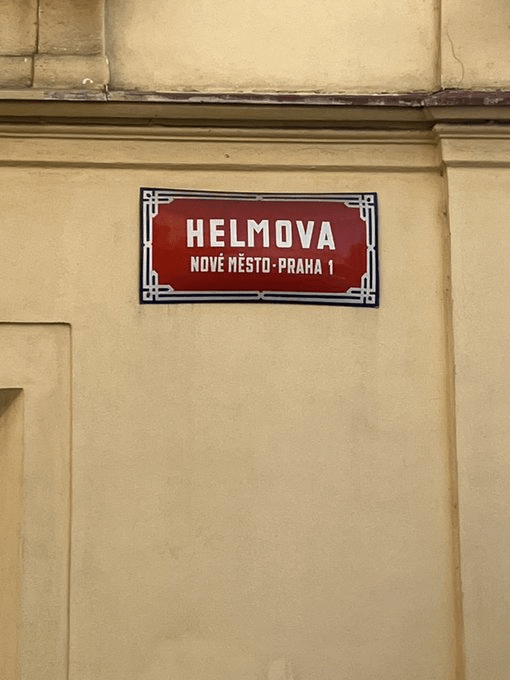
    From 1885, Aleš ran a painting academy where this embankment is now named after him; the street sign at the top of the post is on the building’s façade, which we’ll take a closer look at tomorrow.

    He’s also commemorated at another building in the street, number 4.

    In 1908, Aleš became a full member of the Czech Academy of Sciences and Arts.

    He died of a stroke on what is now Bělehradská (https://whatsinapraguestreetname.com/2024/03/02/prague-2-day-40-belehradska/) in 1913; he’s buried at Vyšehrad.

    The embankment, meanwhile, offers some wonderful views and relatively few people, even on a busy day.

  • Originally published on X on 25 April 2024.

    Daniel Adam was born into a well-off family in Prague in 1546.

    After studying history at Prague University, he lectured there from 1569 to 1576.

    Also in 1576, he married Anna Melantrichová, daughter of the famous publisher Jiří Melantrich (https://whatsinapraguestreetname.com/2024/10/14/prague-1-day-194-melantrichova/), and started to work at his father-in-law’s printing house.

    In 1578, he published Kalendář historický, which went through the days of the year and described the historical events that happened on them (i.e. this would probably have been my favourite book ever if I’d been around then).

    In the same year, he added ‘z Veleslavína’ to his name, after his father’s birthplace.

    Melantrich died in 1580, and left the business to his son, Jiří, who didn’t do a very good job of it. So, when Jiří also died prematurely in 1586, Adam took over.

    This proved to be a good move – over 130 high-quality publications were released as a result, of which almost half were in Czech (which was not usual at the time).

    Additionally, he was one of the first to publish sheet music, and also published a Czech-Latin-Greek-German dictionary.

    In 1595, Adam moved just outside of Mladá Boleslav; four years later, while in Prague, he caught a fever and died.

    The printing house would then be run by his widow and her second husband, Jan Bohutský.

    Just after Bílá Hora in 1620, it was given to the Jesuits, who were unable to make it reach its past glories.

    There’s a monument to Adam in Veleslavín (of ‘Nádraží’ fame) in Prague 6. Looking forward to sharing a photo of that with you all in 2028 or so (we laugh now, but one day we’ll wake up and realise it’s almost 2029).

  • Originally published on X on 24 April 2024.

    I think we can skip the part in which I explain what St Valentine is the saint of, and the date on which we celebrate him. But here’s some music.

    Anyway, from about 1253, St Valentine’s Church stood here, where, rather than the current-day street, there was actually a square, Valentinské náměstí.

    It followed the usual pattern of Prague churches: 1) built in Romanesque style; 2) gained Gothic elements as the years went by; 3) became a Hussite church; 4) was forcibly re-Catholicised; 5) was abolished thanks to Joseph II; 6) was demolished in 1794.

    It was replaced by a residential house, but that too was got rid of during the ‘asanace’ (clean-up) of Prague around 1900, a process which got rid of Valentinské náměstí too.

    Despite all this lost heritage, the Art Nouveau building that is named after St Valentine, and which was built just after the asanace, is pretty cool.