What's in a Prague street name

Every street in Prague, one by one.

  • Originally published on X on 23 April 2024.

    Žatec is a town of approximately 19,000 inhabitants in the Ústí Region, named after a hillfort which existed there in the early 10th century.

    It was an important city in Hussite times – when preachers predicted that it was one of five cities which would survive the final destruction of the world – and survived a month-long siege during the Second Crusade to Bohemia in 1421.

    It also played its role two hundred years later – its former mayor, Maxmilián Hošťálek z Javořice, was one of the 27 rebels executed on Old Town Square in June 1621.

    As one of the biggest cities in Bohemia at the time, it also had a good deal of money, and used part of this to buy what is now number 4 on the street, owning the house from 1615 to 1641 and giving the street its name.

    After the Thirty Years’ War, though, Žatec started to decline, and also became predominantly German-speaking (its German name is Saaz); having been the regional capital for centuries, it was demoted to district town in 1850.

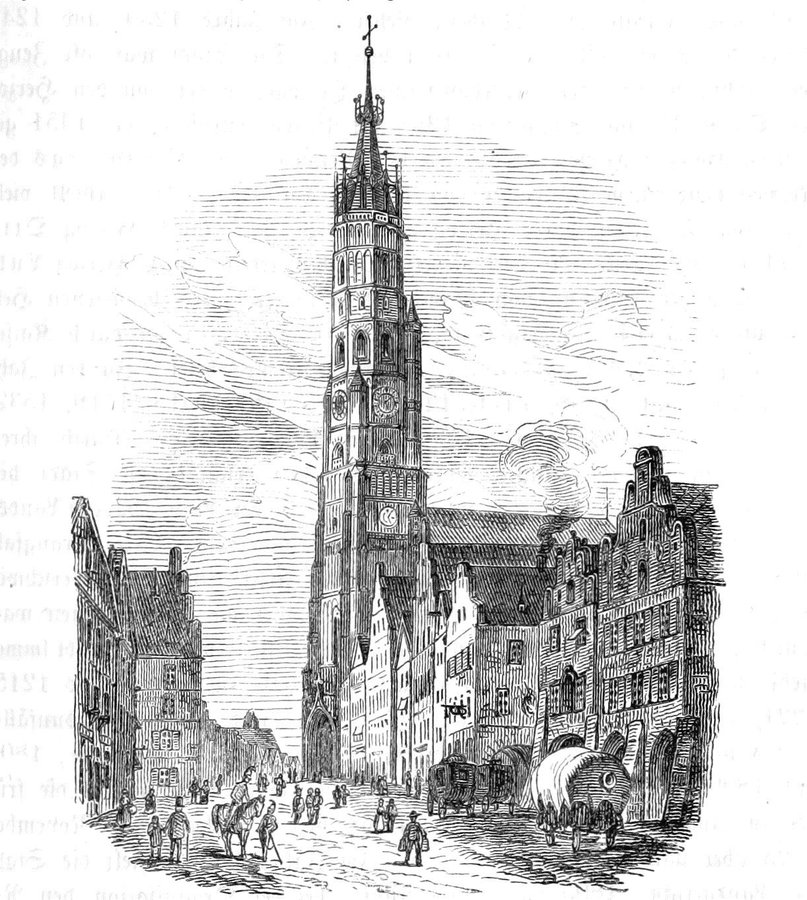
    This is Žatec as depicted by Václav Hollar (https://whatsinapraguestreetname.com/2023/02/28/prague-3-day-163-hollarovo-namesti/).

    The 18th and 19th centuries also saw the growth of brewing and hop cultivation in the city (Pivovar Žatec still exists), and, during the Industrial Revolution, a major cardboard and paper box factory was opened here.

    Some more pictures of Žatec, industrialisation-style, credited to Josef Wara (1863-1937).

    And some non-industrial ones.

    In May and June 1945, 5,000 German inhabitants of the town were marched from the town square to Postoloprty, where about 800 were shot. Even in a time of extreme brutality, it remains the largest known massacre of Germans living in Bohemia after WW2.

    In 1960, Žatec lost its status as district town to Louny. As with much of Czechoslovakia under communism, housing estates were constructed and historical parts fell into disrepair.

    However, restoration is now gradually taking place, and, in 2023, Žatec and its hop-based surroundings were placed on the UNESCO world cultural heritage list: https://whc.unesco.org/en/list/1558/.

    And, in April 2024, Žatec was named Historical Town of the Year.

    The person you are most likely to have heard of from Žatec is film director Jan Svěrák, born here in 1965:

    And you may also have seen Žatec without realising it, for example if you saw Yentl around 1983: https://filmap.tumblr.com/post/183585506716/yentl-barbra-streisand-1983-hadasss-house.

    Or, more recently, JoJo Rabbit: https://english.radio.cz/zatec-czech-town-providing-perfect-location-major-productions-including-jojo-8106955.

    Back in Prague, number 1 on Žatecká features one side of the National Library – the side which includes the entrance to the National Marionette Theatre and the Kingdom of Puppets, an amateur theatre founded in 1920. The entrance is charming.

    As is the plaque of UNIMA, Union Internationale de la Marionnette / International Puppetry Association, founded here in 1929.

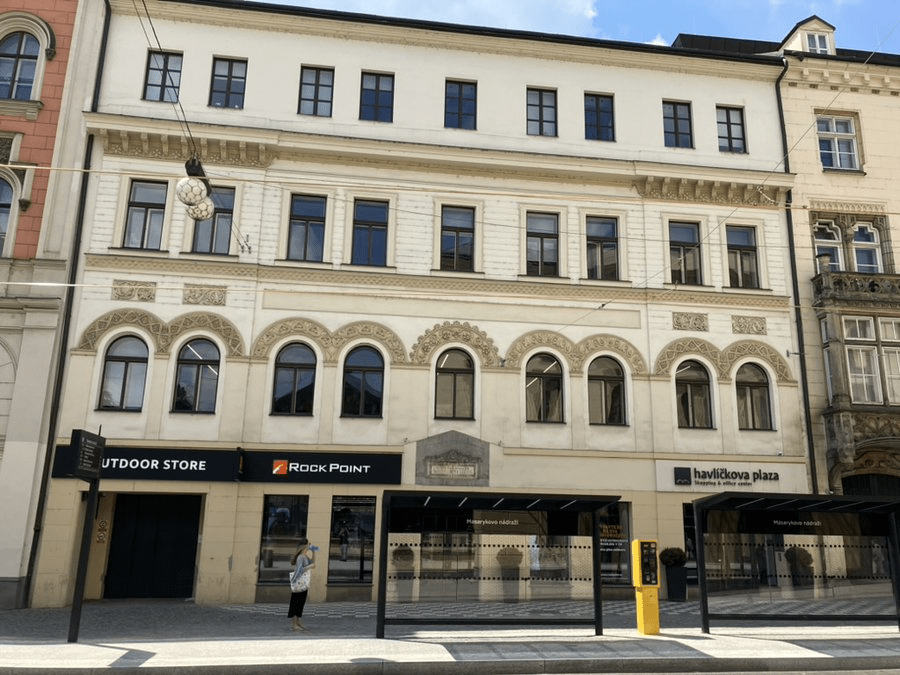
    Number 4 – not the original building bought by the city of Žatec, but standing in its spot – has some pretty interesting things going on on its façade too.

  • Originally published on X on 22 April 2024.

    This is one of the oldest streets in Prague, originally connecting Old Town Square – the city’s main marketplace – with a ford across the Vltava, where the Rudolfinum is now.

    The street was originally called Svatovalentinská, which there’ll be more about in two threads’ time.

    Number 8 on the street is called U Tří kaprů (The Three Carps). And you’d think that would be the reason for the street name, wouldn’t you? Well, you’d be wrong.

    Between 1537 and 1783, Prague’s Old Town had 36 mayors (for an example of one, take a look at https://whatsinapraguestreetname.com/2024/09/29/prague-1-day-155-krocinova/).

    Mayor number 11 was Pavel Kapr z Kaprštejna, who was in charge from 1565 to 1567. He bought U Tří kaprů (I can’t tell you if this was because he was amused by the name or not), and the street name followed (‘Kaprovic’ and ‘Kaprová’ were also in use in the 16th century).

    A later member of the dynasty, Jan Daniel Kapr z Kaprštejna, wouldn’t be fondly remembered by the Czechs: in 1621, he presided over the trial of the participants in the Estates Uprising, which ultimately led to their execution on Old Town Square.

    For those wondering if he lived happily ever after, the answer is a pretty categorical no: in 1625, his wife, Anna Marie, asked to meet up for a rendezvous in Dolní Počernice, but, when Jan was travelling through Hrdlořezy, his wife’s lover, Adam Zapský ze Zap, shot him dead.

    They, in turn, were executed in 1626.

    Please take these few sentences as your reminder that, yes, people can be terrible, but no, they haven’t just deteriorated massively in the last decade or so.

    Back in Josefov and on Kaprova, number 10 was lived in by the legendary pianist and composer, Jaroslav Ježek (https://whatsinapraguestreetname.com/2023/01/14/prague-3-day-136-jezkova/).

    The apartment – now named The Blue Room – is managed by the National Museum, and can be accessed as part of a guided tour on Tuesday afternoons: https://www.nm.cz/en/czech-museum-of-music/jaroslav-jezek-memorial-the-blue-room.

    Meanwhile, if you’re on Kaprova and decide you’re done with walking around the centre of Prague for the day, the street offers an escape route.

  • Originally posted on X on 21 April 2024.

    And once again, I remind myself that ‘Mikuláš’ is Czech for ‘Nicholas’.

    Saint Nicholas (of Bari) died in 343, and was known for secret gift-giving, hence Dutch folklore coming up with Sinterklaas, who is one of the sources for Santa Claus.

    Saint Nicholas is also the patron saint of sailors, archers, brewers, pawnbrokers, unmarried people, merchants, repentant thieves and therefore basically everyone.

    The Czechs (and Slovaks) aren’t alone in having a version of this name that begins with ‘m’ – see also Ukrainian Микола, Polish Mikołaj, Hungarian Miklós, Belarusian Мікалай, Lithuanian Mikalojus and Slovenian Miklavž.

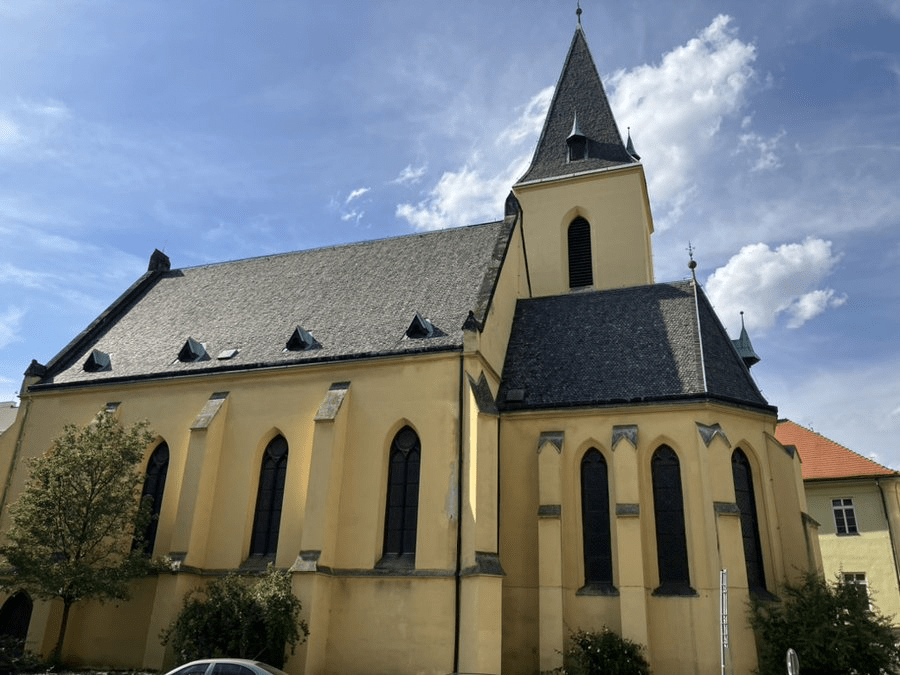
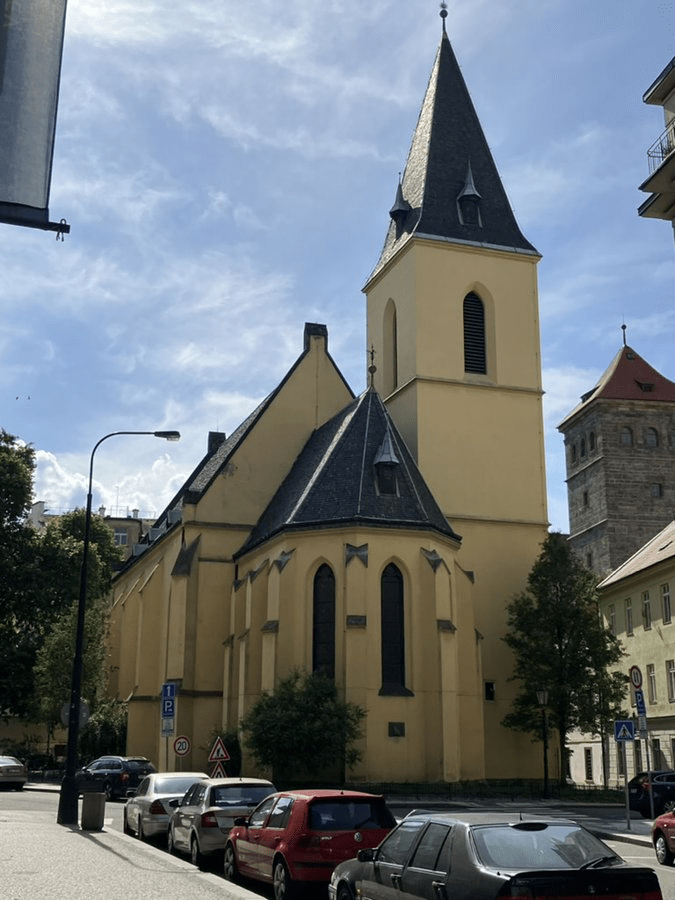
    The earliest mention of a church devoted to St Nicholas in this spot is from 1273 (it also mentions that the area had been recently flooded); the current building is obviously not from then, but a few elements of the original building remain in the cellar.

    Much like the Church of Our Lady before Týn (this photo is how that church looks from this one), St Nick’s was a centre of Hussite worship in the early 1400s, though it reverted to Catholicism around the 1430s.

    In the 1630s, the church’s Gothic basilica fell into the hands of the Montserrat Benedictines, who, a couple of decades later, would carry out extensive reconstruction.

    However, in the 1730s, the Gothic building was torn down and replaced with a Baroque central building.

    The church was deconsecrated in 1787, and the monastery was abolished; the church was used as a warehouse, then as a grain storage facility, then, from 1865, as a concert hall.

    It only filled this latter function for a short time, as, in 1871, it was leased to the Russian Orthodox Church. They used it until 1914.

    The fact that this was outside when I went there may be a coincidence; how nice it would be to live in a world where it wasn’t necessary for such a stand to exist at all.

    In 1920, the church started to serve the newly formed Czechoslovak Hussite Church; it’s still their main church (and, unlike the country it’s named after, didn’t split in two when 1992 became 1993).

    For once, I went inside while mentally drafting this post, and it was totally worth it.

    The view as I left was something of an ‘I get to live in this city’ moment too.

  • Originally published on X on 20 April 2024.

    Franz Kafka was born in a house on the present-day square in 1883. It was called U Věže (At The Tower), and was destroyed as part the ‘clean-up’ operation in the Old Town in 1897.

    His father, Hermann, was originally from Osek, a South Bohemian village with a large Jewish population. After working as a travelling salesman, he became a wholesaler of luxury goods in Prague.

    His mother, Julie, hailed from Poděbrady, and was born into the family of a well-off retail merchant.

    Kafka didn’t get on with his father, whom he described as despotic; both parents were away on business a lot and the children would largely be raised by servants and governesses.

    Kafka had two younger brothers, Georg and Heinrich, who died in infancy, and three younger sisters, Gabriele (Elli), Valerie (Valli) and Ottilie (Ottla), who would all be murdered in the Holocaust.

    The three sisters were all born in Dům U Minuty (https://whatsinapraguestreetname.com/2024/10/12/prague-1-day-190-staromestske-namesti-old-town-square/).

    From 1889 to 1893, Kafka attended the German Boys’ General School on Masná, then switching to the German State Gymnasium in Palác Kinských on Old Town Square, which (in things no child wants to experience) is also where his dad had his store.

    The shop would move (a very short distance) to here in 1896: https://whatsinapraguestreetname.com/2024/10/09/prague-1-day-180-celetna/; this was the first time that Kafka would have a bedroom to himself.

    In 1901, Kafka started to study chemistry at Karl-Ferdinand University. He switched to law after two weeks.

    At university, he also befriended a fellow student, Max Brod (pictured in 1914).

    Graduating in 1906, he soon took up employment at Assicurazioni Generali on Wenceslas Square (https://whatsinapraguestreetname.com/2024/09/17/prague-1-day-123-vaclavske-namesti/).

    Incidentally, 1906 was also the year in which the family business would move to another address on Celetná, Hrzánský Palace.

    Resigning from the insurance company after less than a year, Kafka then got a job at the Workers’ Accident Insurance Company for the Kingdom of Bohemia on Na Poříčí, where he would work until 1922.

    Kafka’s biggest gripe about both jobs was that they took up time that he could have spent writing instead; to make matters worse, his father still expected him to help out in the family shop.

    On top of that, Kafka became a partner in Prague’s first asbestos factory, along with his brother-in-law, Karl Hermann, in 1911. Said factory was located in Žižkov: https://whatsinapraguestreetname.com/2023/01/14/prague-3-day-134-borivojova/.

    Despite work commitments, the first publication of Kafka’s work (eight short stories, in this case) occurred in the Munich-based literary magazine Hyperion in 1908.

    As a German-speaking Jewish inhabitant of Prague, Kafka was fascinated by Eastern European Jewry and Yiddish literature; however, he also felt alienated from Judaism and Jewish culture.

    In 1912, Kafka met Felice Bauer, to whom he would be engaged twice (in 1914 and 1917, although they only met seventeen times during their five-year relationship). Kafka and Bauer first met at Max Brod’s house, which is U Mladých Goliášů on https://whatsinapraguestreetname.com/2024/09/27/prague-1-day-148-skorepka/.

    It was also in 1912 that Kafka managed to write a short story, Das Urteil (The Judgement), in eight hours, starting a phase of intense creativity. It was published in Leipzig in the same year, and dedicated to Felice Bauer (this is the 1916 edition).

    During his lifetime, only a few short stories of his, all of which were written in German, were published, and received little attention. The most famous is Die Verwandlung (The Metamorphosis), written in 1912 and published (also in Leipzig) in 1915.

    As further proof of how productive 1912 was, Kafka also started on drafts for a work which he titled ‘Der Verschollene’ (The Man Who Disappeared); he continued with this until 1914, but left it incomplete; it would be published in 1927 as Amerika.

    In 1914 qnd 1915, Kafka wrote Der Process (The Trial), which would appear in print in 1925 (yes, I would have assumed ‘Prozess’ too, but this is the spelling Kafka used).

    He also planned a third novel, but didn’t start writing it just yet.

    From 1916 to 1917, Kafka would stay in an apartment rented by his sister Ottilie on https://whatsinapraguestreetname.com/2024/09/05/prague-1-day-4-zlata-ulicka-u-daliborky/, where he could devote himself to his writing.

    This was followed by renting an apartment at Schönborn Palace – now the US Embassy – on https://whatsinapraguestreetname.com/2024/09/08/prague-1-day-36-trziste/ from March to September 1917.

    Here, that Kafka started to suffer from persistent bleeding, which his doctor identified as being caused by tuberculosis. He was granted long-term sick leave, going to Siřem, near Žatec, to recuperate (he’s on the right; his favourite sister, Ottla, is second from left).

    Meanwhile, around 1919/20, he would become engaged to Julie Wohryzková, a hotel chambermaid. The engagement would only last a few months.

    In 1920, Kafka had a largely correspondence-based relationship with a Czech (and non-Jewish) journalist, Milena Jesenská, who would translate some of his works into Czech and would publish an obituary for him in Národní listy following his death.

    In 1922, Kafka finally found time to start on the other novel he’d been planning since 1914, Das Schloss (The Castle); like his other two novels, he never finished it, but it would appear in print in 1926.

    As all attempts to improve his health failed, Kafka left his job for good in 1922. In 1923, he moved to Berlin in a bid to get away from his family and focus on writing, and lived with a kindergarten teacher, Dora Diamant.

    However, his tuberculosis would return and spread to his larynx, leaving him unable to speak and only able to eat and drink with difficulty.

    He died of heart failure on 3 June 1924, at a spa in Kierling, Lower Austria. He was forty.

    He’s buried in the New Jewish Cemetery in Žižkov (https://whatsinapraguestreetname.com/2022/11/28/prague-3-day-99-izraelska/).

    In two letters to Max Brod – which were never sent – Kafka requested that all his unpublished works be destroyed, a wish that Brod chose not to respect, publishing the bulk of what he owned of Kafka’s writing between 1925 and 1935.

    Kafka’s complete diaries from 1909 to 1923 would be published in German in 1994; a full English-language translation didn’t follow until 2023 (a version edited by Brod had appeared in the 1940s).

    A distinctive statue dedicated to Kafka was unveiled in Prague in 2003 – we’ll get to that in a future post.

    We’d also have a nice picture of David Černý’s mechanical tribute outside the Quadrio shopping centre near Národní třída if it hadn’t been closed for repairs when I took this photo last year:

    And, of course, the museum: https://whatsinapraguestreetname.com/2024/09/08/prague-1-day-59-cihelna/.

    Náměstí Franze Kafky was part of U Radnice (https://whatsinapraguestreetname.com/2024/10/18/prague-1-day-203-u-radnice/) until 2000, when it became a separate street.

    About Prague, Kafka wrote that ‘Prag lässt nicht los’ (‘Prague doesn’t let go’) and ‘Dieses Mütterchen hat Krallen’ (‘This little mother has claws’). A century after his death, it’s continuing to have that effect on me, and I hope those claws never stop clawing.

  • Originally published on X on 16 April 2024.

    In the 14th century, this street became part of the marketplace that we now know as Old Town Square (https://whatsinapraguestreetname.com/2024/10/12/prague-1-day-190-staromestske-namesti-old-town-square/).

    Sellers of bridles (Czech: uzdy) operated here, and the street became known as V uzdářích or Pod uzdáři for a couple of hundred years.

    Back on current-day Old Town Square, a town hall (Czech: radnice) was gradually built from 1338 onwards, and V uzdářích (which wasn’t identical in scope to the current street) became known as Radnická from 1870.

    However, come 1900, Prague was growing, and the city administration needed a bit more space than Old Town Hall could offer on its own.

    From 1908 to 1911, the Nová radnice (typically translated as New City Hall, mainly to avoid confusion with the New Town Hall, which is not new, but is in the New Town: https://whatsinapraguestreetname.com/2024/09/01/prague-2-day-164-karlovo-namesti/) was built.

    The competition for the design of the building was won by Osvald Polívka (also responsible for many other great buildings in Prague, but most famously Municipal House: https://whatsinapraguestreetname.com/2024/10/10/prague-1-day-182-u-obecniho-domu/).

    In 1914, the street was renamed U Radnice.

    Interior features included Prague’s first two paternosters; exterior features included fine statues and sculptures, such as Ladislav Šaloun’s sculpture of Judah Loew ben Bezalel, supposed creator of the Golem of Prague.

    As well as Šaloun’s statue of the Iron Knight, the spirit of a knight who can’t find peace following the suicides of his fiancée and her father, the death of his wife, and his own suicide.

    The relief sculptures at the entrance are by Stanislav Sucharda; they represent ‘Citizenship jointly bearing the burden’ and ‘The common benefit flowing to citizenship’.

    Initially, New City Hall hosted the city treasury, accounting office and collection offices; after the Prague Uprising in May 1945, parts of the Old Town Hall were burned down, and the city administration moved here.

    It’s been the seat of Prague’s mayor ever since, and also hosts the Prague City Council. This is a picture of its slightly more low-key entrance on U Radnice itself.

    Other houses on U Radnice definitely indicate a common theme – you’ve got U Zlatého bažanta (The Golden Pheasant) at number 2 (left-hand part of the first pic), U Zlatého zvonku (The Golden Bell) at number 4, and U Zlatotepců (The Goldsmiths) at number 6.

    Number 8 spoils the consistency somewhat, but I also think U Zelené žáby (The Green Frog) is a great name (which dates back to at least 1428); zoom in above the entrance, and you’ve got a frog welcoming you in.

  • Originally published on X on 15 April 2024.

    Svatý Linhart is Leonard of Noblac (died 559), who is closely associated with the Limousin region of France, where he lived as a hermit.

    He’s the patron saint of imprisoned people, including political prisoners and prisoners of war. As well being the patron saint of horses, and of women in labour.

    Where the south-east corner of the New City Hall now is, there was once St Leonard’s Church. The oldest surviving written mention is from 1268, and it was likely to have been built in the century before that.

    It was where the local population would give donations to disabled people, until that started to take place at the Church of St Lazarus (https://whatsinapraguestreetname.com/2024/09/01/prague-2-day-165-lazarska/) instead.

    Given to French Catholics by Emperor Ferdinand II in 1628, the church was abolished in 1787 and demolished entirely in 1798.

    The New City Hall was built from 1908 to 1911 (more on that tomorrow), and the street was created as a result of that. Here’s what the city hall looks like from this side.

  • Originally published on X on 14 April 2024.

    A long time ago, there was a village here called Na Louži. A ‘louže’ is a puddle or a pool, and the name possibly came from the fact that the area, not being too far from the Vltava, was vulnerable to flooding.

    In what is now the southern side of the square stood the Church of the Virgin Mary Na louži / Kostel Panny Marie Na louži (first written mention dating from 1268; destroyed in the 1790s).

    Hence the name of the square, although, from 1952 to 1990, it was named Náměstí primátora dr. Václava Vacka, after Václav Vacek, co-founder of the Communist Party of Czechoslovakia, mayor of Prague for a brief while in 1945, and again from 1946 to 1954.

    Mariánské náměstí is another one that lost a lot of its buildings around 1900.

    The square includes the eastern entrance to the Klementinum.

    Opposite, meanwhile, is the New City Hall (which I can’t write more about yet because it’ll make an upcoming post extremely empty if I do).

    On the northern side is the Municipal Library, Prague’s biggest; these premises were built between 1925 and 1928.

    The sculptures on the façade, by Ladislav Kofránek, represent literature, sculpture, music, philosophy, drama and architecture.

    On the southern side, you’ve got Clam-Gallas Palace, the location of Czechoslovakia’s first Ministry of Finance. Its entrance on Husova is quite something: see https://whatsinapraguestreetname.com/2024/10/05/prague-1-day-169-husova/.

    Take a closer look, and there’s the Terezka Fountain, or, to give it its official full name, ‘Fountain with an allegorical statue of the Vltava’, where the church once stood.

    It was sculpted by Václav Prachner, and has stood here since 1812.

    The locals apparently started to call the statue Tereza after an attractive local girl who used to come here to get water.

  • Originally published on X on 13 April 2024.

    Originally, the street was called ‘Ostrožná’ or ‘Ostrožnická’, because an ‘ostroh’ is a spur, and spur-makers set up shop in this area.

    A ‘plát’, meanwhile, is, yes, a plate, as in an iron or a steel one.

    Therefore, a ‘platnéř’ would be a platemaker, but, rather than those plates having food put on them, they’d become components of a knight’s armour.

    There’s a story that a knight came to the area, looking for someone to fix his armour; he met the daughter of one of the platemakers, and fell in love with her, but she rejected his advances.

    He reacted by stabbing her; before dying, the girl said that, whatever happened, he would turn to stone and be stuck in this spot for a thousand years.

    The (literally) petrified knight was turned into a statue, placed at the front of number 19.

    The part of the story that is actually true is that number 19 was knocked down in the early 20th century, and the statue was moved to the City of Prague Museum.

    Here’s the street before a large chunk of its buildings were demolished – and also in 1908, during the process. Photos are from https://zastarouprahu.cz.

    The westernmost part of Platnéřská – i.e. the part nearest the Vltava – was called Za Křižovníky, Křižovnická ulička or Malá Křižovnická for several centuries, owing to its proximity to the Knights of the Cross and their monastery (https://whatsinapraguestreetname.com/2024/10/16/prague-1-day-198-krizovnicke-namesti/).

    The monastery complex looks something like this from this side.

    The middle and eastern parts, meanwhile, feature another large chunk of the outside of the Klementinum (https://whatsinapraguestreetname.com/2024/10/15/prague-1-day-197-seminarska/).

    While number 12 in the street is the New City Hall (not to be confused with the New Town Hall – https://x.com/ed__ley/status/1650018266486636544…)… but I’m scheduled to talk about that on day 203, so I’ll shut up for now.

    Ditto the Municipal Library.

    And, as today is kind of an milestone: I think there are 87 streets left to write about in Prague 1, but this may have a margin of error.

  • Originally published on X on 12 April 2024.

    For the name of the street, see https://whatsinapraguestreetname.com/2024/10/16/prague-1-day-198-krizovnicke-namesti/.

    And, for evidence of the Knights of the Cross with the Red Star – including the Red Star itself – see this close-up of the monastery building.

    The monastery takes up a large part of one side of the street; the other side is largely taken up by the Klementinum (https://whatsinapraguestreetname.com/2024/10/15/prague-1-day-197-seminarska/).

    The part of the street to the north of these was once called Granátová – we don’t know exactly why, but it may be related to people (students?) using grenades to defend the Old Town, or to other grenadiers.

    In the 19th century, it was known as Malá (Small) Křižovnická before becoming part of Křižovnická Proper in 1870.

    The northern part is quite grand too – this is the Dance Conservatory of the Capital City of Prague (TKHMP).

    While Dům Na Kocandě, the birthplace of academician Jaroslav Heyrovský (in 1890), also includes remnants of the Old Town fortifications in its basement, as discovered during works in 2016-7.

    And I may have to book myself a night at the Four Seasons one summer, just so I can stop talking about taking pictures of Charles Bridge at 05:00 and actually go and do it.

    Finally, here’s a gift for fans of Ye Olde Street Signs.

  • Originally published on X on 11 April 2024.

    If you’ve got a vague memory of standing somewhere and thinking it must be the most crowded place in Prague, you may have been in this spot.

    In 1233, the Knights of the Cross with the Red Star / Rytířský řád Křižovníků s červenou hvězdou – Bohemia’s only home-grown religious order, and the only religious order led by a woman (St Agnes, getting her own post soon) – was founded.

    Four years later, they were formally constituted by Pope Gregory IX.

    Their original home was on Na Františku (also coming up as a post soon-ish), but, by 1252, they wanted something bigger, so they started building a new monastery by the Judith Bridge (the predecessor to https://whatsinapraguestreetname.com/2024/09/09/prague-1-day-68-karluv-most-charles-bridge/).

    The foundation devoted itself to looking after pilgrims and the sick – so this very central location was ideal. And doesn’t ‘Crusader Square’ sound awesome?

    The monastery had to be rebuilt after a fire in 1378; it didn’t suffer so much in the Hussite Wars, but the Swedish siege of Prague at the end of the Thirty Years’ War (in 1648) was a different story.

    The area didn’t get reconstructed until 1664; the Baroque reconstruction of the monastery church got going in 1679.

    This painting by Franz Josef Sandmann is from 1840.

    Further construction (1908-12) was even further-reaching: many of the early monastery buildings were disposed of entirely, with the church of St. Francis of Assisi being one of the few survivors.

    The order itself stayed in the monastery until 1942, when the Nazis forced them out; they returned after the Prague Uprising in May 1945, but only lasted there for five years before the communist regime, as part of Action K, forced them out again.

    The premises were then used by the Czechoslovak Ministry of Health. The order was allowed to return in 1990.

    There’s also an island here – Křižovnický ostrov – which you think I’d have managed to get a photo of, but here’s 26 minutes of ČT stuff about the island from 2014 instead: https://www.ceskatelevize.cz/porady/10116288835-z-metropole/214411058230032/cast/344469/.

    Just in front of the church, there’s a Neo-Gothic monument to Charles IV (https://whatsinapraguestreetname.com/2024/10/15/prague-1-day-196-karlova/), built by Jacob Daniel Burgschmiet.

    It was unveiled in 1851 – the intended unveiling on the 500th anniversary of the founding of Charles University, i.e. in 1848, became unfeasible due to all the revolutionary stuff going on in that year.

    He’s holding the University’s charter in his hand.

    Also in front of the church, there’s the Wine Column, consecrated in 1676, because, apparently, St Wenceslas is the patron saint of winemakers; the Prague Vineyard Office (which ‘supervised winemakers and bartenders’) operated just by the tower until 1783.

    Turn away from the bridge, and you’ve got St Salvator’s Church, discussed in the Karlova thread (and pictured here with tram).

    Turn back towards their bridge, and you’ve got the Old Town Bridge Tower. It’s been repaired several times over the centuries – some repairs have been more thoughtful than others – and a comprehensive survey is being carried out with a view to the next one.

    In 1621, the heads of those anti-Habsburg rebels who had been executed on Old Town Square (https://whatsinapraguestreetname.com/2024/10/12/prague-1-day-190-staromestske-namesti-old-town-square/) were displayed here.

    Please consider these two photos to be a special mention for spring.

    And, crowded as the square can be, you can still move a little to the right and get photos like this, even on a Saturday afternoon. I’m so incredibly lucky to live here.

  • Originally published on X on 10 April 2024.

    So I guess anyone who felt I only mentioned the Klementinum very briefly yesterday will feel better now.

    The name comes from the Church of St Kliment, which the Dominicans moved into in 1227, when they also created a monastery.

    The monastery was severely damaged by fire at the start of the Hussite Wars in 1420.

    It wasn’t until over a hundred years later – when Emperor Ferdinand I asked the Jesuit order to come to Bohemia – that the building’s decline was reversed. He let the Jesuits move in here (pretty incredible location) in 1556, and they turned the monastery into a college.

    The Church of the Most Holy Salvator (https://whatsinapraguestreetname.com/2024/10/15/prague-1-day-196-karlova/) followed in 1581 (or, rather, its foundation stone did).

    As did the Chapel of the Assumption of the Virgin Mary from 1590 to 1597 (same link as above).

    The Jesuits would continue to purchase local houses and land, and also continued to rebuild and renovate (with an unavoidable pause due to the Thirty Years’ War).

    So successful was their college, that, in 1616, it was granted university status, and became an even bigger rival to the decidedly non-Catholic Charles University than it had been before.

    The Jesuits were expelled from Bohemia in 1618, but were unsurprisingly invited back after Bílá Hora in 1620. In 1622, they were asked to take over the administration of Charles University, and Charles University’s library was moved into the Klementinum.

    The two institutions would be merged entirely in 1654.

    The complex also featured a printing house (more on that in about two weeks), a pharmacy and an observatory.

    From 1709 to 1726, the Klementinum got a High Baroque makeover, including expansions to the college, a new church for St Kliment, and the astronomical tower.

    In 1773, however, the Jesuits were abolished by the Holy See.

    The university was secularised and, in 1775, an archbishop’s seminary moved in (we got there eventually), staying until 1929.

    The street name would follow shortly after.

    In 1777, Maria Theresa declared the university library to be a public one. Since 1990, it’s been the National Library.

    Again, quite a few untold stories in this one (not least about Charles University / the library), but quite likely to turn up in other posts soon enough.

  • Originally published on X on 9 April 2024.

    Charles/Karel/Karl was born in 1316, as the son of John of Bohemia and his wife Elizabeth.

    Because these family trees aren’t confusing enough, his birth name was actually Václav, but he chose the name Charles at his confirmation.

    In 1323, his father sent him to France, where he got an excellent, multilingual education.

    His father also arranged for him to marry Blanche de Valois, a cousin of Charles IV of France (as opposed to Charles IV of Bohemia. This isn’t getting easier).
    Having gained experience of battle at his father’s side in 1331, Karel was persuaded to move back to Bohemia, as his father was away a lot and was also losing his eyesight.

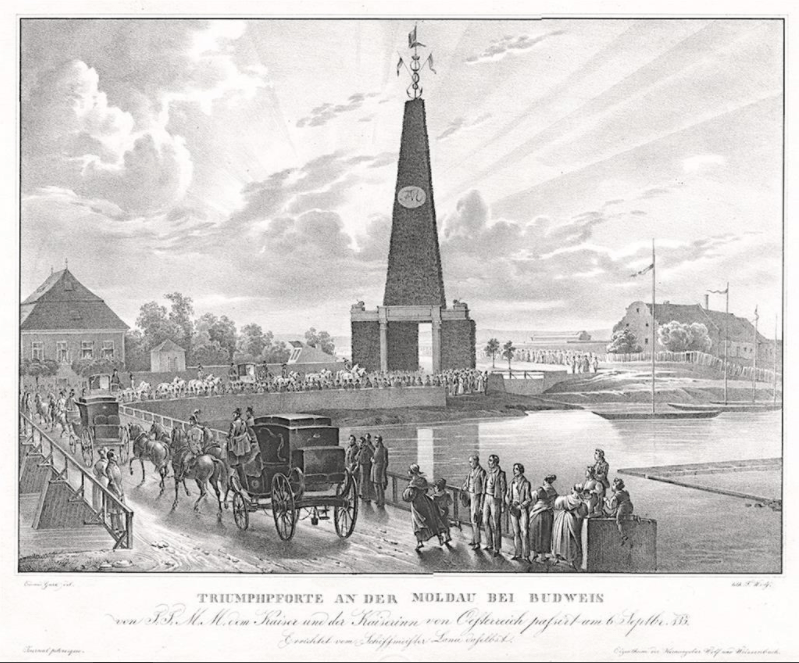
    He returned in 1333 (here he is being welcomed at Újezd) and was named Margrave of Moravia.

    Charles would soon prove to be a more energetic, authoritative and popular leader than his father, which is presumably what no father ever wants to hear.
    Support from Pope Clement IV – a former teacher and confidant – enabled the promotion of Prague from bishopric to archbishopric in 1344.

    But the Pope’s support would come in even more handily in 1346, when Clement supported Charles’ election as King of the Romans (and of Germany), replacing Louis IV (the Bavarian), who Clement seriously disliked.

    Later that year, John would die at the Battle of Crécy, and Charles also became King of Bohemia, a role he’d kind of being playing for the last thirteen years anyway. He’d also become Holy Roman Emperor in 1355.

    Charles made Prague his home, and really worked on turning it into the centre of the empire. Without him, we wouldn’t have the New Town, Charles Bridge, Charles University (the region’s first), and much more besides.

    Beyond Prague, Charles was also successful in increasing the size of the Bohemian crown lands, annexing Upper Lusatia, Lower Lusatia, and, ultimately, Brandenburg.

    However, this would be accompanied by family upsets – his first wife, Blanche de Valois, died in 1348. His second wife, Anne of Bavaria, died in 1353, and his third, Anna von Schweidnitz, in 1362.

    His fourth wife, Elizabeth of Pomerania, would outlive him.

    While his relations with the nobility were generally good, his attempts to codify Bohemian Law (in the Maiestas Carolina, written in 1350) were met with resistance, and by 1355 he’d given up on them.

    A year later, however, his Golden Bull, which set much of the constitutional structure of the Holy Roman Empire, including the system for election of its rulers, was adopted successfully.

    Charles would also find time to write an autobiography, Vita Caroli, as well as other works.

    He died in 1378 and was buried in Prague. In 2005, he was voted the greatest Czech ever in one of those shows that every country seemed to have around that time.

    He’s on here too.

    This leaves a lot out, obviously, but I get the feeling that a lot of the left out stuff will be used in future threads.

    But we’re not done yet, because this street has major footfall (it was on the Royal Route back when there were royals, and is an inescapable part of the tourist route now that there are tourists).

    Starting by Charles Bridge, the Church of the Most Holy Salvator was the Jesuits’ seat in Prague when they were a thing.

    Whereas the Chapel of the Assumption of the Virgin Mary – or Vlašská kaple – was the spiritual home of Prague’s Italian community (see https://whatsinapraguestreetname.com/2024/09/08/prague-1-day-31-vlasska/ for a language lesson).

    And then there’s St. Clement’s Cathedral, the cathedral of the Apostolic Exarchate of the Greek Catholic Church in the Czech Republic. (Note: while writing this, I developed mild nerves that this might be the wrong building, but I’m posting it anyway)

    All of these form part of the Klementinum, the largest complex of buildings in Prague after the Castle. It used to be a Jesuit college (1622-1773), and is now administered by the National Library of the Czech Republic.

    Non-Klementinum highlights of Karlova include U Zlatá studně (The Golden Well), now a hotel. On its façade, you can see Saint Wenceslas and John of Nepomuck, as well as two plague patrons and, on the top floor, Jesuit patrons.

    At the turn of the 1700s, the owners added these decorations to show their gratitude for surviving a plague epidemic.

    While, in 1714, U Zlatého hada (The Golden Snake) was apparently the location of Prague’s first cafe. A few more have opened since.

    Colloredo-Mansfeld Palace is where, in 1620, the royal council of Frederick V of the Palatinate met for the last time after the Bohemian army’s beyond-disastrous showing at the Battle of Bílá Hora.

    While Pöttingovský palác is currently home to Divadlo Ta Fantastika, a repertory theatre owned by Lucie Bílá (stop press: she’s gone and named it after herself now).
  • Originally published on X on 8 April 2024.

    A street sign that accessorises. I approve.

    ‘Malé náměstí’ translates as ’Small square’ (and the map above is another excellent reminder that we might translate náměstí as ‘square’, but it doesn’t necessarily need to be shaped like one.

    And the name – already fairly self-explanatory – makes more sense when you remember that Staroměstské náměstí (https://whatsinapraguestreetname.com/2024/10/12/prague-1-day-190-staromestske-namesti-old-town-square/) used to be known as ‘Velké náměstí’ – i.e. the big square.

    Anyway, let’s take a look around (a pleasingly colourful look around at that).

    Number 1, U anděla (The Angel), was once the pharmacy owned by Angelius de Florentia, Charles IV’s botanist; in the 18th century, it was owned by Ericsson. It now hosts the North Carolina State University European Center in Prague and the Polish Institute.

    Number 2, U Bílého lva (The White Lion), was the site of Prague’s oldest printing house (in 1487), where the first Czech Bible was printed.

    (Side note: this is clearly a later, Baroque modification, and the same goes for most buildings on this square)

    Number 3, Rottův dům, is named after the Rott family, who ran a hardware store here until 1948, when they fled Czechoslovakia (although the shop survived until 1989).

    Full disclosure: I once wound up at the Hard Rock Cafe for some event in 2017. There was a Roxette tribute band playing that evening. I f**king love Prague.

    Number 5 – which is where the street sign pic comes from – is called U Tří kominíčků (The Three Chimneys). It’s impressively narrow.

    This whole set is delightful, actually.

    Number 10, U Zlatého rohu (The Golden Corner), is used by various NGOs, including the Scout Institute.

    Richtrův dům was the home of Prague’s first telephone exchange (from 1882 to 1902, when it moved to Jindřišská (https://whatsinapraguestreetname.com/2024/09/19/prague-1-day-131-jindrisska/).

    And, again, I’m going to have to post a few more houses on the square, because, even if I don’t have anecdotes about them, just look how freaking pretty they are, as is the fountain in the middle of the square.

  • Originally published on X on 7 April 2024.

    Jiřík Černý was born around 1511 in Rožďalovice, near Nymburk, but there are no written mentions of him until 1534, when he gained a bachelor’s degree from the Faculty of Arts at Charles University.

    At some point (the years after his graduation aren’t well documented either), he changed his name to Jiří Melantrich (which is Greek for ‘black-haired’).

    His name does appear in 1545, when he published a book in Prostějov (Doktora Urbana Rhegia rozmlouvání s Annou, manželkou svou / ‘Dr. Urban Rhegius conversing with Anna, his wife’).

    Melantrich moved back to Prague a year or two later, bringing some of his printing materials with him. In 1547, however, Ferdinand I (pictured) banned the printing of non-Catholic books due to the Estates Revolt in the same year.

    Melantrich got around this by joining a company owned by Bartoloměj Netolický, a Catholic. His most famous publication would be the Melantrich Bible, or the Melantriška for short, first published in 1549.

    He would publish another 17 titles before buying Netolický’s share of the business in 1552 and essentially becoming a sole trader.

    In 1557, Melantrich was awarded a coat of arms and became known as Jiří Melantrich of Aventino; in 1558, he became an alderman of Prague’s Old Town.

    Key publications in the 1560s included Epistolarum Medicinalium libri quinque (Five Books of Medical Letters), containing medical letters written to patients by Pietro Andrea Mattioli, the Prague-based physician to King Ferdinand.

    As well as Mattioliho herbář, a Czech translation of Mattioni’s Discorsi (full title probably too long to fit into three posts, let alone one), his analysis of 100 recently-discovered plants, and a key work in the field of botany.

    He also published something with the excellent name of Knížka v českém a německém jazyku složená, kterak by Čech německy a Němec česky … učiti se měl – ‘A combined book in Czech and German, how a Czech should learn German and a German should learn Czech’ – in 1567.

    A new edition of the Bible, with new woodcuts, came out in 1570; interestingly (and unsurprisingly, given increased religions tensions at the time), it came under scrutiny from the Austrian censors despite its text being identical to the previous edition.

    That picture includes the only depiction that we have of Melantrich from the time.

    Inside, we have, for example, Moses drawing water from a rock in the desert and Jonah being thrown ashore by a whale.

    In 1576, Melantrich married his daughter Anna to Daniel Adam, a professor at Charles University, to whom he entrusted the printing house. However, their relationship became tense because Adam – known as Daniel Adam z Veleslavína from 1578 – answered back to the censors.

    Melantrich died in 1580, having published at least 233 works in his lifetime, and was buried in the Bethlehem Chapel (https://whatsinapraguestreetname.com/2024/10/01/prague-1-day-160-betlemske-namesti/). In a clear signal of how he felt about his son-in-law, he left the business to his son Jiří (and absolutely nothing to Veleslavín).

    However, Jiří would die in 1586, so Veleslavín took over the business again. He, in turn, would die in 1599, after which Veleslavín’s son took charge. It was, expectedly, confiscated and given to the Jesuits after the Battle of Bílá Hora, and never regained its past glory.

    Melantrich’s family house on this street – which has had its current name since 1894 – is long gone, but you do get to enjoy, for example, the building created for the Municipal Savings Bank of Prague (1891, the work of Antonín Wiehl and Osvald Polívka). And its exhibitions.

    Or attractive Renaissance buildings such as U pěti korun (The Five Crowns; originally in Gothic style but redone in 1615).

    Which is next to Dům U Košíku (The Basket) and Dům U Svatých Tří králů (The Holy Three Kings). Such beautiful buildings, yet people only ever walk past them in order to make it to the Astronomical Clock in time to see it do stuff for a few seconds.

    While, a little further on, you’ve got three addresses which used to be the monastery of the Order of the Servants of Mary, i.e. the Servites, which was attached to St Michael’s Church (https://whatsinapraguestreetname.com/2024/10/07/prague-1-day-173-michalska/).

    Melantrich was also the name of a publishing company founded by the Czech National Socialist Party (not related to that one) in 1897. During the First Republic, it was Czechoslovakia’s biggest.

    You may well recognise its former headquarters, especially if you’ve watched anything from November 1989 involving a balcony (https://whatsinapraguestreetname.com/2024/09/17/prague-1-day-123-vaclavske-namesti/).

    The printing house closed down in 1999.

  • Originally published on 6 April 2024.

    ‘Kůže’ means skin, but also leather. There are two modern-day adjectives derived from this: kožní and kožený. ‘Kožná’ is the feminine form of… well, neither, actually.

    Anyway, in the 18th century, number 8 in the street was a kožnice, i.e. a warehouse and shop for leather goods. Indeed, from about 1800 until 1870, the street was called U kožnice.

    I know there’s always the risk of something like that Spanish woman who restored that painting happening, but my goodness, this graffiti. Surely number 8 deserves a bit of vigilante justice.

    Even if it’s just to honour Artúr Görgei (1818-1916), one of the leading lights of the Hungarian Revolutionary Army, who studied chemistry at Charles University from 1845 to 1848 and lived here.

    Before its leather era, Kožná was known as U zlatého medvěda (The Golden Bear), after number 1 in the street, which is actually called U Dvou zlatých medvědů (the *two* golden bears).

    Currently owned by the Museum of the Capital City of Prague, it was, in 1885, the birthplace of Egon Kisch, a legendary reporter, best known for his travels across the world (he was known as Der rasende Reporter – the Furious Reporter), his communism and his hatred of Nazism.

    Kisch previously got a mention on https://whatsinapraguestreetname.com/2024/09/23/prague-1-day-139-panska/, and there will be more (especially when I get to the street named after him in Prague 4 / Nusle, which is likely to happen before the end of this year).

  • Originally published on X on 5 April 2024.

    A ‘kamzík’ is a chamois, i.e. a goat-antelope mainly found in the Alps, but also in the Tatras, Carpathians, Balkans and Pyrenees. One has to assume they like mountains.

    Closer to home, they were planted (can one plant an animal?) into the Sudetes (AKA the Krkonošsko-jesenická subprovincie, or Sudety) in the early 20th century, and apparently these chamois are the healthiest in Europe.

    Number 4 in this street is called U bílého kamzíka (The White Chamois), and has been called that since about 1650. Around 1800, the street followed suit.

    So I guess it’s nice to realise it’s not named after their hides being flogged at one of the nearby markets (spoiler: not the case for tomorrow’s street).

    Kamzíková features some quite well-known buildings, many of them part of the Karolinum complex (https://whatsinapraguestreetname.com/2024/10/09/prague-1-day-179-ovocny-trh/). Of course, it only features their behinds, and you’re better off going to Ovocný trh or Celetná (https://whatsinapraguestreetname.com/2024/10/09/prague-1-day-180-celetna/) for a proper look at them.

    Indeed, the street was known as Za Karolinem until 1800. But back in the Middle Ages, it was called Pleierova, after Oldřich Pleier, the owner of number 9 (which, in its current form, is called U Černého slunce, or the Black Sun, and, yes, looks better on Celetná).

    Kamzíková itself is more of a passageway between more important streets, and, while you might think that makes it sound quite appealing… it’s kind of not.

  • Originally published on X on 4 April 2024.

    On one end of Železná, you had the Old Town’s most important medieval market (https://whatsinapraguestreetname.com/2024/10/12/prague-1-day-190-staromestske-namesti-old-town-square/)…

    …and, on the other end, you had another one which was almost as important (https://whatsinapraguestreetname.com/2024/10/08/prague-1-day-175-havelska/).

    So, it made sense for people with an interest in trade and selling to settle here. Such as traders in iron, i.e. ‘železo’.

    The street name ‘Železníků’ can be traced as far back as 1354, but got simplified to its current form in the 15th century.

    Meaning it’s sadly nothing to do with Železník (1978-2004), four-time winner of the Velká pardubická steeplechase.

    Železník’s mum and dad were called Želatina and Zigeunersohn; Želatina gave birth to Želka, Žeton, Žitomír, Žikava, Žerotín and Železník, proving that animals get more exciting names than we do.

    It’s also nothing to do with Železná Sparta, which is the nickname given to Sparta a hundred years ago, when they might have been the best football team in Europe: https://gameofthepeople.com/2023/12/19/100-years-ago-iron-sparta-were-probably-europes-best/.

    Železná is largely a thoroughfare for tourists to get from A to B (much as the traders used it once upon a time), but also includes this very worthy addition to Prague: https://www.praguepride.cz/en/events/community-center.

  • Published on X on 2 and 3 April 2024 (there was a fair amount to say).

    Part 1: the history

    In 1338, John of Luxembourg (King of Bohemia from 1310 to 1346) gave the Old Town permission to build itself a town hall. This seemed like the perfect location, as a major market had existed here for centuries (https://whatsinapraguestreetname.com/2024/10/12/prague-1-day-189-tynska/).

    Rather than build something from scratch, the councillors decided to buy property from rich families and adapt it.

    By 1364, the Town Hall had a tower – Prague’s tallest at the time, and not significantly changed in the centuries since.

    As a result, the square was called Staré tržiště (The Old Marketplace), which changed to Staroměstský rynk (Old Town Market) in the 14th century (note how ‘rynek’ is still the standard Polish word for ‘market square’, and Poland has a lot of fine ones).

    In 1410, an astronomical clock, largely the work of Mikuláš of Kadaň and Jan Šindel, was inaugurated. It’s the oldest clock of its kind that’s still in operation.

    Its current decorations are from 1490 (possibly carried out by Jan Růže), and the clock was worked on by Jan Táborský of Klokotská Hora in the mid-16th century. It’s not changed fundamentally since (the crowds have increased, though).

    In 1422, not long after the clock came into existence, Old Town Square saw one of its most infamous events, when Jan Želivský (https://whatsinapraguestreetname.com/2022/11/19/prague-3-day-23-jana-zelivskeho/) was arrested by the Prague town council and then beheaded here.

    But that was outdone in gruesomeness 199 years, later, when the Habsburg regime executed 27 Czechs who had led the Bohemian Revolt, which had been quashed by the Czech defeat at the Battle of White Mountain (Bílá Hora) the year before: https://english.radio.cz/400-years-pragues-old-town-square-executions-8720953.

    In 1650, Old Town Square gained the Marian Column, which was Ferdinand III’s way of saying thanks to Prague for defeating the Swedes in 1648.

    One might say that not forcing people to convert to Catholicism is another good way of showing gratitude, but hey.

    The first picture shows it as it looked around 1900; the second shows it as it looked in 1918, when it was pulled down by a group of Žižkov firemen, encouraged by Franta Sauer (https://whatsinapraguestreetname.com/2022/11/22/prague-3-day-76-sauerova/).

    It was then restored in 2020, supported by ODS and ANO among others, but not so much by people like Mayor Zdeněk Hřib who (like me) don’t exactly see it as a symbol of tolerance, religious freedom or independence: https://english.radio.cz/marian-column-returns-old-town-square-after-more-a-century-8682622.

    By the 17th century, the square had come to be known as ‘Staroměstský plac’ (Old Town Market) or ‘Velké náměstí’ (Big Square).

    In 1784, when the Old Town, New Town, Malá Strana and Hradčany became one administrative unit, the town halls of the last three were closed down, and the one on Old Town Square started to serve the whole of Prague.

    Key events in the 19th century included the Neo-Gothic extension of the Old Town Hall (1838-1848), the official introduction of Staroměstské náměstí as the square’s name (1895), and – hard to imagine now – the introduction of trams. They would run until 1966.

    Here’s a picture of one going past the Astronomical Clock, an image so unimaginable that I’m half-expecting to find out it’s made by AI.

    At the start of the 20th century, Old Town Square wasn’t immune to the ‘rehabilitation’ (asanace) that aimed to improve hygiene but also destroyed a lot of cultural heritage.

    One victim was the Krenn House, one of the largest Baroque houses in the Old Town.

    Old Town Square has always been a popular place for demonstrations – this picture is of a demonstration in support of universal suffrage, held in November 1905.

    In 1915, a monument was erected to Jan Hus, 500 years after he was executed. Financed by public donations, it soon became a symbol of resistance to Habsburg rule.

    This therefore made it an inevitable location for pro-independence demonstrations in 1918 (the speakers in this two pictures are the politician, Václav Klofáč, and the lawyer and soon-to-be Inspector General of Czechoslovakia’s armed forces, Josef Scheiner).

    During the Prague Uprising in May 1945, the Town Hall was captured by insurgents and became one of the main targets of Nazi fighters, who set the building on fire, destroying part of the city archives. The Neo-Gothic extension had to be demolished: https://www.esbirky.cz/predmet/150989?searchParams=.

    In November 1962, a bomb went off on Old Town Square during a celebration of the Great October Socialist Revolution.

    29 people were injured; the Communist media didn’t devote a single word to the incident, and the case remains unsolved: https://cesky.radio.cz/vybuch-na-staromestskem-namesti-v-roce-1962-se-vysetrit-nikdy-nepodarilo-8767167.

    Also unsolved is the story of a pipe bomb which exploded at the foot of the Jan Hus statue in June 1990, injuring 18.

    This is how it was reported by the LA Times at the time: https://www.latimes.com/archives/la-xpm-1990-06-03-mn-803-story.html.

    And footage from the TV news: https://ct24.ceskatelevize.cz/clanek/specialy/30-let-zpet-vybuch-na-staromestskem-namesti-49018.

    Another bomb would go off at Hostivař a couple of month later, made from the same piece of pipe: https://ct24.ceskatelevize.cz/clanek/specialy/30-let-zpet-hostivarska-bomba-47510.

    You may also want to take a look at https://whatsinapraguestreetname.com/2024/09/29/prague-1-day-155-krocinova/ to learn about a fountain which isn’t on the square anymore.

    Part 2: the buildings

    Mikšův dům once belonged to a furrier by the name of Mikeš, but (after a fire) was bought by the Old Town in 1458 and incorporated into the Town Hall.

    Next door, Dům kramáře Kříže, has a very similar story – Kříž was a shopkeeper who bought the house in 1387, and it too became part of the Town Hall in 1458. It includes council chambers, one of which is used for weddings.

    Dům U Minuty is famous not only for its freaking wonderful sgraffito decorations, but also because Franz Kafka lived here from 1889 to 1896 (and all three of his sisters were born here).

    The Church of Saint Nicholas was built from 1732 to 1737, replacing what had been a centre of Hussite ideology back in the day. It was reinstated as a Hussite church in 1920.

    The former building of the Prague Municipal Insurance Company is now the Ministry for Regional Development of the Czech Republic.

    (Briefly imagines getting to go to work on this square every day)

    These are the buildings that were destroyed to make way for this one in 1899.

    While here, what is now a restaurant was once part of a monastery dedicated to St Salvatore. The other buildings that were part of the monastery were destroyed as part of the ‘clean-up’ of Prague that took place in 1902-3.

    In 1843, Palác Kinských, a standout even on a square like this, was the birthplace of Bertha von Suttner. In 1905, she would become the first woman to win the Nobel Peace Prize.

    Next door, U Kamenného zvonu (The Stone Bell) is used by the Gallery of the Capital City of Prague.

    Štorchův dům was built in 1896-7 for a publisher, Alexander Štorch. What you see is a restoration from 1948 (with later modifications), as the house was burned down during the Prague Uprising in May 1945.

    U Kamenného beránka (The Stone Lamb) was once a literary and cultural salon, run by Berta Fantová and attended by, among others, Albert Einstein, Christian von Ehrenfels, Max Brod and Franz Kafka (who we’ve established didn’t have much of a commute to get there).

    U Červené lišky (The Red Fox) was purchased by Coast Capital Partners in 2017 for ‘the highest known sum in the Czech Republic that a buyer was willing to pay for a house in the centre’ (CZK 230,000 per square metre, and I don’t feel I’ve helped anyone by specifying that).

    While I don’t have specific comments on Dům Na Kamenci other than that I love that colour.

    In non-building territory, the Prague Meridian was used to tell the time until 1918 (high noon was determined by a shadow cast by the Marian Column). The marker on the ground says ‘The Meridian according to which time in Prague was determined in the past’ in Czech and Latin.

    Seriously, though, what a city.

  • Originally published on X on 1 April 2024.

    In 965, Ibrahim ibn Yaqub, an Arabic-speaking, Sephardi Jewish traveller (and probable merchant) whose family came from what is now Tortosa in Catalonia, travelled to Prague.

    He wrote about his trip – and what he wrote is the oldest written reference to Prague that we have.

    He wrote that it was ‘the largest city in terms of trade’ with a market where people sold and bought slaves, tin, furs and food.

    It’s highly possible that he was talking about this spot here.

    Even if he wasn’t, a market definitely existed in this spot by the 1100s. It had a ‘merchant’s centre’ which was fortified, with a moat, walls and two gates, and anyone who wanted to enter had to pay a fee – or Ungelt (in German).

    However, once traders had paid this, it was worth it – they could sleep here, as could their horses, for whom there was a stable, and they could store their supplies. So important was the centre that it had its own Romanesque church (dedicated to the Virgin Mary) and a hospital.

    As for the Czech name, there’s an Old Slavic word – tynъ – which means ‘wall’. It’s assumed that this is of Germanic origin, an origin which has since given us the German ‘Zaun’ (wall), the Dutch ‘tuin’ (garden), and – wait for it – the English ‘town’.

    As the Old Town grew in importance, the original church was replaced by an Early Gothic church in 1256, but, by the mid-1300s, the parishioners were quite flush with cash and decided to fund something even grander.

    Construction was initially led by Matthias of Arras (responsible for the early stages of St Vitus’ Cathedral) and Peter Parler (who took over work on St Vitus’ after Matthias died, and was also responsible for Charles Bridge). It was ready for use – if not complete – by 1380.

    The church fell into Hussite control (from 1427, its vicar was Jan Rokycana – https://whatsinapraguestreetname.com/2022/11/19/prague-3-day-19-rokycanova/), but the ensuing wars, combined with the fact this construction was taken a bit more seriously than that of a panelák, meant that it wasn’t completed until 1511.

    More gruesomely, the roof of the church couldn’t be built as planned, as, in 1437, Emperor Sigismund – not, shall we say, a Hussite stan – had decided that the timber meant for this job should be used to build gallows for the execution of Jan Roháč (https://whatsinapraguestreetname.com/2022/11/25/prague-3-day-81-rohacova/).

    After the Battle of Bílá Hora in 1620, the church was, like Bohemia itself, subject to forced recatholicisation – the statue of George of Poděbrady (the only Hussite king) was replaced by a relief of the Madonna, and Rokycana’s tombstone was destroyed, as were his remains.

    After the Thirty Years’ War, the interior was redone in Baroque style, but the church suffered fires in both 1679 and 1819. It always seems to have some kind of renovation going on.

    Back to the Ungelt/Týn, wealthier Prague residents would start to build their own homes around the market in the 1300s (though none of these are the originals because, yes, fires).

    After the Hussite Wars, Prague’s position as a centre of international trade had been massively screwed, and the Ungelt became a place for domestic trade only.

    In 1774, the customs office moved to Haštalská, and Ungelt/Týn became neglected. After reconstruction work, it was opened to the public again in 1996.

    Number 2 (or, if you prefer, number 14 on Old Town Square) is the Týnská škola / Týn School, which operated from 1394 until 1842. Teachers here included both Jan Rokycany and Matěj Rejsek (https://whatsinapraguestreetname.com/2024/08/19/prague-2-day-76-rejskova/) of Powder Tower fame (https://whatsinapraguestreetname.com/2024/10/10/prague-1-day-181-u-prasne-brany/).

    Number 3, U Černého slona (The Black Elephant), is now a hotel whose website says it’s had some pretty important guests (Tycho Brahe, Václav Havel, Madeleine Albright).

    While number 7, Palác Budovců z Budova, is named after one of its owners, Václav Budovec z Budova, who would be executed just a stone’s throw away on Old Town Square in 1621, four years after he purchased the house. He’s commemorated by a statue on the façade.

    And number 6, U Zlatého prstenu (The Golden Ring), was reconstructed by the Czech-Croatian architect Vlado Milunič in the 1990s. Since 2016, it’s been part of the Museum of the Capital City of Prague.

    Finally, U Černého jelena / The Black Stag was the birthplace of painter Karel Škréta (https://whatsinapraguestreetname.com/2024/02/18/prague-2-day-34-skretova/), and this, too, is commemorated by a plaque.

    There are two more streets named after Týn – including one which is the complex itself – so expect to see some of these buildings from slightly different angles in future posts.

  • Originally published on X on 31 March 2024.

    Yesterday, I gave you the brief things that we know about Mr Štupart: https://whatsinapraguestreetname.com/2024/10/12/prague-1-day-187-stupartska/.

    Today, I’m able to give you the address where he once owned a house (from 1664), but not the house itself, as that was demolished in 1911.

    The street was originally called Štupartská, just like its neighbour, but gained an adjective in 1925. I’m not convinced that it’s actually the smaller of the two streets, and, if it is, it’s not by a significant amount.

    Malá Štupartská is also where I took the pictures of St James’s Church on here: https://whatsinapraguestreetname.com/2024/10/11/prague-1-day-185-jakubska/.

    So, inevitably, to the left of the church, you’ll find the buildings of the former monastery (numbers 6 and 8). One of them is now a school.

    Across the road at number 7, Dům U Božího oka (God’s Eye House) is part of the Týn complex (more on that soon). Another victim of the fire of 1689, it was restored in early Baroque style in 1694.