What's in a Prague street name

Every street in Prague, one by one.

  • Originally published on X on 28 March 2023.

    U Nemocnice was built before 1750.

    Until 1750, this was Dobytčí. That’s the adjective coming from dobytek – livestock – and recalls the market that used to exist here.

    Then it was named Ústavní (‘institutional’), after a local institute for noblemen. This lasted until 1800, when the name Lípová was introduced, which stuck until 1869 (https://whatsinapraguestreetname.com/2024/08/31/prague-2-day-135-lipova/ is current-day Lípová, and now I get why that was called ‘lower’ Lípová until 1880).

    U Nemocnice (‘By the Hospital’) has been the street’s name since 1869. The hospital in question is Všeobecná fakultní nemocnice v Praze (General University Hospital in Prague / VFN).

    When Joseph II came to power in 1780, he had quite a few ideas, the most remembered of which involved banning several monastic orders and liquidating about 140 monasteries.

    However, he was also interested in improving public health facilities, particularly for the poor, and these were to be funded, in part, by proceeds from the closure of the monasteries, as well as poorhouses and other medical facilities that weren’t up to scratch.

    Joseph founded Vienna’s General Hospital in 1784, followed by equivalent facilities in Brno (1786 – now known as St Anna’s), and Olomouc (1787).

    VFN would follow in 1790. It would have opened earlier, but there were disagreements on where it should be located – Karlov didn’t have a good water supply, so present-day Náměstí Republiky and Strahov were considered instead.

    It was Joseph himself who intervened, suggesting an underused building on the location of the former cattle market (namely the aforementioned institute for nobles). Expensive reconstruction started in 1789, with the hospital opening a year later.

    The hospital was designed to provide care to all patients, irrespective of their status, religion or nationality; poor citizens of Prague got care for free, as long as they could prove their circumstances (and had lived in Prague for ten years).

    Nowadays, the hospital is one of the most important institutions in Prague, and, with the First Faculty of Medicine of Charles University, is also renowned for its teaching, science and research.

    It’s exactly 25 years and two days since VFN was where Parkinson’s disease was operated on for the first time in the Czech Republic: https://www.novinky.cz/clanek/zena-zdravi-pred-25-lety-se-v-cesku-poprve-operovala-parkinsonova-nemoc-blanku-operace-mozku-vratila-do-zivota-40426604

    VFN also recently announced that it was opening a new intensive care unit for the morbidly obese: https://www.expats.cz/czech-news/article/rise-in-extreme-obesity-leads-to-opening-of-new-metabolic-unit-in-prague

    Meanwhile, if you enter the hospital’s grounds, a statue of old Joe still awaits you: https://cs.wikipedia.org/wiki/V%C5%A1eobecn%C3%A1_fakultn%C3%AD_nemocnice_v_Praze#/media/Soubor:Socha_Josefa_II._na_n%C3%A1dvo%C5%99%C3%AD_VFN_Praha.jpg

  • Originally published on X on 27 March 2023.

    Salmovská was built in the 15th century or earlier.

    Until the 15th century, the street was called Krupná, after which it changed slightly to Krupičná.

    There used to be a market here, and the names are presumably linked to what was on sale – krupice is semolina, and krupka is groats, or pearl barley.

    he street was called Salmova from 1750 to 1870; since then, it’s had its current name.

    The House of Salm was a noble dynasty, founded in the 11th century in Salmchâteau, nowadays a village in south-east Belgium.

    In the 12th century, an offshoot of this family was first mentioned – the Salm-Reifferscheidts, originating in the Rhineland.

    Over the centuries, proving that some people can never have enough surnames, further offshoots occurred: Salm-Reifferscheid-Bedburg, Salm-Reifferscheidt Krautheim, Salm-Reifferscheidt-Raitz and Salm-Reifferscheid-Dyck.

    The House of Salm-Reifferscheidt-Raitz came into being in 1734, after some sort of split among the Bedburgs.

    Raitz, is, nowadays, Rájec-Jestřebí in Blansko District in Moravia.

    One Antonín Karel Salm-Reifferscheid bought Rájec and had its castle rebuilt in the 1760s. The Salms also had a good number of palaces in Prague, including this one: https://www.ngprague.cz/en/about/buildings/salm-palace

    One of the family – Hugo Karel František Salm-Reifferscheidt-Raitz, born in 1832 – apparently enhanced a large garden which was on this spot, and it became a popular hangout for students (basically a co-working space for the pre-wifi age).

    However, it started to disappear in the 1860s, as the number of buildings in the area increased.

    Also in the ‘however’ corner: there are record of the street being called Salmova long before the garden was upgraded.

    It’s not fully clear if the street was named after a specific Salm, or all of them (‘Salmova’ would apply one, ‘Salmovská’ several).

    I’m now also wondering exactly who founded / built up / stopped giving a toss about the garden.

    The family’s status as one of the most important landowners in Moravia somewhat inevitably came to an end in 1945.

    On 29 June 1914, the day after Franz Ferdinand was assassinated in Sarajevo, a fictional guy called Švejk spent a few hours at the police station on Salmovská, perfectly oblivious to world events (Hašek referred to the street as Salmova, though).

  • Originally published on X on 26 March 2023.

    Pod Větrovem was built in 1894.

    We’ve touched on this one briefly before: Větrník, Větrná hora or Větrov is the (windy) hill which the Church of St. Apollinaire was built on https://whatsinapraguestreetname.com/2024/08/25/prague-2-day-113-apolinarska/.
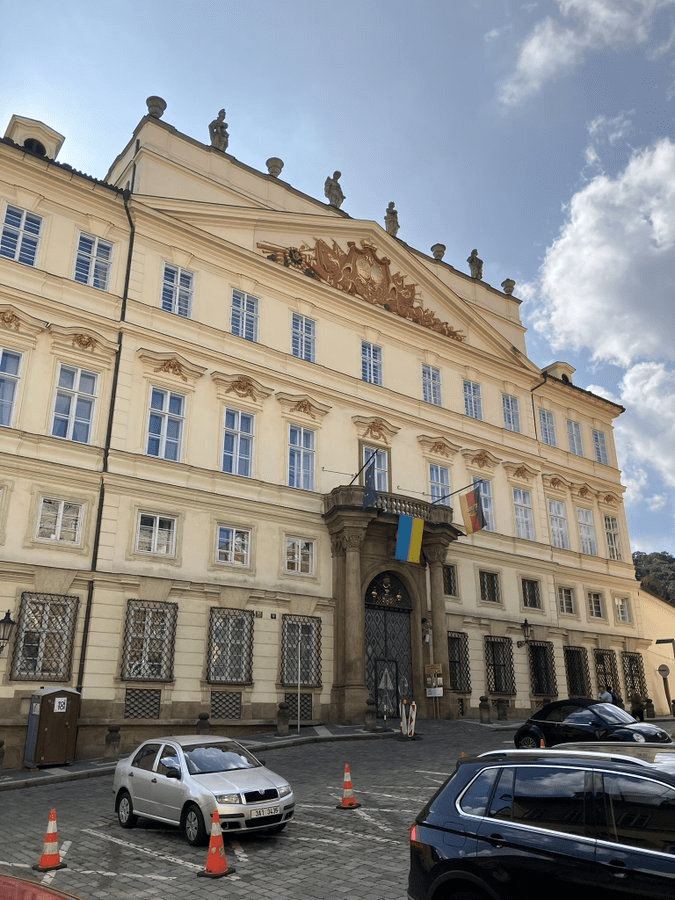
    In a mildly desperate bid to pump this thread up a bit, let’s look at some words for different types of wind (vítr) in Czech, using our old friend, the Beaufort scale / Beaufortova stupnice.

    At 0, you’ve got bezvětří, i.e. things are completely calm (unless it’s thirty degrees, in which case you are almost certainly not).

    At 1, you’ve got a vánek, a breeze, whereas, at 2, you’ve got a větřík, a ‘small wind’, or a slabý vítr, literally ‘a weak wind’.

    At 3, the ‘weak’ wind has become mírný – mild – but go up to 4, and you’re dealing with a dosti čerstvý vítr – a ‘quite fresh wind’. And to think the world makes fun of us Brits for phrases like that.

    5 is a čerstvý vítr – a fresh wind, while, when you get up to 6, you’ve got a silný vítr to deal with – a strong one.

    This, in turn, becomes a prudký vítr, an intense wind, at 7.

    Becoming progressively less fun, 8 is a bouřlivý vítr (a stormy wind), 9 is a vichřice (gale), and 10 is a silná vichřice (a strong gale).

    11 is a mohutná vichřice – a hefty wind – and 12 is an orkán, a hurricane.

    The windiest place in the Czech Republic is Milešovka, which we covered here: https://whatsinapraguestreetname.com/2023/12/23/prague-3-day-190-milesovska/.
  • Originally published on X on 25 March 2023.
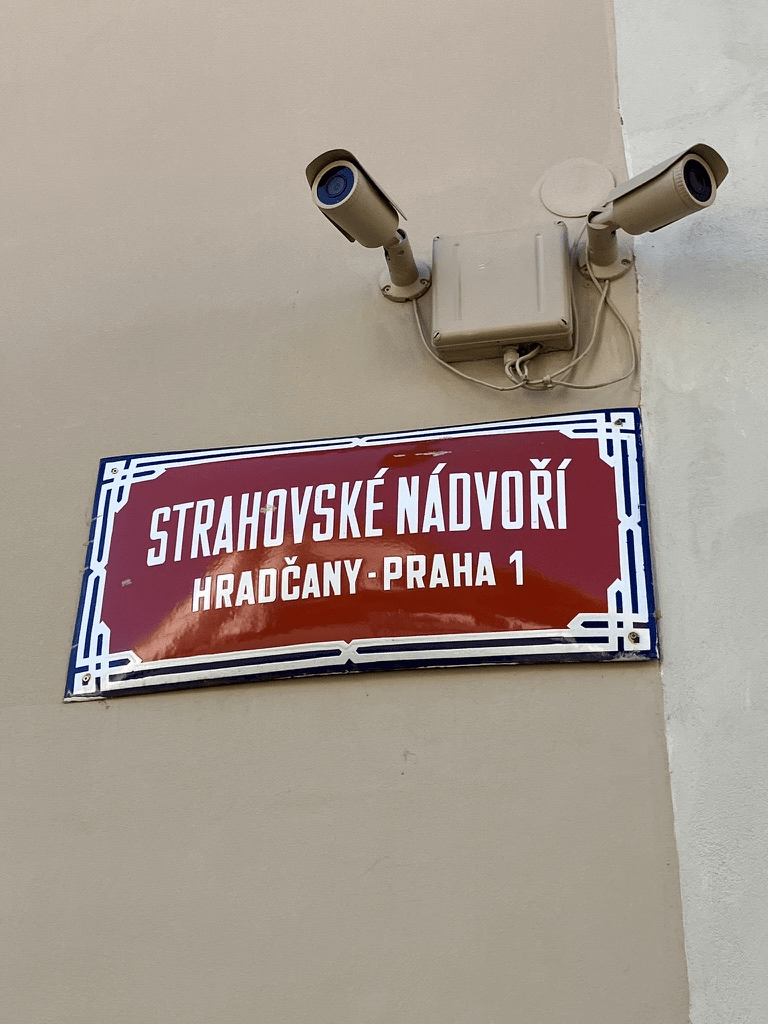
    Lípová was built in the 14th century.

    Until the 17th century or so, this was Svaté Kateřiny (St Catherine’s), after the convent-then-monastery: https://whatsinapraguestreetname.com/2024/08/28/prague-2-day-128-katerinska/

    It then became Lípová or U Lip until about 1800, before turning into Zadní Lipová until 1880, at which point the name ‘Lípová’ stuck.

    A lípa is a linden tree, and, much like with Pod Lipami in Žižkov (https://whatsinapraguestreetname.com/2022/11/20/prague-3-day-48-pod-lipami/), the street was so called because of the presence of these trees in the surrounding area.

    In June 1848, the Prague Slavic Congress was held. It was the first occasion, or one of the first occasions, in which a multitude of voices from different Slavic groups were heard.

    Like so many momentous events, it also suffered from a lack of clear objectives, as well as the fact that many of the attendees wanted completely different things. However, one thing that was agreed on was that the linden tree should be the national tree for Czechs.

    It’s also the national tree for Slovaks, Slovenes, and the somewhat less Slavic Latvians (although they’ve decided to have the oak as a national tree too).

    Logically, linden branches have also found their way onto the flag of the President of the Czech Republic:

    Apparently, disparaging the flag can land you a fine of up to CZK 10,000, so please comment carefully.

    But please also enjoy this quality moment in which I remind you all that the President of the Czech Republic is no longer Miloš Zeman.

    From 1990 until 31.12.1992, the Pravda vítězí part was actually Veritas vincit instead, in order to not ruffle any Slovak feathers at a time when people were falling out over hyphens and stuff.

    Things whose names originate from lipa include lipanj (Croatian June), lipiec (Polish July), липень (Ukrainian July), the 100 lipa which made up a Croatian kuna until they adopted the Euro this year, Lipizzan horses, and Leipzig.

  • Originally published on X on 24 March 2023.

    Ječná was built a long time ago.

    In 1348, Karel IV founded Prague’s New Town. There was a barley market (barley = ječmen) in this location, whereas, just to the north, there was a rye market (https://whatsinapraguestreetname.com/2024/02/27/prague-2-day-36-zitna/).

    However, the (former) market sold pork as well as barley, and therefore came to be known as Svinský trh. The street, meanwhile, became known as Svinská, and the gate at the end of it as Svinská brána.

    Like the Rye Gate (https://pic.x.com/n31rbnwlce), it was destroyed in 1875 as the old city walls were gradually demolished.

    The street has been called Ječná since about 1750.

    In 2016, the Czech Republic was the world’s 17th-largest producer of barley, between Ethiopia and Romania, and two spots ahead of China.

    1,845,254 tonnes of the stuff were produced here in that year, and the best barley apparently comes from the Vyškov and Mělník regions.

    I’m going to be incredibly intuitive and suggest that the large amount of production might possibly, just possibly, have something to do with the fact that barley is used to make beer.

    Number 7 on Ječná was the long-term residence of Milan “Mejla” Hlavsa (1951-2001), founder of Plastic People of the Universe. During totalitarianism, his flat became a hangout for many members of the underground.

    There used to be a memorial plaque to Hlavsa here, and, if you put 10 crowns into it, it would play his most famous song, Muchomůrky bílé, which also has an incredible, moody, Prague-based video:

    But then some tosspot decided to steal the plaque in 2011. The building itself is currently under some much-needed reconstruction.

    If you’re having an off day, here’s 18 seconds of photos of Czechs on Ječná on 22 February 1998, celebrating the national ice hockey team’s first ever gold medal at the Winter Olympics:

  • Originally published on X on 23 March 2023.

    Náměstí I. P. Pavlova was built in 1897; nowadays, it’s home to Prague’s busiest metro station.

    Until 1925, this was Komenského náměstí, and was presumably changed because there already was one in Žižkov: https://whatsinapraguestreetname.com/2022/11/26/prague-3-day-82-komenskeho-namesti/

    It then became náměstí Petra Osvoboditele. Petr Osvoboditel is King Peter the Liberator, Petar I Karađorđević, or Peter I of Serbia, first King of Yugoslavia from 1918 until his death in 1921.

    In 1942, the Nazis, who had invaded Yugoslavia a year previously, renamed the square U Slepé brány / Am Blindentor, after a building that, until 1875, stood where Ipak is now.

    After a brief trip back to being named after old Pete (1945-48), it then became náměstí Říjnové revoluce (October Revolution Square) until 1952.

    Ivan Petrovich Pavlov, meanwhile, was born in Ryazan in 1849. He studied in a theological seminary, but then quit to devote himself to science.

    He started studying physiology in St Petersburg in 1870, and received his medical degree nine years later.

    In 1891, he was given permission to set up a physiological department at the city’s Military Medical Academy.

    Here, he would investigate the gastric function of dogs by analysing their saliva, noting that dogs would often salivate before they started eating their food.

    This led him to distinguish between two types of reflexes – as well as innate reflexes, there are conditioned reflexes, which are caused indirectly by certain combinations of stimuli.

    He also proved that the digestive process is, in part, regulated by the nervous system.

    For his work, he was awarded the Nobel Prize in Physiology or Medicine in 1904.

    After the October Revolution, Pavlov refused to hide his disdain for the Bolshevik regime, and even asked to move to Sweden.

    The request was not granted; instead, the regime entrusted him with management of the Physiological Institute of the Academy of Sciences of the USSR.

    Pavlov died of bronchopneumonia in Leningrad in 1936; in shocking ‘people in the Kremlin being full of sh*t’ news, the powers-that-be lauded him as a model of Soviet science.

    You will probably know that the square is popularly referred to as Ípak or Pavlák.

    However, other nicknames for it include Slinták, Slinťák or Slintáč – and slintat is to slobber, dribble or drool. Which makes sense (and is incredble).

    This has suddenly reminded me of the day in 2009 when I decided to take a picture of every single metro station in Prague. Which, looking back, was the sort of obsessive nerdiness that has led to this entire series.

  • Originally published on X on 22 March 2023, when I also forgot to take/add a photo of the street sign. Maybe I’ll go out and take one now.

    Tyršova was built in 1893.

    Fridericus Emanuel Tirsch was born into a German-speaking in Děčín in 1832. By the age of six, he had lost both parents and two sisters (the father and sisters all dying of tuberculosis).

    He was then brought up by the family of his late mother’s brother, moving to Prague in 1841. Never in the best of health, he was advised by his doctor here to take up gymnastics.

    He also got seriously into Czech patriotism, insisting on taking his final school exams in Czech (not his native language), and changing his first name first to Bedřich, then to Miroslav.

    After starting law studies at Charles University, he realised this wasn’t his thing, so he switched to philosophy and aesthetics, graduating in 1855 and becoming a private tutor near Beroun.

    During his tutoring years, he also worked on Czech gymnastics terminology, and befriended one Jindřich Fügner (https://whatsinapraguestreetname.com/2024/07/06/prague-2-day-58-fugnerovo-namesti/).

    In 1862, he and Fügner created a not so little something called Sokol, which I wrote a not so little something about here: https://whatsinapraguestreetname.com/2024/08/26/prague-2-day-114-sokolska/

    Tyrš was a man of many other interests, though, particularly visual arts and aesthetics, which led him to take many study trips to England, France and Germany and produce multiple books on the subject.

    After Fügner died in 1865, Tyrš worked as a tutor for his daughter, Renata. They would end up getting married in 1872, when Tyrš was 50 and Renata was, erm, 18.

    In 1882, just after Charles University had split into German and Czech parts, Tyrš was appointed a docent at the Philosophical Faculty, and, a year later, a professor of art history.

    However, when on holiday in the Ötztal (Tirol) in the summer of 1884, he went for a walk and never came back.

    His body was found in the Ötztaler Ache river just under two weeks later. The circumstances around his death were never clarified.

    He’s buried next to Fügner in Olšany Cemetery. There’s also a memorial to him at the Sokol on Polská (https://whatsinapraguestreetname.com/2024/01/27/prague-2-day-14-polska/).

    A bit further afield (because the Sokols did spread their wings pretty far), there’s a Tiršova street named after him in the Savski venac district of Belgrade, which contains the biggest children’s hospital in Serbia: https://tirsova.rs/

    While this list makes it look like street-namers over the years have loved him almost as much as they did Jan Hus: https://commons.wikimedia.org/wiki/Category:Tyr%C5%A1ova_streets_in_the_Czech_Republic

  • Originally published on X on 21 March 2023.

    Na bojišti (On the battlefield) was built in the Middle Ages.

    Called Bojiště until 1822, it was then renamed U blázince (‘At the madhouse’) until 1880, after the institution on Kateřinská (https://whatsinapraguestreetname.com/2024/08/28/prague-2-day-128-katerinska/). Thank goodness it’s not called that anymore.

    In the mid-to-late 12th century, Henry II, Duke of Austria, started to colonise Vitorazsko, a region which is now shared between Austria (where the main town is Gmünd) and Czechia (where the main town is České Velenice).

    Soběslav II, then Duke of Bohemia, got a little bit narked at his territory being stolen, so much so, that, in 1176, he started looting the churches in the region. Henry had a moan about this to Frederick Barbarossa, Holy Roman Emperor.

    In 1178, Barbarossa – who already felt that Soběslav was a bit too cocky – had him replaced with Bedřich (who had himself been replaced by Soběslav five years earlier).

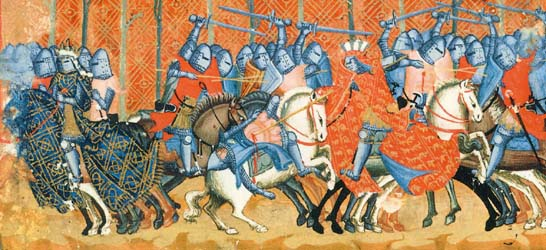
    Soběslav, however, wanted a rematch. On 23 January 1179, the two men’s armies clashed at Loděnice, near Beroun, where Bedřich was heavily defeated and only escaped death by fleeing.

    On 27 January, Soběslav’s army arrived at the Nusle Valley. Bedřich’s army launched an attack where Na Bojišti is located now.

    Soběslav’s army, which was less numerous and exhausted by its previous battles at the coldest time of year, was defeated. Soběslav himself retreated abroad, dying in 1180 (we don’t know where).

    Bedřich, meanwhile, would rule until 1189, though ‘rule’ may be a strong word, given that he was largely a puppet of the Holy Roman Empire throughout.

  • Originally published on X on 20 March 2023.

    Melounová was built in 1890.

    Confession: I sometimes get *really* nervous about getting the diacritics on these street names wrong.

    So it was something of a comfort to find out that, until 2019, the street sign here was incorrect (Melounova): https://encyklopedie.praha2.cz/ulice/75-melounova

    Melounova would imply the existence of a Mr Meloun at some point; Melounová implies the existence of something else.

    And that something else was a house called U zlatého melounu (‘At the golden melon’), not to be confused with the house of the same name just off Old Town Square.

    The existence of the house in the Old Town also means that Googling the one in the New Town is proving to be a bit of a pain in the ass (also, Google Maps hasn’t got the 2018 memo yet, and still thinks the street is called Melounova).

    It seems the house doesn’t exist anymore, but either I’m searching in all the wrong places or its destruction is remarkably undocumented for somewhere so central. Ah well.

  • Originally posted on X on 19 March 2023.

    Viničná was first mentioned in 1869.

    This is a remarkably quick one: a vinice is a vineyard, and readers of the Prague 2 posts won’t be too surprised to know that there were once several of these round here.

    Once upon a time, pre-Viničná, there was another street just to the west of here, called Větrník, and named after the local hill: https://whatsinapraguestreetname.com/2024/08/25/prague-2-day-113-apolinarska/.
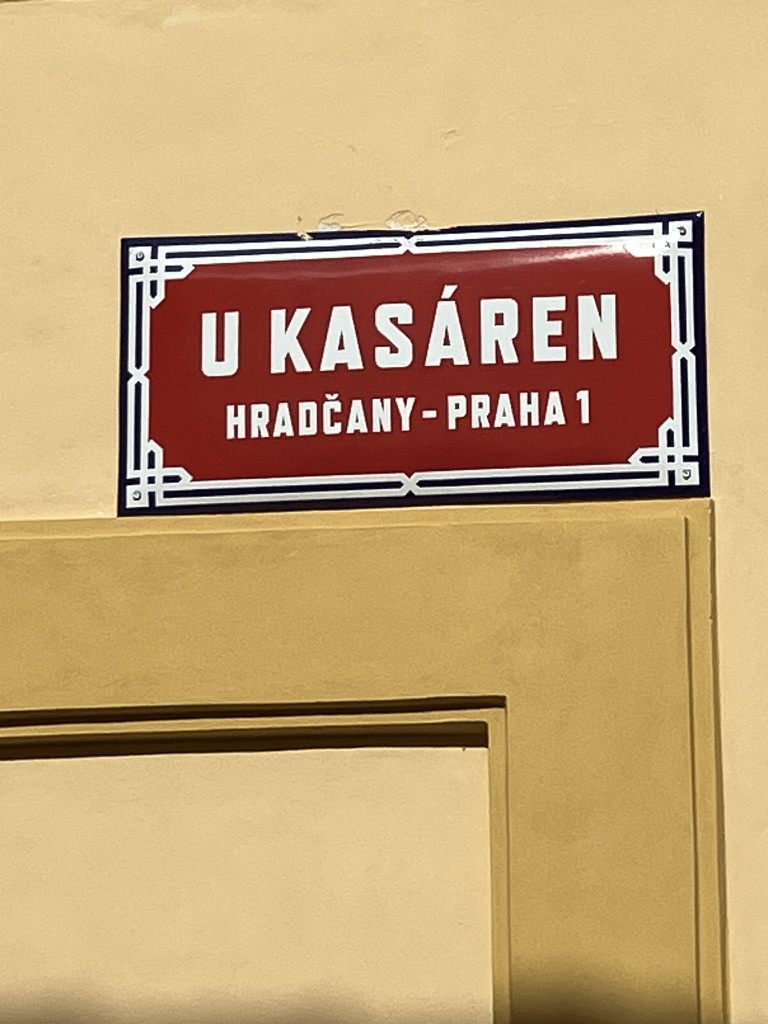
    Nowadays, Viničná is best known for hosting part of Charles University’s Faculty of Science (Unit 7, built in 1879).

    In 1911, a certain Albert Einstein occupied the chair in theoretical physics at the German Charles-Ferdinand University (as opposed to the Czech one – the two had separated in 1882).

    He and his wife, Mileva, lived at Lesnická 1215/07 in Smíchov. Apparently, they didn’t enjoy Prague very much, and, after 16 months, they moved to Zürich instead. Nevertheless, their brief stay is commemorated by a plaque at number 7, the entrance to the Faculty.

  • Originally published on X on 18 March 2023.

    Until about 1870, the street was known as Zahradnická, because the area, at that time, consisted mainly of gardens.

    Karel IV founded the Convent of St Catherine (Klášter sv. Kateřiny), including a church, in 1355. It was burnt down by the Hussites in 1420, and I should really just save ‘It was burnt down by the Hussites in 1420’ as a template on my phone.

    It took almost exactly a century for the convent and the church to be rebuilt; in 1565, the nuns left and were replaced by monks. So I’ve just realised that Czech doesn’t have separate words for ‘monastery’ and ‘convent’.

    Both the monastery and the church were given a significant upgrade in Baroque style in the first half of the 18th century, but the monastery fell victim to Joseph II’s reforms, and was turned into a military training centre in 1787.

    In 1822, it then became an institution for the mentally ill. It was here that the composer Vilém Blodek (https://whatsinapraguestreetname.com/2023/02/26/prague-3-day-147-blodkova/) died in 1874.

    However, the church reverted to its original function in 1841, before being handed over to the City Museum in 1950.

    Meanwhile, after May 1945, the former monastery building began to be used by the neurological clinic of the First Medical Faculty of Charles University.

    In the 1990s, the church was restored. It is now owned by the Orthodox Church, which has held services there since 2012, and its official name is Kostel svaté Kateřiny Alexandrijské (Church of Saint Catherine of Alexandria).

  • Originally published on X on 17 March 2023.

    The original Benátská was built as far back as 1489.

    By the 19th century, there was a Velká Benátská, which ceased to exist when the Botanical Gardens were built. There was also a Malá Benátská, and the present-day street more or less follows that street’s pattern.

    Benátky is Venice, or, rather, Benátky *are* Venice (see later on).

    The area used to consist of wetlands and swamps, which presumably made whoever named the street think of there.

    I went to Venice once. The food was severe tourist trap territory. But I also got that kind of photo that makes you feel like being in a tourist trap is entirely worth it.

    Quite enjoyed this moment too.

    In Czech, Benátky is plural. It’s in good company with international cities, as it’s joined by Antverpy, Atény (Athens), Cáchy (Aachen), Brémy (Bremen), Drážďany (Dresden) and Helsinky.

    A memo which, however, never made it to Tbilisi or Miami, which are singular.

    This also applies to about eight billion place names in the Czech Republic (and Slovakia, and Poland) too – but listing them here will leave me without material for some of my future street name posts, so I’ll shut up for now.

  • Originally published on X on 16 March 2023.

    Trojická was built around 1850.

    Trojická translates as ‘Trinity’, and the street is named after the Church of the Holy Trinity in Podskalí / Kostel Nejsvětější Trojice v Podskalí.

    A chapel is documented as having stood here in 1358, dedicated either to St Antony or to St Andrew. In ‘words I feel like I’ve written hundreds of times’ news, it was burned down during the Hussite Wars, before being restored in 1476.

    The church started to fall into disrepair in the 1700s, prompting its reconstruction in baroque style. One wall from the original church remains.

    Key stages in the reconstruction included the chapel (1751) and the new tower (1782). The church was also one of the buildings that did survive the ‘renovation’ of the neighbourhood in the 19th century.

    There’s a nice set of pics (i.e. I forgot to take any of my own) on https://commons.wikimedia.org/wiki/Category:Holy_Trinity_Church_in_Prague_(New_Town,_Trojick%C3%A1).

  • Originally published on X on 15 March 2023.

    This embankment was formed in 1951 from the joining of two separate streets (see later for details of the multiple name changes).

    Alois Rašín was born in Nechanice, near Hradec Králové, in 1867. He went to Prague to study medicine at Charles University, but then switched to law.

    After graduating in 1891, he became increasingly involved in the Young Czech Party, so much so that he was sentenced to two years’ imprisonment in the Omladina Trial of 1894, and lost his academic titles.

    He was released early in the following year, and got his titles back. He withdrew from active politics for a while, but rejoined the Young Czechs in 1907, entering the Imperial Council in 1911.

    When World War 1 started, Rašín joined Maffia, a secret resistance group whose other founders included Edvard Beneš and Karel Kramář.

    His activities led him to be sentenced to death in 1916, but this never happened as Charles I came to power and commuted his sentence to (harsh) imprisonment.

    Amnestied in 1917, he became more politically active than ever.

    On 28 November 1918, he was one of the five men who declared an independent Czechoslovakian state. He subsequently became the state’s first Minister of Finance, holding the position until 1919, when the Social Democrats and Agrarian Party came to power.

    He would become Minister of Finance again in October 1922, but would come to be blamed for skyrocketing unemployment.

    It was only there months later, on 5 January 1923, that Rašín was shot outside his apartment on Žitná by Josef Šoupal, a 19-year-old anarchist. He would die of his injuries on 18 February.

    In the same year, a district of Rokycany was named after him (Rašínov). It is still called this today.

    According to English Wikipedia: ‘One time when Germans demanded bigger autonomy, he stuck out his tongue and call them monkeys. Rašín lived ascetic life avoiding any dance or sport’. Well then.

    As well as the banknote above, the Czech National Bank issued a quite snazzy commemorative note in his honour in 2019:

    Oh, wait, there were those name changes I promised.

    The northern part of the embankment started as Palackého nábřeží in 1875, switching to Vltavské nábřeží from 1940, and then becoming – urgh – Reinhard-Heydrich-Ufer from 1942 to 1945, then reverting to Palackého nábřeží.

    The southern part, meanwhile, came into being as Vyšehradské nábřeží in 1905, before becoming Podskalské nábřeží in 1919, and then Rašínovo in 1924. From 1941 to 1945, it was Karl-Lažnovský-Ufer, after a pro-occupation journalist poisoned by the Resistance in 1941.

    In 1951, the two parts were merged as Nábřeží Bedřícha Engelse (he of ‘Marx and’ / ‘oh, so Czechs don’t say Friedrich’ fame), before a reversion to Rašínovo in 1990.

  • Originally published on X on 14 March 2023.

    Ladova was built in 1925.

    Until 1961, this was ‘V Ohradách’, ‘In the Enclosures’ (approx). Until the 19th century, there were warehouses here where firewood and wood for construction purposes were stored.

    Josef Lada was born in Hrusice (nowadays in Prague-East) in 1887. An accident at the age of six months left him blind in one eye.

    Discovering his talent for drawing as soon as he started school, by the age of 14 he was already studying in Prague. Before he was out of his teens, his humorous drawings and cartoons had been published in several newspapers.

    In 1906, Lada got into the Academy of Arts, Architecture and Design in Prague (VŠUP), and, in 1909, he founded his own magazine, Karikatury.

    After World War II, a writer called Jaroslav Hašek asked Lada if he could provide some illustrations for his short stories, which were about to be published in book form.

    The name of the collection was The Good Soldier Švejk. You’ll recognise him.

    In the 1920s, Lada started writing his own books, the most famous of which were about Mikeš, a black cat who could talk.

    Relatedly-ish, when I was 15, my parents got a black cat, Daphne, who would talk (well, miaow) every time I spoke to her. We had some great conversations in her 17 years and 11 months on the planet, and she was the best goddamn animal that ever lived.

    During the 1920s and 1930s, Lada’s work was also presented at major exhibitions in Prague, and he was commissioned to design the stage for a production of Strakonický dudák by Tyl (https://whatsinapraguestreetname.com/2024/07/01/prague-2-day-53-tylovo-namesti/) at the National Theatre.

    Lada largely went into seclusion when WWII started; after the war, his work became increasingly melancholic, which isn’t surprising when you consider that his daughter, Eva, died in an aerial bombardment near Emmaus Monastery in 1945, aged 16, and his wife died in 1951.

    However, he continued to draw for children’s books and also took part in the creation of animated films, such as 1955’s Čert a Káča (based on a work by Božena Němcová).

    An exhibition was prepared to celebrate Lada’s 70th birthday – but he died three days before that milestone, in December 1957.

    Three decades of his life had been spent living on this very street at number 2045/1; the renaming of the street was suggested by his own daughter, Alena (1925-1992).

  • Originally published on X on 13 March 2023.

    Plavecká was built centuries ago, but wasn’t named until the mid-19th century.

    We’ve covered the fact that the people of this district, Podskalí, made their living by trading in wood: https://whatsinapraguestreetname.com/2024/08/26/prague-2-day-121-na-vytoni/.
    And then we covered the history of Podskalí itself yesterday: https://whatsinapraguestreetname.com/2024/08/26/prague-2-day-122-podskalska/.
    Plavecká, meanwhile, is named after the plavci who lived here, and were an integral part of this trade arrangement. They floated the wood down the river.

    Their way of life forms the backbone of the 1952 film Plavecký mariáš, presumably named after mariáš, one of the most popular card games round these parts:

    Plavci can also translate as ‘swimmers’. This feels like a perfect opportunity for a quick language lesson, so: a regular swimmer is a plavec, but a mořeplavec is a seafarer and a vzduchoplavec is an aeronaut. Meanwhile, a plavecký styl is a swimming stroke.

    Speaking of swimming strokes, if you swim naznak, you’re doing the backstroke, if you swim prsa, you’re doing the breaststroke, swimming kraul is, more easily, the crawl, and swimming na čubičku is doing the doggy paddle.

  • Originally published on X on 12 March 2023.

    Podskalská was built in 1870.

    We touched briefly on the settlement of Podskalí yesterday: https://whatsinapraguestreetname.com/2024/08/26/prague-2-day-121-na-vytoni/. It was incorporated into Prague’s New Town in 1348, and then burned down in 1420 during fighting over Vyšehrad.

    After the Hussite Wars, three of Podskalí’s four churches were rebuilt. The district survived for a few more centuries, but as Prague got bigger in the 19th century, parts of it were demolished.

    In 1890, Prague was hit by floods so bad that three of Charles Bridge’s arches swept away. The authorities decided that an embankment wall was needed to protect the city from any such damage in future.

    Other reasons for the this ‘rehabilitation / redevelopment / renewal’ (all possible translations of asanace) included poor sanitation and the lack of a sewage system.

    Between 1905 and 1914, the village of Podskalí disappeared in favour of (amongst other things) Rašín Embankment and the Vyšehrad Tunnel. Several buildings survive, however, including the customs house (see yesterday’s post, again).

    There’s a quite wonderful short film about Podskalí from 1967, a time when people with memories of the settlement were still around to tell their stories:

  • Originally published on X on 11 March 2023.

    Na Výtoni was built in 1894, and was called Vejtoňská until 1903.

    Once upon a time, there was a settlement here called Podskalí. The first written mention is from 1198, but it’s likely to have originated a long time before that.

    The locals made a living by rowing and trading in wood. When logs were brought here, one twelfth of each log would be cut out, and the locals would collect this as a duty.

    One of many words that Czech has used over the centuries for ‘to cut out’ is vytnout – hence Výtoň, and the customs officers being known as vejtoníci.

    Apparently, the customs office is now both a pub and a museum. I went to the pub in May 2020, and, perhaps because of all the May 2020-ness in my brain at that time, or the fact that I just really wanted a non-bottled beer, I failed to notice the museum: https://commons.wikimedia.org/wiki/File:V%C3%BDto%C5%88_celnice_1.jpg.

    Finally, back to the street itself: if you’ve ever seen a cafe with a better name than this, you’re a liar.

  • Originally published on X on 10 March 2023.

    Na hrobci was built around 1890.

    Hrobec is presumably a no-longer-used diminutive of hrob, or ‘grave’. And it’s theory time.

    Theory number one is that, back the the olden days when things were decidedly pagan, there was a burial ground here.

    Theory number two is that this was where various (possibly fictional) Přemyslids were buried, specifically Přemysl, Nezamysl, his wife Hruba and their son Mnata (see https://whatsinapraguestreetname.com/2024/08/25/prague-2-day-103-neklanova/ for a list of princes).

    Na Hrobci was also the name of a house where the street is now, which included images of six Přemyslid princes – the three listed above, plus Vojen, Vratislav (https://whatsinapraguestreetname.com/2024/08/25/prague-2-day-99-vratislavova/) and Good King Václav.

    For language fans, Czech expressions involving hrob include obracet se v hrobě (to be turning in one’s), kopat si vlastní hrob (to dig one’s own) and stařec nad hrobem (‘coffin dodger’).

  • Originally published on X on 9 March 2023.

    Svobodova was built in 1884. Czech Wikipedia’s disambiguation page lists 17 different Jan Svobodas. So please give me a minute.

    Jan ’10 of 17’ Svoboda was born in 1800 or 1803 in Hořepník, near Pelhřimov.

    He studied at the seminary in Klagenfurt, which I’m mentioning mainly because I lived near there as part of my studies exactly 20 years ago, and always find the rare occasions on which Carinthia gets mentioned quite exciting.

    Moving to Prague instead of getting ordained, he taught at the Týn School. He was a good enough teacher to get sent to Germany to learn more about the education system there, with a view to setting something similar up in Bohemia.

    On his return, he opened a primary school on Na Hrádku (coming up) in 1832, with the educational premise being ‘mens sana in corpore sano‘ and all that. *resists temptation to sing ‘biti zdrava’ in public*

    His experiment was so successful that it ended up getting put into a book.

    In 1842, he moved to a teaching role at a different school, in Malá Strana, but died of tuberculosis two years later.

    The school in Na Hrádku lasted a few decades, until a larger school was opened to cater better to the local children’s needs: https://whatsinapraguestreetname.com/2024/08/26/prague-2-day-117-na-dekance/.