What's in a Prague street name

Every street in Prague, one by one.

  • Originally published on Twitter on 1 September 2022.

    Vita Nejedlého was built in 1885.

    This one’s been through its fair share of other names.

    Until 1940, and again from 1945 to 1947, it was Veleslavínova, after Daniel Adam z Veleslavína (1546-99), lexicographer, publisher, translator and secret member of the Unitas Fratrum (https://whatsinapraguestreetname.com/2022/11/26/prague-3-day-83-ceskobratrska/).

    From 1940 to 1945, it was Zelenkova, after Jan Dismas Zelenka (1679-1745), a Baroque composer who spent his professional life in Dresden.

    In 1947/48, it was Lokvisova, after Martin Húska (died 1421), a Táborite priest known as ‘Loquis’ because of his oratorical ability.

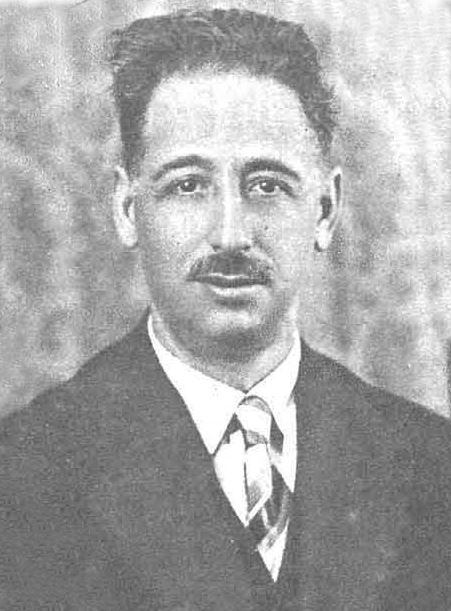
    Vít Nejedlý, also a composer, was born in Smíchov in 1912, graduating from Charles University in 1912 with a dissertation on the modern Czech harmonica.

    Active as a left-wing student, he moved to the Soviet Union when the Nazis occupied Bohemia and Moravia, and became a member of the Union of Soviet Composers.

    He was a specialist in the ‘mass song’ genre, mass songs (intended to be sung by the ‘broad masses’) being the type of songs that the Soviet authorities would want to be sung at rallies and demonstrations.

    Here’s one:

    In 1943, he became commander of the Music Platoon of the First Czechoslovak Independent Brigade.

    As the Brigade made its way to Czechoslovakia, he died of typhoid at Dukla Pass (Dukelský průsmyk), on the Polish-Slovakian border in January 1945.

    As your regular reminder that Czech surnames are the best, ‘nejedlý’ translates as ‘inedible’. I wonder if this is why the street-naming authorities decided this street should bear his first name as well.

  • Originally published on Twitter on 31 August 2022.

    Přibyslavská was built in 1898.

    Přibyslav is a town in the Havlíčkův Brod district, currrently with about 4,000 inhabitants. It was first mentioned in writing in 1257 (under the name of Priemezlaves).

    In the same century, the town became the second most important silver mining location in Bohemia, after Jihlava. However, deposits were gradually depleted and miners made their way to the Kutná Hora region instead.

    In October 1424, Jan Žižka’s Hussites besieged the town. He died at their camp in the nearby village of Šenfeld a few days later.

    His followers then besieged Přibyslav and used it as a fortified base from which they could make their way into Moravia. They held the town until their defeat at the Battle of Lipany (https://whatsinapraguestreetname.com/2022/12/23/prague-3-day-120-lipanska/).

    Přibyslav suffered serious fires in 1767, 1775 and 1842, as well as cholera epidemics in 1821 and 1836 respectively.

    Nowadays, it looks quite quiet and cozy. https://pribyslav.cz/gsp/p1=18846

  • Originally published on Twitter on 30 August 2022.

    U Viktorie was built in late 2021.

    It’s named after the home ground of FK Viktoria Žižkov (officially the eFotbal Arena).

    Viktoria was set up in 1903, with most players being local students.

    It grabbed people’s attention by beating Sparta 1:0 in 1906. In 1909, the club got its own training ground, at Ohrada (https://whatsinapraguestreetname.com/2022/11/19/prague-3-day-11-na-ohrade/).

    Becoming more and more successful, they won the Charity Cup in both 1913 and 1914. They also won the championship for the only time in 1928.

    Around 1916, the future legendary actor Vlasta Burian was their goalkeeper.

    The successful 1931 film, Muži v offsidu, directed by Svatopluk Innemann and based on the novel by Karel Poláček, is about Viktoria Žižkov’s fans.

    You can watch it here.

    In the 1930s, there were plans to build a huge stadium for the club at Třebešín (https://whatsinapraguestreetname.com/2022/11/26/day-96-na-trebesine/). This proved financially unviable, and the team spent about two decades playing on other clubs’ pitches.

    Communism meant name changes (Sokol in 1950, Sokol ČSAD in 1951, TJ Slavoj Žižkov in 1952, then back to its current name in 1965), and over forty years outside of the Czechoslovak First League.

    Businessman Vratislav Čekan bought the club in 1992, just when it was about to go bankrupt. Money meant good players, a swift return to the (now) Czech First League, and a victory in the first ever Czech Cup in 1994.

    Here they are playing Chelsea in the European Cup Winners’ Cup in the same year:

    Financial difficulties kicked in in 1996, however, and Čekan sold the club, and the hard times started again.

    In 2003, the club was found guilty of bribery (https://english.radio.cz/why-i-wont-support-my-local-football-club-8628865…); in 2014/5, players boycotted games for a while as their salaries weren’t being paid.

    Viktoria currently plays in the third tier ČFL, having just been relegated.

    Its most recent match was two days ago against Teplice B; Viktoria won 2-1.

  • Originally published on Twitter on 29 August 2022.

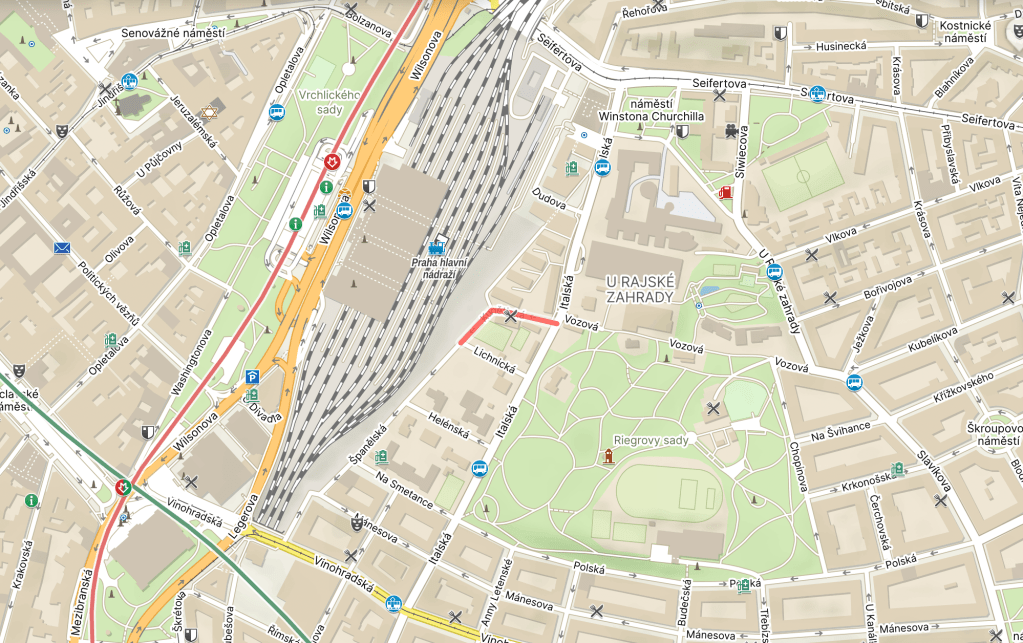
    U rajské zahrady was built in 1895. It translates as ‘At the Garden of Paradise’.

    The street was Přemyslova, after one or more of the Přemyslid dynasty, until 1930.

    There were vineyards around here in the 15th century; four centuries later, a popular garden restaurant opened, complete with concerts and balloon flights (a novelty at the time).

    In 1886, the garden architect František Josef Thomayer created a storage garden, with flowers stored in greenhouses, later to be distributed to parks across Prague.

    The greenhouses also provided flowers for special events – when the General Land Centennial Exhibition took place in 1891, no fewer than 120,000 plants grown here decorated the individual pavilions.

    The construction of what is now the Prague University of Economics and Business (Vysoká škola ekonomická v Praze, VŠE) meant that the garden’s role was taken over by a location further east – see https://whatsinapraguestreetname.com/2022/11/26/prague-3-day-93-u-zasobni-zahrady/.

    The area became increasingly neglected, as concrete became a bigger priority than greenery. It wasn’t until 2006-8 that the park took its current form.

    Its views of Prague are… not bad, shall we say. Photo from https://park-rajska-zahrada.cz/odpocinek.

    Great pic of back in the day on https://zizkovskelisty.cz/spolecnost/misto-pro-leto-rajska-zahrada….

  • Originally published on Twitter on 28 August 2022.

    Siwiecova was built in 1980.

    Until 2009, this was Havelkova, Václav Havelka (1893-1967, and yes, that was his actual name), was a Communist functionary, so it’s quite amazing the street maintained this name for so long.

    Not least given that the street is the home of the Institute for the Study of Totalitarian Regimes / Ústav pro studium totalitních režimů.

    Ryszard Siwiec, born in 1909, was an accountant from Przemyśl, Poland, a graduate of Kazimierz University in Lviv, and a fighter in the Home Army in WW2.

    On 8 September 1968, Siwiec set himself ablaze at a national harvest festival in Warsaw, attended by 100,000 people.

    This was a protest against the Soviet invasion of Czechoslovakia, in which Poland had participated.

    He died four days later. The authorities were quick to portray Siwiec as mentally ill, and an alcoholic.

    His farewell letter to his wife was intercepted by the security services, and not delivered to her until after one-party rule had ended in Poland.

    Siwiec’s self-immolation preceded that of Jan Palach by four months.

    There is footage here; caution is strongly advised.

    Václav Havel awarded Siwiec the Order of Tomáš Garrigue Masaryk In 2001.

    A memorial ceremony to Siwiec took place a few days ago: https://twitter.com/PavelZacek_69/status/1569253672466399233.

  • Originally published on Twitter on 27 August 2022.

    Náměstí Winstona Churchilla was built in 1935.

    Until 1955, this was U Pensijního ústavu (‘At the Pension Institute’), named after the large functionalist building on the square, once the tallest office building in Czechoslovakia.

    It became known as the Dům odborových svazů (House of Trade Unions) in 1951.

    Since 2019, it’s been called the Dům Radost (House of Joy) and contains offices, a cinema, shops and a cafe.

    From 1955 until 1977, this was Gustav Kliment Square, after a prominent member of the Communist Party who died in 1953.

    From 1977 to 1990, it was Antonín Zápotocký Square. Zápotocký was PM of Czechoslovakia from 1948 to 1953, and President from 1953 until his death in 1957.

    Post-communism, it became Winston Churchill Square. A statue of Churchill, identical to the one in Parliament Square in London, and sculpted by Ivor Roberts-Jones, was unveiled in 1999.

    Its unveiling was attended by Margaret Thatcher, Churchill’s grandson and Václav Klaus. Aren’t you glad selfies weren’t a thing in 1999? https://www.theguardian.com/world/1999/nov/18/kateconnolly.lucyward

    You will probably remember this happening in 2020: https://www.irozhlas.cz/zpravy-domov/winston-churchill-black-lives-matter-praha_2006111043_pj

    Searching for English-language articles about the statue being defaced led me to this good two-parter about Afro-Czechs: https://globalvoices.org/2020/06/24/afro-czechs-on-visibility-racism-and-life-in-the-czech-republic-part-one/.

  • Originally published on Twitter on 26 August 2022.

    Seifertova was built in 1875.

    Until 1940, this was Karlova, after Karel IV; from 1940 to 1945, it was Lutherova, after Martin Luther.

    After a brief return to its original name, it became Kalininova from 1947 to 1990, after Mikhail Kalinin (1875-1945), an Old Bolshevik revolutionary after whom Kaliningrad is named.

    Jaroslav Seifert, meanwhile, was born in 1901 in Bořivojova Street (coming soon). As a child, his family moved around various poor sublets in Žižkov.

    Seifert went to school in Kubelíkova (also coming soon) and Hálkova in Prague 2, but didn’t complete his studies.

    In 1921, his first collection of poems, Město v slzách (City in tears) was published. He joined the Communist Party in the same year and became a regular contributor to Rudé právo.

    He was expelled from the party in 1929 after protesting against the increasingly Stalinist style of Gottwald’s leadership.

    He then joined the Social-Democratic Workers’ Party and started writing for Právo lidu. In 1949, he dropped journalism to devote himself entirely to literature.

    He didn’t reach mainstream success again until 1956, after the partial liberalisation of cultural life.

    He spoke out against the Soviet invasion in 1968, earning him the disapproval of the regime and forcing him to lead a secluded life.

    In December 1976, he was one of the first signatories of Charta 77.

    In 1984, he became the first (and, to date, only) Czech to win the Nobel Prize for Literature. Ill health prevented him from going to Stockholm, and the Communist media barely mentioned the award at all.

    Seifert died in January 1986. The authorities, now using his success for propaganda purposes, gave him a state funeral at the Rudolfinum, which turned into an anti-communist demonstration: https://cesky.radio.cz/jsou-jisti-mrtvi-nebezpecne-zivi-pred-35-lety-byl-pohrben-jaroslav-seifert-8706020.

    His words, on Czechoslovakian television, on 9 September 1968: ‘Jako jsme si dali na podstavec první tank, který přijel v květnu 1945 do Prahy, tak si vystavíme poslední, který opustí naši vlast.’

    Translation: ‘Just as we put on a pedestal the first tank that arrived in Prague in May 1945, so we will display the last one that leaves our homeland’.

  • Originally published on Twitter on 25 August 2022.

    Táboritská was built in 1885.

    The Táborites have come up *cough* more than once *cough* in these posts, so here’s a quick brief.

    They were radical Hussites, known as ‘Picards’ by their enemies.

    Aiming to develop a communal society, they founded the town of Tábor in 1420, named after Mount Tabor in Galilee (the site of the transfiguration of Jesus).

    They rejected ceremonies, priesthood, and vestments, as well as the worship of relics and images. They did not reject the wealth that came from the local gold mines, however.

    In less peace-and-love-esque news, they saw it as their duty to kill all heretics, otherwise known as ‘everyone else’. This didn’t stop them from combining with other Hussite forces when the time was right.

    Their army was commanded by Jan Žižka until he started to find the Táborites too radical, and left to form another group, the Orebites (https://whatsinapraguestreetname.com/2022/12/04/prague-3-day-107-orebitska/), in Hradec Králové.

    Their strength was broken at the Battle of Lipany in 1434 (https://whatsinapraguestreetname.com/2022/12/23/prague-3-day-120-lipanska/), but their way of thinking still had a strong influence on the Moravian Brotherhood (Unitas Fratrum), founded in 1457 (https://whatsinapraguestreetname.com/2022/11/26/prague-3-day-83-ceskobratrska/).

    The most famous Táborites, other than Žižka, were Prokop Holý (https://whatsinapraguestreetname.com/2022/11/23/prague-3-day-77-prokopova/), Mikuláš of Hus, Jan Roháč of Dubá (https://whatsinapraguestreetname.com/2022/11/25/prague-3-day-81-rohacova/), Bohuslav of Švamberk and Chval Řepický of Machovice.

  • Originally published on Twitter on 24 August 2022.

    Lupáčova was built before 1875.

    Martin Lupáč studied in Prague, where he got to know Jan Hus personally. In 1412, he took part in the burning of the Papal Bull.

    In 1421, he became a preacher in Chrudim. He was a moderate Hussite who wanted all the arguing factions to shut up and get on with each other.

    In the early 1430s, he participated twice in the Council Of Basel. In 1435, he was elected suffragan (i.e. assistant bishop) to Jan Rokycana (who was not recognised as bishop by the Pope – https://whatsinapraguestreetname.com/2022/11/19/prague-3-day-19-rokycanova/).

    His moderate stance meant that he was a key participant in the proclamation of the Compacts of Basel in Jihlava in 1436, and in negotiations between Zikmund and the Táborites the year after.

    However, Zikmund expelled him from his role in Chrudim, and he disappeared from view until he became a mediator, again, in Klatovy in 1452, this time between Rokycana and the Táborites.

    After the Unity of Brethren was founded in Kunwald in 1457 (https://whatsinapraguestreetname.com/2022/11/26/prague-3-day-83-ceskobratrska/), Lupáč remained a strong supporter of its, well, unity, until his death in 1468.

    I am totally forming a band called Zikmund and the Táborites. Who’s in?

  • Originally published on Twitter on 23 August 2022.

    Havlíčkovo náměstí was built in 1875.

    Until 1910, this was Basilejské náměstí, now the name of another square slightly to the east (https://whatsinapraguestreetname.com/2022/11/26/prague-3-day-94-basilejske-namesti/).

    Between 1940 and 1945, it was Husovo náměstí (limited explanation required).

    Karel Havlíček Borovský was born in 1821 and studied in Německý Brod (now Havlíčkův Brod, after him), moving to Prague in 1838 to study philosophy at Charles University.

    In Prague, he joined the seminary, but was expelled in 1841, having developed a strong aversion to the Roman Catholic Church’s conservatism and anti-national spirit.

    Originally a Russophile and Pan-Slav, he went to Russia for a year, returning in 1844 with a conviction that Pan-Slavism was not going to work.

    In 1846, he became editor of Pražské noviny, leaving to found Národní noviny in 1848. This became the Czech liberals’ paper – but Havlíček felt that revolution was a bad idea, as the Czechs were not strong enough yet and the potential repercussions if they lost were huge.

    In July 1848, just after the failed Prague Uprising, he was elected to the Austrian Reichstag, but quit soon afterwards to focus on his journalism.

    Arrested for criticism of the regime in 1849, he was acquitted by a sympathetic jury.

    Národní noviny was forced to cease publication in 1850. Havlíček moved to Kutná Hora and set up a satirical magazine, there, Slovan (‘The Slav’), but this too was banned in 1851.

    He was exiled to Brixen (South Tyrol) in 1851, writing some of his most famous works there. Returning to Bohemia in 1855, he found that his wife had died a few days before.

    Havlíček himself succumbed to tuberculosis in 1856. He was only 35.

    His funeral became a major event, attended by, amongst others, František Palacký, František Ladislav Riegr, Václav Hanka, Karel Jaromír Erben and Božena Němcová, who allegedly placed a crown of thorns on Havlíček’s coffin as a symbol of martyrdom.

    Havlíček is buried in Olšany Cemetery. Slightly further afield, there is also an asteroid named after him: https://waymarking.com/waymarks/wm11QAW_2706_Borovsky_Karel_Havlcek_Borovsk_Praha_Czechia….

    The square is the location of the Žižkov Town Hall (see https://whatsinapraguestreetname.com/2022/11/20/prague-3-day-64-olgy-havlove/ for two rounds of Havel-marriage-related Town Hall activity).

    A statue of Havlíček, sculpted by Josef Strachovský, was placed here in 1911. It was removed during the occupation in 1943, but was recast three years later.

    The park underwent renovation in 2015, and now contains paving stones including famous quotes from Havlíček’s works.

  • Originally published on Twitter on 21 August 2022. Also, this was actually day 120, and Lipanská, which I’ve posted as day 120, was actually day 121. Like any of this matters.

    Miličova was built before 1875.

    Milíč z Kroměříže was born around 1325 in Tečovice, and was educated in Olomouc.

    From 1358 to 1362, he worked in the royal office, going from registrar to proofreader to notary in this time.

    In 1362, he became a canon at Prague Cathedral, but became a lay preacher the year after.

    He predicted that the Antichrist would take over the government, and that it would take the form of Karel IV. As it wasn’t possible to simply ban him from Twitter for spreading this information (what with it being 1366), he got put in prison.

    In 1372, he founded a preacher’s school and a refuge for penitent prostitutes in the Old Town and called it Jerusalem.

    He served Eucharist at every mass – this was unique, as the laity elsewhere only received Eucharist once a year. The practice would become increasingly popular in Bohemia in the late 14th century.

    Somewhat inevitably, he was accused of heresy. He went to Avignon in 1374 to defend himself. His defence was a success, but he died shortly afterwards and is buried there.

  • Originally published on Twitter on 22 August 2022.

    Lipanská was built before 1875.

    The Battle of Lipany, also known as the Battle of Český Brod, was fought on 30 May 1434.

    On one side, you had the Táborites (radical Hussites), led by Prokop the Great (https://whatsinapraguestreetname.com/2022/11/24/prague-3-day-80-prokopovo-namesti/), and the similarly radical Sirotci (Orphans), led by Jan Čapek ze Sán. This was the more experienced side.

    On the other side, you had the moderate Hussites, AKA the Utraquists or Calixtinists (https://whatsinapraguestreetname.com/2022/11/28/prague-3-day-100-kalisnicka/), led by Diviš Bořek z Miletínka, in coalition with the Catholics. This was the side with a numerical advantage.

    When shelling between the two sides’ wagon forts began, the Coalition feigned confusion and started to retreat. The Radicals became convinced that victory was theirs – until the Coalition started to fire at them.

    The Coalition entered the Radicals’ camp, and the Orphans fled to nearby Kolín. A massacre ensued, with the Radicals suffering 1,300 deaths, including that of Prokop, versus 200 deaths for the Coalition.

    The Orphans largely ceased to exist. In 1436, the Compacts of Basel were signed (https://whatsinapraguestreetname.com/2022/11/26/prague-3-day-94-basilejske-namesti/), allowing Hussite priests to administer wine to laymen during the Eucharist. Shortly afterwards, all major factions acknowledged Zikmund Lucemburský as King of Moravia.

    The last significant Táborite, Jan Roháč z Dubé (https://whatsinapraguestreetname.com/2022/11/25/prague-3-day-81-rohacova/) was hanged in 1437 after refusing to recognise Zikmund. The Hussite Wars were officially over.

    Moderate Hussites would constitute the majority of the Czech population for approximately two centuries, until the Thirty Years’ War.

  • Originally published on Twitter on 20 August 2022.

    Cimburkova was built before 1875.

    Ctibor Tovačovský z Cimburka was born around 1437. His father, Jan Tovačovský z Cimburka, was a supporter of the Hussites and also governor of Moravia from 1437 to 1460 (and has his own street at https://whatsinapraguestreetname.com/2022/11/26/prague-3-day-87-tovacovskeho/).

    Upon his father’s death in 1464, Ctibor was appointed a court judge in Moravia. A supporter of Jiří z Poděbrady, he led an unsuccessful crusade in Silesia in 1466, and his army was also defeated at Olomouc in 1468.

    In 1469, when Jiří’s son was captured, Ctibor was appointed governor of Moravia in his place.

    He was also Supreme Chancellor of the Kingdom of Bohemia from 1471 to 1479.

    In 1480, he wrote the first Moravian law book, Kniha Tovačovská, outlining the system of Moravian law and the division of society.

    He also reconstructed the Tovačov fortress in 1492, with its tower being the oldest Renaissance building north of the Alps.

    He died, childless, in 1494; his cousin, also childless, died in 1502, meaning the Cimburka family ceased to exist.

    Confession: I have no intention of stopping these tweets like, ever, but I have significant Hussite Fatigue right now.

  • Originally published on Twitter on 19 August 2022.

    Štítného was built before 1875.

    Tomáš Štítný ze Štítného was born into the lower nobility at the  Štítná fortress (now part of Žirovnice, Vysočina Region) around 1333.

    He moved to Prague to study at the Art Faculty of Charles University, where he became acquainted with reform preachers and started his literary activities.

    In the 1350s, he returned to Štítný, but settled in Prague again in 1381 after the death of his wife, and became one of the first writers to use the local vernacular.

    He wrote the Klementinum Codex, which prescribed some of the essential practices of Christianity and daily life. He is often regarded as the first person to teach the science of ethics in Bohemia.

    While he slightly predated the Hussite movement, his thoughts – including his opposition to excessive worshipping of saints and veneration of relics – certainly became a major influence on it.

  • Originally published on Twitter on 18 August 2022.

    Blahníkova was built in 1883.

    Until 1952, this was Švihovského, named after Půta Švihovský (died 1504), a Bohemian nobleman who was the highest regional judge of the Kingdom of Bohemia for 25 years.

    According to German Wikipedia, he was a bit of a prick, though, and – rather incoherently given where his street was – a hater of Hussites.

    Vojtěch Kristián Blahník (1888-1934), meanwhile, was a theatre historian and critic.

    After dropping his studies in mechanical engineering, he spent 1907 to 1909 working as a teacher in his native Pardubice region, before moving to Prague and becoming an editor.

    His connection to the theatre was strengthened by his marriage to Růžena Wenigová, sister of the writer Adolf Wenig and stage and costume designer Josef Wenig.

    After WWI, he became head of the library at the Ministry of National Defense. He also contributed to several newspapers, wrote several books, and lectured on the history of theatre at the Prague Conservatory.

    In nearby Štítného street (coming to Twitter… tomorrow, actually), he directed at the Masaryk Hall, where Jára Cimrman’s Žižkov Theatre is now located.

    In 1934, Blahník shot himself in Litoměřice. He was 45.

  • Originally published on Twitter on 17 August 2022.

    Krásova was built in 1885.

    Jan Krása was a merchant from Prague, who was an alderman for the New Town from 1390 to 1413.

    A fervent supporter of Jan Hus, he was one of the leaders of an uprising in Wrocław in 1418, where seven councillors were killed by local craftsmen.

    On 1 March 1420, a papal bull was published by Pope Martin V, ordering Sigismund of Luxembourg, who had become King of Bohemia in 1419, to launch a crusade again the Hussites.

    On the 15th, Sigismund sentenced Krása to death in Wrocław. He was burned at the stake.

    Conflict between the Hussites and Catholics, already at war since the previous year, accelerated, with the Battle of Vítkov Hill taking place less than three months later.

    Material on Krása is relatively thin in the ground – his only Wikipedia page is in Polish, and consists of three sentences. But he gets a pretty long street, so, you know, swings and roundabouts.

  • Originally published on Twitter on 16 August 2022.

    Husinecká was built in 1889.

    In 1898, a nearby street, Ambrožova (not the current one which is discussed under https://whatsinapraguestreetname.com/2022/11/21/prague-3-day-68-ambrozova/) was merged into Husinecká.

    Husinec (current population approx. 1,400) is a village in the Prachatice district in South Bohemia.

    It’s best known as the supposed birthplace of… oh, guess, in 1369.

    However, Jan Hus was named after the village, not vice versa – a ‘hus’ is a place where geese (‘husy’) breed. The village was first mentioned (as ‘Hussenecz’) in 1291.

    There was a castle here until 1441. As is so often the case, it changed hands multiple times, and was ultimately burned down.

    Hus’s family home can still be visited. I’d post a link to the website but Twitter has randomly deemed it potentially harmful.

  • Originally published on Twitter on 15 August 2022.

    Dalimilova was built before 1875.

    Dalimil’s Chronicle is the oldest existing verse chronicle in the Czech language.

    It is based on five older chronicles which were written in Latin: the Boleslav, Prague, Břevnov, Opatovice and Vyšehrad Chronicles.

    In its 106 chapters, it goes from the construction of the Tower of Babel all the way up to the reign of John of Luxembourg (around 1314).

    There are sections after that, but they were probably added by a different writer.

    Speaking of the writer… we don’t actually know who it was (or who they were). Baroque historiography connected the work to one Dalimil Meziříčský, but it’s not clear if he even existed.

    The Chronicle was first published in book form in 1620. After the Battle of Bilá Hora, it fell into oblivion and was not republished until 1786, in time to play its role in strengthening the Czech national consciousness.

  • Originally published on Twitter on 14 August 2022.

    Kostnické náměstí was built in 1889.

    Kostnice is the Czech name for the German town that we’re allowed to call either Konstanz or Constance in English.

    It lies on Lake Constance, which you’ll hear many people calling Bodensee instead.

    Konstanz became a major spiritual centre in the late 6th century; in 1192, it was granted a certain amount of autonomy within the Holy Roman Empire by being declared an Imperial City.

    In the Czech/Bohemian context, it was the Council of Constance, held between 1414 and 1418, at which Jan Hus was burned at the stake.

    There is a Jan Hus Museum in Konstanz to this day: https://www.konstanz.de/kultur++freizeit/museen++ausstellungshaeuser/hus-haus.

    Not inappropriately, Konstanz has been twinned with Tábor since 1984. And Richmond upon Thames, for the Londoners among us.

    It was also the birthplace of Count Ferdinand von Zeppelin, inventor of the eponymous airship.

    Back on the square, the centre was revitalised in 2018 and 2019.

    I went and sat at the outdoor cafe there last weekend and would recommend doing so to anybody.

  • Originally published on Twitter on 13 August 2022.

    Příběnická was built in 1899.

    It was called Chodská until 1947, after the old name for the area around Domažlice (https://whatsinapraguestreetname.com/2022/11/19/prague-3-day-14-domazlicka/).

    The Chodové, who lived in the region, were direct subjects of the King, and were responsible for guarding the border between Bohemia and Bavaria.

    Příběnice, meanwhile, is a derelict castle in the Tábor district, established by the  Rožmberk family in the 13th century.

    The owner of the castle in the early 1400s, Oldřich II z Rožmberka, was initially a Hussite, but later moved over to the Catholic side, presumably out of fear of the nearby Táborites.

    He was probably right to fear them, as they took over the castle in 1420 and destroyed the town of Příběnice in 1428.

    After the Táborites were defeated at the Battle of Lipany in 1434, they were gradually forced to come to terms with the Rožmberks. A peace treaty was signed in 1437, one of the conditions of which was that the castle should be destroyed.

    The ruins of the castle can still be accessed as part of a hiking trail from Tábor.