What's in a Prague street name

Every street in Prague, one by one.

  • Originally published on Twitter on 12 August 2022.

    Pod Vítkovem was built in 1872.

    It was known as Vítkov until 1947, and as ‘under Vítkov’ ever since.

    So here are the new facts about the memorial as promised during https://whatsinapraguestreetname.com/2022/12/04/prague-3-day-106-u-pamatniku/.

    The Nazis seized the lower buildings of the Museum in 1939, but somehow didn’t bother seizing the Monument until 1942, enabling the resistance to remove everything of value in the meantime.

    The Tomb of the Unknown Soldier, under the statue, was established in 1949. It includes remains of soldiers who died at the Battle of Zborov in 1917, the first major action of the Czechoslovak Legions on the Eastern Front.

    Since 2006, the monument also houses the remains of Alois Eliáš, the prime minister of the Protectorate of Bohemia and Moravia from 1939 to 1942, executed by the Nazis for secretly participating in the resistance.

    You can read more about the Memorial – and get tickets to visit its various components – on https://nm.cz/en/visit-us/buildings/the-national-memorial-on-the-vitkov-hill….

  • Originally published on Twitter on 11 August, 2022.

    U Božích bojovníků was built in 1885.

    Boží bojovníci are ‘warriors of God’.

    Yes, we’re obviously talking about Hussites again. But today I get to compensate for that with music!

    Ktož jsú boží bojovníci (written ‘Ktoz jsu bozi boyownici’ back in the day) / ‘Ye who are warriors of God’ was the Hussites’ song of choice during their wars.

    Its authorship was unclear for centuries, although the discovery in 1872 of the Jistebnický kancionál, a collection of spiritual songs, indicated that the most likely composer was Jan Čapek z Klatov, a priest.

    You can hear the song – and read a translation in the subtitles – here:

    There’s also a version on YouTube with 1.1 million hits, but the singer is not somebody I want to promote. Feel free to look, but don’t say that I sent you.

    Here’s an orchestral version at Prague Castle in 2008, commemorating the 90th anniversary of the Castle Guard.

  • Originally published on Twitter on 10 August 2022.

    Jeronýmova was built in 1896.

    Jeroným Pražský, or Jerome of Prague (1379-1416), studied at Charles University, as well as at Oxford, where he read the teachings of John Wycliffe (https://whatsinapraguestreetname.com/2022/11/19/prague-3-day-26-viklefova/).

    He later distributed Wycliffe’s works in Bohemia.

    In 1409, he was heavily involved in the Decree of Kutná Hora, which, for the first time, gave Czechs a majority of votes over the affairs of Charles University.

    Spending time in Vienna in 1410, he was found guilty of perjury and excommunicated for spreading Wycliffe’s ideas.

    When Jan Hus was arrested at the Council of Constance in 1415, Jeroným rushed there to defend him.

    He started to flee back to Prague when he realised he was about to be arrested – but only made it as far as Hirschau (in Bavaria) before being caught.

    In a bid to save himself, he denied his support of Wycliffe and Hus’s teachings before the Council, but remained imprisoned.

    In May 1416, he distanced himself from his recantation, and condemned the pride, luxury and pomp of the Church.

    He was condemned as a heretic on 30 May, and was tortured and burnt at the stake on the same day.

  • Originally published on Twitter on 9 August 2022.

    Řehořova was built in 1897.

    Řehoř Krajčí (died 1474) was a knight, and possibly the nephew of Jan Rokycana (https://whatsinapraguestreetname.com/2022/11/19/prague-3-day-19-rokycanova/).

    In 1457, he founded the Unity of Brethren in Kunvald (see https://whatsinapraguestreetname.com/2022/11/26/prague-3-day-83-ceskobratrska/). The group’s popularity led to significant tension with Uncle, an Utraquist.

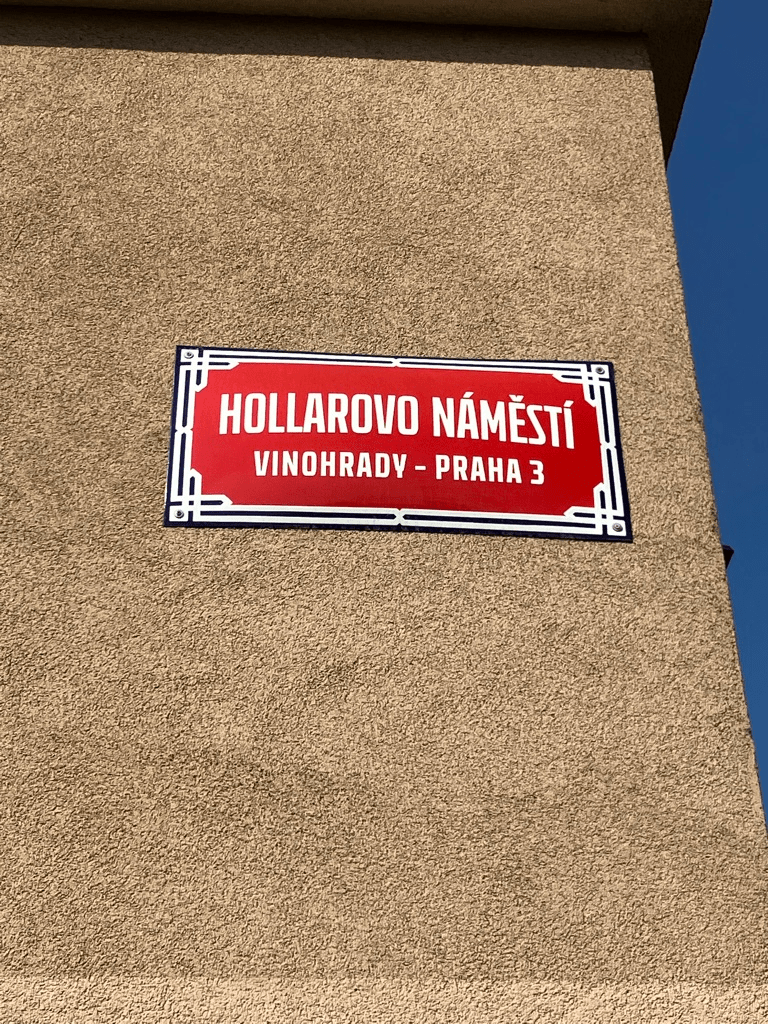
    From 1897 to 1940, and again from 1945 to 1947, this was Havlíčkova. The presence of a photo of Havlíčkovo náměstí on my phone means I won’t explain this one any further for now.

    Under the Nazi occupation, the street was called Ochranovská, or Herrnhuterstraße.

    Ochranov, or Herrnhut, is a town near Görlitz in Saxony, founded by German-speaking refugees from Bohemia in the early 18th century.

    Its name means something like ‘shelter’ in both languages.

    The Moravian Church was founded in Ochranov / Herrnhut by Nikolaus Ludwig, Reichsgraf of Zinzendorf und Pottendorf, in 1722.

  • Originally published on Twitter on 8 August 2022.

    Orebitská was built in 1885.

    The Orebites (Orebité) were a radical branch of the Hussites, named after a procession that they took part in on Mount Oreb, which is located in Třebechovice.

    Oreb itself was named after Horeb, the mountain at which Moses received the Ten Commandments.

    Their ideological leader was Ambrož Hradecký – who has his own street in Žižkov too (https://whatsinapraguestreetname.com/2022/11/21/prague-3-day-68-ambrozova/).

    The Orebites played a key role in the burning of the monastery at Mnichovo Hradiště in 1420.

    Three years later, they merged with Žižka’s faction, which named itself the ‘Sirotci’ after his death in 1424.

  • Originally published on Twitter on 7 August 2022.

    U Památníku was built in 1933, and translate as ‘at the memorial’.

    The ‘memorial’ in question is the National Monument on Vítkov Hill. It contains the Tomb of the Unknown Soldier, a ceremonial hall, and an exhibition on Czech/Czechoslovak statehood.

    However, it’s most famous for its statue of Jan Žižka, towering over the neighbourhood that bears his name.

    An association was founded in 1882 for construction of the monument, and a memorial tablet was placed on the hill in 1910.

    The monument was ultimately built between 1928 and 1938, honouring Czechoslovakian legionaries. Until 1940, this street had the more specific name of U památníku osvobození (‘At the liberation monument’).

    From 1940 to 1945, it went by the distinctly less patriotic name of ‘Na Vítkově’. It then reverted to ‘U památníku osvobození ‘ until 1961.

    After several unsuccessful attempts, the Žižka statue was commissioned in 1931 from the sculptor Bohumil Kafka (1878-1942). He completed the plaster model in 1941, but died shortly afterwards. The statue itself was unveiled in 1950.

    By then, the authorities had decided that the monument should celebrate Communism, and, from 1954 to 1962, it housed the Klement Gottwald mausoleum.

    There are other Vítkov factoids, obviously, but if I reveal them all now, one of my upcoming posts will be very short indeed.

    The Army Museum here reopened on 28 October after reconstruction. The reopening appears to have been a success, at least according to the MoD: https://mocr.army.cz/informacni-servis/zpravodajstvi/armadni-muzeum-zizkov-otevreno-pro-verejnost–proudy-navstevniku-hned-prvni-den-240096/

  • Originally published on Twitter on 6 August 2022.

    Trocnovské náměstí was presumably built before 1875.

    We’ve covered nearby Trocnovská on https://whatsinapraguestreetname.com/2022/11/30/prague-3-day-102-trocnovska/, but otherwise we have a reversal of Dovcovagate (Dovcova being the street that exists on Google Maps but nowhere else, as covered on https://whatsinapraguestreetname.com/2022/11/26/prague-3-day-86-dovcova/).

    My atlas, Google Maps and http://mapy.cz all confidently state that this is part of Husitská (https://whatsinapraguestreetname.com/2022/11/28/prague-3-day-101-husitska/).

    And yet there are at least two street signs claiming that this is a separate square.

    But campuj.online/blog/praha-zitra-navrh-florence… provides the answer – the new square is part of a project to better connect Florenc with the areas of Prague immediately around it. Which can only be a good thing.

    No official date for when this will be a ‘real’ square yet.

  • Originally published on Twitter on 5 August 2022.

    Prvního Pluku has had this name since 1947. It translates as ‘(the street of) the First Regiment’.

    In 1877, three pre-existing streets – Anenská, Křížová and Mlýnská – were joined together to form a street called Vinohradská (not that one).

    This became Pibranser Straße – Příbram Street – under the Nazi occupation, before becoming Vinohradská again until 1947.

    The Karlín barracks, with a capacity of up to 2,000 men, were built here in the 1840s, with the location chosen partly because it was above the highest point the Vltava had ever reached.

    They were known as Ferdinand’s Barracks until 1918.

    During the Second World War, they were used by the Wehrmacht and known as the Hindenburg Barracks.

    In 1968, they were used for some of the anti-occupation broadcasts made by Czechoslovak Radio.

    The barracks hosted various units and facilities of the Prague garrison until 2008.

    In 2017, on the 200th anniversary of the founding of Karlín, the barracks were reopened as a cultural centre that I am going to make a point of visiting: https://kasarnakarlin.cz/en/o-nas.

    From 1906, Infantry Regiment no. 91 was housed here. This was the battalion that Jaroslav Hašek’s Švejk belonged to.

    I really need to reread Švejk.

    Update, June 2024: Unfortunately, the cultural centre was forced to close by the local building authority, apparently because it hadn’t received permission to carry out its activities within the interior spaces: https://www.expats.cz/czech-news/article/popular-kasarna-karlin-cultural-center-ordered-to-close-with-immediate-effect.

    Good piece about the situation here: https://balkaninsight.com/2024/07/18/the-sound-and-the-fury-reasoned-debate-over-social-noise-in-prague-drowned-out/.

  • Originally published on Twitter on 4 August 2022.

    Pernerova was built before 1850.

    The street sign says Pernerova is in Karlín – and it mainly is – but its westernmost parts are in Žižkov.

    Jan Perner (1815-45) was a designer and builder of railways.

    He studied at Prague Technical College from 1831 to 1833.

    In 1836, he went to Russia and worked on the construction of the first Russian railway (Petrograd to Tsarskoye Selo and Pavlovsk).

    Returning home, he worked on construction of the Břeclav-Brno line in 1839, and then designed the route for the Prague-Vienna line.

    By 1842, he was chief engineer of the state railways, and the Emperor approved his proposal for a route from Prague to Dresden. Perner also helped choose the location of Prague’s Main Station.

    He died at the tragically early age of thirty when his head hit a pole when he was looking out of the window of a moving train. He was the first person to die in a railway accident in Bohemia.

    The square outside the station in Pardubice is named after him, as is the Faculty of Transport at the city’s university.

    His name has also been given to several EuroCity trains over the years, including one that left Pardubice for Prague at 06:09 this morning.

    Former names of the road were:

    • Žižkova (which I doubt needs explaining) from 1839-1940 and again from 1945-7;

    • Olmützer Straße (Olomouc Street) from 1940 to 1945; and

    • UNRRA (i.e. United Nations Relief and Rehabilitation Administration) from 1947 to 1951.

  • Originally published on Twitter on 3 August 2022.

    Trocnovská was built in 1889.

    Trocnov, population 112, is a village in the České Budějovice district. Before 1949, the name ‘Trocnov’ only referred to the court there, and the village itself was called Záluží (approx. ‘Behind the Floodplain’).

    Jan Žižka was born less than two kilometres from the village.

    According to legend, he was born in the forest under an oak tree, next to fields which belonged to one of the two Meierhofs of the village.

    A Meierhof is a farm or building, occupied by the administrator of a noble or ecclesiastical estate.

  • Originally published on Twitter on 2 August 2022.

    Husitská was built before 1872, and has had its current name since 1947.

    Husitská is named after its most famous resident, the architect, philosopher, politician, nuclear physicist and adult film actress Kateřina ‘CoCo’ Husitská.

    A woman so impressive that the street was named after her 24 years before she was even born.

    Oh, who are we kidding? It’s named after the Hussites. All of them.

    Until 1875, this was the Horská silnice, the ‘mountain road’ which led to Kutná Hora.

    From 1875 to 1940, and again from 1945 to 1947 it was Husova, i.e. Jan Hus had the street to himself before it was decided to make it belong to a huge number of people instead. #communism

    From 1940 to 1945, the Nazis clearly had a ‘change a street name while keeping as many letters as possible’ thing going on, as this became Huttenstraße.

    Ulrich von Hutten (1488-1523) being a German knight and satirist who became a follower of Martin Luther.

  • Originally published on Twitter on 1 August 2022.

    Day 100 already. Huh.

    Kališnická was built in 1910.

    A kališník is an Utraquist. The Utraquists were a branch of the Hussites who believed that Eucharist in both kinds (i.e. bread and wine) should be administered to churchgoers.

    They constituted a majority of Hussites. They were also known as the Prague Party, or the Calixtines – after the Latin word for ‘chalice’.

    And ‘chalice’ being kalich in Czech is how we arrive at kališník.

    While it’s obviously not what gave the street its name, a kališník obecný is a Helvella acetabulum, which is a cup-shaped fungus that looks somewhat like a cabbage leaf.

    I know that a chalice looks like a cup, but can’t guarantee whether the Hussites were major cabbage-eaters.

    They were Czech, though, so the chances it was absent from their diet are very low indeed.

  • Originally published on Twitter on 31 July 2022.

    Izraelská was built in 1945.

    Until 1995, the street was part of ‘Nad vodovodem’ (‘Above the water pipeline’), which is still located directly to the east of it in Prague 10.

    Izraelská is directly south of the New Jewish Cemetery. The cemetery founded in 1890, as the previous Jewish cemetery (located where the Television Tower now is) had become overcrowded.

    It has space for 100,000 graves, as well as its own urn cemetery (despite Judaism considering cremation as destruction of property).

    The most famous resident of the cemetery is obviously Franz Kafka, but here are many other highly noticeable people who are buried here:

    Vilém Flusser, Czech-Brazilian philosopher (biography on https://flusserstudies.net/flusser).

    Arne Laurin, journalist and editor of the Prager Press (obituary from 1945 on https://jta.org/archive/arne-laurin-influential-czech-jewish-journalist-dies-in-new-york-was-56…).

    Arnošt Lustig, author whose work frequently dealt with the Holocaust (2007 interview with Czech Radio on https://english.radio.cz/arnost-lustig-writers-are-clowns-8604571…).

    Jiří Orten, poet who died aged 22 in Prague as he was hit by an ambulance, but was refused treatment because of his religion. The Jiří Orten Award is awarded annually to a Czech author under the age of 30. Biography in French on https://francais.radio.cz/jiri-orten-8046726….

    Ota Pavel, writer of autobiographical and biographical novels (see this Radio Prague broadcast from 2005: https://english.radio.cz/golden-eels-and-long-ordeals-life-and-times-ota-pavel-8095568…).

    I really wanted to find out exactly when the name change took place in 1995 – specifically to see if it happened as a reaction to the assassination of Yitzhak Rabin.

    I wasn’t able to find out, though I did establish that Václav Klaus attended Rabin’s funeral in Jerusalem (https://cesky.radio.cz/zpravy-utery-7-listopadu-1995-8055054…), and then-president of Israel Ezer Weizman visited Prague in January 1996 (https://cesky.radio.cz/zpravy-streda-10-ledna-1996-8055093…).

  • Originally published on Twitter on 30 July 2022.

    Nad Třebešínem III was named in 1938, although the road wasn’t properly built until the 1940s.

    The only ‘full’ street sign on Nad Třebešínem III suggests it’s in Prague 10. Which it is, mainly.

    But, while number 3 is in Prague 10, number 5 is in Prague 3 (proof attached, complete with ‘temperamental dog’ warning).

    We’ve taken the Třebešín story as far as we can on https://whatsinapraguestreetname.com/2022/11/26/day-96-na-trebesine/, so let’s talk about when Třebešín was the home of Karel Gott (information taken from https://prazsky.denik.cz/zpravy_region/karel-gott-vily-bungalov-strasnice-bertramka-kobylisy-pieta-pohreb-20191012.html…).

    In 1969, Gott asked the architect (and former Olympic basketballer) Jiří Siegel to build him a house on Slunečná, in the style of an American bungalow.

    It was pretty high-tech for the time – swimming pool, sliding windows, floor-mounted window convectors, and now I’m talking like an estate agent.

    Gott sold the house to the future Czechoslovak Minister of Construction, Karel Polák, in 1974, and moved to Bertramka in Smíchov.

    In one interview, he (Gott, obvs) stated that the humidity in the house wasn’t good for his vocal cords.

    Here’s Karel in 1969, around his moving-in date, putting a rather spirited (and German-language) twist on the Stones’ Paint It Black.

    And here he his around the time he left his allegedly humid house, giving the Rubettes’ Sugar Baby Love some welly in Czech and not looking very sad to be leaving Třebešín at all.

  • Originally published on Twitter on 29 July 2022.

    Zvěřinova was built in 2016, making it the newest street yet.

    Josef Zvěřina (1913-1990) was a priest, art historian, theologian, philosopher and educator.

    He graduated from the (no longer existing) Archbishops’ Gymnázium in Bubeneč in 1932, and was ordained as a priest in Rome in 1937.

    After the Czech universities were abolished in 1939, he taught at a ‘substitute’ theological school, but was imprisoned for his anti-German activities for just over a year, starting in 1942.

    After WWII, he joined the theological faculty of CU, but was called up for military training when theological schools were closed in 1950.

    In early 1952, he was sentenced to 22 years’ imprisonment. Released early in 1965, he served as a theologian in the underground church.

    In November 1989, he gave speeches to the protesting students, including before an estimated 800,000 on Letná on 25 November (other speeches from that day are in the video below).

    After the revolution, it was expected that he would teach at the relaunched theological factory of Charles University – but he died unexpectedly in August 1990.

    He was fully rehabilitated in December of the same year.

  • Originally published on Twitter on 28 July 2022.

    Na Třebešíně was built in 1925.

    It’s mainly in Prague 10, but street signs don’t lie. Also, it was originally designated as a square.

    Třebešín is the name of the residential district located here on a long hill. It’s significantly more villa-based than the areas that surround it.

    Before 1914, this area was just fields; the first houses were recorded in 1926.

    The origins of the name Třebešín aren’t clear, but it was first mentioned on a map in 1841.

    There’s a district of Hradec Králové called Třebeš, however, and that was originally called Střebeš – which leads me to wonder if Třebešín’s name has something to do with stříbro, i.e. silver.

    A park on this street (admittedly in the Prague 10 part) is named after Jiří Karen (1920-2000), a poet who, in addition to his Czech works, also published several volumes in Esperanto.

  • Originally published on Twitter on 27 July 2022.

    Pod Kapličkou was built in 1925.

    Yes, I thought we were only going to get more central from here on, but then my atlas kindly reminded me that there’s a few streets on the outskirts of Prague 3 that I forgot about.

    I found out that Pod Kapličkou is named after a nearby kaplička, but, when I thought it was time to double-check my facts, Seznam Slovník started to have a laugh.

    I know that a kaple is a chapel (I also know that my Mac just tried to change kaple to ‘maple’ THREE TIMES).

    So I am assuming a kaplička is a small chapel. But the dictionary also tells me that a kaplička is a gauge cluster, or one of these.

    Given the street was built in 1925, I’m going to quietly go with the odds that we’re dealing with a chapel here. Not sure it’s there anymore, mind you.

  • Originally published on Twitter on 26 July 2022.

    Basilejské náměstí – Basel Square – was built in 1932.

    The Swiss city of Basel, as well as being a very nice place to walk around (which the square is currently not – see later on) has a special significance for Czechs.

    The Council of Basel was called in 1431 by Pope Martin V (who died before it could take place) in order to discuss papal supremacy and Hussite heresy.

    In 1436, the Council and the moderate Hussites (the Utraquists) agreed upon the Compacts of Basel, or the Compactata. These granted Hussite priests the right to administer wine to laymen during the Eucharist.

    A year later, the Council confirmed that ‘communion under both kinds’ (i.e. receiving both consecrated bread and wine) was not heretical.

    Google Maps typically suggests that I go through Basilejské náměstí if I want to walk into the centre. Normally, this works quite well.

    Lately, it works less well, as there’s so much building work going on that you start to wonder if somebody in Basel recently declared functioning pavements as heretical as well.

    In the last few days, it finally seems to be going in a visibly right direction, though: https://www.blesk.cz/clanek/regiony-praha-praha-zpravy/718192/malo-zelene-hodne-betonu-na-sitich-se-kvuli-podobe-basilejskeho-namesti-dohaduji-obyvatele-i-politici.html

  • Originally published on Twitter on 25 July 2022.

    U Zásobní zahrady was built in 1947.

    A zásobní zahrada is a ‘supply garden’.

    The garden here provided flowers for Prague’s parks, and for specific events, from 1937 onwards. That’s a lot of flowers.

    It replaced a previous storage garden, also located in Žižkov, but at Rajská zahrada, which we’ll discuss when we get a little more central.

    This was a year after the Kapslovna factory closed down, as production was moved to Vlašim in 1936. Meaning that I’ve managed to work out a little bit more of what was here post-factory and pre-biathlon association.

    The walls around the southern part of the Kapslovna factory were demolished around 1960; the supply garden disappeared along with them.

    There are nice photos of both supply gardens (I think it’s both of them, in any case) on https://praha3.cz/aktualne-z-trojky/zpravy/retrospektiva/zahrada-ktera-zdobila-kvetinami-prahu-n1131671.htm….

  • Originally published on Twitter on 24 July 2022.

    Na Parukářce was built in 1947.

    We explained Parukářka yesterday – see https://whatsinapraguestreetname.com/2022/11/26/prague-3-day-91-pod-parukarkou/ – so today we can talk about people not quite agreeing what this area should be called.

    We know about Vrch svatého Kríže / Mount of the Holy Cross, named after a wooden cross placed on the summit in 1822.

    And about Parukářka, a name given in 1804 after a wigmaker based here.

    Olšanský vrch / Olšany Hill also gets mentioned – Olšany being the village that was located around here once upon a time (https://whatsinapraguestreetname.com/2022/11/22/prague-3-day-73-olsanska/).

    Then, there’s Zámeček (Little Castle), named after a one-floor building that was located at the bottom of the steps until about 1910.

    Finally, other records say that the old name of the hill was Křížek (Small Cross).