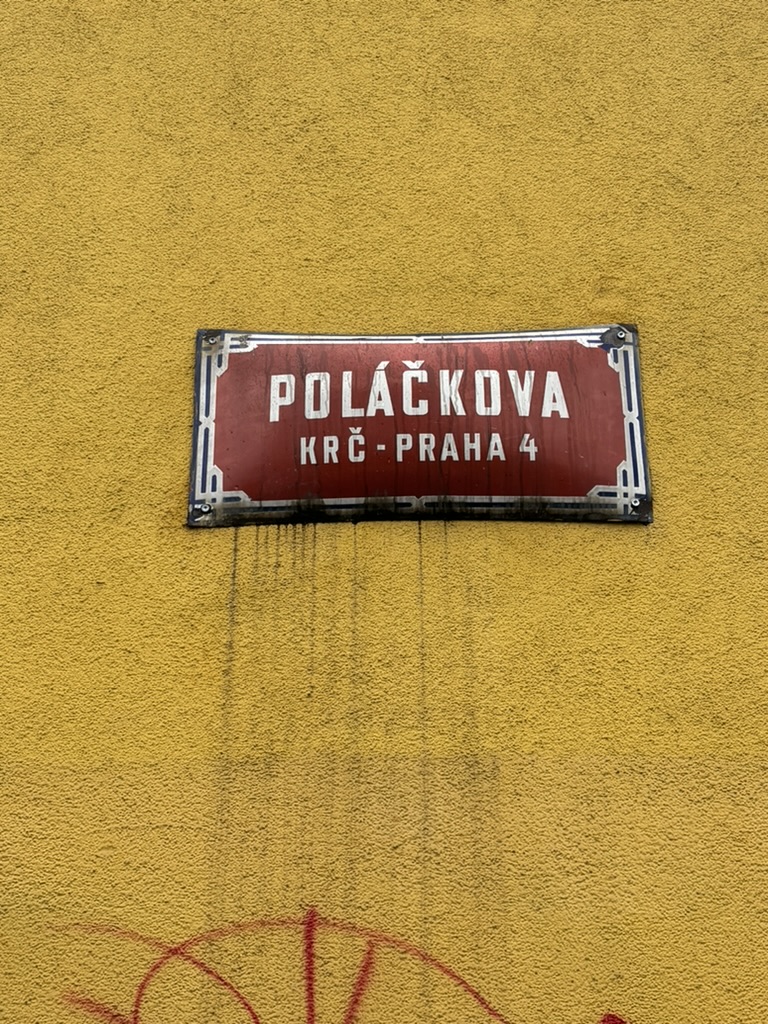
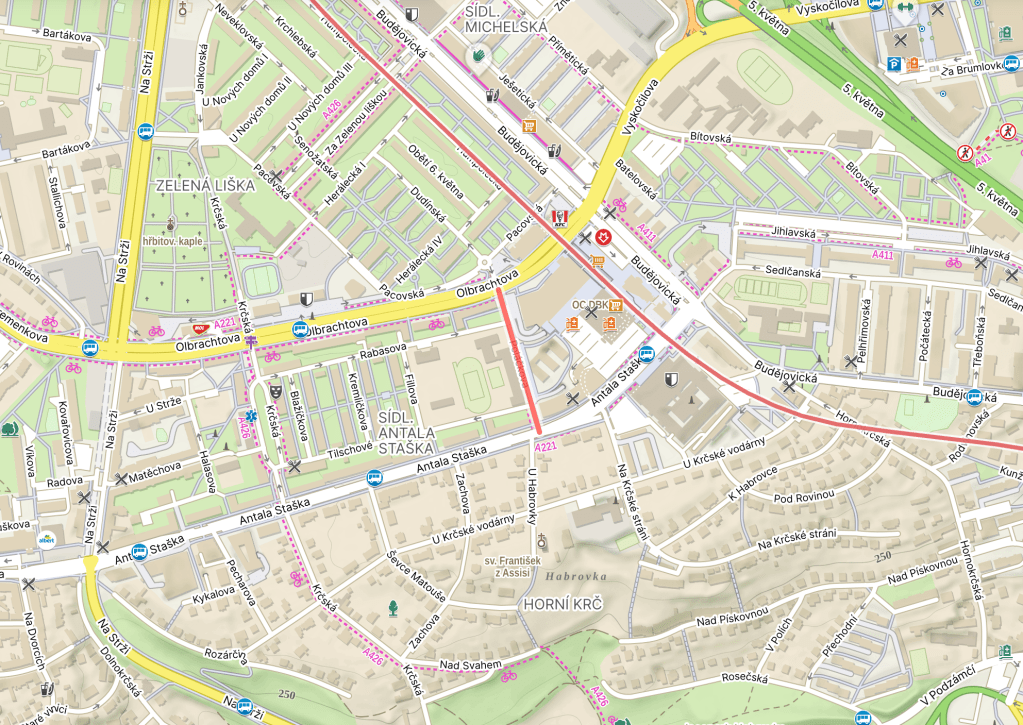
Poláčkova was built in 1962.
Karel Poláček was born in Rychnov nad Kněžnou in 1892; his father was a Jewish merchant. He also went to school there, but was expelled from grammar school for behaving badly and getting poor grades.
Eventually, he ended up finishing his schooling on Truhlářská (AKA one of the streets that the Palladium Shopping Centre is on – see https://whatsinapraguestreetname.com/2024/11/10/prague-1-day-266-truhlarska/). He matriculated in 1912.
Poláček then studied law at Charles University, while running a student puppet theatre in Rychnov. Struggling to find employment in Prague, he joined the army when WW1 started; he served on the Italian and Russian fronts, and also escaped captivity in Serbia.
After the war, he worked at the export and import commission, an experience which influenced his first short story, Kolotoč (Carousel). He also started writing for two satirical magazines, which brought him into contact with the Čapek brothers (https://whatsinapraguestreetname.com/2024/01/30/prague-2-day-24-sady-bratri-capku/).
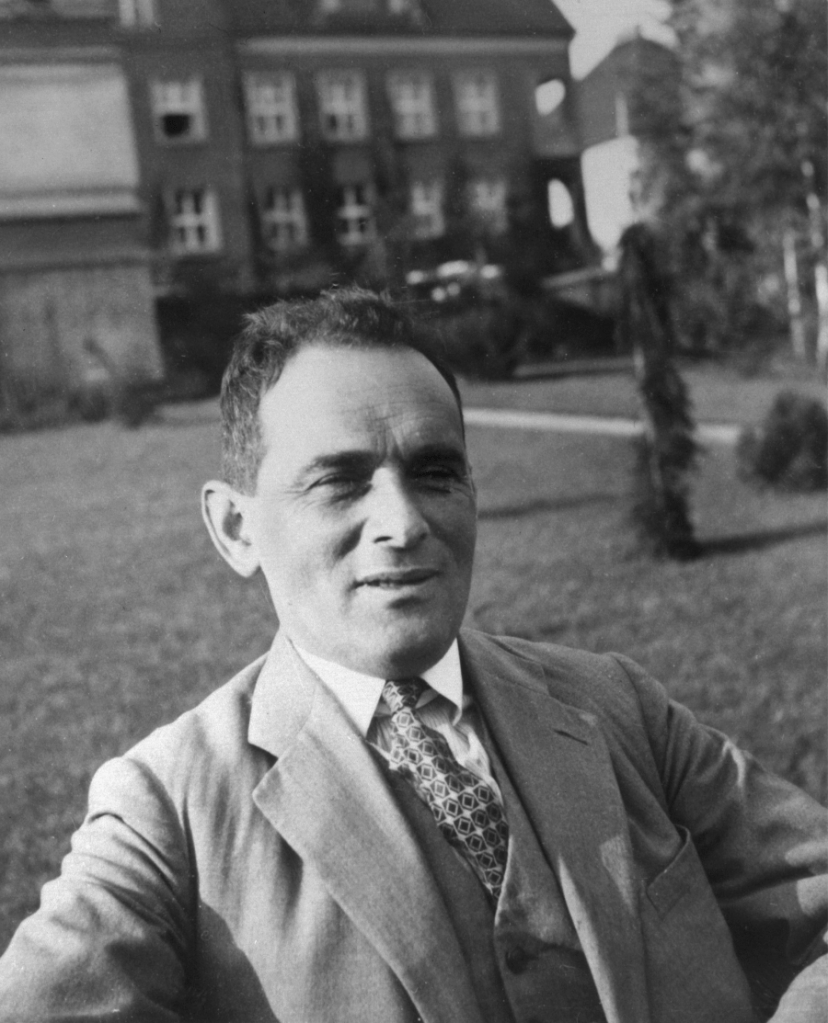
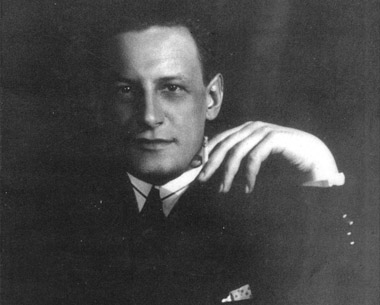
It was actually Karel Čapek who took this picture of Poláček.
His novels were often humorous portrayals of people shaped by their professions or hobbies, and have been compared to the works of Chekov. Poláček also wrote short stories, including about the Jewish faith, and a collection titled Židovské anekdoty (Jewish Anecdotes, 1933).
His first significant literary success was Muži v offsidu (1931 – never let it be said that Czenglish is a new invention), where the main characters are the football teams of FK Viktoria Žižkov (https://whatsinapraguestreetname.com/2023/01/13/prague-3-day-129-u-viktorie/) and SK Slavia Praha.
Poláček worked as a columnist for Lidové noviny, and also for the Melantrich publishing house (https://whatsinapraguestreetname.com/2024/10/14/prague-1-day-194-melantrichova/). However, his Jewish roots and the Nazi occupation meant he was let go from Lidové noviny in 1939.
Although he and his partner, Dora Vaňková, managed to get his daughter from a previous marriage, Jiřina, to England, Poláček and Dora were deported to Terezín in July 1943, and were sent to Auschwitz in October 1944.
Until the 1990s, it was assumed that Poláček died at the gas chambers in Auschwitz, but an eye-witness, Klára Baumöhlová, confirmed that he was transported to a camp at Hindenburg (current-day Zabrze), where one his plays as performed (and Baumöhlová played a role).
In January 1945, Poláček participated in a march from Hindenburg to the Gleiwitz camp (located in current-day Gliwice); he did not survive this.
In 1995, fifty years after his death, Poláček was posthumously awarded the Order of Tomáš Garrigue Masaryk.
A year earlier, Poláček’s last novel, Bylo nás pět (There were five of us), which he had written shortly before being sent to Terezín, had been made into a television series.
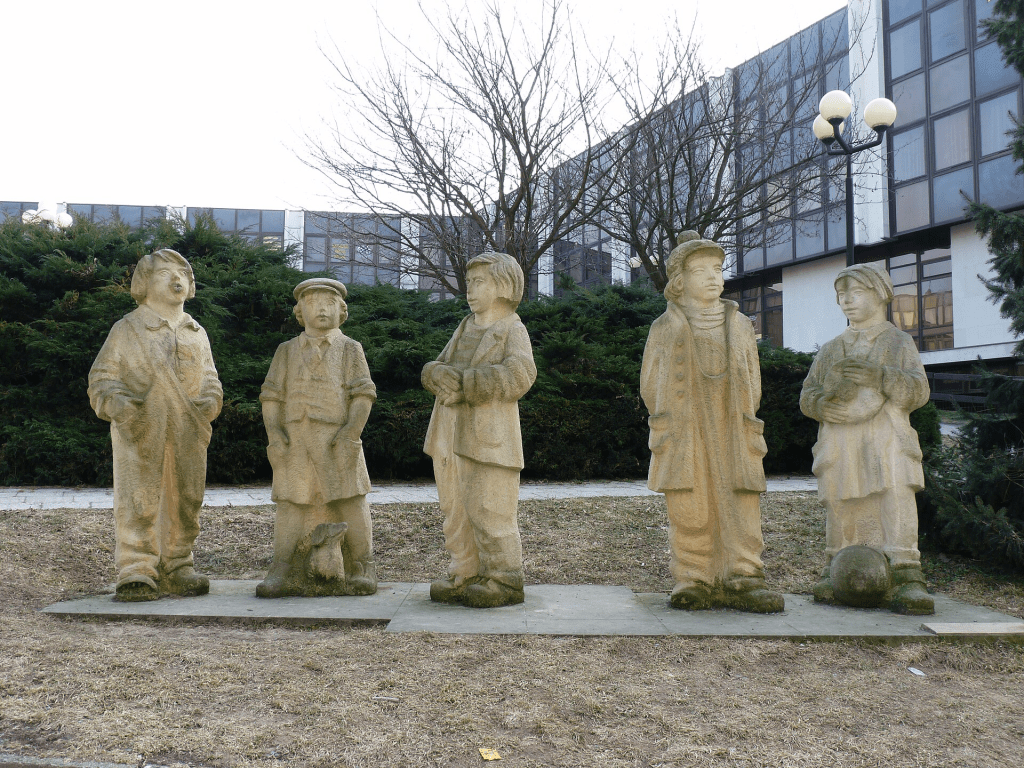
This tribute to the five main characters, in Poláček’s native Rychnov, is one that I find incredibly touching (photo from Wikimedia Commons, by Krvesaj).
 What's in a Prague street name
Leave a comment