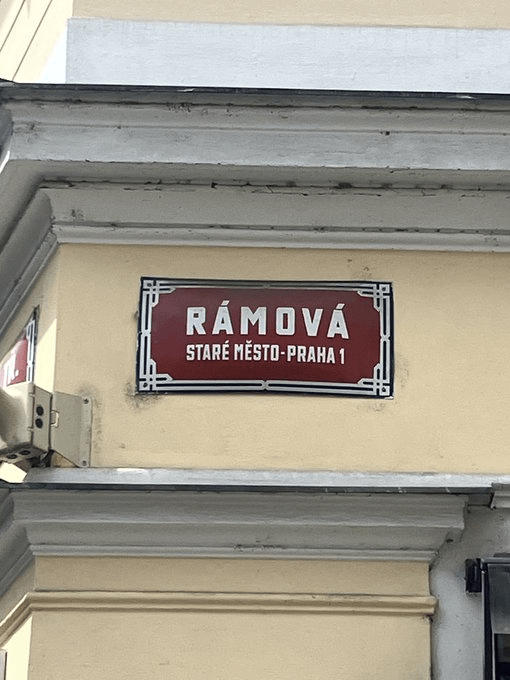
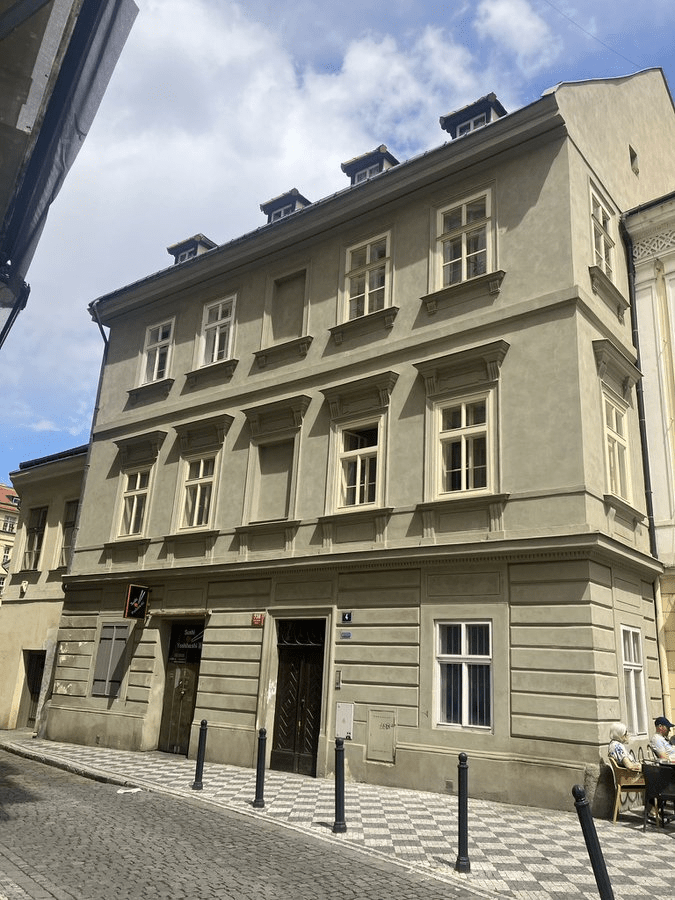
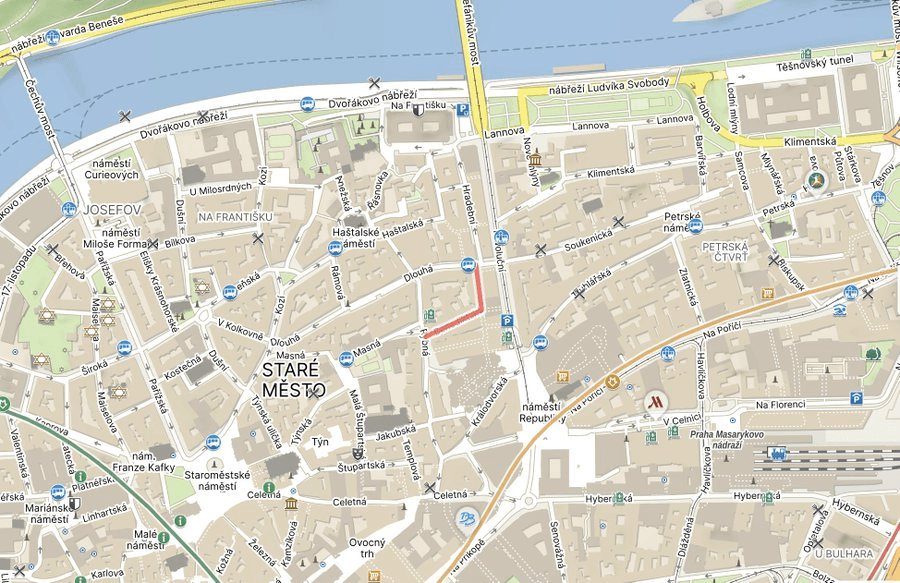
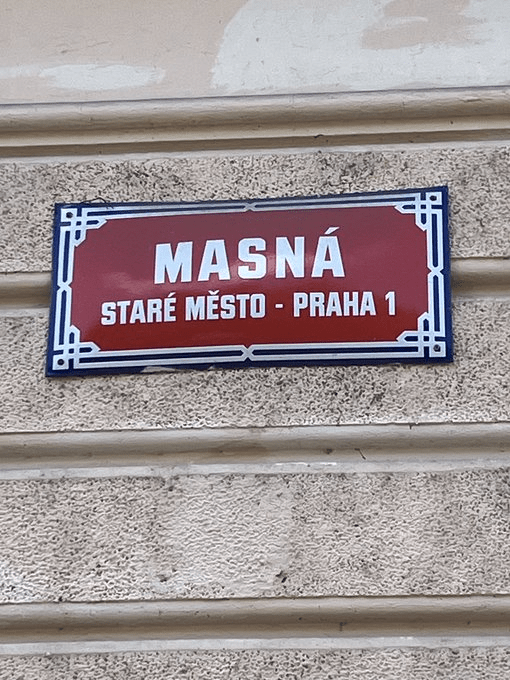
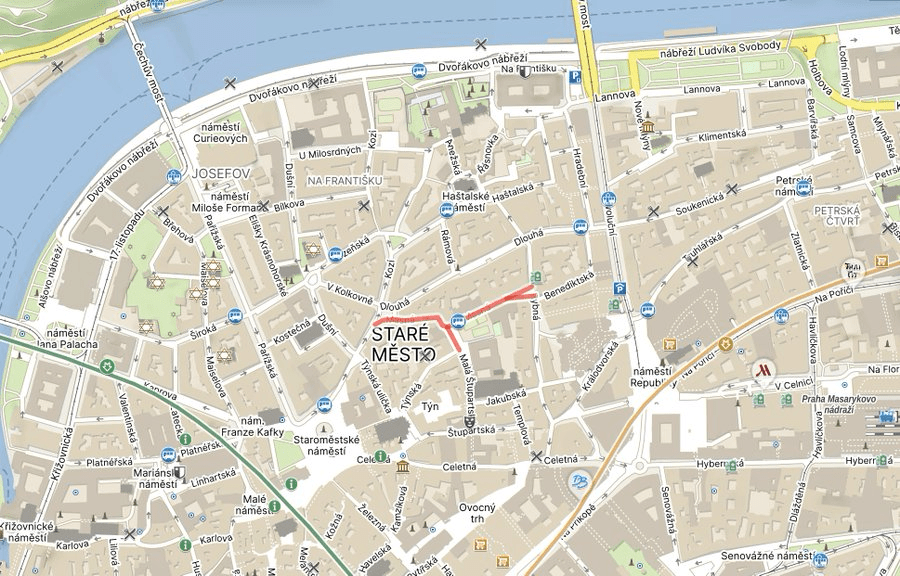
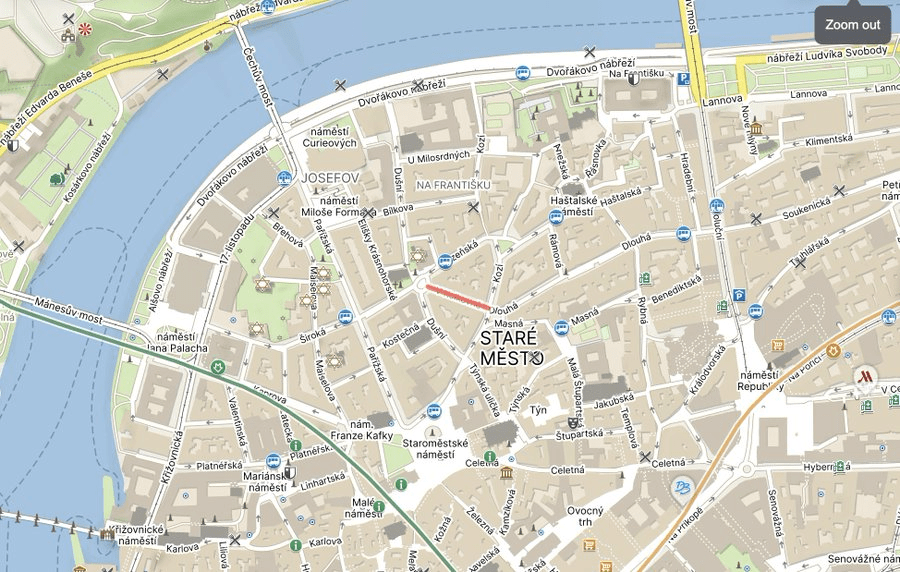
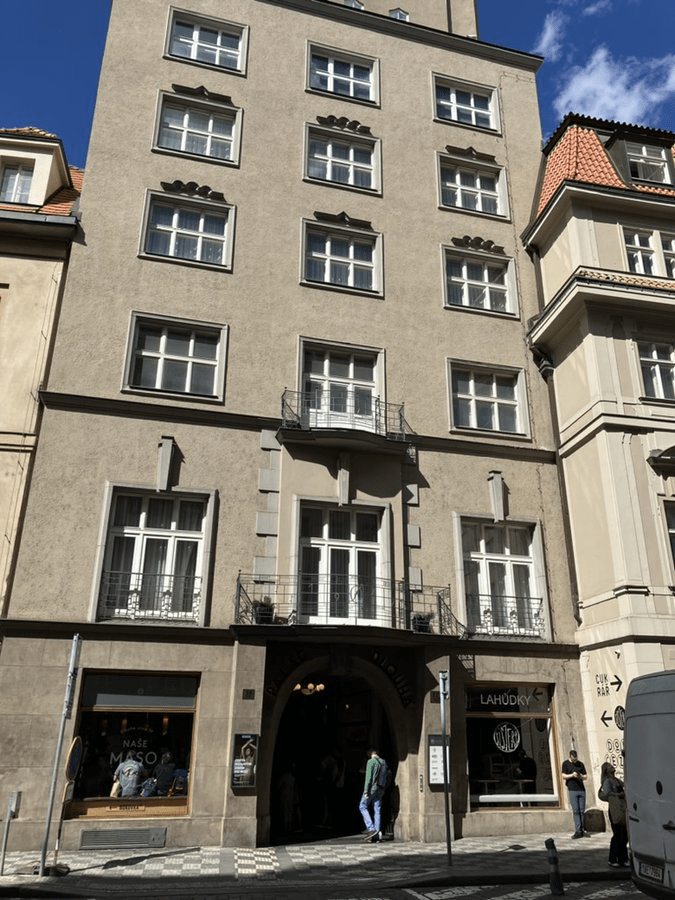
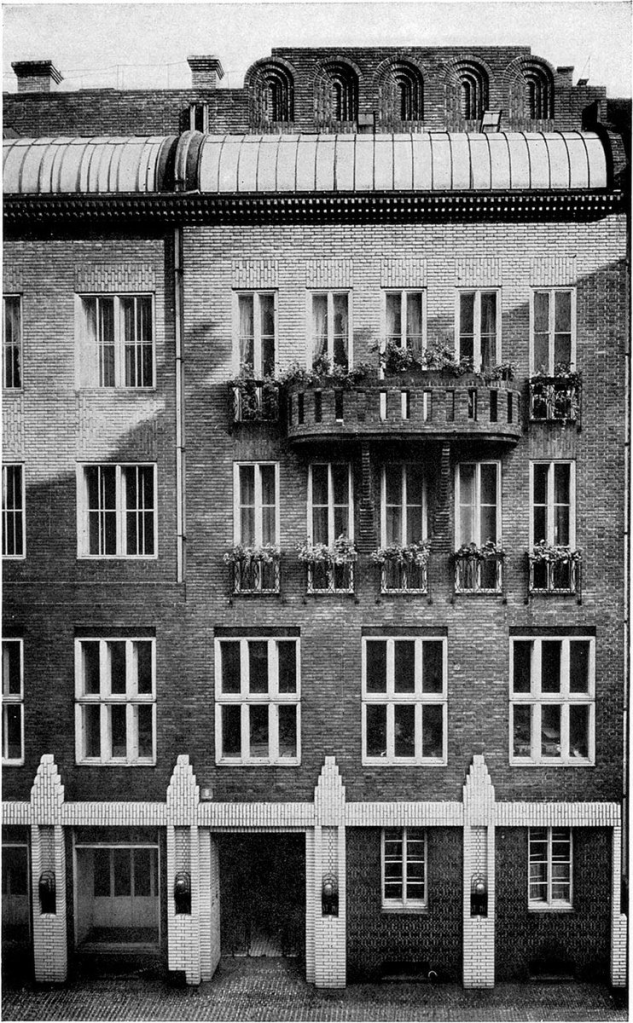
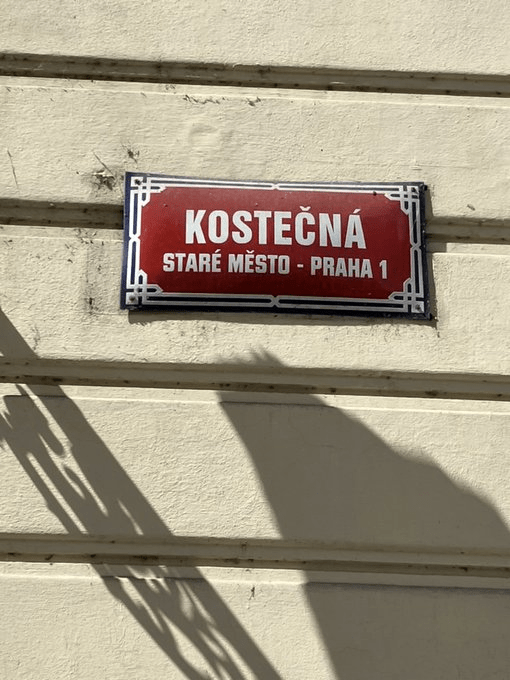
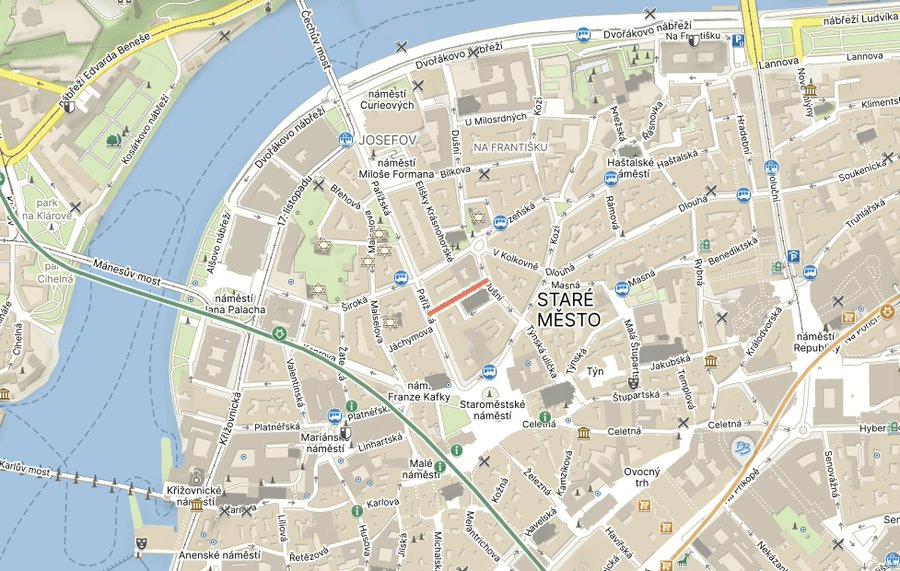
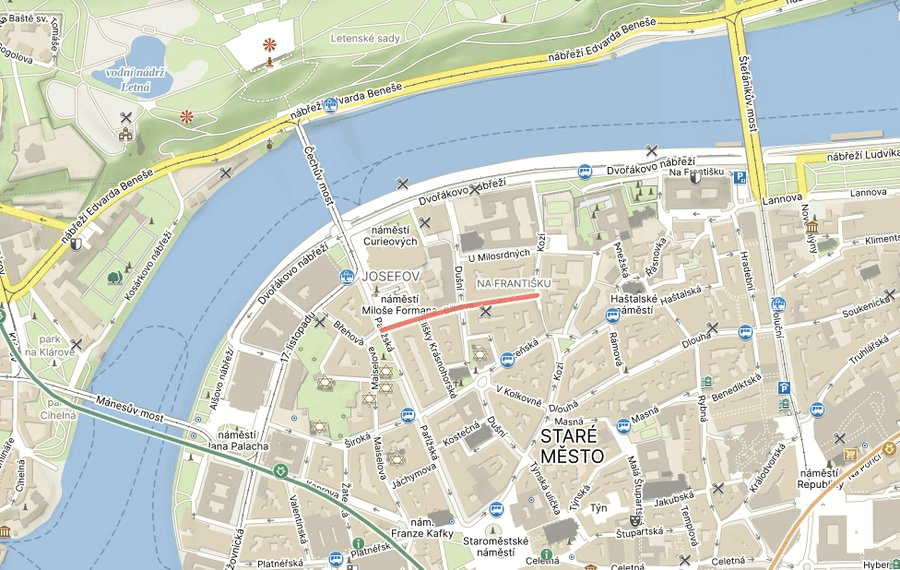
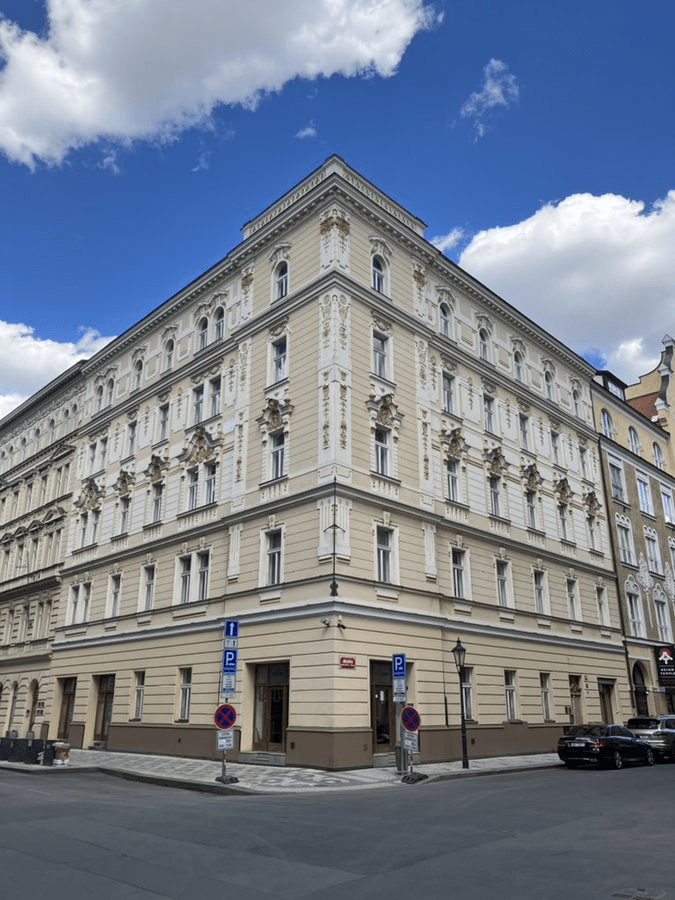
The first one is that the street is named after number 4, U Modrého rámce (The Blue Frame). It’s pictured, and, at least in 2024, not noticeably blue.
The second theory is that the street is named after the frames (Czech: ‘rámy’) used by local cloth weavers, who worked nearby on Haštalské náměstí (coming up in about a week).
A cloth weaver in Czech is a ‘soukeník’, and they too have a street named after them in Prague 1, which will get a thread at some point in the 260 range.
In other words: there really are a lot of these streets, aren’t there.
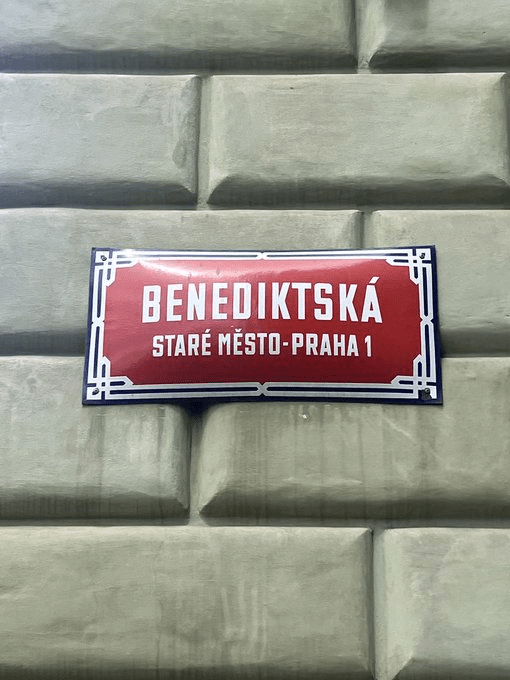
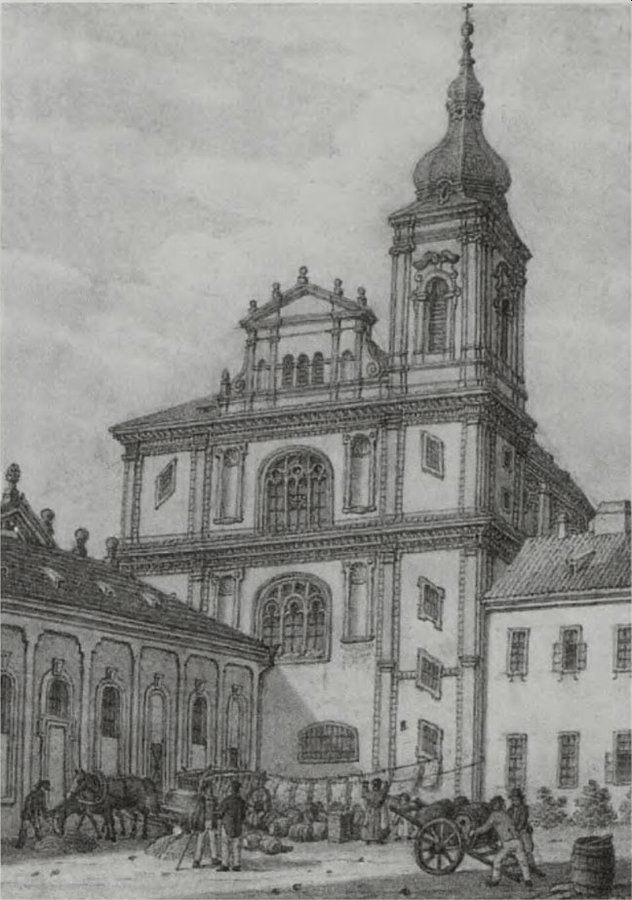
However, before the meat shops (probably – I can’t say for certain when those appeared), there was also the Church of St Benedict, built at some point between 1150 and 1175.
The Teutonic Knights – somehow not mentioned in any of these threads to date – moved in around the 1230s, took over the church, and also had their Old Town Command built nearby, probably simultaneously with the development of the Old Town fortifications.
The command only lasted about 200 years; the church underwent reconstruction around the same time that the command was abandoned, and became part of the Norbertinum, a seminary for Premonstratensian canons.
The church was destroyed in 1792, which is also when the street was renamed, as if that’s some sort of compensation for the loss of what might have been quite an attractive building (in an area of the Old Town which… could do with a few more).
This also explains why this post has a minimum of photographs to accompany it. If you want to know what the spot the church was located on looks like now, please enjoy this picture of the Kotva shopping centre.
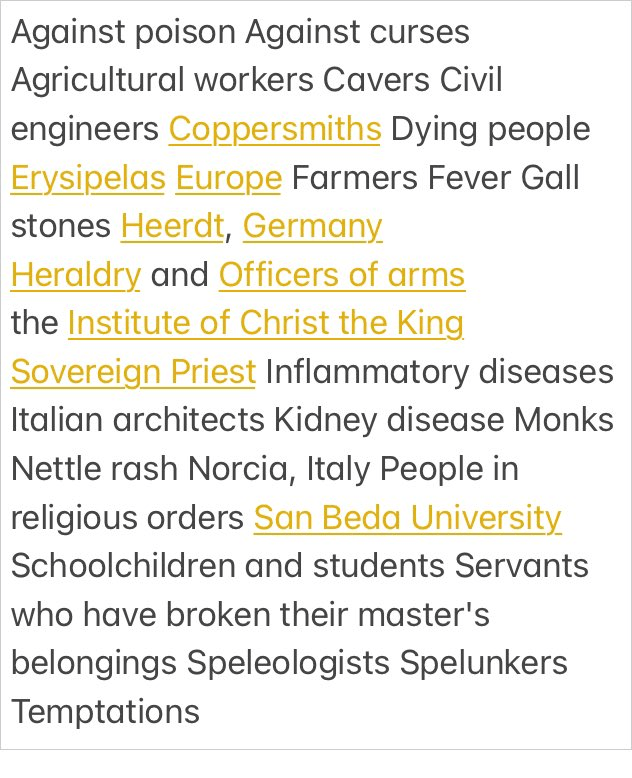
Bonus St Benedict trivia: he’s the patron saint of so many things that I’m just going to do a copy-and-paste from Wikipedia here.
The street (which was smaller at the time) therefore became known as Masný trh (‘Meat market’), while, at other times, U masných krámů (‘The Meat Shops’) and Masnotrhová (also ‘Meat market’, but an adjective) were used.
In 1870, various streets were joined together, and were called Masná.
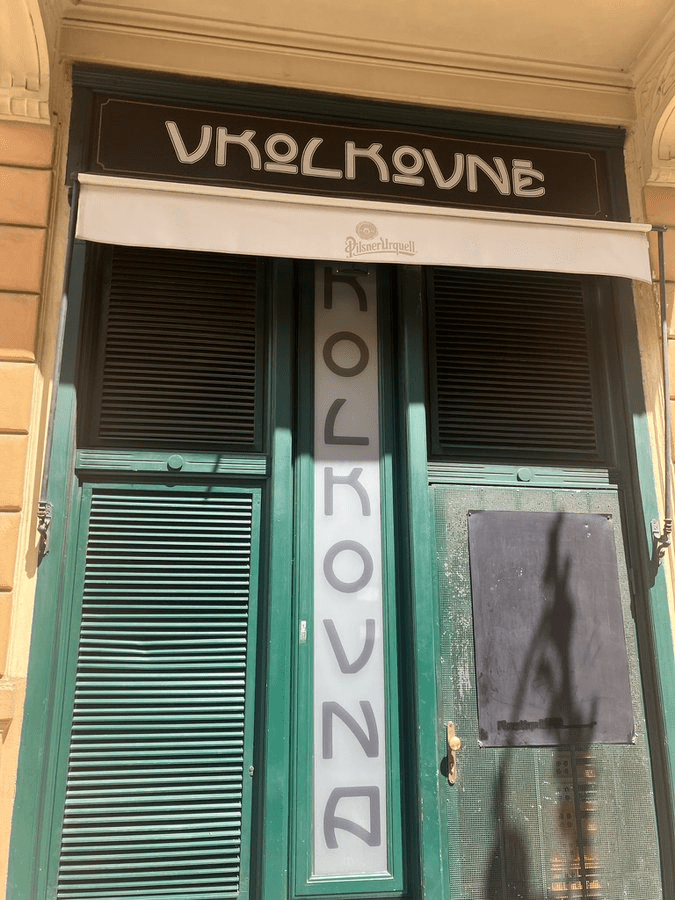
‘Kolkovné’ is stamp tax or stamp duty; I would explain in detail what that is, but it’s been fifteen years since my tax exams, and stamp duty was one of the chapters that I don’t think I fully understood at the time.
We believe stamp duty originated in Venice in 1604, and, while we now associate it with property purchases, it also used to be payable on most legal documents, including cheques, receipts and marriage licences.
And, at number 1 on this street, the Stará kolkovna was the stamp duty office.
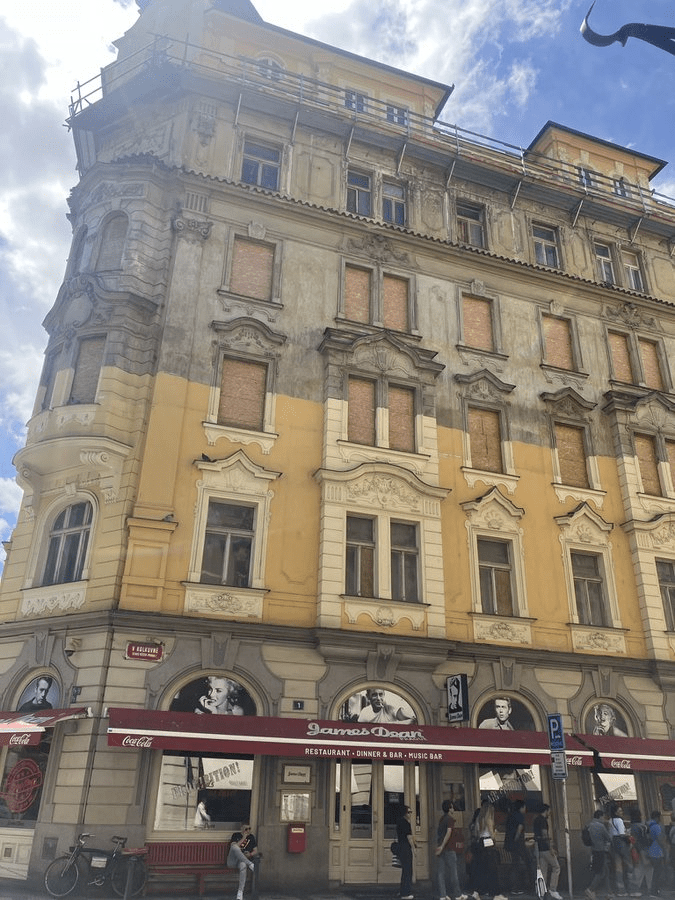
It’s not there anymore – it was destroyed in the ‘asanace’ in 1904 – and its replacement now makes me understand how all the Kolkovna restaurants across Prague got their name.
The destruction becomes all the more disheartening when you learn that Václav IV apparently had this building as his main non-Prague-Castle residence in the city.
If you’re not into Czech food, you can walk to the other side of the road and have a chat with Jimmy Dean (maybe about how those upper floors need a bit of love).
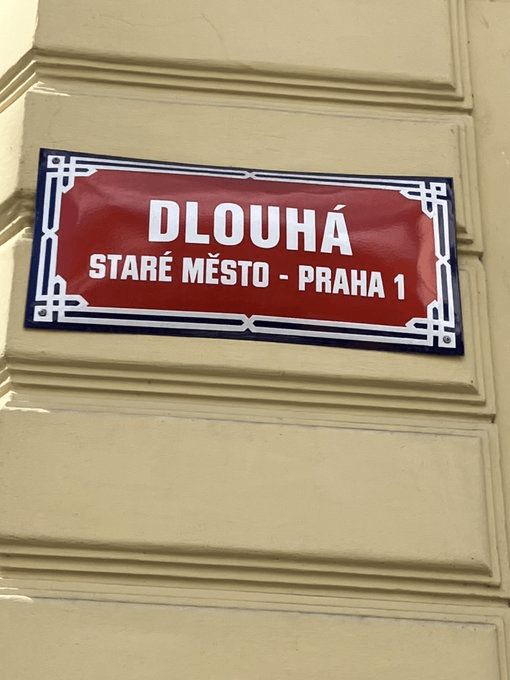
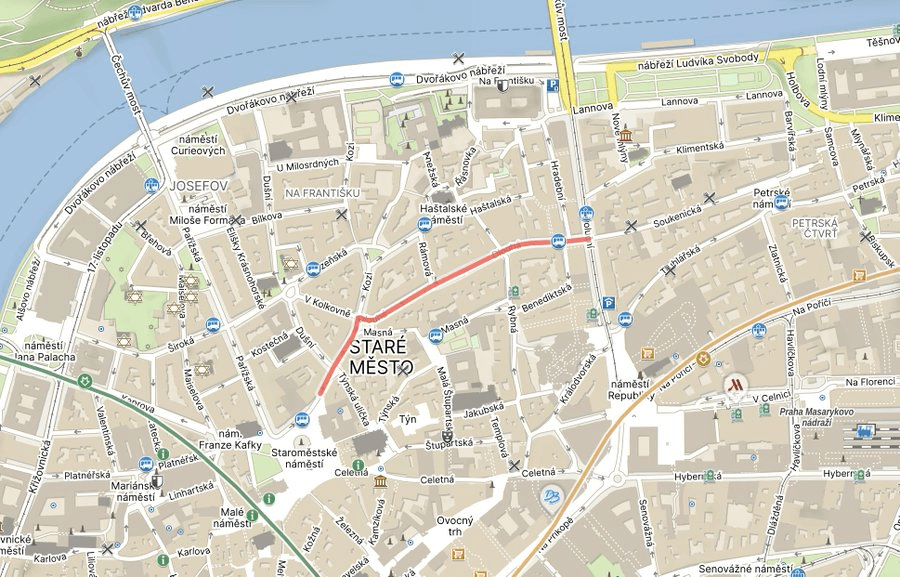
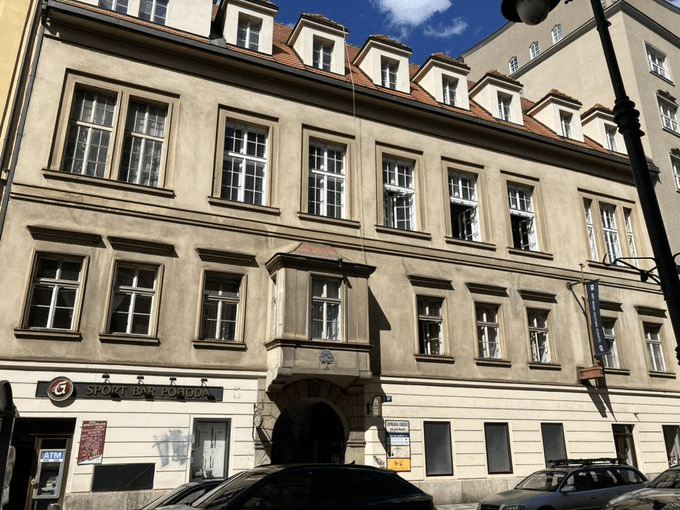
If you compare Dlouhá to other long-ish streets in the Prague 1 series, it’s – let’s not beat around the bush – not especially packed with historical anecdotes. But it’s not devoid of buildings worth mentioning, either.
Divadlo v Dlouhé, founded in 1996, is a municipality-run repertory theatre which prides itself on its diverse repertoire and its 80,000 annual visitors: https://divadlovdlouhe.cz/o-nas/
It’s particularly renowned for two festivals – Dítě v Dlouhé, which is aimed at younger children (and took place last month), and 13+, which is aimed at teenagers (and took place in January).
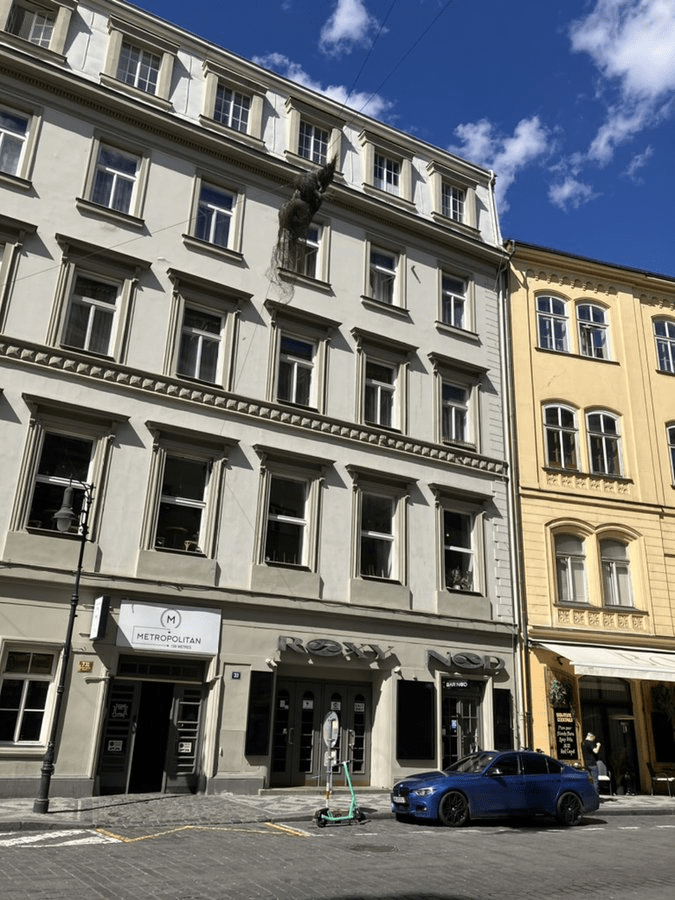
There’s also Roxy, a music club founded in 1992 in the premises of a former cinema. https://instagram.com/roxyprague/ gives an idea of who plays there.
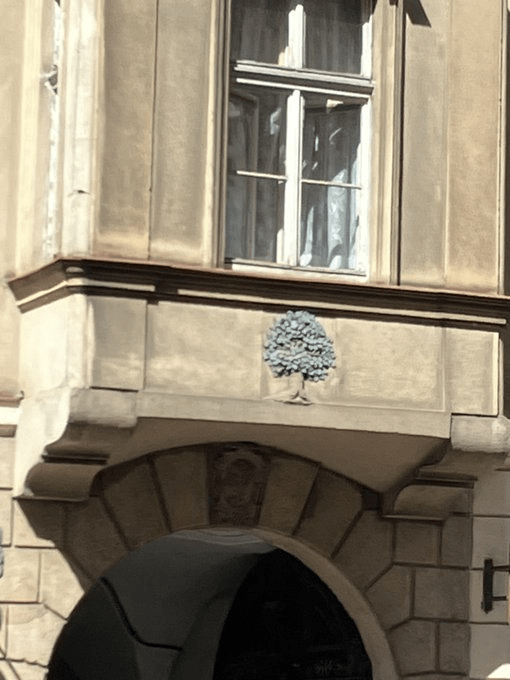
Also worth a mention is U Zlatého stromu (The Golden Tree), created when two Gothic houses were joined around 1600. The tree remains (not quite sure how golden it is now).
Is it wrong to suggest that all these places could do with, you know, a bit of colour?
Anyway, let’s finish this off with one of the greatest things ever to involve the word ‘Dlouhá’:
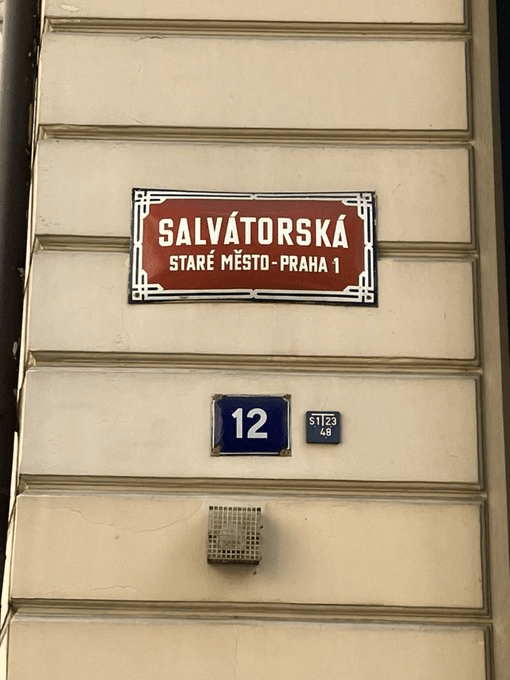
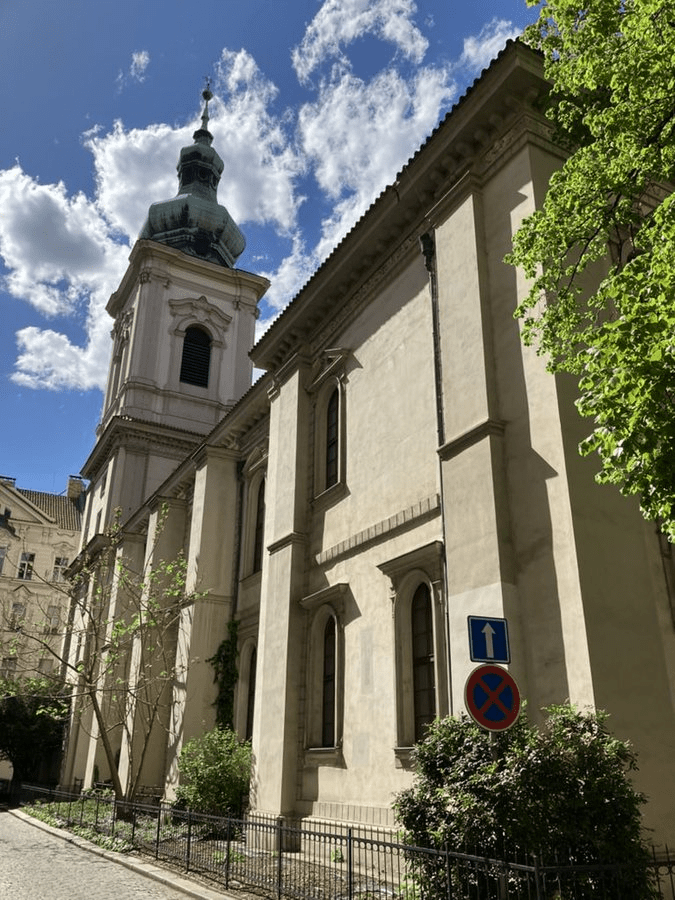
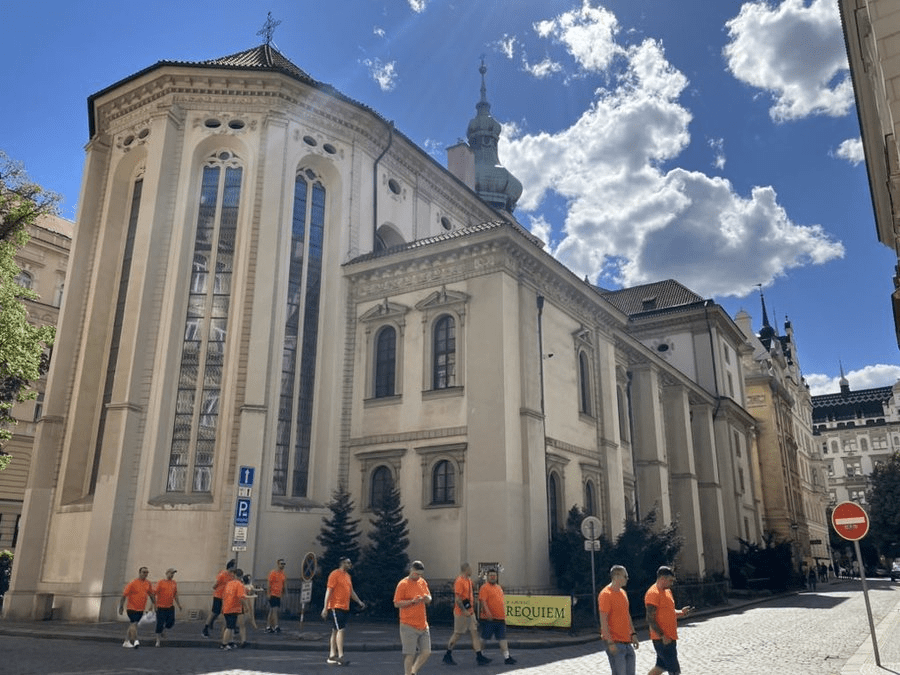
In 1610, a Protestant nobleman, Jáchym Ondřej Šlik, bought a plot of land for the construction of a German Evangelical church; the foundation stone was laid a year later, and the church (Kostel svatého Salvátora / St Salvator’s Church) was consecrated in 1614.
Salvátor is a Czech transliteration of the Latin word for ‘saviour’; churches dedicated to ’St Salvator’ are most likely dedicated to Christ himself, as he is believed to be the saviour of the world / Salvator Mundi.
In 1624, the church was given over to the Order of Minims, a religious order founded by Francis of Paola in Italy in the 1400s (they’re known as the Paulanerorden in German, and as ‘pauláni’ in Czech).
Actually, they’re officially known as the Řád Nejmenších bratří sv. Františka z Pauly in Czech, but character limits.
They already had a monastery, the last remnants of which can still be found on Old Town Square.
When both the church and the monastery were abolished, the church building began to be used as a mint (from 1795 to 1848).
In 1863, the building was purchased by the Czech Evangelical Church of the Augsburg Confession, which uses it to this day.
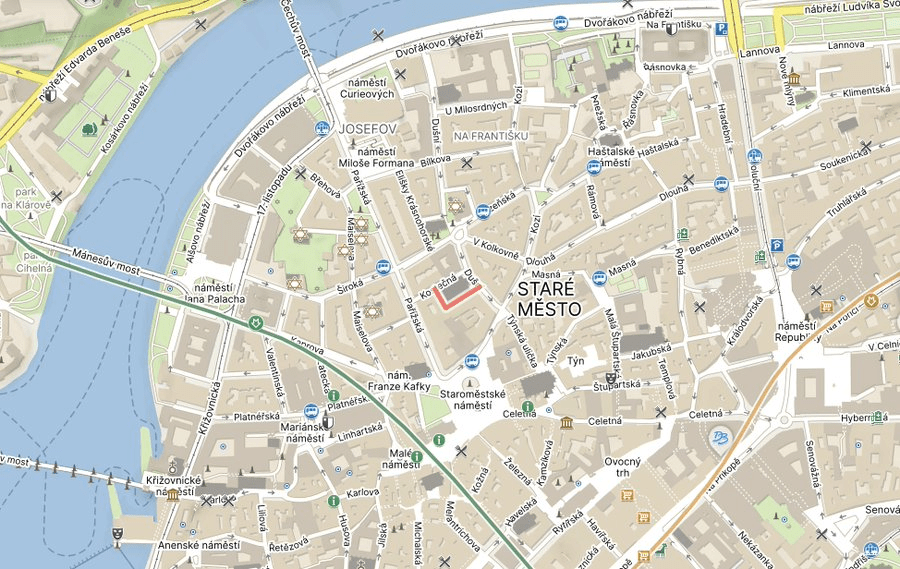
The street itself, however, wasn’t created until 1902, as part of the ‘clean-up’ / asanace of the Old Town.
Also of note on Salvátorská is the Art Nouveau Štencův dům, built between 1909 and 1911. It housed what was apparently the most modern printing house in Austria-Hungary (albeit briefly, if it was only completed in 1911).
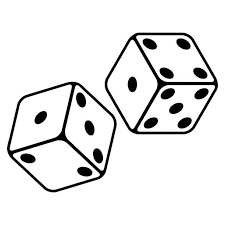
You know what a kostka is. Six sides. Numbers from 1 to 6 totalling 21. An item which may indirectly lead you to realise which of your friends gets seriously competitive about Monopoly. Reminds you of that shopping place near the airport.
Or, if you’re feeling like a dictionary definition, a ‘polyhedron used in games of chance’.
The oldest die was found near the Indus River and is believed to be about 5,000 years old; they became particularly popular in Ancient Rome.
And they were so popular that we’re now looking at a street which is named after the people who made them (please let me know if there’s a more interesting word for that than ‘diemaker’).
Apparently, their popularity in the Middle Ages meant that there were multiple decrees and laws banning them (this sounds extreme, but you assume that there was some sort of anti-gambling drive involved).
The street’s name has shifted subtly over time, having gone from Kostková to U kostkářů to Kostečná.
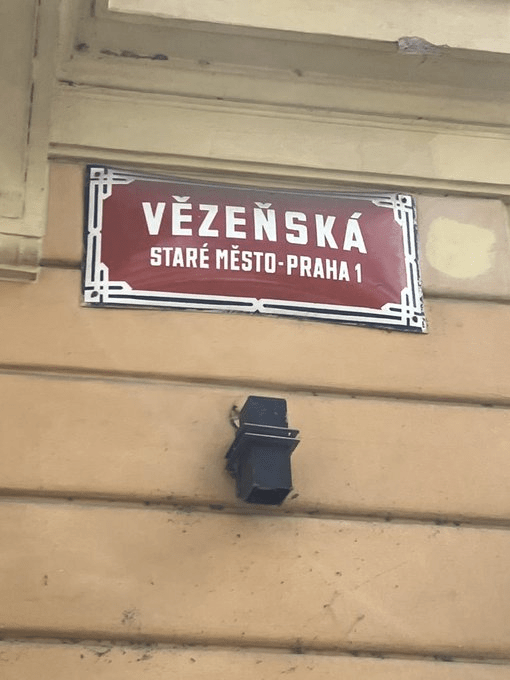
A ‘vězení’ or a ‘věznice’ is a prison, and apparently there was once one here.
The name can be traced back to the 18th century, but the prison… sorry, I’m drawing a blank.
Across the country, there are ‘vazební věznice’ (remand prisons, i.e. prisons in which people are detained who have been charged but not convicted), and regular ‘věznice’, which house those who have been convicted.
Of the 25 non-remand prisons in the country, none are in Prague; of the ten remand prisons, two are in Prague – in Pankrác and Ruzyně.
Realising that these Prague 3 / Prague 2 posts still have things that could be added to them is a reminder of just how endlessly this city fascinates me.
Not that that’s enabling me to tell you about the prison I was *actually* supposed to write about today.
The oldest Jewish settlements in Prague were probably on Malá Strana and near Vyšehrad. The Vyšehrad one disappeared around the end of the 11th century.
The one in Malá Strana, meanwhile, was burned down in 1142, when Conrad III of Germany laid siege to Prague Castle. The Jewish population therefore crossed the river and settled in the Old Town.
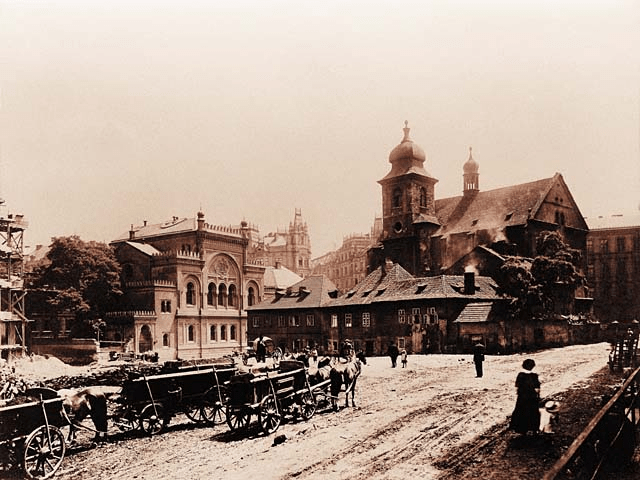
However, we’re not sure if they moved to an existing Jewish settlement, or founded a new one. What we do know is that a synagogue was built here around the 12th century and was called the Altschul (the Old School).
Apparently, it was used by Jews of Byzantine origin, and was located at a slight distance to the Jewish town and its inhabitants, as the two groups didn’t quite see eye to eye.
The synagogue suffered greatly over the years – it was burnt down during the 1389 pogrom, as well as in 1516 and 1689. It also got closed down, as ordered by Leopold I, from 1693 to 1704.
It was also subject to huge mistreatment from 1745 to 1748 (Maria Theresa had ordered the Jews out of Prague in 1744), requiring reconstruction in 1750… only to get burnt down again in 1754.
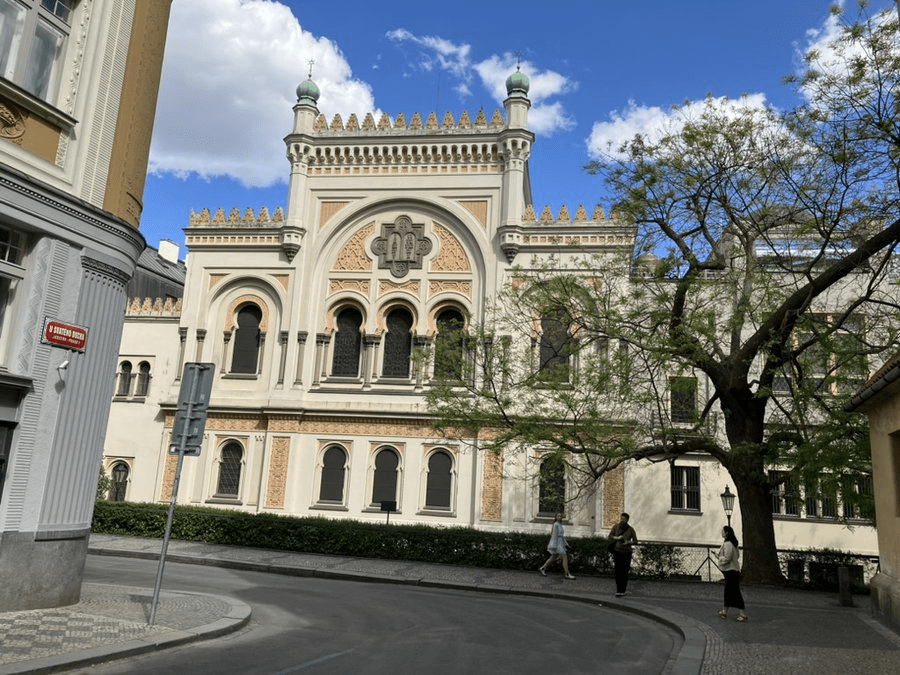
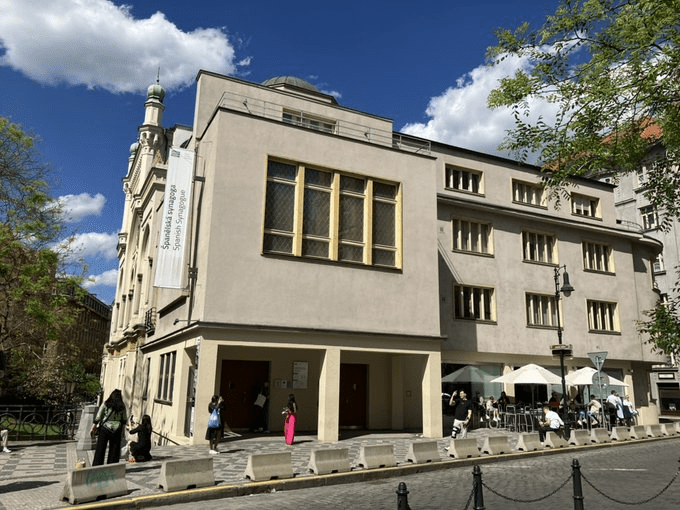
It got reconstructed shortly after (this picture is from 1769), but, in 1867, was deemed not big enough to suit the community’s needs. It was demolished and replaced by the Spanish Synagogue.
Which I assume is so called because of its Moorish Revival style (which is giving me enjoyable memories of a summer spent doing Cádiz-Seville-Granada-Córdoba in 2011).
Like so many synagogues, this one fell into disrepair – although that happened relatively late, in the 1970s – and was revived in 1998, under the management of the Jewish Museum.
U staré školy also includes the Robert Guttmann Gallery, named after a Jewish painter of naïve art, who was born in Sušice (South Bohemia) in 1880 and died in the Łódź Ghetto in 1942.
Next door to that is the administrative museum of the Jewish Museum in Prague.
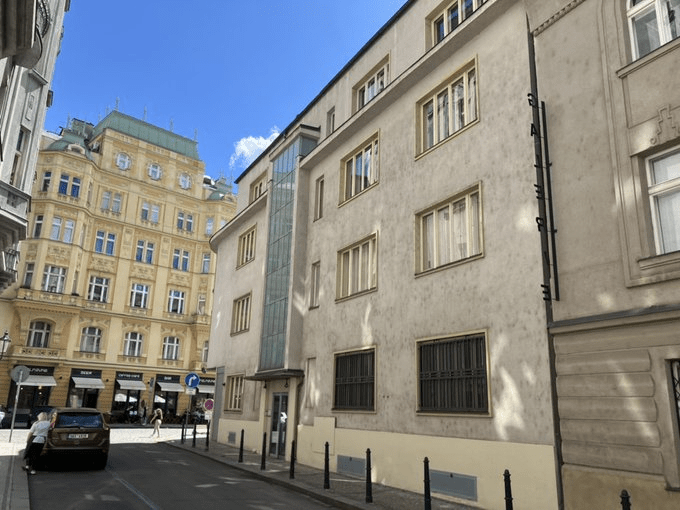
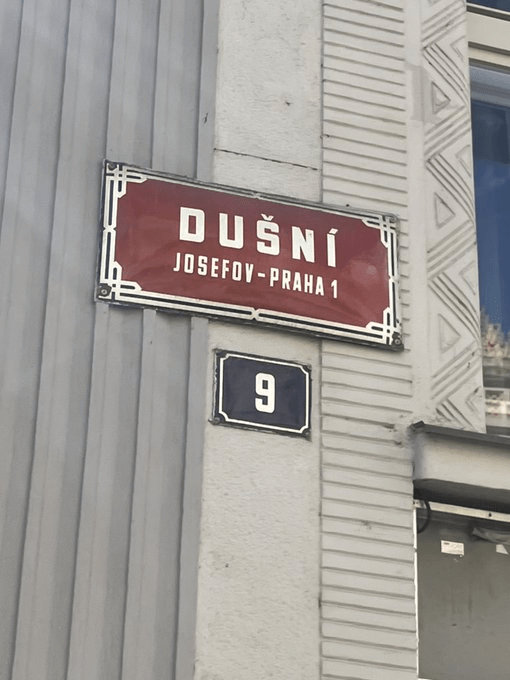
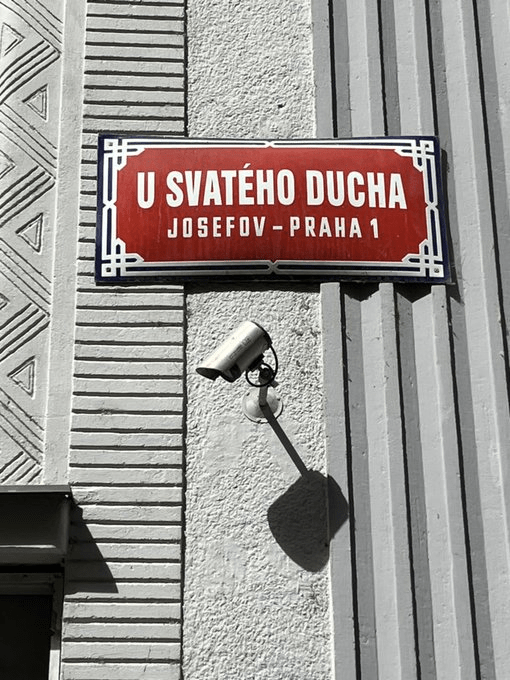
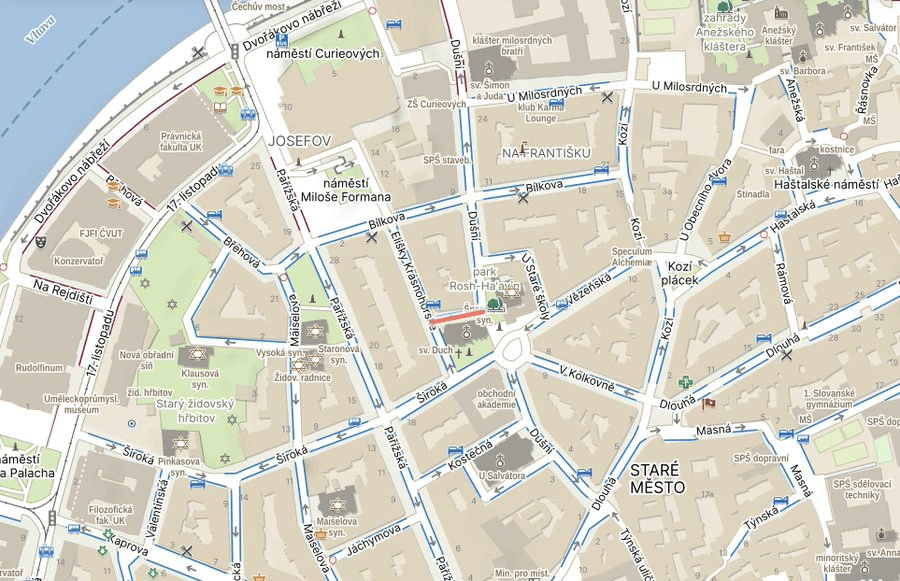
Originally, the southern part of the street was called U sv. Ducha (like yesterday’s street), and the northern part was called Sv. Kříže, after a Church (and Monastery) of the Holy Cross which existed from 1256 until 1783.
Dušní does include the Spanish Synagogue – but that’s a much better fit for tomorrow’s post.
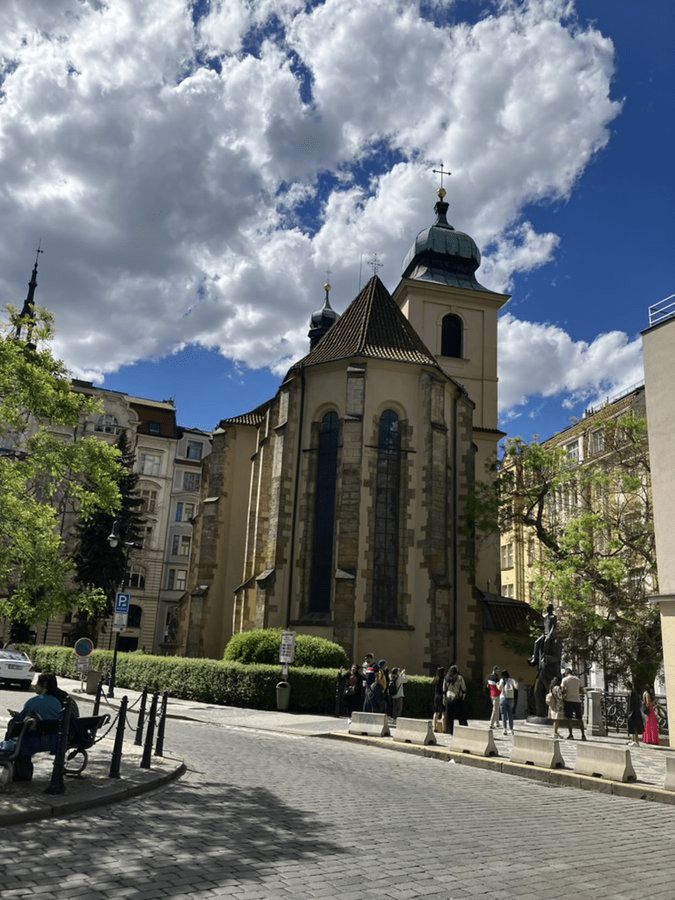
Duch svatý, or svatý Duch, is not an obscure saint, disappointing as that is for those of us who were hoping Duch was a Celtic missionary or something. He’s the Holy Spirit.
The Church of the Holy Spirit was built at some point between 1325 and 1350; it originally had a neighbour, the Benedictine Convent of Divine Mercy (Benediktinský klášter Božího Milosrdenství).
Both were sold off during the Hussite wars, but the church was later restored.
Eventually, the monastery/convent was discontinued, but the church survived. There were extensive repairs after a fire in 1689.
During the clean-up of the Old Town in the early 20th century, the church was one of the rare buildings that benefited: its foundations were strengthened and remains of older buildings were discovered.
Before that, the church had also done relatively well out of the closure of other churches in the area in the 1780s, as it gained some of the better parts of their insides.
Since 2015, the church has served the Armenian Apostolic Church (Հայաստանեայց Առաքելական Եկեղեցի / Hay Aṙak’elakan Yekeghetsi).
An orchestra that a friend of mine plays in gave a concert in the church last November, meaning I was lucky enough to see its insides, which are quite fine (and also excellent for language enthusiasts). Apologies for the lack of photos.
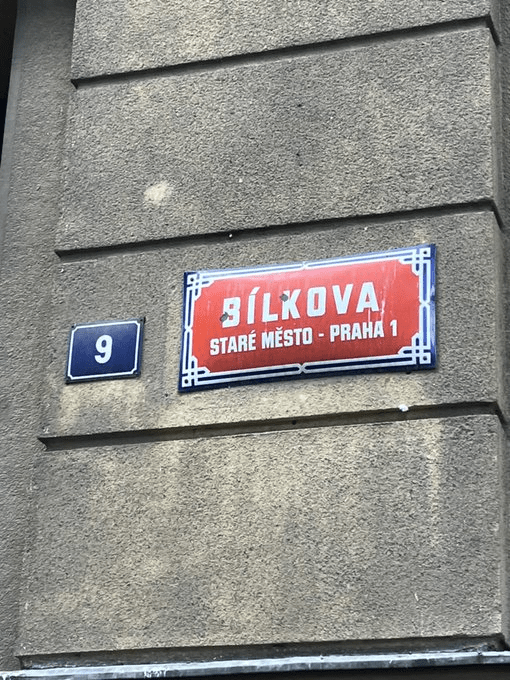
Where number 11 on Bílkova stands now, there was once a building called U Bílků. It’s believed that its name derived from ‘bělidlo’, and that this also led to the street name.
I’d have assumed that it was named after a Mr Bílek, but there you go.
The street was created in 1893 after the rehabilitation (asanace) of Josefov.
Originally, the western part was called ‘Masařská’ after its meat shops, the middle part was called Scheplsova after a spa owned by a Mr Scheples, and the eastern part was called V cípu.
His mother, Anna, was arrested by the Nazis for lying about her involvement in the distribution of anti-Nazi leaflets, and died of typhus at Auschwitz-Birkenau in 1943.
His father, Rudolf (actually not his biological father, as he later found out), was also arrested for being part of a resistance group, and died at the Mittelbau-Dora concentration camp in 1944.
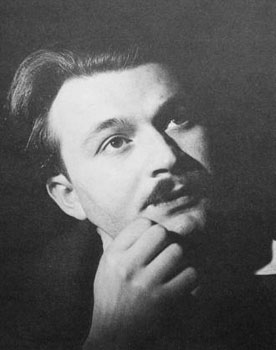
Forman then studied at the Film and Television Faculty of the Academy of Performing Arts in Prague (FAMU), and worked as an assistant to Alfréd Radok, creator of the Laterna Magika.
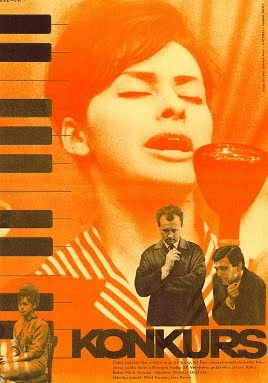
Forman and cameraman Miroslav Ondříček first attracted attention with Konkurs (Talent Competition), a medium-length film released to theatres in February 1964.
In the same year, his Černý Petr (Black Peter) – about a Czech teenager working in a grocery store – won the Golden Leopard prize at the Locarno Film Festival.
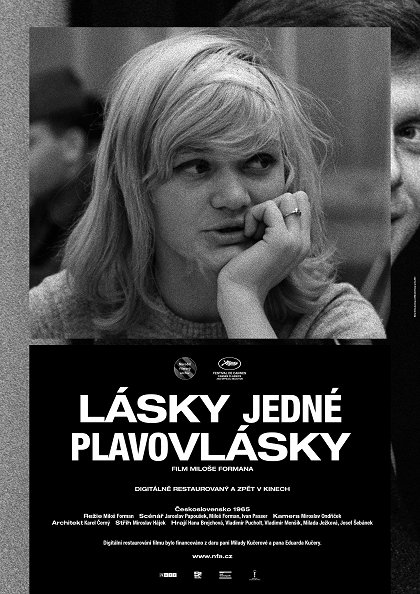
Then, in 1965, Lásky jedné plavovlásky (Loves of a Blonde) – about a young woman working in a shoe factory – was nominated for Best Foreign Language Film at both the Oscars and the Golden Globes.
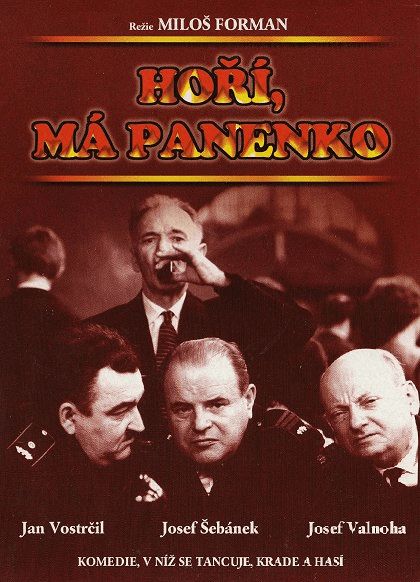
There would also be an Oscar nomination for 1967’s Hoří, Má Panenko (The Firemen’s Ball), set at a volunteer fire department’s annual ball. This was Forman’s first colour film.
In 1968, Forman went to Paris to discuss production of an upcoming film; during his stay, Russian tanks invaded Czechoslovakia. His film studio claimed he had left the country illegally and fired him; he therefore emigrated to New York.
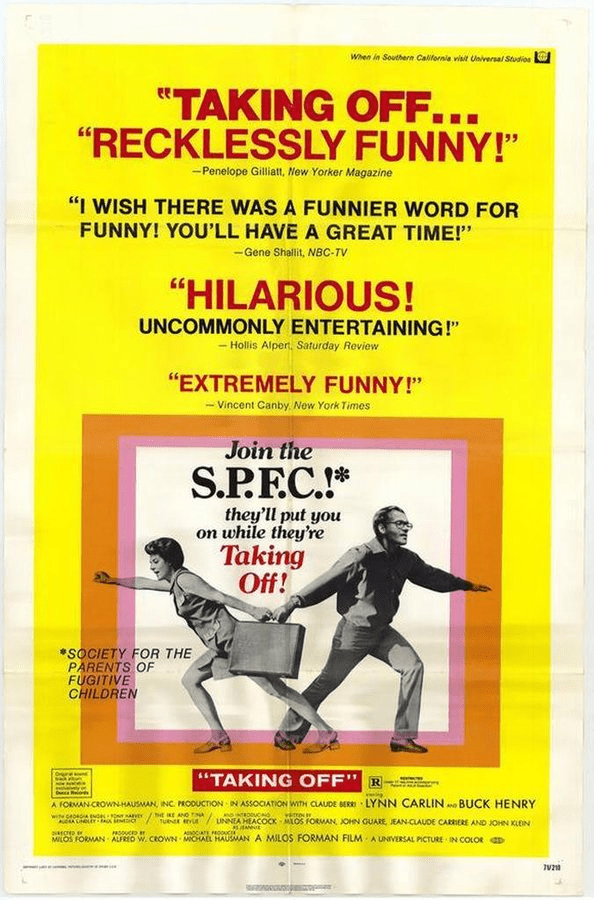
His American career didn’t get off to the best start – Taking Off (1971) won a prize at the Cannes Film Festival, but was not a commercial success, so much so that Forman ended up owing the studio money.
Much greater success came with 1975’s One Flew Over the Cuckoo’s Nest, with its five Oscars: Best Director, Best Actor, Best Actress, Best Picture and Best Adapted Screenplay. Only two other films have ever won in all these categories.
This was followed by a film adaptation of the musical Hair (1979) and of the historical novel Ragtime (1981).
However, the next huge success would come in 1984, with the film version of Peter Schaffer’s play Amadeus. The film grossed over USD 90 million, and won eight Oscars (across all ceremonies, it won 40 of the 53 awards it was nominated for).
Forman was allowed to return to Czechoslovakia for filming – this mainly took place in Kroměříž, although you’ll also see Prague locations in the film: https://movie-locations.com/movies/a/Amadeus.php.
In 1989, Forman’s adaptation of Les Liaisons dangereuses, Valmont, was overshadowed by Dangerous Liaisons, an adaptation by Stephen Frears which had been produced in the previous year.
Later productions, such as The People vs. Larry Flynt (1996), Man on the Moon (1999), and Goya’s Ghosts (2006), would garner mainly positive reviews, but would struggle at the box office.
Forman died after a short illness in Danbury Hospital, Connecticut, in 2018 (his home was nearby, in Warren, and he’s also buried in that town): https://www.bbc.com/news/entertainment-arts-43767278. He had become a US citizen in 1977.
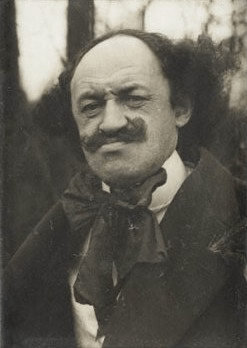
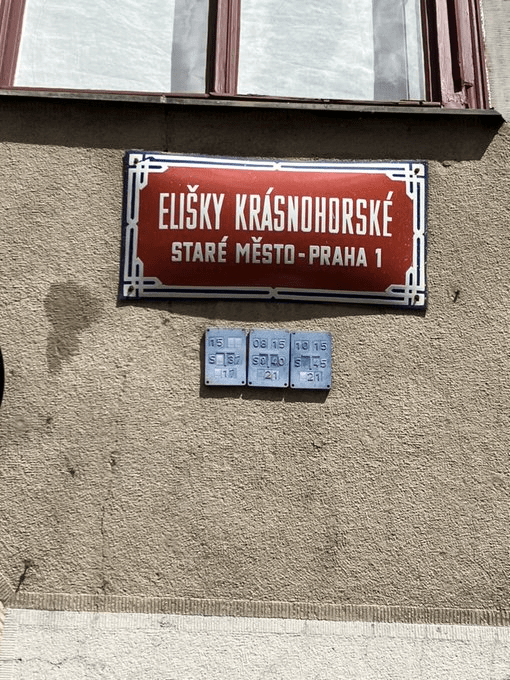
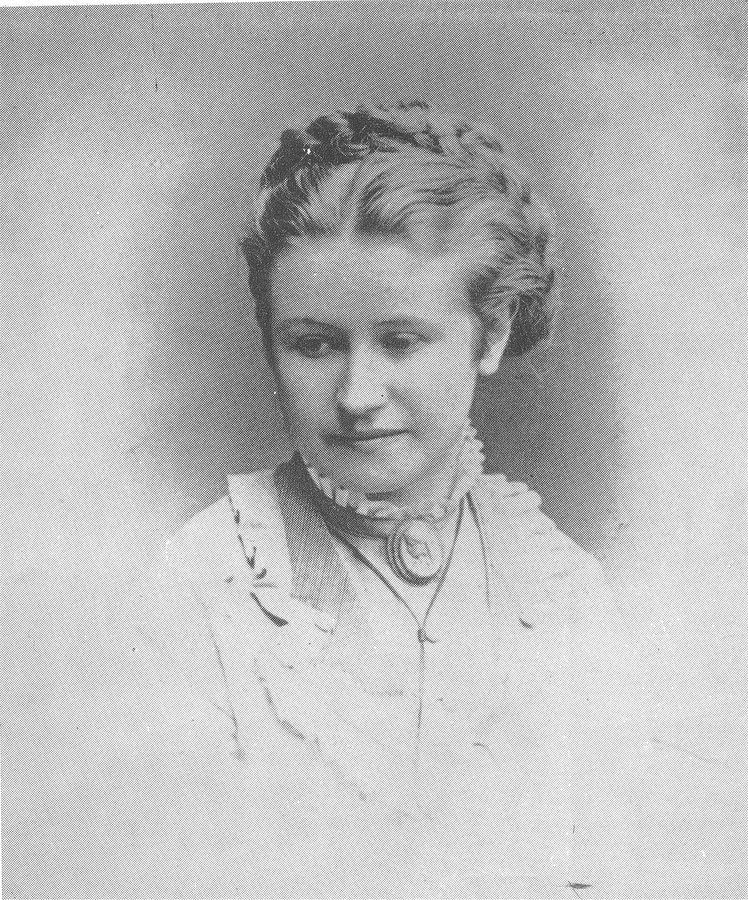
Alžběta Dorota Pechová was born in Prague’s Old Town in 1847, the seventh of her father’s eight children (he was married twice).
Her father believed that his family was from Krásná Hora, near Příbram – apparently, this wasn’t actually true, but it did result in the pseudonym which Alžběta later adopted.
Eliška attended a German-language grammar school in Prague, and later became a member of the Ruchovci (a group of Czech writers who aimed to promote Czech literature and avoid foreign literary influences).
Her work to promote Czech literature over its German counterpart included a series of novels aimed at teenage girls.
Two years later, she would found a women’s magazine, Ženské listy.
At this time, Prague lacked a Czech-language state grammar school for girls, so Krásnohorská started a petition for one, gaining almost 5,000 signatures. Because many people’s heads were still in the Dark Ages, this didn’t work out.
She wrote quite harshly about T. G. Masaryk – who rightly thought they were a fake – though that didn’t stop him from later making her the first female member of the Czechoslovak Academy of Sciences and Arts.
She also wrote libretti for operas – four for Karel Bendl, four for Bedřich Smetana, and one for Zdeněk Fibich, and translated works including Lord Byron’s Childe Harold’s Pilgrimage.
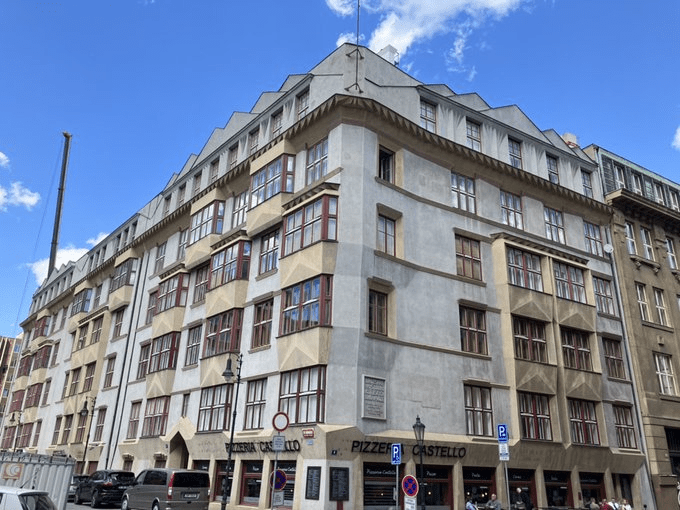
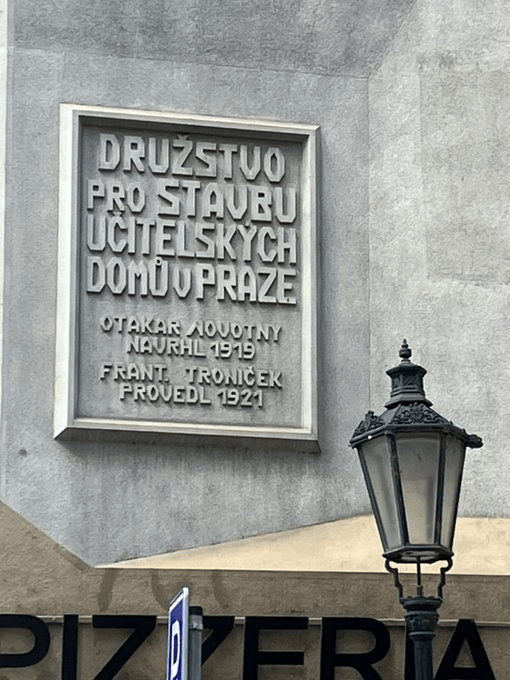
The most distinctive buildings in the street that’s named after her are probably the Cubist ‘Teachers’ Houses’ designed by Otakar Novotný and built between 1919 and 1921.
Goodness, I love Cubist buildings. If you’re ever planning on writing an article on why Cubism is problematic and we shouldn’t be a fan of it, you may well have your reasons for doing so, but please block me in advance.
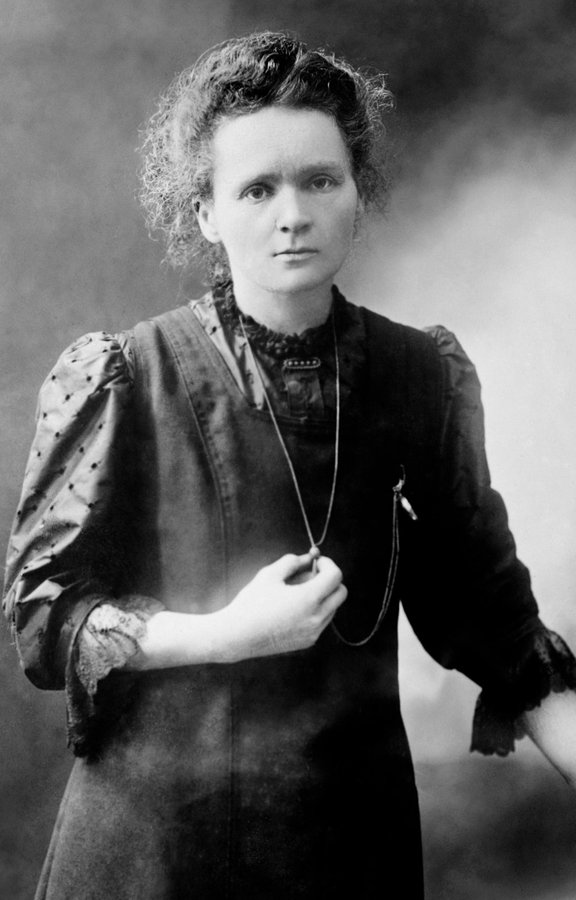
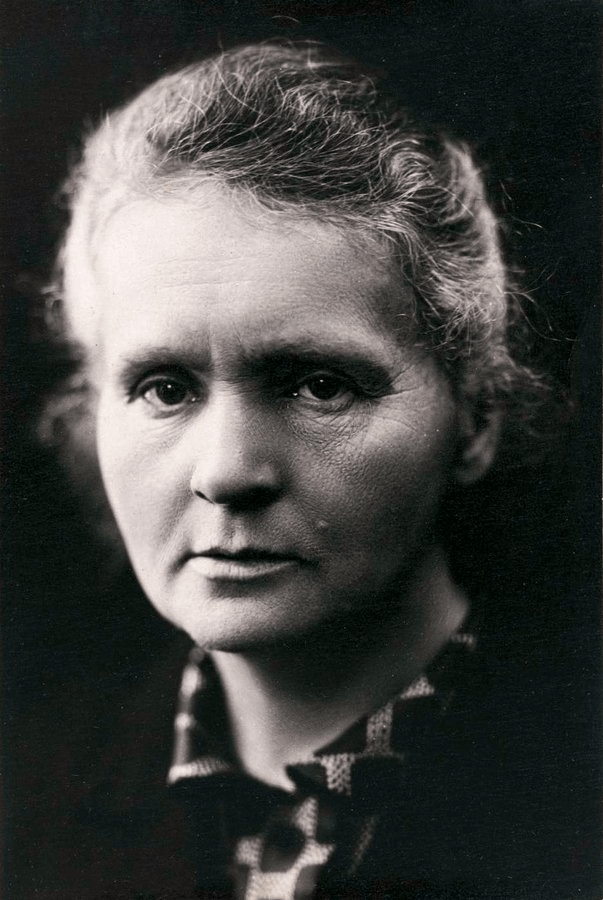
Pierre Curie was born in Paris in 1859. He was educated at home by his parents (his father was a doctor), and took his baccalaureate in science when he was 16.
Two years later – when he was just 18 – he would already have a degree in physical sciences from the Paris Faculty of Sciences.
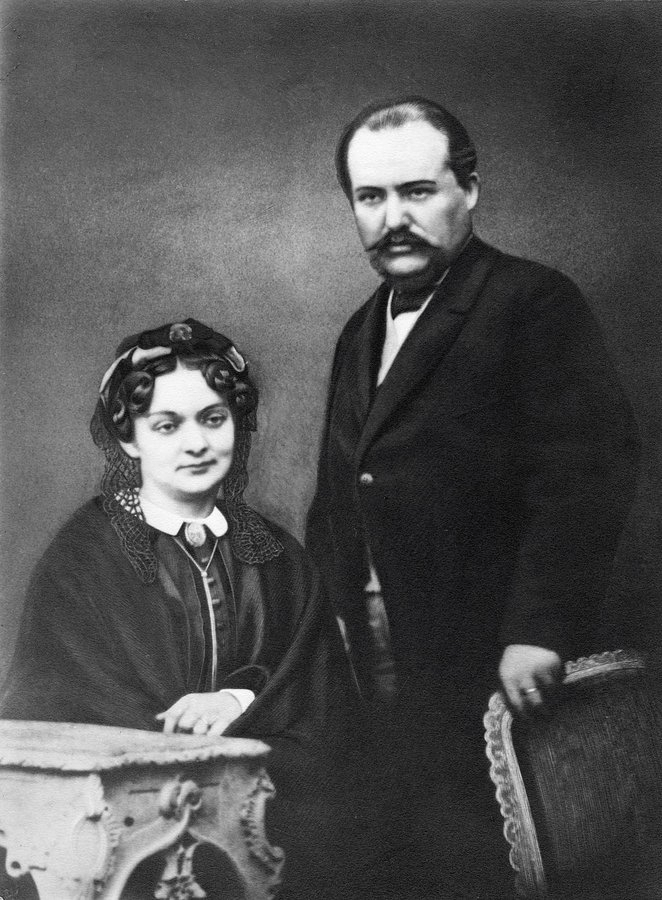
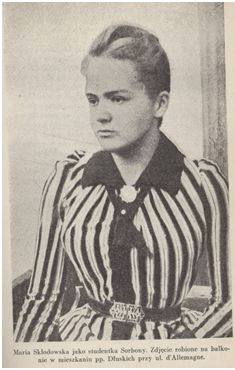
Meanwhile, Maria Skłodowska was born in Warsaw, then part of the Russian Empire, in 1867. Both her parents (pictured) came from families who had lost their property and fortunes due to their support for an independent Poland.
She studied at the Flying University, an underground institution (the ‘official’ universities didn’t allow women to enrol), along with her sister Bronisława (right), who went to study medicine in Paris.
In 1891, Maria would join her; in France, she came to be known as Marie. She obtained a degree in physics from the University of Paris in 1893, followed by a master’s in mathematics in 1894.
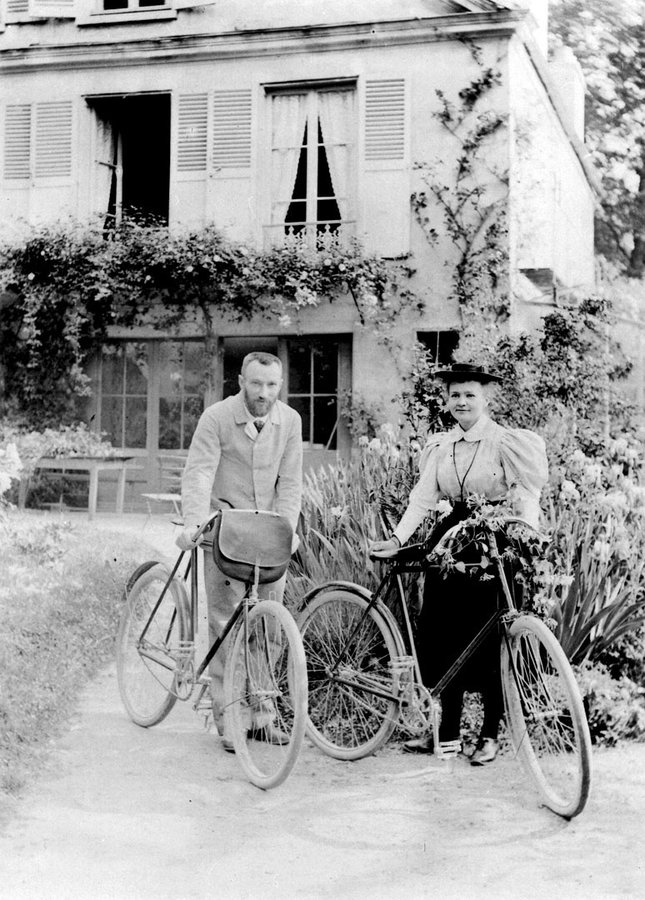
A mutual friend, the Polish physicist and diplomat Józef Wierusz-Kowalski, introduced Pierre and Marie to each other. They would marry in 1895, the same year in which Pierre received his doctorate.
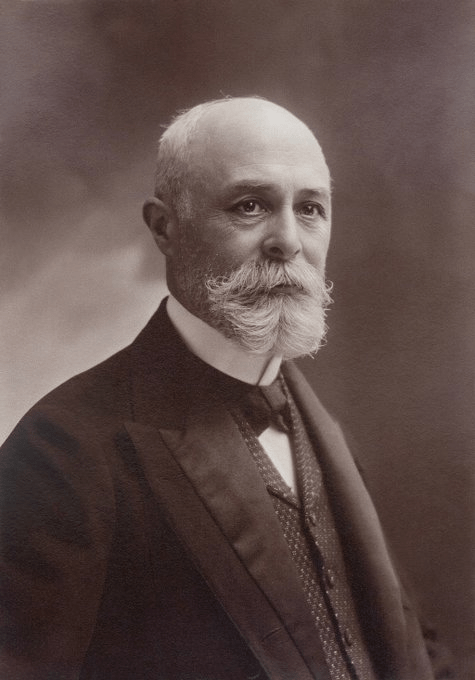
Also in 1895, Wilhelm Röntgen discovered X-rays, and, in early 1896, Henri Becquerel started experiments which would lead him to conclude that uranium salts emitted rays of their own accord.
Using an electrometer which Pierre had developed with his brother in the early 1880s, Marie discovered the uranium rays could make the surrounding air conduct electricity, and hypothesised that radiation came from the atoms themselves.
In 1898, she discovered that thorium was also radioactive. Pierre dropped his research to join his wife on hers.
In the same year, they would announce the discovery of two more elements: polonium, named after her native (and partitioned) Poland, and radium; they also coined the term ‘radioactivity’.
They published 32 scientific papers in the next four years, one of which stated that exposure to radium caused tumour-forming cells to be destroyed more quickly than others.
In June 1903, Marie received her doctorate, and the couple went to the Royal Institution of Great Britain in London to give a speech, although Pierre was only allowed to speak, because sexism and some people generally being awful.
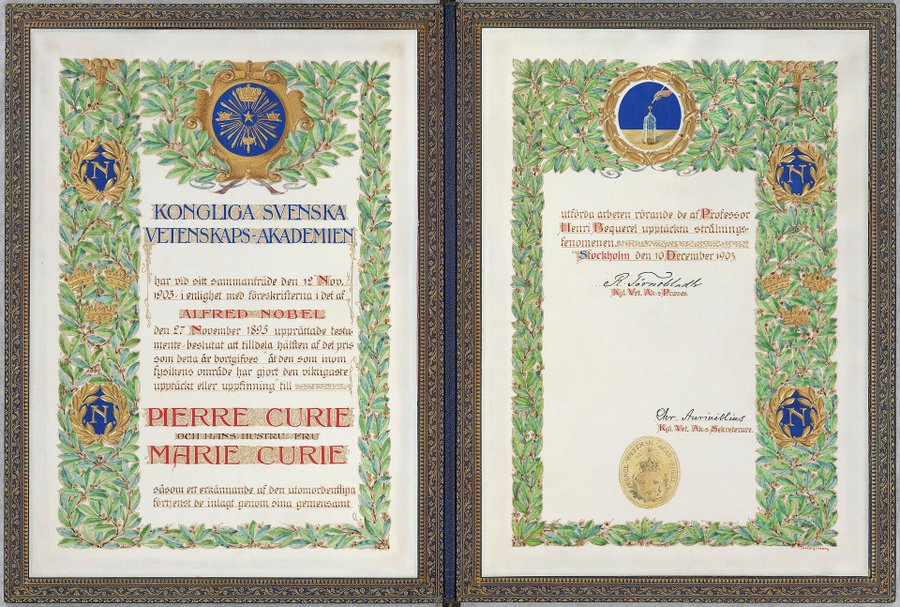
In December 1903, Pierre, Marie and Henri Becquerel received the Nobel Prize for Physics. Marie was the first woman to win a Nobel prize, although – more sexism alert – a committee member had to lobby hard for her to be nominated at all.
In 1906, Pierre was struck by a horse-drawn vehicle on the Rue Dauphine in Paris and died instantly. He was 46.
A devastated Marie was given the chair of the physics department at the University of Paris, becoming the university’s first female professor.
In 1909, she founded the Institut du Radium, now known as the Curie Institute; in the following year, she managed to isolate radium. The term ‘curie’ was first attributed to a unit of radioactivity in 1910, too.
However, large chunks of the French public continued to see her as ‘not one of theirs’, especially when she was revealed to have had an affair with Paul Langevin, a former student of Pierre’s who was separated, but not divorced from, his wife.
In 1911, Curie would win a second Nobel Prize, this time in chemistry. The chair of the Nobel Committee encouraged her not to turn up to collect her prize, given her private life; she ignored him.
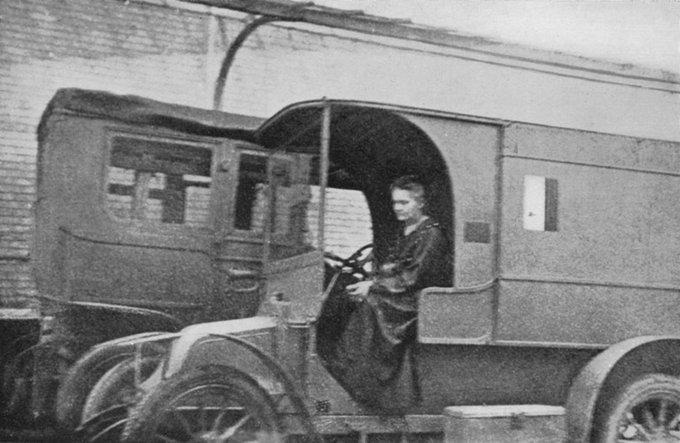
During World War I, Curie created mobile radiography units (‘petites Curies’), used to treat an estimated one million French soldiers.
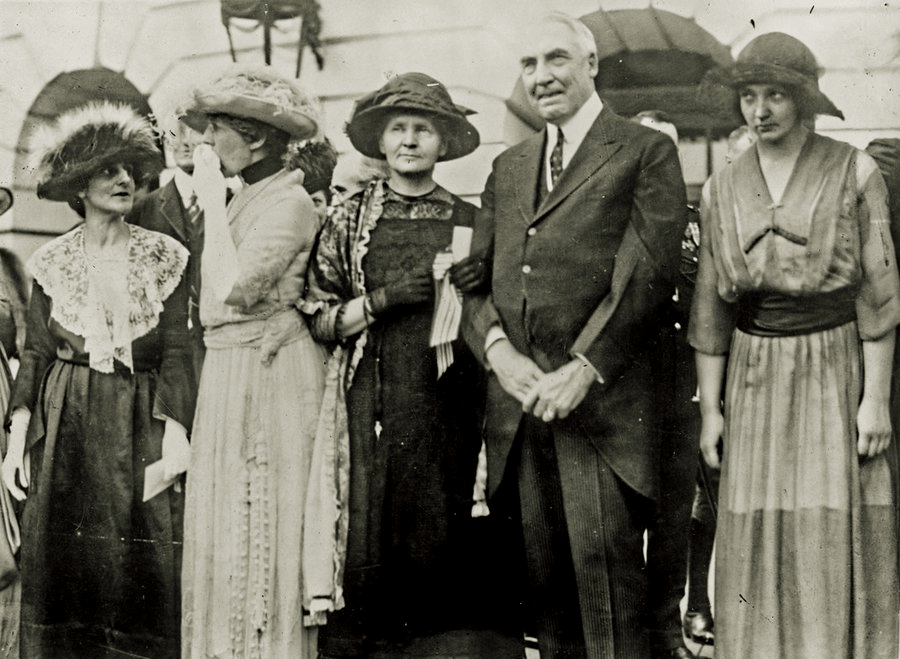
In 1921, Curie visited the White House and also turned down the Legion of Honour (possibly thinking France’s gratitude was a case of too little, too late); in 1922, she joined the League of Nations’ International Committee on Intellectual Cooperation.
Curie died in 1934 from aplastic anaemia (when the body fails to produce enough blood cells); a study in 1995 concluded that this was more likely due to her use of radiography in WW1, rather than exposure to lethal levels of radiation during her experiments.
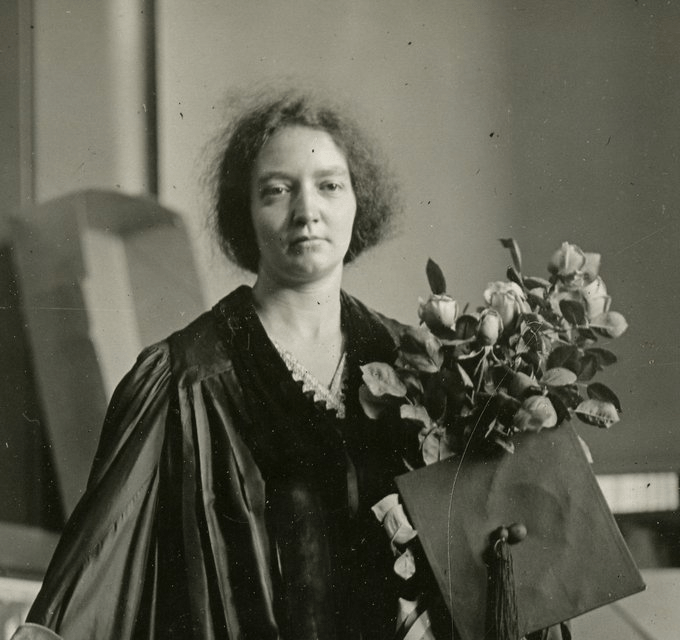
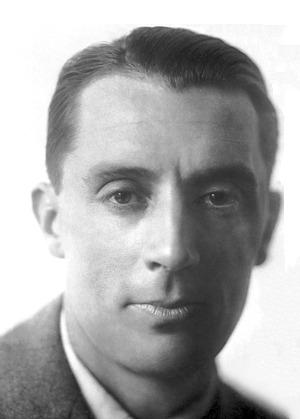
In 1935, her daughter and son-in-law, Irène and Frédéric Joliot-Curie, would receive the Nobel Prize in Chemistry for their discovery of induced radioactivity.
Both Marie and Pierre were buried in Sceaux, in the southern suburbs of Paris; their remains were transferred to the Panthéon in 1995.
Her name has been given to an EU fellowship programme, a metro station in Paris, numerous academic institutions, and a British charity providing hospice care.
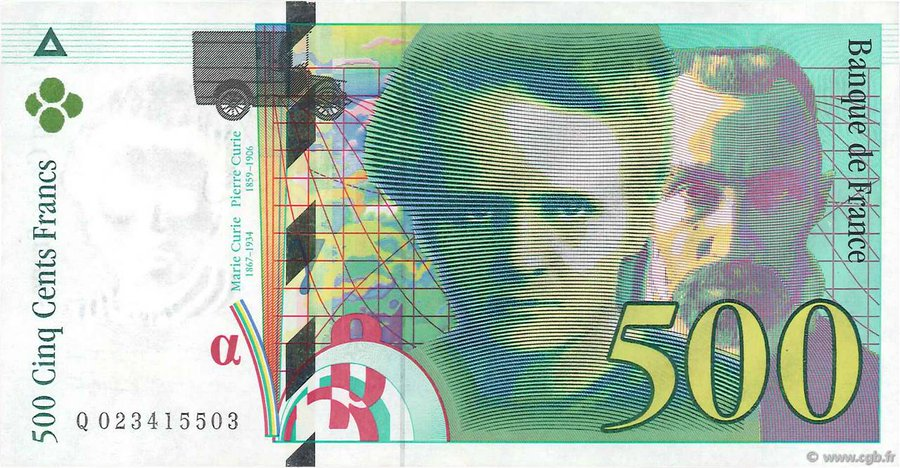
She’s also on French fifty cent coins, having previously been on French 500 franc notes when those were a thing.
Náměstí Curieových was given its current name in 1960. Before that, it was called Janské náměstí, apparently because John of Nepomuk’s body was fished out of the Vltava here in 1393.
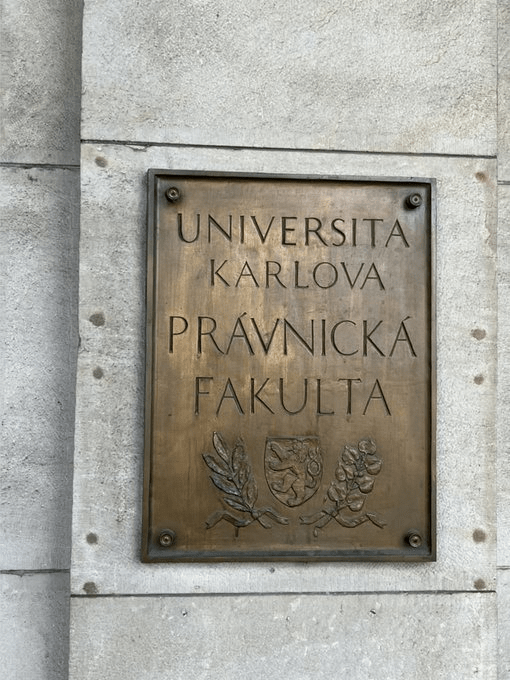
The square includes the entrance to the Law Faculty of Charles University; the faculty was founded in 1348, but the building was created between 1924 and 1931.
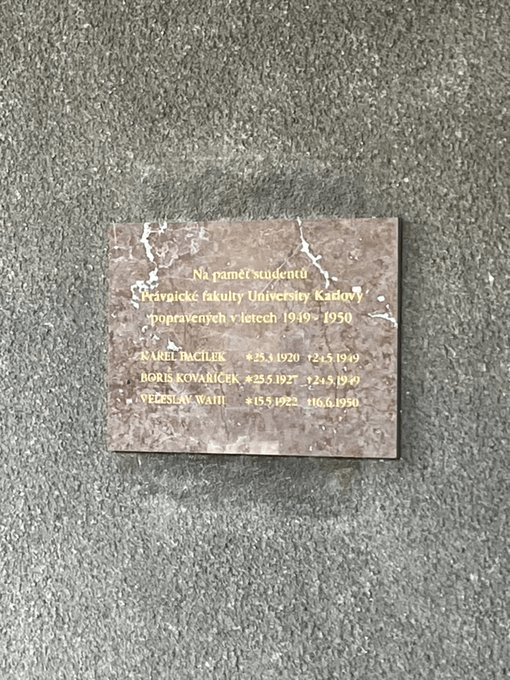
There are also plaques commemorating those who died here during the Prague Uprising in May 1945, and those students executed by the Communists in 1949 / 1950.
Across the road is what was opened in 1974 as Inter-Continental Praha, and is apparently due to reopen as Fairmont Golden Prague sometime in 2024 (in other words, what you currently see is a building site).
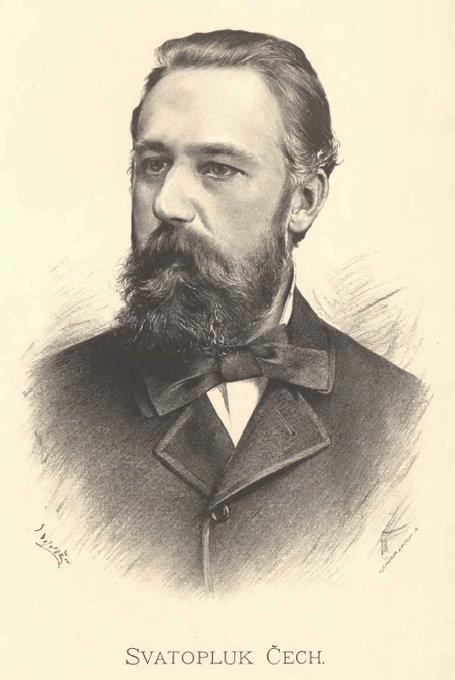
Svatopluk Čech was born in Ostředek, near Benešov, in 1846; his father, František, was a patriot who worked as a journalist in 1848/9, when the Austrian Empire’s first elected parliament operated from Kroměříž.
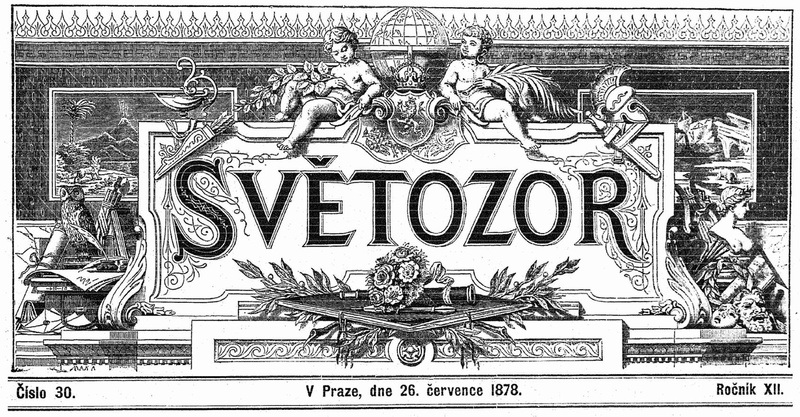
He contributed to Czech publications such as Ruch and Květy; he later became editor of Světozor (from 1871) and Lumír (from 1873 to 1876).
He left his law degree behind for a few years to devote himself to his writing, but practised again from 1876 to 1879.
Čech’s written works included epics, often about the Hussite Wars (such as his first poem, Husita na Baltu (Hussites on the Baltic), Adamité (The Adamites), and Žižka).
Other works, such as Evropa and Slávie, were influenced by the political events of the day, and he published two volumes of poetry concerning the rebirth of the Czech nation.
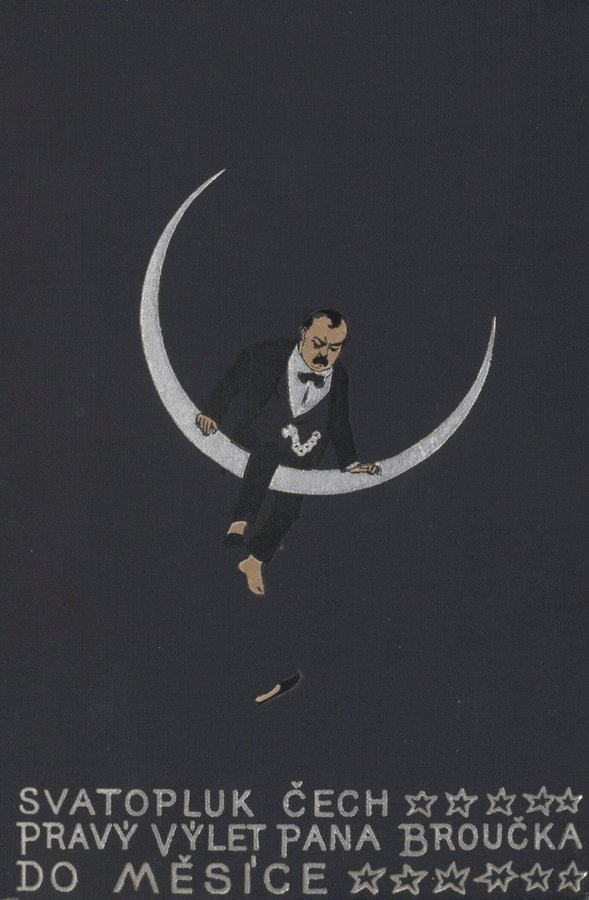
He’s arguably best known for Pravý výlet pana Broučka do Měsíce (Mr. Brouček’s True Trip to the Moon, 1888) and Nový epochální výlet pana Broučka (Mr. Brouček’s new epoch-making trip, also 1888).
(if these have official English titles, please shout, of course)
In these stories, the Mr Brouček goes the the Moon and to the day before the Battle of Vítkov Hill (1420) respectively, and is not much respected by those he meets in either case.
The stories are seen as early examples of Czech science fiction.
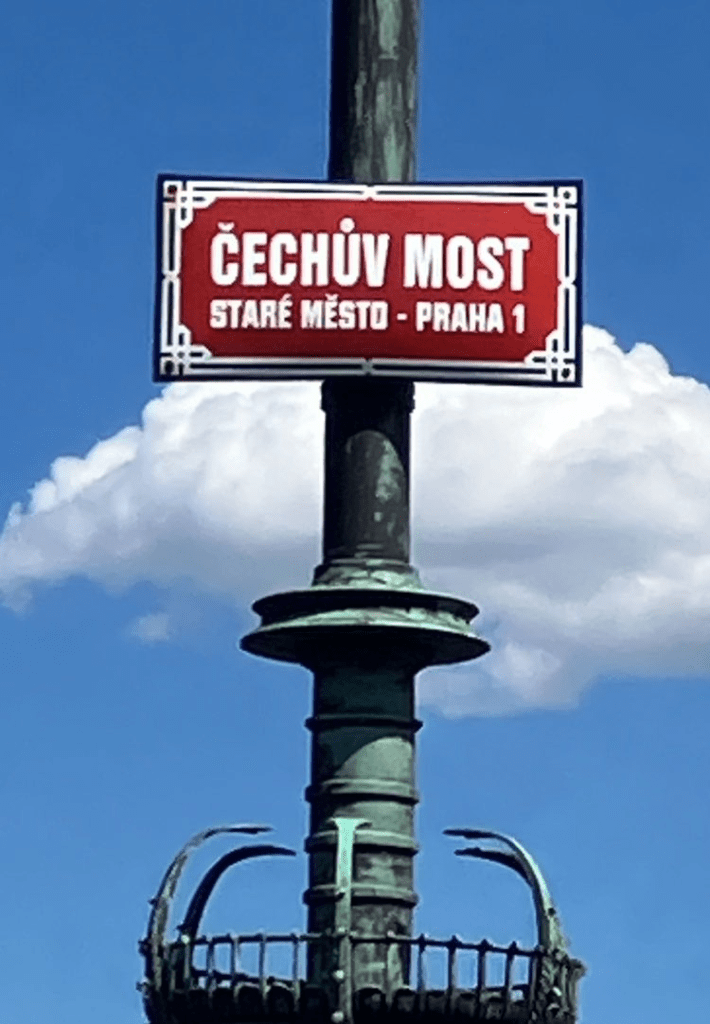
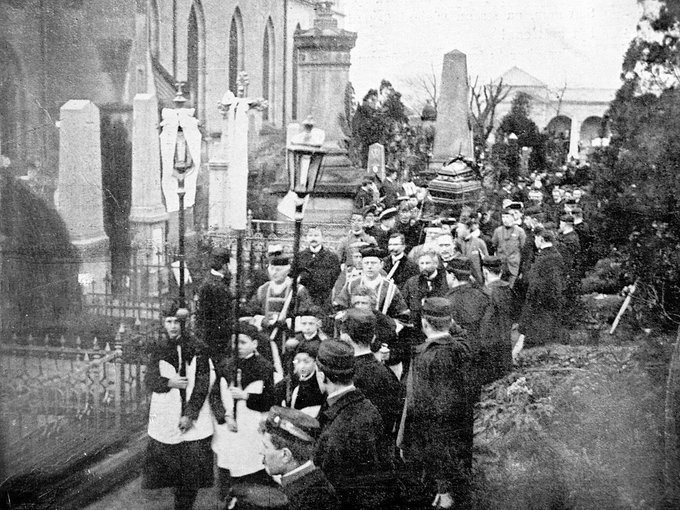
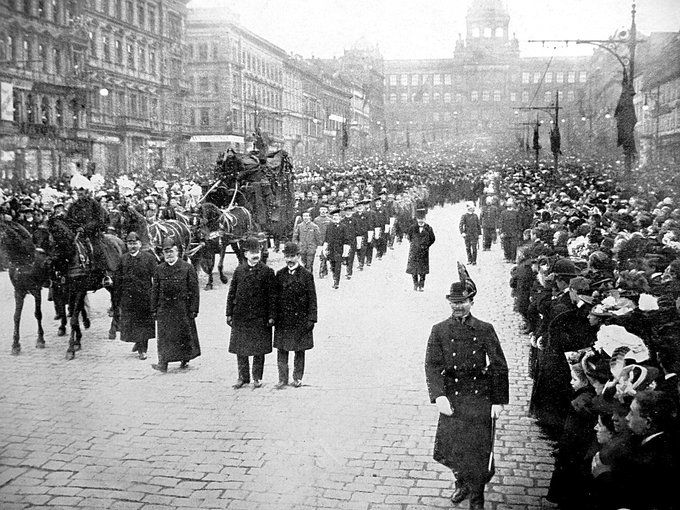
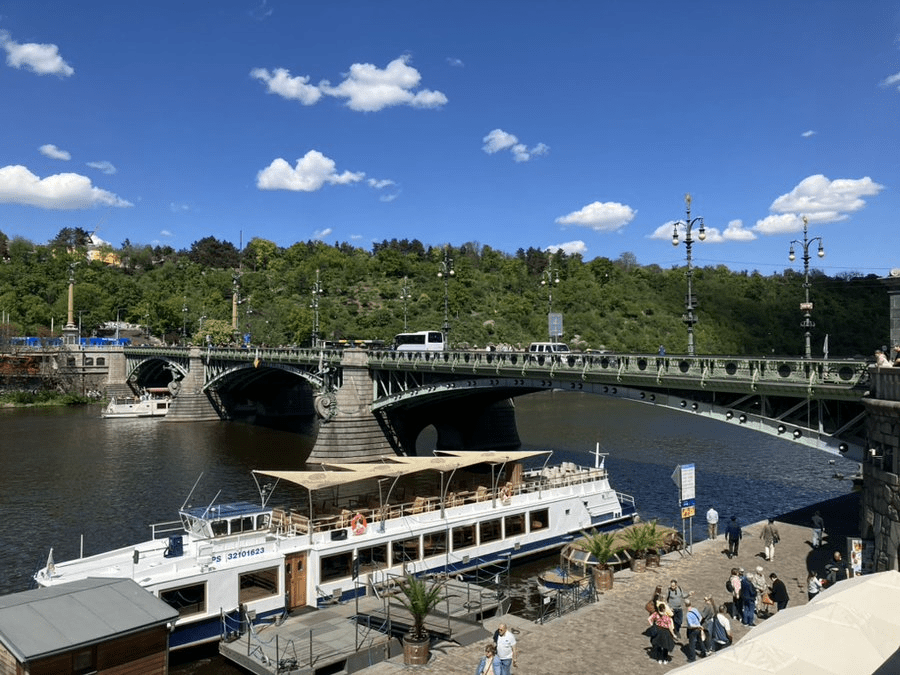
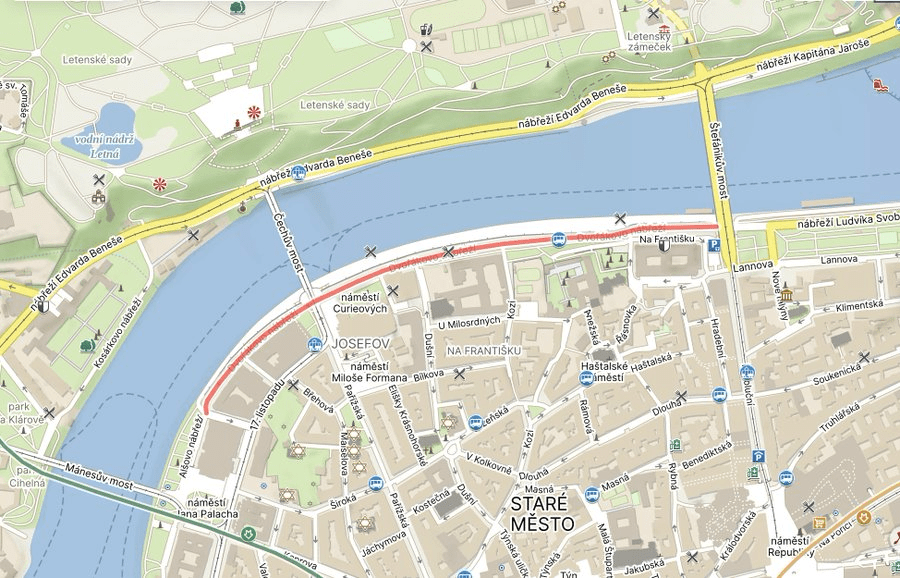
Čech died in Prague in 1908, and is buried at Vyšehrad. This bridge was named after him later that year.
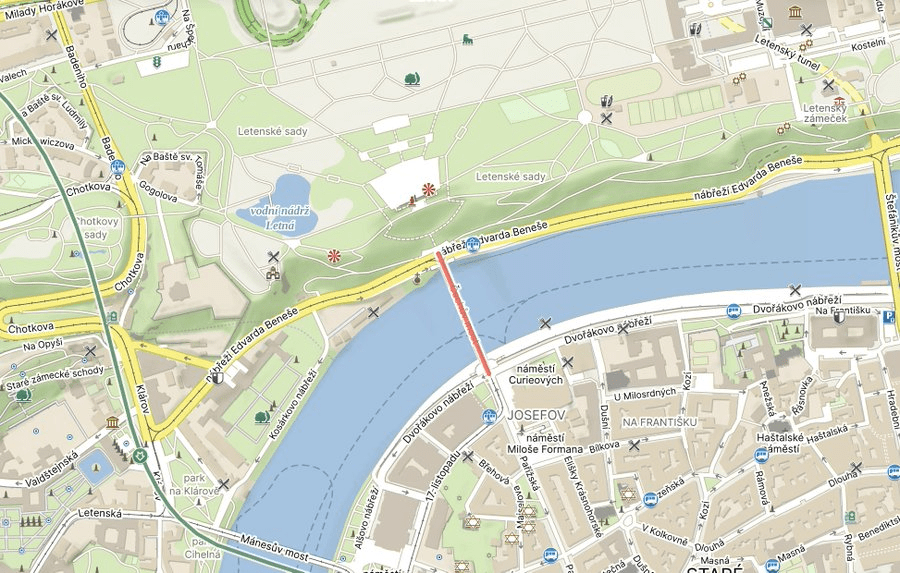
Construction of the bridge had started in 1905; of the bridges across the Vltava in Prague, it’s the shortest. However, it’s also one of the most interesting architecturally.
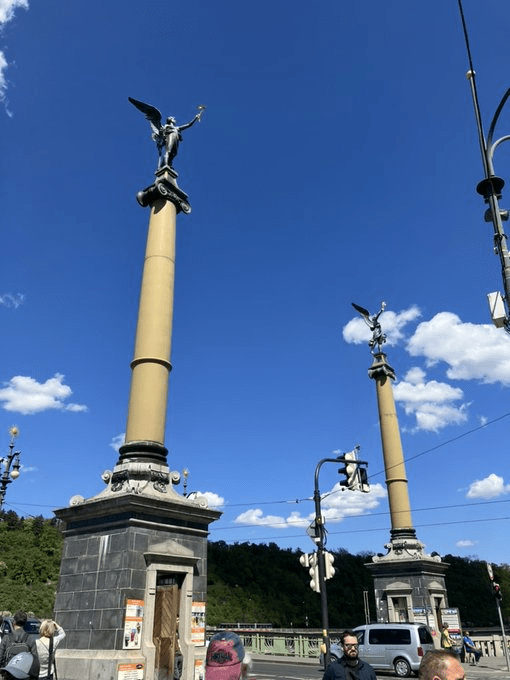
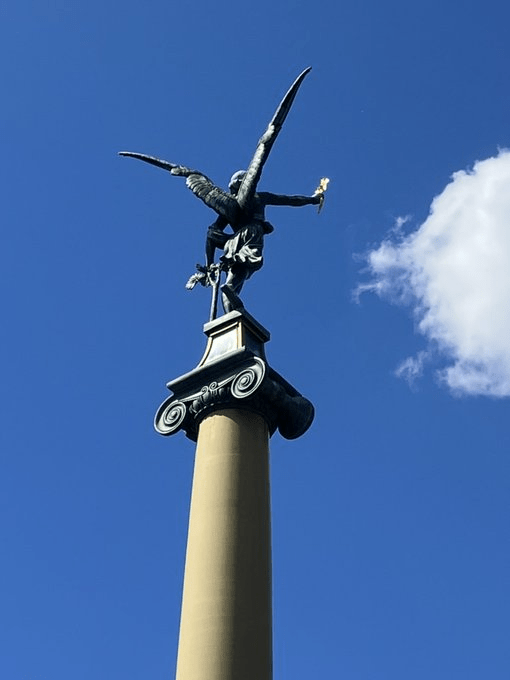
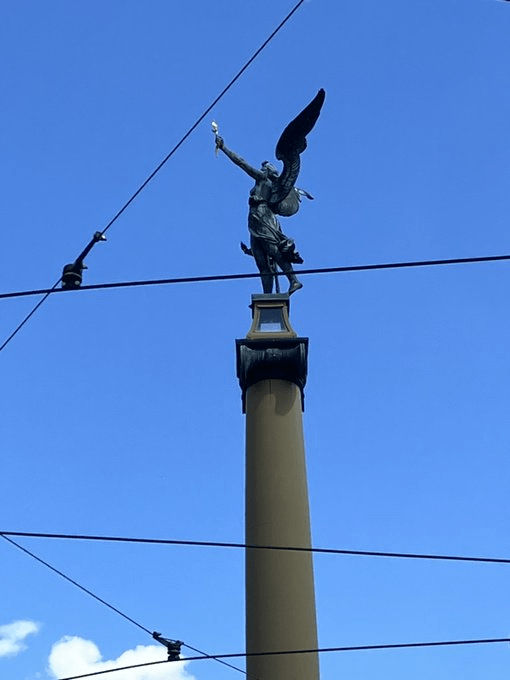
For example, it has four bronze statues of women with wings, made by the sculptor Antonín Popp.
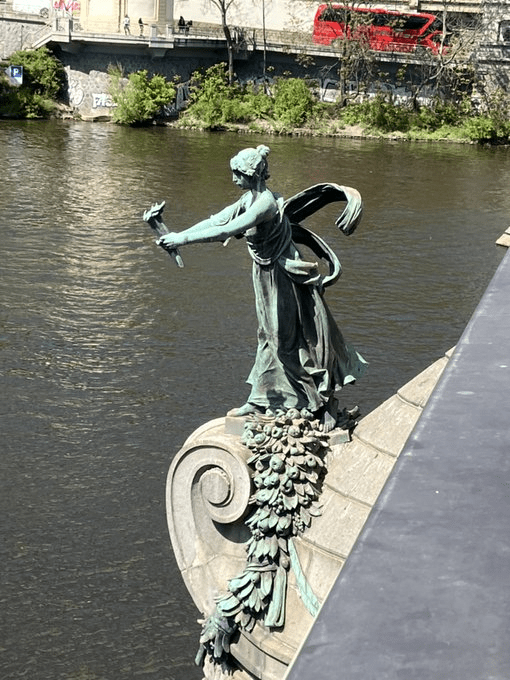
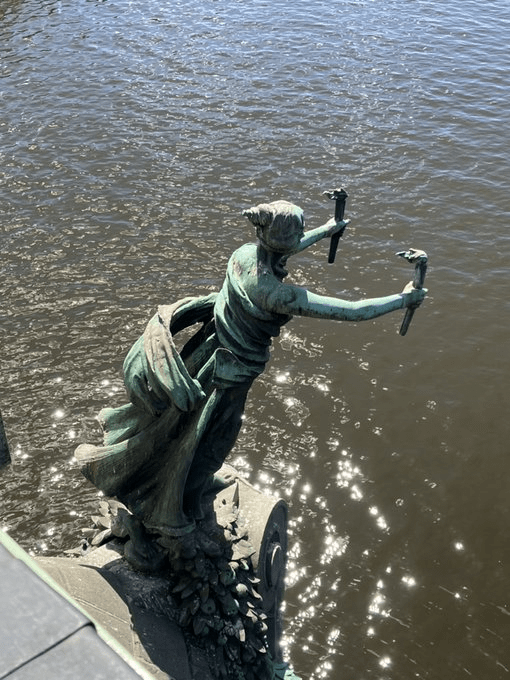
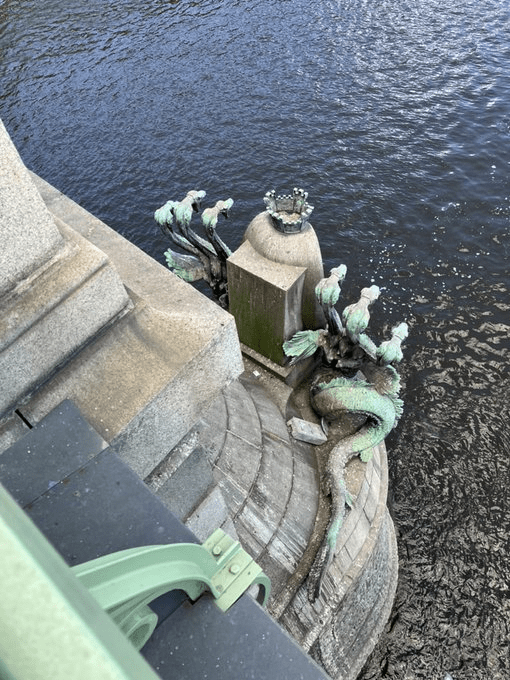
As well as, on each side, statues of female torchbearers, and of hydras flanking Prague’s coat of arms (not that you can see that in the picture).
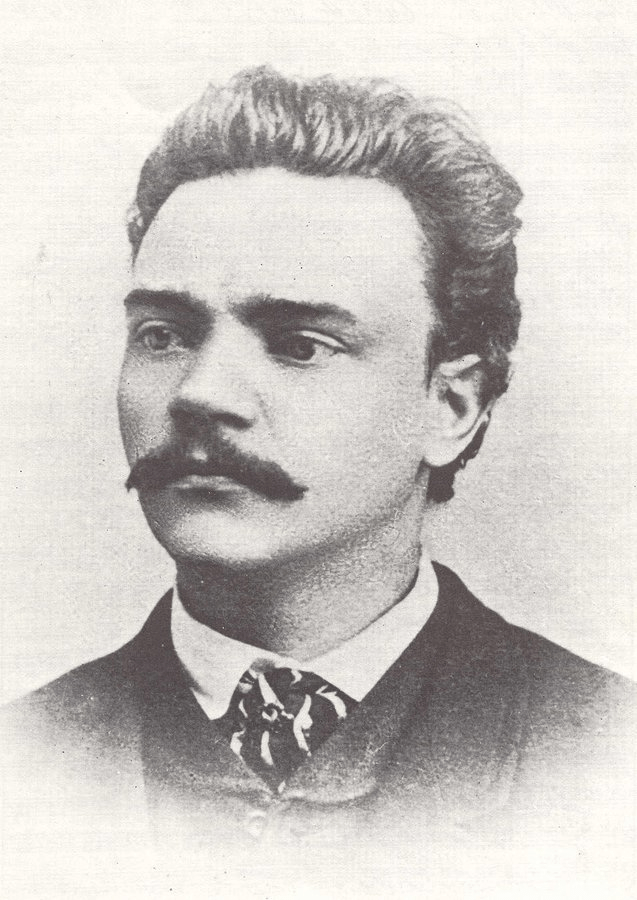
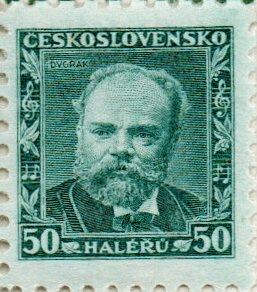
Antonín Leopold Dvořák was born in Nelahozeves, in Mělník District, in 1841, as the eldest of nine children.
He started learning the violin at the age of six, also studying music theory, piano and organ during his schooldays.
In 1857, he went to Prague to study at the organ school (which would be incorporated into the Prague Conservatory in 1890), graduating two years later.
Dvořák’s first documented compositions date from 1861, although these met with little response.
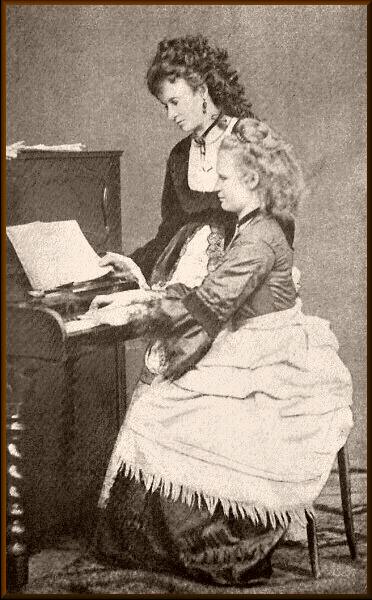
Dvořák also gave piano lessons, and fell in love with one of his pupils, Josefína Čermáková (standing); she rejected him, but, in 1873, he did end up marrying her younger sister, Anna (seated).
They would have nine children, of whom six would survive into adulthood.
From 1874 onwards, he started submitting compositions to be considered for the Austrian State Prize; his 1877 submission resulted in a letter from the Prague-born Eduard Hanslick, informing him that a certain Johannes Brahms was very impressed.
Support from Hanslick and Brahms meant that, by 1878, Dvořák’s Slavonic Dances had been published by the Berlin publisher Simrock, and, by 1879, were being played in France, Britain and the US.
In 1884, Dvořák went to London to conduct his own Stabat Mater in front of 12,000 people at the Royal Albert Hall. He developed close ties to the British classical scene, and would return to the country at least seven times (this is him and Anna in London in 1886).
His Requiem, composed in 1890, was actually premiered in Birmingham, and only got its Czech premiere at the National Theatre in the following year.
He received an honorary degree from the University of Cambridge in 1891.
In 1892, Jeanette Thurber, the founder of the National Conservatory of Music of America, invited Dvořák across the Atlantic. He accepted, working as the Conservatory’s director until 1895.
Returning to Bohemia, he composed two of his most famous operas, Rusalka and Armida, and became a professor at the Prague Conservatory.
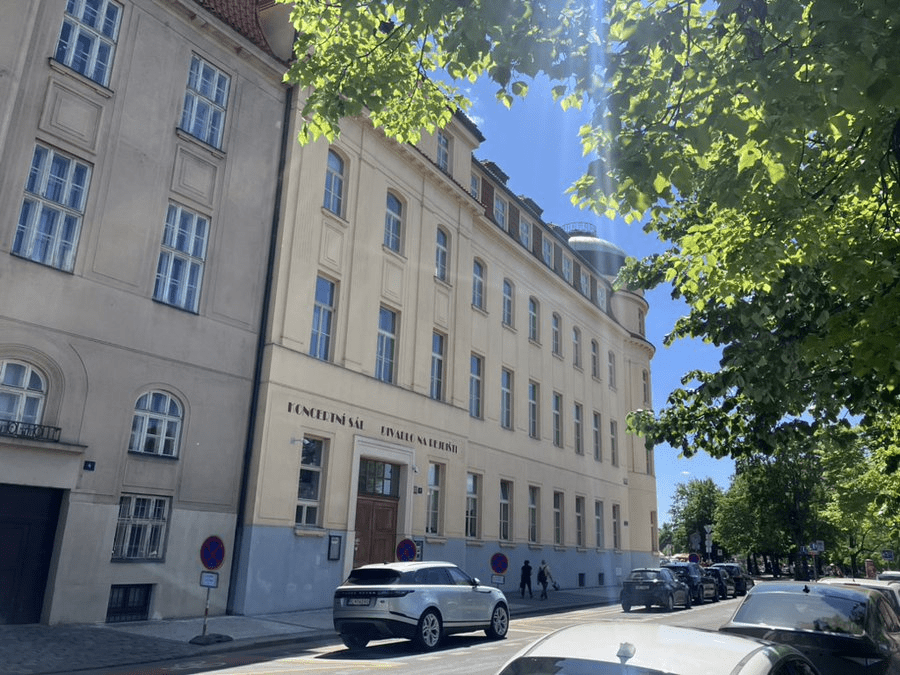
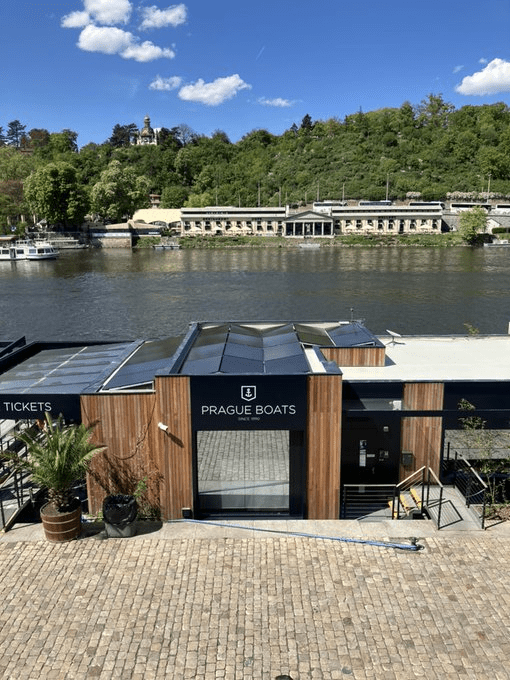
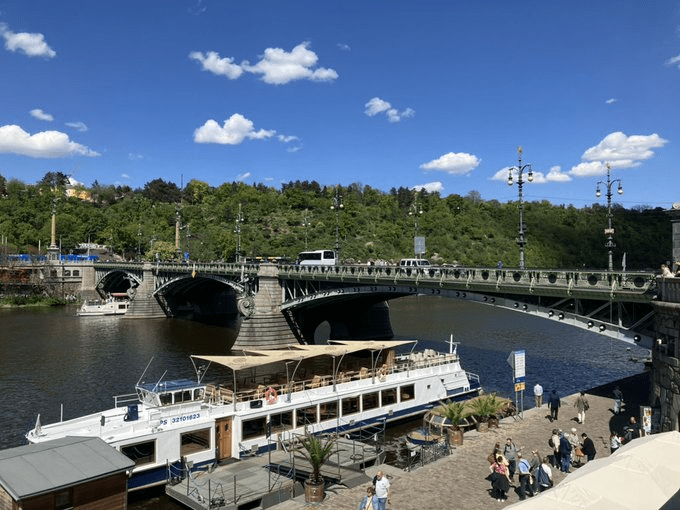
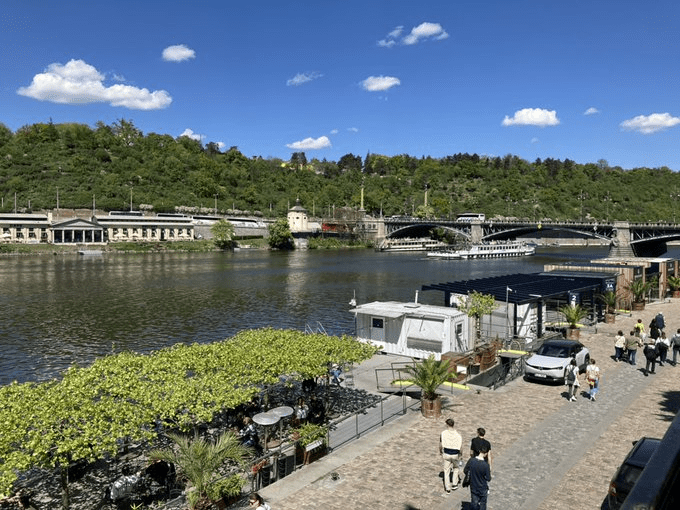
In 1901, there were national celebrations for his 60th birthday, he was knighted, and he also became director of the Conservatory (which, appropriately, has one of its entrances on this very embankment).
Dvořák died of a stroke on 1 May 1904. His funeral took place four days later, and he was then buried at Vyšehrad. The embankment was named after him in the same year.
Unlike many musicians discussed in these threads, it seems that Dvořák was a modest, uncomplicated personality, who loved nature and was also a major railway enthusiast.
However, his love for nature was also accompanied by anxiety and panic attacks when in a city environment, which apparently got worse with the years.
In the Middle Ages, the southern part of the street was called Schielesova (presumably a Mr Schiesel owned some property here), whereas the southern part was called Břehová or Pobřežní (which means much the same thing).
There was also a square round here until the early 20th century rehabilitation of the district, first known as V hampejze (‘hampejz’ means ‘brothel’), and later as Poštovské due to the local post office.
Number 7 on Břehová is the Faculty of Nuclear and Physical Engineering of the Czech Technical University in Prague (or FJFI ČVUT v Praze, which isn’t really any snappier).
Whereas I know I also took pictures of number 8 for a reason, but that reason might just be that it’s a very attractive building.
Incidentally, ‘tichá voda břehy mele’ literally translates as ‘quiet water grinds the banks’, and is the Czech equivalent of ‘still waters run deep’.
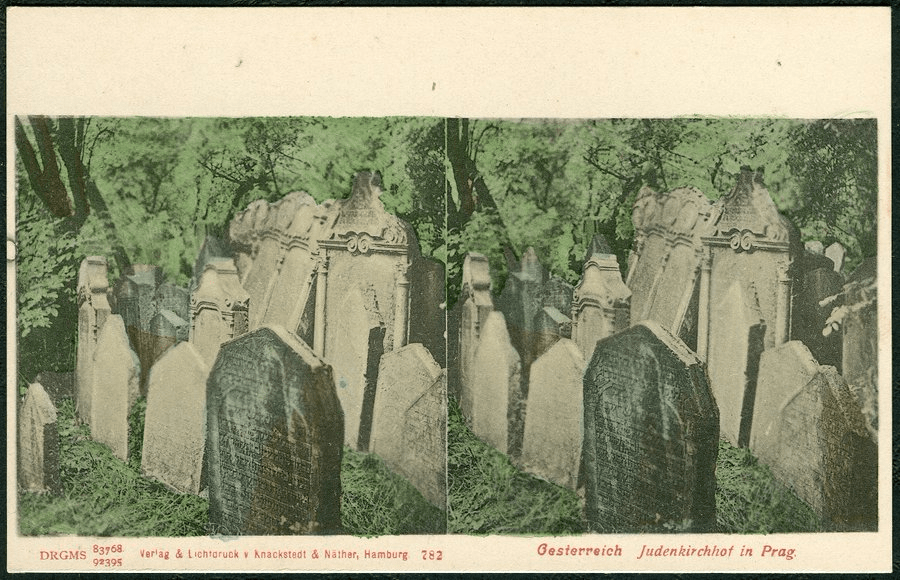
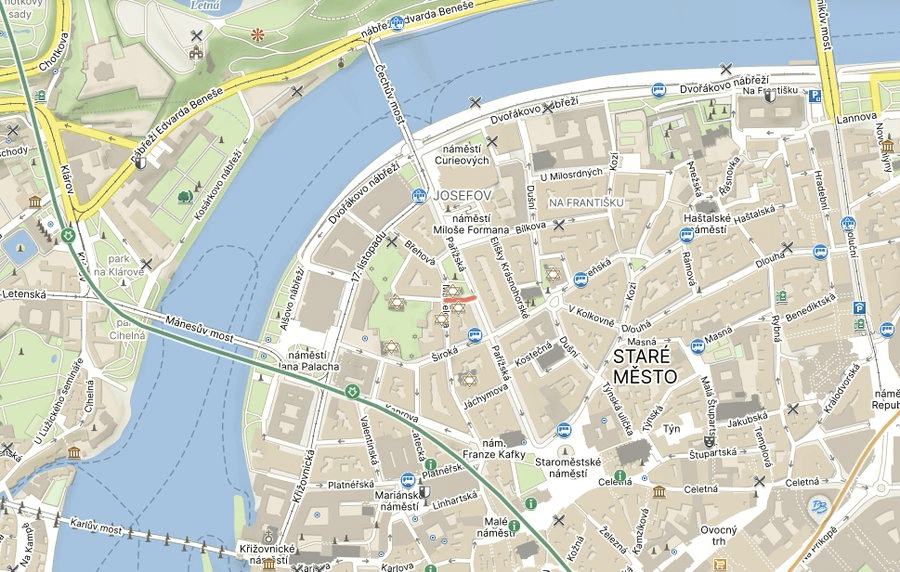
King Vladislav II had that one closed down in 1478. However, this cemetery wasn’t opened as a reaction to the closure of the other one – one of its graves dates back to 1439.
However, when land couldn’t be purchased, there was a problem: Halacha (the collective body of Jewish religious laws) dictates that individual graves can’t be disturbed, and that the tombstones of the deceased must be preserved.
Therefore, graves would be arranged in layers – as many as twelve, in some cases.
In 1784, Joseph II decreed that burials in city centres had to be banned for reasons of hygiene; however, the final gravestone dates from 1787.
A cemetery which had been opened to bury plague victims became the city’s new Jewish cemetery. It’s located where the Žižkov TV tower is now.
Despite Halacha, the rehabilitation of the Old Town did result in the old Jewish cemetery being reduced in size in 1903, and part of its former land ended up being taken up by the Museum of Arts and Crafts. Protective walls were added a few years later.
Notable people whose graves are here include the chronicler David Gans, Mordecai Maisel, and the rabbis David Oppenheim, Judah Loew ben Bezalel and Joseph Solomon Delmedigo.
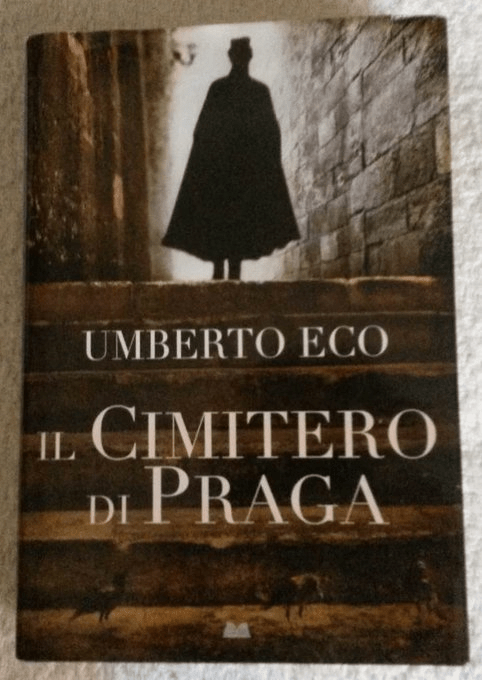
There’s a chance that you’ve read a novel that is named after this cemetery.
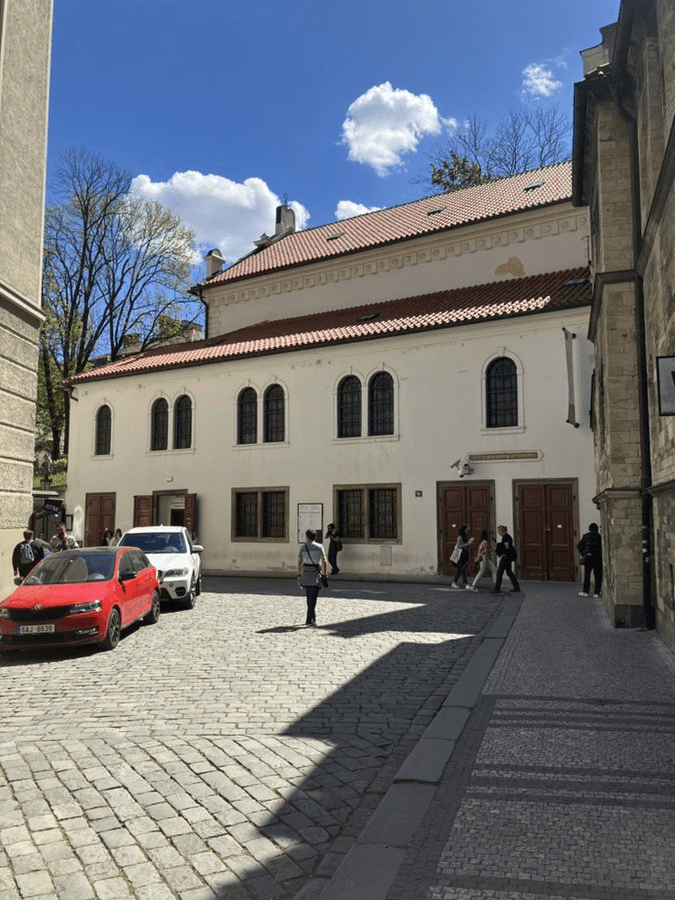
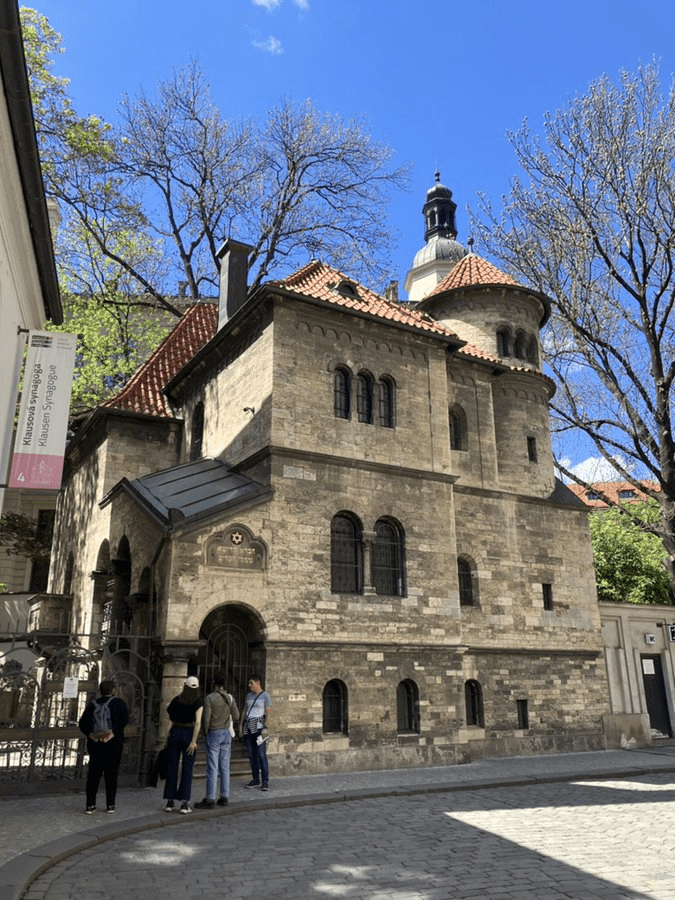
The street also includes the Klausen Synagogue, the largest in the old Jewish town, and the only Baroque one.
Next to that is the cemetery’s New Ceremonial Hall, built between 1906 and 1908 in Neo-Romanesque style. It was originally the place of last service for the deceased, but hasn’t served that purpose since WW1.
It – like much everything in this thread – is now administered by the Jewish Museum.
I’m not in Prague today, but if you are, and have cleaning tools and a ladder, here’s an idea for a fun day out.
‘Červená’ means ‘red’. Jewish butchers had their shops round here, and these were painted red.
Originally, the street was called Řeznická (a ‘řezník’ is a butcher), though, for a time in the late 18th / early 19th centuries, it was called Nová Poštovská due to the post office being moved here from nearby Břehová (coming on day 220).
The current street name came into use at the start of the 20th century, after the asanace / rehabilitation of the district.
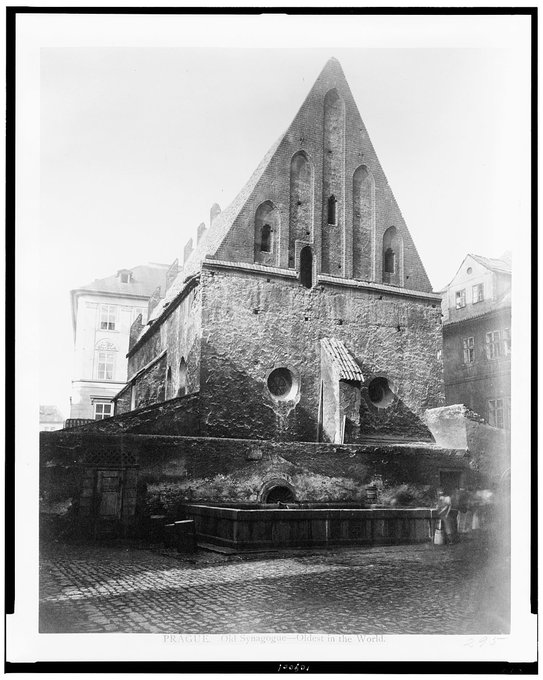
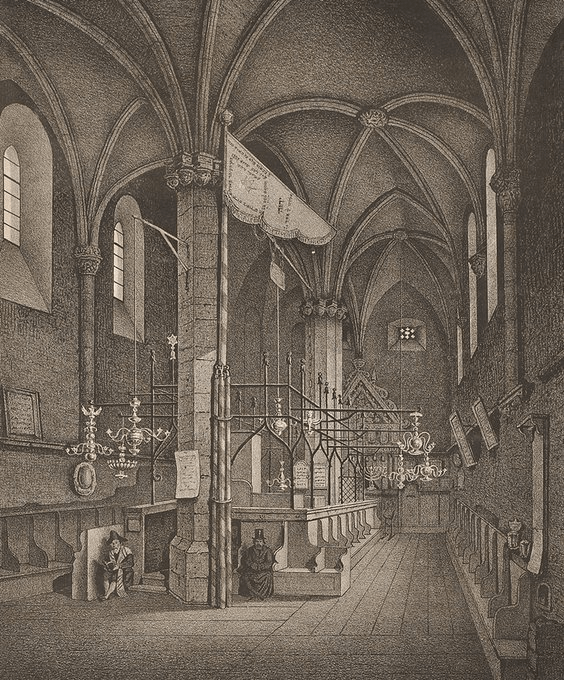
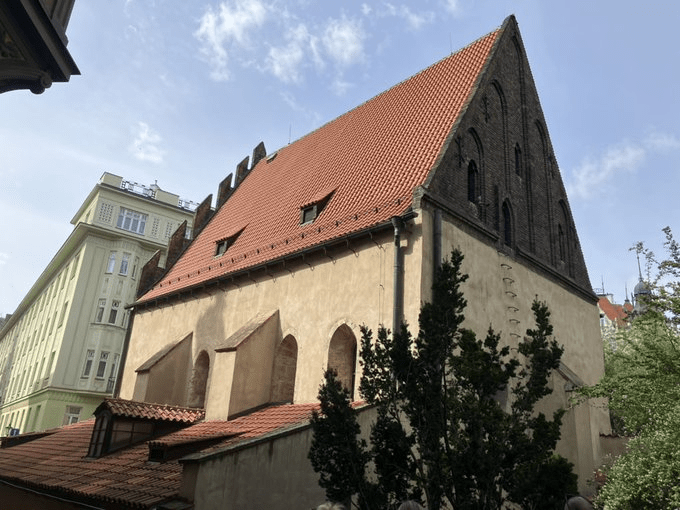
In the late 1200s, a synagogue was built here, originally called Nová škola due to there already being a Stará (old) škola on Dušní (which will be day 227).
At Easter 1389, the Jews of Prague were accused of ‘vandalising the eucharistic wafer’, and a pogrom (Bloody Easter) occurred. Jews trying to enter the synagogue were murdered; it’s said that there were 3,000 victims. Many Jews fled to Hungary and Poland.
It’s said that the synagogue bore traces of their blood until 1618. During the 16th century, when other synagogues started to appear in the district, it became known as the Old New Synagogue / Staronová synagoga.
The synagogue was repaired in 1618, then restored in both 1716 and 1883. It was one of the buildings that wasn’t damaged during the great fire of 1689.
It’s also been reconstructed several times since, for example in 1996-7, 1998 and 2006-7. It remains the oldest functioning synagogue in Europe.