What's in a Prague street name

Every street in Prague, one by one.

  • Originally published on X on 25 June 2024.

    This was an important area for centuries – see https://whatsinapraguestreetname.com/2024/10/10/prague-1-day-183-kralodvorska/, for example – but, as the border between the Old Town and the New Town, it was long dominated by a moat, then by the city walls.

    The square was constructed in the 1860s, at the same time as the city walls were demolished. It was initially called Josefské náměstí after St Joseph’s Church, which is still there, and used to have a monastery attached to it.

    This name was in place until 1916, when the square was renamed náměstí Františka Josefa I, after Emperor Franz Joseph I, who died in the same year.

    The Austro-Hungarian Empire only managed to outlive old Franz by two years, and, in 1919, the square was renamed to commemorate the brand-new state of Czechoslovakia.

    On the Old Town side of the square, you’re most likely to be interested in Obecní dům: https://whatsinapraguestreetname.com/2024/10/10/prague-1-day-182-u-obecniho-domu/.

    And the Powder Gate: https://whatsinapraguestreetname.com/2024/10/10/prague-1-day-181-u-prasne-brany/.

    Before getting your fill of Peak 1970s with the Kotva Department Store (I must admit that I’m quite excited to see what its current renovations do to it, given that it’s not scheduled to open again until 2027).

    On the New Town side, we can start with the Czech National Bank, built based on a design by František Roith between 1935 and 1942.

    And then to Dům U Hybernů (more information on https://whatsinapraguestreetname.com/2024/09/20/prague-1-day-134-hybernska/), formerly used by Irish monks, now used by musicals.

    Next door, you have the Hybernians’ former monastery. Look behind the tour buses, and you’ll see a combination of words that you never, ever seem to hear on the news these days.

    Across the road, the St Joseph Barracks (Kasárna Josefská) were built in 1799; from 1919, they were known as the Jiří z Poděbrad barracks, in line with the patriotic fervour of the time. They lasted until 1993.

    There’s a strong chance that you’re familiar with what took their place in 2007, whether you’d want to be or not. The façade of the barracks, at least, has been maintained.

    For those wanting to do the full independence trail, you start here, on the other side of the Vltava: https://whatsinapraguestreetname.com/2024/09/12/prague-1-day-87-vitezna/, cross here: https://whatsinapraguestreetname.com/2024/09/12/prague-1-day-90-most-legii-legion-bridge/, walk along here, taking in all the fine buildings: https://whatsinapraguestreetname.com/2024/09/14/prague-1-day-106-narodni-national/, have a slightly shorter walk along here: https://whatsinapraguestreetname.com/2024/09/25/prague-1-day-144-28-rijna/, get a bit annoyed that this one wasn’t given an independence-related name, but acknowledge that it’s worth a stroll anyway: https://whatsinapraguestreetname.com/2024/09/22/prague-1-day-137-na-prikope/, re-read today’s post, and then head up here: https://whatsinapraguestreetname.com/2024/11/10/prague-1-day-255-revolucni/.

  • Originally published on X on 24 June 2024.

    In the 14th century, the street was named Štercéřská after the owner of one of the houses, but also Hrnčířská after the potters (hrnčíři) who lived and worked there.

    Continuing the trades and crafts theme that’s been quite prevalent in this series, a ‘truhlář’, also known as a ‘stolař’, is a joiner or a cabinetmaker.

    A ‘truhla’ is a chest or a box, borrowed from Middle High German; in modern-day German, ‘Truhe’ has the same meaning.

    Number 8 in the street, formerly known as Na skále, Na pískách or Dům Ratzenbeckský, was renovated recently; formerly a prayer house, the leisure centre Jednička (Number One) has operated here since 2023: https://www.idnes.cz/bydleni/rekonstrukce/praha-rekonstrukce-jednicka-baroko-malby-centrum-deti-seniori-rodice-truhlarska.A230512_132356_rekonstrukce_web.

    While, if you look at the Truhlářská side of the Palladium Shopping Centre, you’ll learn that this is where Josef Kajetán Tyl (https://whatsinapraguestreetname.com/2024/07/01/prague-2-day-53-tylovo-namesti/) wrote the lyrics to the Czech national anthem in 1834.

    It’s probably worth mentioning that, back then, this was Kasárna Josefská, i.e. military barracks, and that Tyl didn’t come up with the words while wondering where the best place was to buy some new shoes.

  • Originally published on X on 23 June 2024.

    ’Sukno’ is the Czech word for ‘broadcloth’ – i.e. plain, dense woven cloth, typically made of wool.

    These days, it’s mainly used for costumes. In the past, it was used for trousers, skirts, jackets and military uniforms (the Czech for ‘skirt’ is ‘sukně’).

    Somebody who weaves this cloth would be a ‘soukeník’ (a weaver, or, in British English, a draper); the street got its name from the workers who were doing their trade here in the 15th century.

    În 1548 and 1643, most or all of the buildings in the street were destroyed by fire.

    One of the buildings that didn’t survive was the birthplace of Václav Hollar (https://whatsinapraguestreetname.com/2023/02/28/prague-3-day-163-hollarovo-namesti/).

    Also born in the street was the composer Karel Bendl, in 1838.

    In 1762, Soukenická was the location of Prague’s first maternity hospital: https://ct24.ceskatelevize.cz/clanek/domaci/tradice-prazskych-porodnic-je-pripisovana-marii-terezii-291419.

  • Originally published on X on 22 June 2024.

    In the early Middle Ages, this area was a settlement called Poříčí (which means ‘riverside’). I’ll try not to give too much commentary on that today, as I’m saving it for a future thread.

    It was mainly inhabited by German merchants, who, around 1150, had a church built and called it St Peter’s (same second sentence as in previous post, but a different future thread).

    The church was handed over to the Teutonic Knights in 1215, and the district eventually became known as Petrská čtvrť (Peter’s District, or thereabouts. Probably Peterstown or Petersville if this were in an English-speaking country?).

    When Petrská čtvrť was incorporated into Prague’s New Town in 1348, it was one of the few areas which already had an established network of streets and buildings; the streets have largely been preserved.

    Until the early 20th century, Petrská čtvrť’s economy was dominated by its proximity to the Vltava; mills survived until 1915-7, when the banks of the Vltava were regularised.

    The square itself didn’t get its name until 1894, when the surrounding area was rehabilitated.

    It’s quite nice these days – not so many people, which is a pleasing feature of this entire section of the New Town (main roads and tunnels aside), and pedestrianised.

    It also served as inspiration for the novels of Jaroslav Foglar: https://whatsinapraguestreetname.com/2024/11/04/prague-1-day-242-ve-stinadlech/.

    This association does an excellent job of promoting the district and its heritage, and even publishes a regular newspaper: https://petrskactvrt.cz/news.php. They’re on FB and Insta.

    For those keeping count, we have exactly three weeks of Prague 1 posts left, unless a new street has sprung up in the meantime.

  • Originally published on X on 21 June 2024.

    We’ve spoken about how this was once an area of mills: https://whatsinapraguestreetname.com/2024/11/10/prague-1-day-258-nove-mlyny/.

    Specifically, ship mills, also known as ‘škrtnice’ (cutters) in Czech, existed on the Vltava as far back as the 1300s, and survived until 1818.

    A ‘ship’ in Czech is a ‘loď’, and, while ‘lodní’ is the standard adjective deriving from that, ‘lodecká’ means much the same thing (yes, yes, I’m sure there are nuances).

    I’ll stop the vocabulary thing now, as it’ll leave me with nothing to say in one of my next threads.

    If you notice one building on Lodecká, it’s quite likely to be the award-winning Bytový dům s tělocvičnou (‘apartment building with a gymnasium’), built between 2009 and 2011.

    Proving that names don’t need to be imaginative, it consists of small-size apartments and a gym, which is used by a local school and is also open to the public.

  • Originally published on X on 20 June 2024.

    A ‘barva’ is a colour; it can also mean ‘dye’, although you will also hear ‘barvivo’ used for this.

    A place where dyeing takes place – i.e. a dyeworks or a dyehouse – is a ‘barvírna’, whereas one who engages in this trade – i.e. a dyer – is a ‘barvíř’.

    And it was in this street, conveniently located next to the Vltava, that dyers worked in the Middle Ages. Their guild also set up a meeting place in this street in 1477.

    Apparently, ‘barvíř’ can also be used if you want to describe someone as a painter while also being incredibly disparaging about it/them.

  • Originally published on X on 19 June 2024.

    Clement of Rome, or Clement I, was the fourth Pope, serving from 88 to 99 AD. Persecuted by the Emperor Trajan, he was tied to an anchor and dragged out to sea.

    This is how he is portrayed at St Sofia’s Cathedral in Kyiv.

    A pre-Romanesque church in this area of Prague is mentioned as early as 993, which would make it the second oldest church on this side of the Vltava after one at Vyšehrad. It was destroyed around 1100.

    By about 1200, a Romanesque church was standing in its place, and served as the local parish church (except for a brief period from 1225 to 1232, when it was used by the Dominican order).

    That order then moved to – well, you might have guessed if you know the Old Town: https://whatsinapraguestreetname.com/2024/10/15/prague-1-day-197-seminarska/.

    As the surrounding area was built up, the church was deemed too small to serve the parish, and was destroyed around 1400, after which a Gothic basilica was constructed in its place.

    This, too, served as a parish church, but got looted in the Hussite Wars (by the Hussites – one of their biggest detractors preached here), but, post-war, the church ended up in the hands of the Utraquists.

    They stayed until 1621 (‘until 1621’ = ‘not exactly their choice to leave’), having overseen the creation of a bell tower (1550s) and a Gothic vault (1578).

    Afterwards, the church was administered by priests from the Church of St Peter (nearby, and one of the few Prague 1 churches yet to be covered).

    It closed down entirely in 1784, along with many other places of worship, and later became a granary.

    In 1850, it became a functioning church again, and was used by the Calvinists; since 1918, it’s been used by the Evangelical Church of Czech Brethren.

    That Church was created in the same year, following the unification of the Lutherans and the Calvinists. It’s now the second-largest in Czechia.

    Back on St Clement for a second: the earliest church in Bohemia, founded around 880 in Levy Hradec, was also named after him.

    Levý Hradec was the seat of the Bohemian princes until they decided to move to Prague, the only reason why this isn’t day 262 of What’s In A Levý Hradec Street Name: https://levyhradec.cz.

  • Originally published on X on 18 June 2024.

    A ‘nemocenská pojišťovna’ is a ‘health insurance company’, and, between 1924 and 1926, a building designed by Bohumil Hypšman and František Roith was created to house one of these.

    This coincided roughly with the same time that grand ministerial buildings were being built on the Vltava (https://whatsinapraguestreetname.com/2024/11/10/prague-1-day-257-nabrezi-ludvika-svobody/).

    Later, it served as a polyclinic, and then as an office for the Czech Social Security Administration. The Ministry of Labor and Social Affairs apparently moved the latter to Vysočany in 2006.

    I’m the most Prague-positive person I know (especially when compared to people on Twitter, my God), but the fact that such a grand – and potentially useful – building is sitting idle and decaying in such a prime location is nothing short of a disgrace.

    As is the fact that hardly anyone on the internet – for whom ‘up in arms’ is a default body pose – seems to be up in arms about this.

    The four statues on the façade are meant to symbolise the functions of the insurance company: work, the family, life, and the spa. I think we can all take inspiration from them, and wish they weren’t accompanied by a broken window.

    And, seriously, I know I’m repeating myself, but what the f**k is a building with a façade like this doing looking like that?

    This one’s really got to me, and I’m going to log off before I become another Ranty Twitter Person.

  • Originally published on X on 17 June 2024.

    Something of a day off for me today, because I posted this yesterday: https://whatsinapraguestreetname.com/2024/11/10/prague-1-day-258-nove-mlyny/.

    But, of course, the view of the tower from this street is different, so here you go.

  • Originally published on X on 16 June 2024.

    Before the New Town was founded in 1348, Prague got its water from public and private wells (there were aqueducts too, but these were only used for royal buildings and churches).

    Later, four waterworks were set up; the ones serving this part of the New Town were called Novomlýnská (‘New Mill’).

    The street name itself translates as ‘New Mills’ – i.e., there were several mills around here once upon a time.

    The water tower is first mentioned in writing in 1484, when it was made of wood; when a (somewhat less flammable) Baroque, stone version was built in 1658, it was the tallest of the water towers in Prague.

    However, fireproof doesn’t mean waterproof, and, in 1655, flooding reduced the tower to nothing (half of it collapsed, causing the other half to fall into the Vltava).

    Work on a replacement took place between 1658 and 1660; it served its original purpose until 1877.

    Renovated in 2017, it features a multimedia exhibition called Praha hoří (Prague is Burning), and is the only water tower in Prague that’s accessible to the public (I think – please correct me if the Vinohrady Water Tower’s viewpoint is functioning these days).

    Vávrův dům, at number 2, is often erroneously referred to as Vávrův mlýn, but is actually the home of a former miller, not a mill itself. It’s named after Zdeněk Vávra, a real estate owner who bought the house in 1890 (it remained with the family until 1948).

    It was taken over by the Prague Post Office in the 1970s, and, since being renovated in 1986-8, hosts the Prague Postal Museum.

  • Originally published on X on 15 June 2024. ‘Nábřeží’ = ‘Embankment’.

    Ludvík Svoboda was born in Hroznatín, a village in Vysocina Region, in 1895. His father died a year later (apparently after being kicked by a horse), and his mother remarried in 1898.

    He attended the Agricultural School in Velké Meziříčí, and was then called up to the Austro-Hungarian Army in 1915. He was captured in Ternopil, and trained as part of the fire brigade of the city of Kyiv.

    In 1916, he enrolled in the Czechoslovak Legion, and, in 1917, took part in the Battle of Zborov (https://whatsinapraguestreetname.com/2022/12/04/prague-3-day-111-pod-vitkovem/).

    He then took part in the battles for the Trans-Siberian Railway (see https://whatsinapraguestreetname.com/2024/09/12/prague-1-day-90-most-legii-legion-bridge/), and, when Russia became communist, was one of the soldiers stuck a long way from home.

    His journey home – once Czechoslovakia had become independent – therefore had to go via Japan, the Pacific, the Panama Canal, and the United States.

    Initially taking over the family farm, Svoboda was soon remobilised in reaction to events in Hungary (in 1921, Charles I, the last Emperor of Austria-Hungary (pictured), made two attempts to retake the Hungarian throne).

    Svoboda married Irena Stratilová (pictured in her future First Lady days) in 1923, and, in the same year, joined the 36th regiment in Uzhhorod (then still in Czechoslovakia) as a staff captain. He would stay there for eight years.

    Afterwards, he was moved to Hranice, where he taught Hungarian at the Military Academy for three years, and, in 1934, was promoted to lieutenant colonel, and moved to the Jan Žižka 3rd Regiment in Kroměříž, which he had already served in from 1921-3.

    Being promoted to commander of the reserve battalion, this obviously became a bigger deal as war once again loomed. After the Nazis occupied Bohemia and Moravia in March 1939, Svoboda started to work for the Czech resistance.

    He managed to get to Poland, where he formed a Czechoslovak unit in Kraków, transferring 700 men to the Soviet Union when Nazi Germany invaded Poland in September. In the USSR, they were confined to Czechoslovak-adminstered camps.

    In July 1941 – a month after Germany had invaded the USSR – renewed diplomatic relations meant that the Soviets allowed formation of a Czechoslovak military unit on their territory.

    In January 1942, Svoboda became deputy commander of the 1st Czechoslovak Independent Infantry Battalion.

    Leaving for the front in the autumn, it first saw military action in March 1943 in Sokolovo, near Kharkiv.

    Their success in slowing down the German forces led to the formation of the 1st Czechoslovak Independent Infantry Brigade, commanded by Svoboda. It fought hard on the Voronezh Front, and also participated in the Battle of Kyiv (November 1943).

    In 1944, the Brigade was converted into an army corps; under Svoboda’s command, the corps took the Dukla pass and entered Czechoslovakian territory – which Svoboda had not been on since 1939.

    In April 1945, the Communists set up a government in Košice; Svoboda was appointed Minister of National Defence. He then became Minister of Defence after the Prague Uprising and the reestablishment of Czechoslovakia.

    In 1948, nearly the entire non-Communist part of the cabinet resigned in protest against the policies of Klement Gottwald; Svoboda, formerly seen as apolitical, did not. After the February coup, he joined the Communist Party.

    Svoboda became Deputy PM in 1950, but was dismissed the following year as part of the purges of the time. He was sent to run a farm, then to prison; released after Stalin’s death, he was chosen (apparently by Khrushchev) to lead the Klement Gottwald Military Academy.

    In March 1968, at the height of the Prague Spring, Alexander Dubček nominated Svoboda to replace Antonín Novotný as President of Czechoslovakia. As a war hero who had been punished during the purges, society viewed him relatively favourably.

    However, when Warsaw Pact forces invaded in August, Svoboda was one of those forced to sign the Moscow Protocols, which ended the Prague Spring and the liberalisation of society, which now got delayed by over two decades.

    In increasingly poor health, Svoboda resigned in 1975 and died in 1979.

    He believed that his actions in signing the Moscow Protocols prevented thousands of people from suffering much, much more than they would have done had he refused.

    Whether this was true or not, Svoboda’s lack of hardline communist learnings – and his past as a war hero – are surely why this embankment didn’t undergo a swift name change in 1990; indeed, he is still an honorary citizen of Prague, Plzeň, Brno and Ostrava.

    Nice views too.

    Before we go (yes, this was another long one), we’ve got to give a special mention to the Ministry of Transport, originally (1927-32) built for the Czechoslovak Ministry of Railways (it still hosts the HQ of České Dráhy too).

    It was here, on the night of 20/21 August 1968, that the Central Committee of the Communist Party of the Czech Republic found out that Warsaw Pact forces had invaded, and issued a declaration rejecting this invasion.

    Also on the embankment, the Ministry of Agriculture was built in 1928 in neo-Classicist style; it’s quite imposing, but lacks the ‘quirks’ of the two ministries to its west (the Ministry for Industry and Trade was covered in several recent threads).

    There’s something outside the Ministry that’s worth noting – but that’s on a different street, and, therefore, for a future post.

  • Originally published on X on 14 June 2024.

    Vojtěch Lanna was born in Čtyři Dvory, now part of České Budějovice, in 1805. He was the son of a shipmaster.

    When he was sixteen, he moved to Prague to study mechanical engineering at what is now ČVUT (the Czech Technical University).

    However, he was expelled for misbehaviour, and returned to České Budějovice, where he got a job as part of the crew for boats transporting salt between Budějovice and Týn nad Vltavou. His father also taught him shipbuilding.

    In 1825, Lanna became authorised to manage river shipments, and also travelled to Hamburg by boat.

    Upon his father’s death in 1828, he inherited the family business, which branched out into shipping wood and graphite as well as salt.

    He also leased horse-drawn carriages between Linz and České Budějovice – continental Europe’s second-ever public railway line – which meant he could import salt from Austria.

    In 1832, Lanna married Filipina Peithnerová; when she died eighteen months later, he married her sister, Josefina.

    Around this time, Lanna also leased all water structures on the Vltava between Budějovice and Prague; soon, the stretch of the river where he was in charge of construction and maintenance of buildings extended all the way to Saxony.

    In 1835, Lanna, who was aware that it’s a good idea to know the right people, had a monumental gate built next to his shipyard in tribute to Emperor Ferdinand I, who was passing through; unsurprisingly, Ferdinand bestowed honours upon him soon afterwards.

    In 1840, Lanna purchased Poříčí Castle and the surrounding land and villages, and – moment when it all comes together alert – assisted in the construction of the Emperor Francis Chain bridge: https://whatsinapraguestreetname.com/2024/11/09/prague-1-day-254-stefanikuv-most/.

    This assistance consisted in the fact that all the material – wood, iron and construction stone – was provided by Lanna. He also built Prague’s first stone embankment (now https://whatsinapraguestreetname.com/2024/09/30/prague-1-day-156-smetanovo-nabrezi-smetana-embankment/).

    Further construction in the 1840s included Prague’s first railway station (Masarykovo – coming up before the Prague 1 series ends) and the Stádlec Suspension Bridge in South Bohemia; Lanna also helped Kladno develop as a centre of coal mining.

    In the 1850s, Lanna would also be contracted to build the Karlín Viaduct (pictured), develop a foundry with a blast furnace in Kladno, and build the Western Railway.

    He also moved the family to Prague and had a house built – it’s mentioned on https://whatsinapraguestreetname.com/2024/09/20/prague-1-day-134-hybernska/.

    However, the underperformance of one of his companies (Prague Ironworks Company) put paid to construction of the railway for the moment; he was forced out of the company’s management in 1862.

    Lanna died of heart failure in Prague in 1866.

    The family business was taken over by his son, Vojtěch Lanna Jr (pictured as a child with his parents), who would co-found the Museum of Decorative Arts in Prague (https://whatsinapraguestreetname.com/2024/10/23/prague-1-day-212-17-listopadu/).

    Lanna Sr has also given his name to a park – a very tranquil, underrated park, if I may – between the street and the Vltava.

  • Originally published on X on 13 June 2024.

    The street is located where the easternmost part of the Old Town walls once stood (see https://whatsinapraguestreetname.com/2024/11/09/prague-1-day-251-hradebni/).

    In the 1700s, the part nearer the river was called Náplavní or Náplavka, both referring to the riverbank.

    The southern part was called Trubní or Rourová – ‘trubka’ and ‘roura’ are both words for ‘pipe’ or ‘tube’, and a pipeline led from here to the Novomlýnská Water Tower (coming up in the next few days).

    In the 1800s, the street was known as Alžbětinská třída, or, colloquially, Eliščina – Elizabeth Avenue, after a spa by the Vltava.

    This name stuck until late 1918, when there was, yes, a revolution. I’m going to be lazy and point you to https://whatsinapraguestreetname.com/2024/09/25/prague-1-day-144-28-rijna/.

    I’ve spent a few Saturday afternoons round these parts lately to take pics for this series, and Revoluční seems to have a disproportionately above-average number of incredibly drunk tourists around that time.

    I assume there’s some pubs nearby with obscene offers on drinks, but if there’s another reason, feel free to tell me.

    If you’re able to ignore them (some of them make it difficult), there are a couple of things worth looking at on the street, such as Palác Batex, which, in interwar Czechoslovakia, was the main meeting place for Prague’s queer community.

    There’s also the functionalist Palác Merkur, designed by Jaroslav Fragner and built between 1934-6. It’s served many functions; in the 1960s, it was a check-in office for Czechoslovak Airlines, which sounds terribly archaic now.

    Generally, however, it’s not unreasonable to categorise Revolućní as somewhere you pass to get from A to B (B often being Letná), rather than somewhere where you dawdle.

  • Originally published on X on 12 June 2024.

    Milan Rastislav Štefánik was born in Košariská, a village nowadays in the Trenčín Region of Slovakia, in 1880.

    He was the son of an evangelical priest, Pavol Štefánik, who raised his children to be interested in Slovak history and culture.

    Leaving his village at nine, he went to school at the Evangelical Lyceum in Bratislava, but had to move because his brother – also studying there – didn’t get good enough grades to continue. He then studied in Sopron and Szarvas (both now in Hungary).

    An outstanding student at all three schools, Štefánik then went to Prague to study civil engineering. During his studies, Štefánik started to take an interest in the progressive ideas of a professor, one T. G. Masaryk (https://whatsinapraguestreetname.com/2024/09/01/prague-2-day-156-masarykovo-nabrezi/).

    In 1900, he started to study astronomy and physics at Charles University; in 1901, he became chairman of Detvan, the Slovak student association.

    In 1903, Vavro Šrobár, a Slovak doctor and politician (https://whatsinapraguestreetname.com/2023/03/02/prague-3-day-167-srobarova/), who had founded Detvan, relaunched his magazine, Hlas (voice). Štefánik helped edit its artistic section.

    He also wrote articles which aimed to inform Czechs of the difficult situation that Magyarisation was creating for Slovaks.

    He somehow found time to graduate during all this (in 1904), and then moved to Paris.

    After a difficult start, Štefánik got a job at the Paris Observatory, a job which enabled him to observe the Moon and Mars from Mont Blanc, and to witness a full eclipse in Alcossebre, near Valencia.

    Later losing his job (the new owner of the Observatory seriously disliked him), a new opportunity came when the French authorities allowed him to go on trips to, amongst other places, Tahiti (where he observed Halley’s Comet).

    He wanted to settle there, but the French authorities had other ideas – they wanted him to travel to Ecuador and the Galapagos. Štefánik’s career was also thwarted by health problems.

    These problems – and a stomach operation – meant that his desire to join the Western Front in WW1 was delayed until 1915, when he qualified as a pilot from the military aviation school in Chartres.

    Seeing the opportunities for emancipation from Austria-Hungary that WW1 could bring, Štefánik tried to create a unit of Czech-Slovak volunteers.

    In September 1915, he was transferred to Serbia, but his time there was cut short by a plane crash and illness; after receiving treatment in Rome, he headed back to Paris.

    Having been introduced to Prime Minister Aristide Briand – and, in December, to Edvard Beneš – Štefánik pushed for the creation of a central representative body of Czechoslovak foreign resistance.

    In February 1916, this led to the founding of what would become the Czechoslovak National Council, where he and Beneš were vice-chairmen (the chair was Masaryk).

    After another bout of ill health, Štefánik went to Italy, then to Russia, then to Romania, to spread the word. The trip to Romania resulted in 1,500 volunteers being found.

    Further success came in early 1917, when the temporary government in Russia gave its support, and also when Štefánik travelled to the USA and gathered another 3,000 volunteers.

    In December 1917, the French government signed the Decree on the Creation of the Czecho-Slovak Army in France. Negotiations with the Italian government were more of a challenge, but also resulted in an agreement being signed in April 1918.

    On 28 October 1918, when Czechoslovakia became independent, Štefánik was its first Minister of War (Šrobár was Minister of Health).
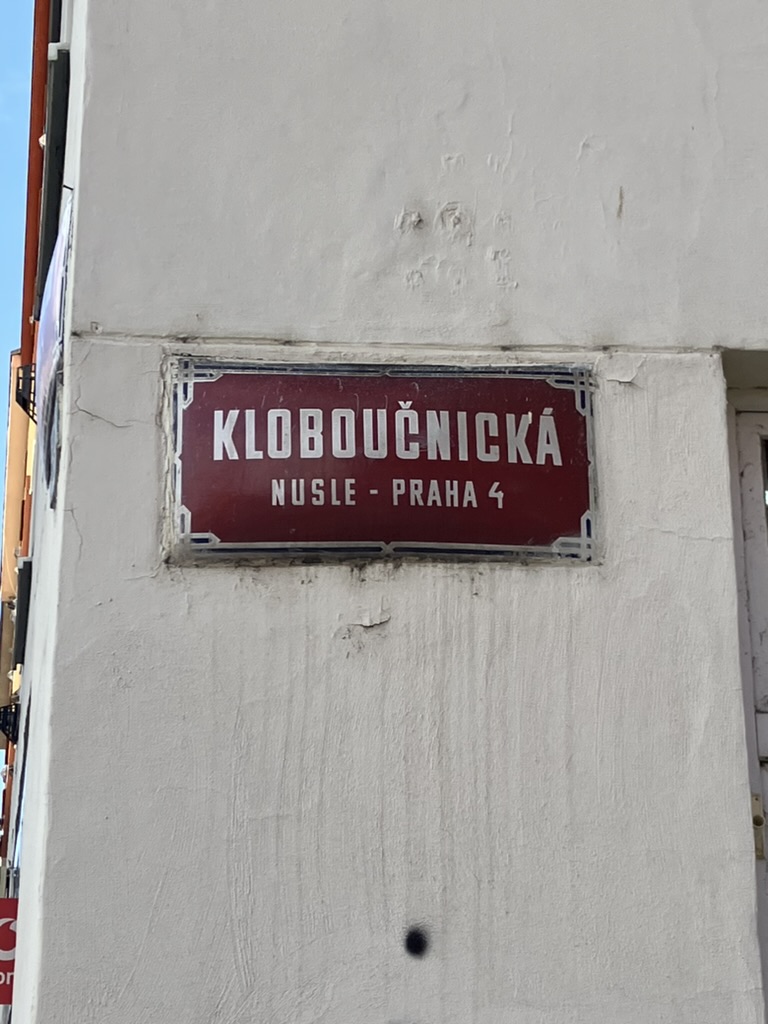
    Much of his work in this period was spent working out what to do with the Czechoslovak legions who were stuck in Siberia, after Russia had become communist and decided that it cared as much about Slavic solidarity as it does in 2024: https://whatsinapraguestreetname.com/2024/09/12/prague-1-day-90-most-legii-legion-bridge/.

    By this point, Štefánik hadn’t been to his motherland since his father’s death in 1913. On 4 May 1919, he boarded an aircraft near Udine in Italy, intending to fly to Slovakia.

    While a definitive account of events is not available, the plane crashed at Ivanka pri Dunaji, near Bratislava. All those on board were killed, including Štefánik, who was 38.

    In Bratislava, an embankment, a bridge and the airport were all named after him. He’s also been seen on various coins, stamps and banknotes (this one is from 1926).
    And these quite fetching 20 koruna coins, issued in 2018, 100 years after Czechoslovak independence.
    We need to talk about the history of the bridge too. Originally, this was the site of the Emperor Franz Joseph I Bridge, built between 1865 and 1868. It was promptly renamed Štefánikův most upon Štefánik’s death in 1919.

    The bridge was dismantled in 1946/7, and replaced by the current bridge between 1949 and 1951.

    From 1947 until 1997, it was named Švermův most, after Jan Šverma (1901-44), a journalist, communist activist and resistance fighter against the clerical fascist Slovak State.

    A statue which stood on the bridge is now at Olšany Cemetery (https://commons.wikimedia.org/wiki/Category:Jan_%C5%A0verma#/media/File:Jan_Sverma_memorial_Olsany_Cemetery_Prague_CZ_052.jpg/2); meanwhile, Jinonice Metro Station, on the yellow line, was also known as Švermova when it opened in 1988.

  • Originally published on X on 11 June 2024.

    This guy again (this street is ‘behind’ the church): https://whatsinapraguestreetname.com/2024/11/05/prague-1-day-245-hastalske-namesti/.

    Wherever Castulus is watching this from right now, I hope it makes him happy knowing that, although he’s only got Wikipedia pages in 14 languages (cf. 123 for St Peter), he has *four* streets named after him round here.

    Bonus material: Za Haštalem is home to Dům Řásnovka, and should arguably be called Řásnovka instead of the street that actually is: https://whatsinapraguestreetname.com/2024/11/07/prague-1-day-247-rasnovka/.

  • Originally published on X on 10 June 2024.

    A quick one today: K Haštalu leads to the Church of Svatý Haštal, or Castulus, which I covered here: https://whatsinapraguestreetname.com/2024/11/05/prague-1-day-245-hastalske-namesti/.

    Some of Castulus’ relics are in the church; if you want to see more, you may wish to head to St Martin’s Church (officially named after ‘St. Martin und Kastulus’, but often abbreviated at Castulus’ expense) in Landshut, south-east Bavaria.

  • Originally published on X on 9 June 2024.

    Soběslav I, Duke of Bohemia from 1125 to 1140 (https://whatsinapraguestreetname.com/2024/08/24/prague-2-day-96-sobeslavova/), started the process of fortifying Prague (‘hradby’ are fortifications).

    However, the process of fortifying the Old Town (and Malá Strana) really got going during the rule of Václav I (1230-1235, and, unlike Soběslav, as King), and would continue under his successors, Přemysl Otakar II (1253-1278) and Václav II (1278-1305).

    And Hradební would have been where the easternmost fortifications were.

    That’s pretty much the entire story, so let’s take a look at where the Old Town fortifications had gates (slash shamelessly plug a few older threads).

    Můstek is named after a bridge which led from Havelské město to whatever was there before the New Town appeared in 1348 (i.e. fields). At the end of the bridge was a gate into the Old Town, of which Havelské město was/is part: https://whatsinapraguestreetname.com/2024/10/08/prague-1-day-175-havelska/.

    Another gate led to Kutná Hora, and was therefore called Horská. It decayed after the New Town was founded, but you’re quite likely to recognise the gate tower which sprung up nearby in the 15th century: https://whatsinapraguestreetname.com/2024/10/10/prague-1-day-181-u-prasne-brany/.

    Koňská brána – The Horse Gate – stood at the top of the Horse Market, but was ultimate destroyed to make way for the National Museum. You’re even more likely to know the Horse Market than you are the Power Gate Tower: https://whatsinapraguestreetname.com/2024/09/17/prague-1-day-123-vaclavske-namesti/.

    Apparently, there was *another* Svatohavelská gate which was destroyed in 1874 to make way for Senovážné náměstí: https://whatsinapraguestreetname.com/2024/09/19/prague-1-day-132-senovazne-namesti/.

    Slepá brána (Blind Gate) was another victim of the 1874 destructions, and was located here: https://whatsinapraguestreetname.com/2024/08/31/prague-2-day-134-jecna/.

    And Brána svatého Štěpána (St Stephen’s Gate) was located here: https://whatsinapraguestreetname.com/2024/09/28/prague-1-day-150-bartolomejska/.

    Whereas Brána svatého Valentina (St Valentine’s Gate) was here: https://whatsinapraguestreetname.com/2024/10/20/prague-1-day-206-kaprova/.

    And the Zderaz Gate (located on https://whatsinapraguestreetname.com/2024/09/28/prague-1-day-149-na-perstyne/.

    There’s also the Poříčská brána, but I can’t link to anything as it’s in the thirtysomething streets that I haven’t written about yet.) was where John of Luxembourg entered Prague in 1310.

    Like many streets that are near main roads, Hradební has the misfortune of featuring the backends of buildings rather than the more interesting front parts. As an example, Palác Merkur looks like this from here and will be covered more in a few days’ time.

    But Hradební does feature some quite well-situated halls of residence for the Academy of Performing Arts in Prague (Akademie múzických umění v Praze; AMU).

    As plugging old threads is clearly my thing today, their headquarters have an even better location: https://whatsinapraguestreetname.com/2024/09/08/prague-1-day-38-malostranske-namesti/.

  • Originally published on X on 8 June 2024.

    In the 1100s, there was already a settlement round here, named Újezd and centered around today’s Church of St Castulus (https://whatsinapraguestreetname.com/2024/11/05/prague-1-day-245-hastalske-namesti/).

    When the Convent of Saint Agnes was built in 1231 (https://whatsinapraguestreetname.com/2024/11/05/prague-1-day-243-anezska/), the district started to grow.

    The order residing here was originally inspired by the Order of Friars Minor, founded by St Francis of Assisi in 1209 so, one of the first buildings to be created was the Church of St Francis of Assisi (to the right in this picture). The district became known as Na Františku.

    The church was possibly the first Gothic building in the whole of Bohemia; however, when the entire monastery complex was renovated, starting in 1978, the church was the last building to be done, in 1986.

    Na Františku is also a good place to view some other buildings which have been covered in recent days, such as the Church of Saints Simon and Jude (https://whatsinapraguestreetname.com/2024/11/05/prague-1-day-244-u-milosrdnych/).

    And the Na Františku Hospital.

    And then we have the Ministry of Industry and Trade, constructed from 1928 onwards on what was, until that point, a neglected plot of land. The design was by Josef Fanta, who was also responsible for Prague’s main train station (https://whatsinapraguestreetname.com/2023/12/25/prague-2-day-9-wilsonova/).

    The sculptures on the façade, just in front of the glass dome, represent Industry, Trade, Crafts and Navigation.

    On the western side (formerly the entrance to the Patent Office), the statues symbolise Mathematics, Physics, Chemistry and Engineering.

    While those on the eastern side symbolise Enterprise, Ingenuity, Perseverance and Truthfulness, and the statues of children on each side represent Trade and Industry.

    These are just some of the 120+ statues on the building, without taking into account all the other elements.

    I feel like people don’t mention what an incredible building this is often enough.

  • Originally published on X on 7 June 2024.

    A street with a name, but without a sign.

    Malá Klášterní translate as ‘Little Convent Street’, so let me take you back to here: https://whatsinapraguestreetname.com/2024/11/05/prague-1-day-243-anezska/.

    But what the street (all 30 metres of it) lacks in street signs, it makes up for in open spaces, specifically Zahrada za svatyněmi (‘The Garden behind the sanctuaries’), which was renovated in 2016.

    On the one side, you’ve got a decent view of the convent (and basically the entire ‘street’).

    On the other, you’ve got excellent views of both the Church of St Salvator and the Ministry of Industry and Trade.

    The park is also home to some statues whose modernity contrasts strongly with the surroundings. For example, here’s Buben (Drum) by Čestmír Suška (2001) and Zavěšené břemeno (Suspended burden) by Aleš Veselý (1968).

    As well as Pád II (The Fall II) by Stanislav Kolíbal (1968) and Šikmý průřez šikmou osou (Oblique cross-section with an oblique axis – so, even less catchy in English), again by Aleš Veselý and created between 1992 and 2009.

    Meanwhile, nearer to the street itself, you’ve got Černobílá plastika (Black and white sculpture) and Červená plastika (Red sculpture), both made by Karel Malich in the 1960s.

    But, heading a bit further south, I imagine most people will be most struck by Podobenství s Lebkou (Parable With Skull), created in 1993 by Jaroslav Róna, who also created the famous Franz Kafka statue in Josefov.

    Recently moved over to the convent area from Prague Castle, it depicts a beggar weighed down by a large skull. It probably stands out more here than it did at the Castle, and its new location means you no longer have to pay to see it.

  • Originally published on X on 6 June 2024.

    Quick one today: a ‘klášter’ is a monastery, convent, nunnery or cloister, and this convent was already discussed a few days ago: https://whatsinapraguestreetname.com/2024/11/05/prague-1-day-243-anezska/.

    The church that has its address on Klášterská is the Church of St Salvator (Christ the Saviour), opened in 1611 (and the garden that’s just out of shot is what we’ll be talking about tomorrow).

    And across from that, you’ve got more impressive views of the Ministry of Industry and Trade (and that we’ll be talking about a bit more in two days’ time).